
Andrew McCarthy, J. F. Oberlin University, Tokyo, Japan. https://orcid.org/0000-0002-9530-4079
McCarthy, A. (2024). What are Japanese high school students’ imagined English-speaking future selves? Studies in Self-Access Learning Journal, 15(3), 490–506. https://doi.org/10.37237/202402
(First published online, April 8, 2024.)
Abstract
The research presented in this article was informed by the notion of language learners having a second language future-speaking self-image and how it can have an effect on their motivation to learn a second language. As part of a larger project, the researcher investigated the presence of L2 (second language) future self-images among 12 Japanese high school students (aged between 15 and 18), who took part in one-to-one interviews with the researcher. A thematic analysis of their responses was conducted to examine the extent to which their L2 future self-images had an influence on their L2 motivation. The results showed that the majority of the participants possessed L2 future self-images which are unique to them and that these have had an effect on their motivation to study English. The qualitative data gathered from one-on-one interviews between the researcher and the participants showed how individual language learning experiences can shape and alter L2 future-selves in multi layered and often complex ways.
Keywords: motivation, Japan, future-selves, high school
In a study carried out by MEXT (The Japanese Ministry of Education), 58.4% of 3rd year high school students stated that they do not like studying English (Japan Today, 2015). The results of the survey – conducted at 480 high schools nationwide and encompassing about 70,000 students – may not have been a surprise to many in Japan, but they add statistical weight to what many English teachers in Japan have been observing in their English classes – seemingly unmotivated students. Researchers have put forward various reasons for this; among them the washback effect of difficult university entrance exams (Underwood, 2012), and the overreliance of Japanese high school English teachers on translation (Clark, 2009). Another survey from MEXT in 2022 showed that only 48% of Japanese high school leavers were reaching the recommended level of English proficiency – Eiken grade pre-2 or higher – by the time they graduated (Mainichi Shinbun, 2023).
In 2020, MEXT attempted to increase high school students’ motivation to improve their English communication skills by introducing English speaking tests for the first time for university entrance exams. However, this plan was shelved after widespread backlash from high school English teachers and principals who protested that as it would require students to pay an additional fee it would put poorer families at a disadvantage. Therefore, without changes to the university entrance exam or Japanese English teachers’ teaching methodologies, how are Japanese high school students going to increase their motivation to study English?
Researchers in the area of SLA (second language acquisition) have suggested that qualitative studies of individual learners’ experiences in different contexts and settings are an effective way to investigate what motivates students to learn a second language (Block, 2014; Ellis, 2015; Ushioda, 2009). The study reported in this paper, which was part of a larger study investigating language learning motivation, investigates the English language learning experiences of a group of 12 Japanese high school students and identifies their language learning goals. Through this investigation the following research questions could be asked.
- How do the participants see themselves using English in their future?
- To what extent do the participants possess English-speaking future selves?
- Have past English language learning experiences shaped their English-speaking future selves?
The L2 Future-Self
The notion of the L2 (second language) future-self is based on the concept of the possible self (Markus & Nurius, 1986), and more heavily influenced by Higgins’ (1987) self-discrepancy theory which had a big influence on Dörnyei’s L2 motivational self system (2005) – the instrument that informed the interview guide used in the current study. The following paragraphs will provide an overview of these theories.
The Possible Self
In their seminal work Markus and Nurius (1986) outlined the importance of the self and especially the existence of possible selves in humans and how they relate to achievement and motivation in learning. They highlighted three main components of the possible self-concept: what an individual might become, what an individual would like to become and what they are afraid of becoming (Markus & Nurius, 1986, p. 954). This is important for young learners of the L2 because if they believe that possible selves may be realised in the future then “they will be more willing to work harder now to reach goals later in life” (Seymour, 1995. p. 20). Around the same time, another theory grounded in psychology would come to influence L2 learning – self-discrepancy theory.
Self-Discrepancy Theory
The concept of the ideal self and the ought self were first coined by Higgins (1987). He explained that the ideal self is the person you would like to be while the ought self was the person that you felt you should be in order to, for example, fit into society. In terms of language learning, Higgins’ self-discrepancy theory is important due to the influence it had on L2 motivation researchers, like Dörnyei, whose groundbreaking framework, the L2 motivational self system (2005), is still the dominant instrument for measuring L2 learner motivation today.
The L2 Motivational Self System and the Future-Self
The L2 motivational self system (Dörnyei, 2005), was conceptualised to broaden the scope of L2 motivation research. It comprises three components of L2 motivation, the ideal self, the ought-to self and the L2 learning experience. The importance of the future on the self is what Dörnyei viewed as being the most salient component of self-guides for L2 motivation. The ideal self, or the ‘I want to study another language’ self, is distinct from the ought-to self, or the ‘my father says I should study another language’ self. The ideal self therefore relates to the attributes that an individual would hope and wish to possess, while the ought-to self refers to the attributes that an individual feels obliged to possess due to, for example, perceived parental or social obligations.
What really set Dörnyei’s L2 motivational self system apart from previous frameworks in the same field, however, is the third component, relating to the L2 learning experience and how this can influence a learner’s language acquisition. For example, an important aspect of this was that the attitudes that learners attributed to the L2 community were directly linked to their ideal L2 self. If learners had a positive ideal L2 self-image then they would most likely possess positive attributes in relation to the L2 learning community. Dörnyei’s L2 self system has been tested in many international contexts, (Taguchi et al., 2009) such as Japan, China and Iran. In Japan, 1586 university students participated in the study. The survey was separated into two parts; Part 1, consisting of items relating to attitudes to learning English, and Part 2 consisting of items related to background information, in terms of experience of language learning. The results showed a strong correlation between L2 learners who are motivated by the desire to integrate with the L2 community and the ideal L2 self.
After successfully testing the L2 motivational self-system in a number of different contexts, Dörnyei and Ushioda came up with a future self-guide (Dörnyei & Ushioda, 2011) which could be said to be an updated version of their ‘ten commandments’ of L2 motivation. This guide refers to a number of prerequisites that must be in place in order for future self-guides to have an impact on L2 motivation. They include the necessity for the L2 learner to have a desired future self-image and one that is different from their current self-image. This difference is necessary in order to motivate learners to exert effort and action in order to improve from the current L2 self to the future-self state. The instrument used in this study is based on the L2 motivational self system, and another very similar study by Lamb (2011).
Lamb’s (2011) Study of Future Selves
Lamb, in his 2011 study of the future-selves of young Sumatran learners, asked his teenage participants where they thought they would be in 10 years. Considering the participants in the present study are the same age as those in Lamb’s study, and that Lamb’s research was also investigating future-selves in relation to L2 motivation and learning, it was decided by the researcher to include a similar question in the interview guide. Lamb’s (2011) longitudinal study of learners’ L2 motivation noted how many participants were vague about their futures at the beginning of his research, but over time, many of them became “much sharper” (2011, p. 187). He states that this “possibly signals a diminution of the ought-to-self and a strengthening of the ideal L2 self” (Lamb, 2011, p. 187). In other words, participants who display a vague notion of how they will use the L2 in the future would seem to be motivated by external forces that make them believe they ought to learn the L2. On the other hand, those who have more distinct and definite images of how they see themselves using the L2 in the future are likely to possess stronger ideal L2 selves.
Method
Context and Participants
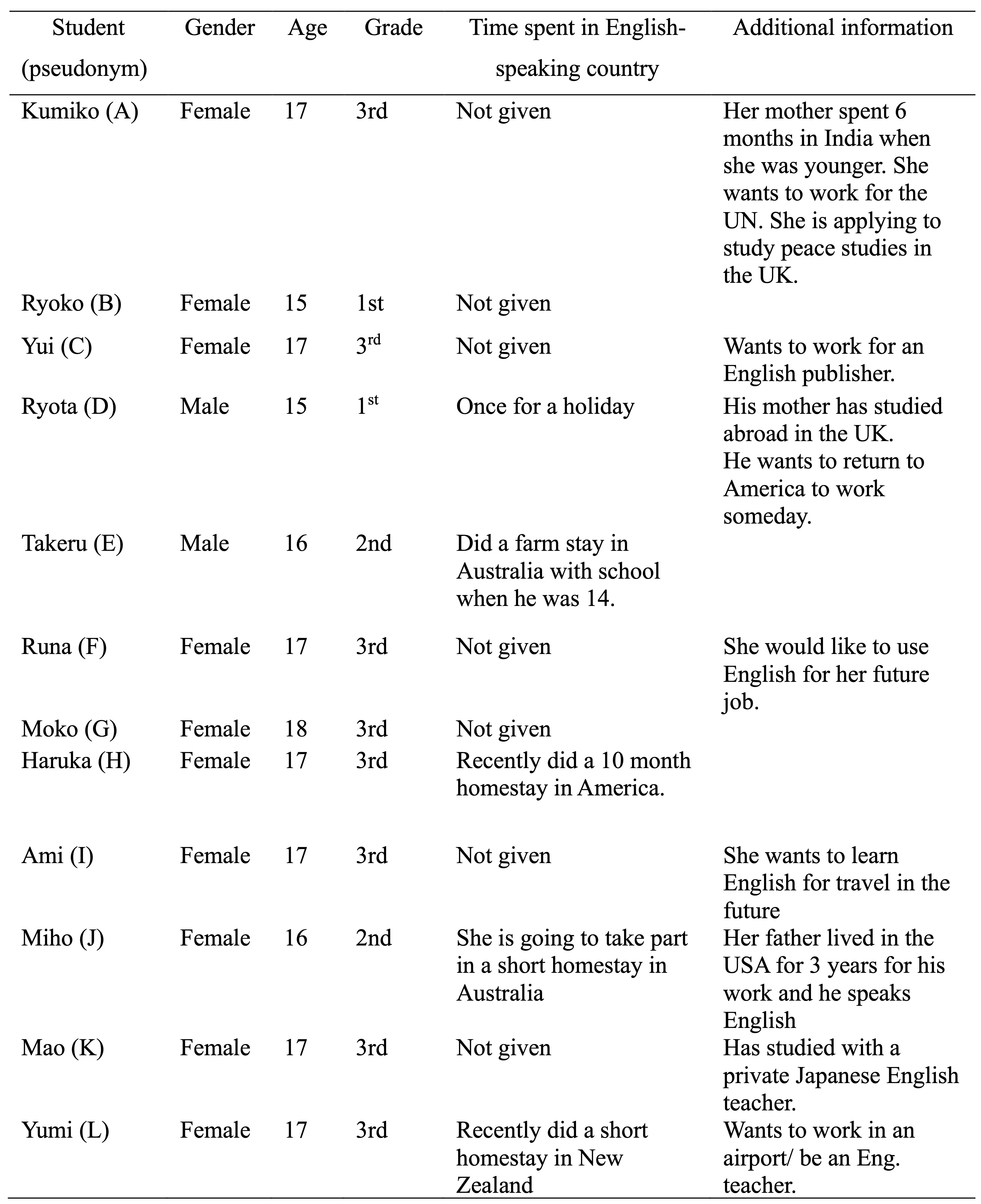
In total, 12 students took part in the study, referred to here as participants. They ranged in age from 15 to 18 at the time of the research, two were male and 10 were female, and all were Japanese high school students, taking six English classes per week, in the school in which the study took place. All 12 took part in an interview and completed a survey. As the sample size was not large, a focus on the qualitative aspect of the study enabled the researcher to probe for emerging data with each individual participant during the interview process. The school in which the research took place is a fee-paying high school where English is one of three core subjects studied, along with Japanese and math. In terms of academic achievement, the school is ranked about average and follows a curriculum that is in line with national Japanese guidelines. Table 1 gives an overview of the student profiles gathered as part of the study.
Table 1
Participant Profiles
Ethical Considerations
Due to the fact that the participants were under the age of 18 when the study was carried out, all relevant ethical procedures for research with underage participants were followed. This included signed consent forms from not only willing participants but also their parents. These were given to participants who responded to an information letter recruiting potential participants to take part in the study, which was distributed to all grade students. Consent to carry out the study was also received from the principal of the school.
Researcher Positionality
As the researcher is also a teacher in the school in which the present study took place, it is appropriate to highlight any issues which arose due to this positionality and how the researcher dealt with these issues to avoid bias in the results. Firstly, even though all 12 participants were students in the school in which the study took place, none of them were students of the researcher. Not allowing current students of the researcher to take part in the study ensured that students would not feel obliged to take part in the study in case they felt that non-participation would negatively impact their class grades. Also, a Japanese colleague was assigned as a gatekeeper for prospective participants to approach and enquire about participation, which they were introduced to in a general information letter. If they decided to take part, the gatekeeper then introduced them to the researcher. This allowed prospective participants to opt-out, not only at any time during the study but also after they had made initial enquiries, without having to make themselves known to the researcher. Finally, during the interview process itself, the researcher maintained a friendly approach to avoid a teacher-student type relationship, which may limit or bias the results.
Data Collection
This study was part of a larger project on English learning motivation involving a mixed methods action research study from which the researcher reports on the qualitative aspects in this paper. The participants were told that the study was about their opinions of their English classes and their motivation to study English. The interviews were carried out on an individual basis between the researcher and each participant using an interview guide (see Appendix). The interview guide was based on questions similar to items in the survey used by Taguchi et al. (2009) – referred to earlier in this paper. The items were selected and adapted to make them more suitable to the current context. The interviews were audio recorded and semi-structured (Shoaib & Dörnyei, 2005), each lasting 15 to 30 minutes, and were then transcribed. The researcher asked questions in English and repeated them in Japanese for ease of understanding. The participants were instructed that they could answer in either English or Japanese or both (depending on their level of English, the participants either mostly answered in English with some Japanese or mostly in Japanese with some English).
Data Analysis
The questions and responses from the interviews were grouped into themes relating to the questions in the interview guide. The themes were either pre-determined, based on the interview guide, or ones which emerged from the data (Braun & Clarke, 2006; King, 2004). Braun and Clarke (2006) recommend “using highlighters or colored pens to indicate potential patterns” (p. 19) as a useful form of thematic analysis. This method of thematic analysis was utilised by the researcher in the present study due to the relatively small sample of participants and raw data gathered. L2 future selves was one of five major themes which were predetermined by the researcher based on the questions from the survey and interview guide. Each of these themes was assigned a colour, and data referring to or relating to them was highlighted in the transcripts and indexed accordingly under each of the five headings. Subsequently, the coloured data which corresponded with each theme was then numbered according to which sub-theme it related to. A number of readings were carried out for each of the sub-themes to identify keywords that emerged from the data, such as travel, work, etc. until the researcher was satisfied that all the relevant data had been coloured, coded and sorted in this way.
Results and Discussion
Future English-Speaking Selves
The theme of future English-speaking selves is related to how exactly, if at all, the participants in this study can imagine themselves using English in their futures. This theme is further divided into five sub-themes: 1. For Work in Japan, 2. For Work in an International Company in Japan, 3. For Living/Working/Studying Abroad, 4. For Talking to Foreigners, and 5. For Travelling Abroad. Figure 1 shows how each participant responded to questions relating to how they imagined themselves using the L2 (English) in 10 years.
Figure 1
Imagined L2 Use in 10 Years
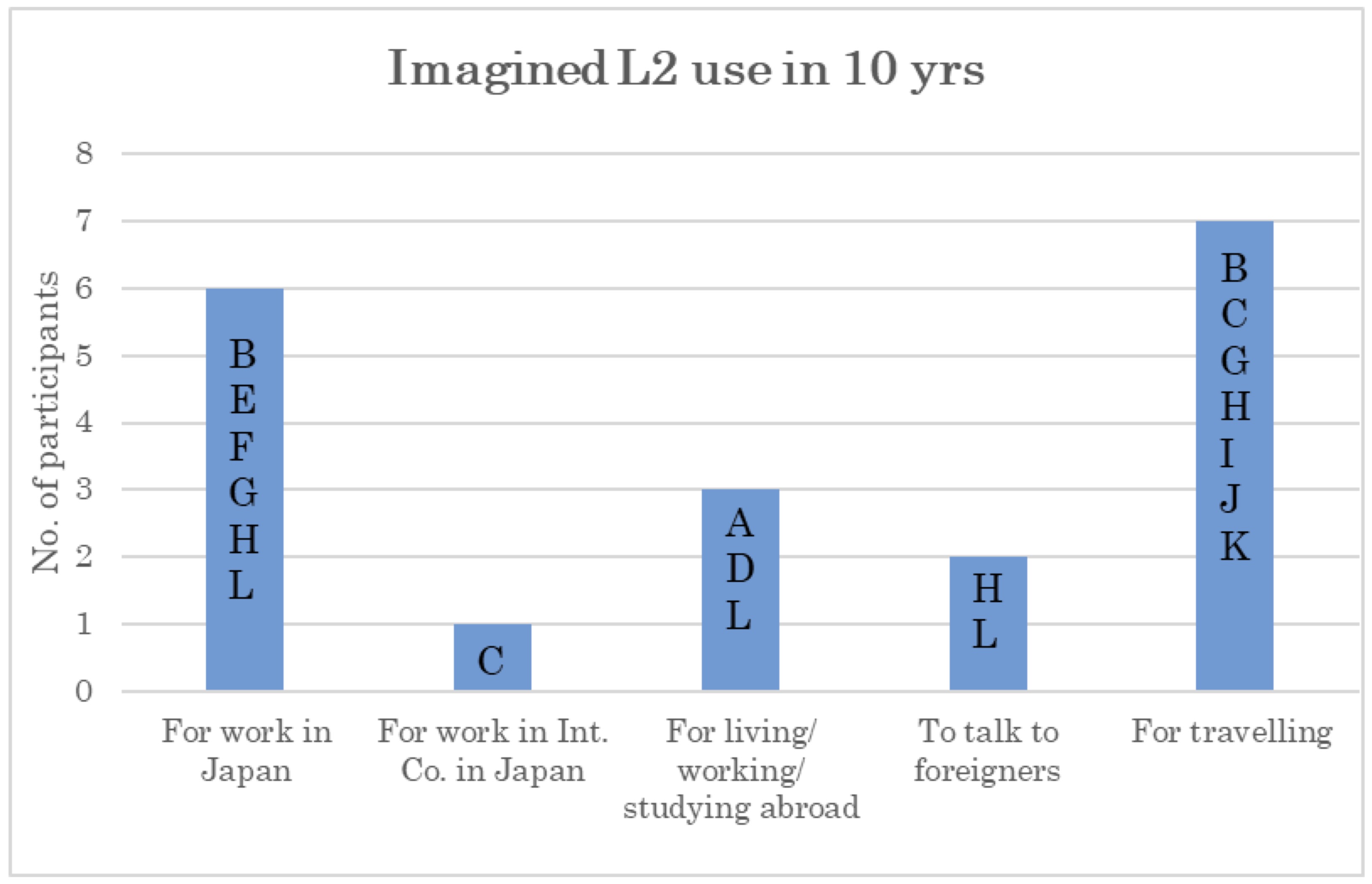
*Note: Each participant was given a corresponding letter, from A to L, in order to illustrate their responses more easily– refer to Table 1 to match the participants’ names with their corresponding letters. In Figure 1, the participants’ letters can be seen mapped onto the vertical bars. If a correspondent’s letter is on the bar, then their responses match the subtheme that the bar represents.
The responses show that over half of the participants mentioned that they can imagine themselves using English for travel in the future. There was also a significant number who stated that they could see themselves using English for their jobs in Japan. Interestingly, only three of the participants saw themselves using English for working, living or studying abroad. Looking at the responses more closely, however, we can see that some participants have clearer and more detailed English future-self-images, while others are vaguer and often indistinct.
For Traveling Abroad
The high number of participants mentioning travel as an English future-self-image could lead us to believe that these participants are displaying ideal L2-selves and are, therefore, intrinsically motivated to learn the L2, at least to some extent. However, when we look at the actual data, we can see that many of the responses relating to travel are vague, brief and indistinct. In Extract 1, Ryoko (B) agrees that she would like to use English in foreign countries in the future, but only a little, and in countries where there are a lot of Japanese people. In the following extracts, (J) indicates a participant response translated from Japanese to English. (JT) indicates a question given in English and repeated by the researcher in Japanese.
Researcher: Ok, let’s keep going so can you imagine yourself using English in your daily life in the future? (JT)
Ryoko: Just a little (J)
Researcher: Just a little bit (J). I see, OK so, and how often, a little bit Ok I see Ok let’s keep going then. Can you imagine yourself using English in foreign countries in the future (JT)?
Ryoko: A little bit (J)
Researcher: A little bit. Ok so what country would you like to go to?
Ryoko: I’d like to go and see Hawaii. (J)
Researcher: Ok, why would you like to go to Hawaii?
Ryoko: Am, Hawaii is very close to Japan and a lot of Japanese people go there so I think I’d like to go and have a look. (J)
Extract 1 – Future Selves (Ryoko)
Only two of the participants offered distinct and clear images of themselves using the L2 while travelling in foreign countries. Haruka (H) seemed quite passionate about her desire to travel and use the L2. She also realises that English is a ‘common language in the world’ and that if she wants to travel ‘all over the world’, being able to speak English may make that dream a reality. Mao (K) would also seem to have a clearer image of herself travelling and using the L2 in the future as she wants to visit art museums in foreign countries. It could be said that she is displaying more of an intrinsic L2 ideal self-image of herself using the L2 in the future, travelling and visiting art museums. In fact, the majority of the participants (Participants B, C, D, E, F, G, I, J), who mentioned or agreed that they would like to use the L2 in the future while travelling, failed to elaborate on their future travel desires. They may then be displaying more of an ought-to rather than an ideal L2 future self. As Chen reminds us, “the ought-to self reflects the social pressure to accept other people’s views” (Chen, 2012, p. 52). They may simply be reacting to perceived societal obligations, such as feeling that they ought to travel to foreign countries and use the L2. Therefore, even though 10 of the 12 participants indicated that they want to use English for travel in the future, only two of them possessed a strong future self-image of themselves travelling and using English.
For Work
Upon analysing the data of the participant’s ideas of what they will do for work in the future, it becomes evident that some of them have clearer career paths laid out in front of them. Some of them even include L2 future-self-images. One of the participants mentioned that they would like to work for an international company in Japan. An international company is generally understood by Japanese people to mean a company that is based in Japan, but its parent company is overseas. Citibank or BMW would be examples. There are also a number of Japanese companies that have decided to adopt English as their operating language, such as Rakuten and Uniqlo, and as such, they may also be categorised as international companies. It is generally understood that to work for an international company, you must speak English. Yui has not only decided what kind of company she would like to work for, she also hopes that it will be an international company. Here, she would seem to show a strong ideal L2 self-image, as she has chosen to follow her passion for books and try to work for a book publisher.
In Japan, a 名刺 (meishi – business card) will always display the name of the company first. When asked what one’s job is, most people will also tell you what company they work for rather than what their actual job is. This is possibly due to the group work ethic that exists in Japan, where people not only dedicate themselves to their company but their work group within that company. Therefore, in relation to work, traditionally Japanese company employees do not see themselves as individuals with job titles (Kopp, n.d.). As such, when designing the interview guide for the present study, the researcher attempted to take this contextual issue into account. Instead of expecting the participants to talk about their dreams of being a pilot or an actress, which is often the focus of Western ELT textbooks and pedagogy, it was decided to ask them probing questions relating to what kind of company they would like to work for. It was hoped that this would result in better-quality data.
This was indeed the case for Runa (F) and Moko (G), who both stated that they would like to work in Japan but that they could possibly see themselves using English for their work. Runa’s responses were indistinct, however, and she failed to elaborate when questioned further. She simply stated in Japanese that in the future, when she talks with foreigners for work, she might use it. Moko was also quite vague, but interestingly, she did admit that due to the perceived threat of terror overseas, she would rather work in Japan. This is a revealing comment, and she is expressing the commonly held view in Japanese society and especially Japanese media, that studying or working overseas can be 危ない (abunai – dangerous).
Three of the participants, however, did not conform to the expected Japanese norm when talking about their hopes and desires for work. In fact, they were quite specific and clear about their futures in relation to their work goals. All three of them stated that they wanted to be teachers and that they saw themselves using English for their jobs. Haruka was generous in aiding our understanding of how exactly she envisioned herself using the L2 in her ideal job. She stated that she wants to be an elementary English school teacher and that she hopes to be able to use English in her job. She does also admit, however, that she may have little opportunity to use English in reality as her workplace will be in Japan and her colleagues will likely be Japanese. Takeru (E) also stated that he would like to be a teacher, not an English teacher but rather a social studies teacher in Japan. He expressed a desire to use English for his job but also admitted that opportunities might be limited.
Probably the clearest and most considered comments relating to future work goals came from Yumi (L), who seemed to have a well-thought-out career plan and had also envisioned how she would use it to improve her English for her ultimate goal of becoming an English teacher. She would, therefore, seem to have the strongest ideal L2 self-image in relation to work goals at least.
To Talk with Foreigners
Integration with native speakers of an L2 has been considered an important L2 motivator since Gardner and Lambert’s (1959) groundbreaking study in Canada. In the present study, two of the participants specifically mentioned that they like to study English because they want to and enjoy speaking to people from other countries. Of course, it could be presumed that participants who mentioned travel or living abroad would also want to speak to native speakers of English. However, the researcher decided to treat this as a separate but related area, to refer to those who wish to learn English in order to speak to foreigners in Japan.
In Extract 2, Yumi was particularly positive about the prospect of speaking English to foreigners, and she seemed to be referring specifically to those she might meet in Japan rather than those she would meet while travelling.
Yumi: I think English is a big door for me. And English makes me really confident and I want to try and talk to a lot of people who come from abroad and I want to know many people who have a different culture. So English is important for me.
Extract 2 – Future Selves (Yumi)
In the above comment in Extract 2, Yumi could be explaining in real terms what Gardner and Lambert (1959) refer to as integrative L2 motivation. In other words, they want to learn the L2 because they want to integrate with native speakers of the L2. Of course, those native speakers could also be family members, such as grandparents or even parents, for whom English, or in Gardner and Lambert’s (1959) case, French, is their L1. In the present study, none of the participants referred to a family member as a native speaker of English. However, their perceived enthusiasm for learning English in order to speak to foreigners in Japan could just as easily be interpreted as integrative motivation. Haruka expresses similar views in Extract 3.
Researcher: Great so why do you want to study and learn English?
Haruka: Because if I can speak English, I’ll be able to speak with lots of people from a variety of countries (inaudible) broaden my world so, yeah
Extract 3 – Future Selves (Haruka)
Desire to Live, Work or Study Abroad
Three of the participants mentioned that they would like to live, work or study abroad. They would also seem to demonstrate a unique explanation for wanting to do so, and as such, this kind of L2 motivation would seem to align more closely with an ideal L2 self-image. These participants are not under any societal, parental or peer pressure to do so and, as such, it could be interpreted as their true desire, wish or 本音 (honne -true feeling/ motive).
Kumiko (A) has evidently thought about her wish to study and work abroad to some degree as she details at length her reason behind her future study goals. She says that she wants to work for the United Nations, and to achieve this goal, she wants to study peace studies at the University of Bradford in England. Even though this does seem to be quite a lofty goal, it is clear that she has researched this and thought about it a lot, and she says that she is looking forward to talking to and debating with English professors in English. This indicates that she has an L2 future self-image of herself speaking English with English professors, and it also demonstrates further evidence of the link between L2 future self-images and L2 motivation. Not only does she seem to have a unique reason behind her L2 motivation but the detail in which she demonstrates this motivation would again seem to point to a more ideal rather than ought-to L2 self-image. This unique L2 motivation is what Ushioda (2009) refers to in her ‘Person in Context Relational View’ of L2 motivation, where she calls for more focus on understanding an individual’s own very personal reasons for wanting to learn an L2.
Yumi is similar in that she seems to have a well-thought-out plan for her use of the L2 in the future. However, she envisions a slightly different long-term future. Like Kumiko, she seems to have clear images of her future, not only mentioning where she would like to live but also describing her image of her life there in a rather humorous way, envisioning ‘a lot of sheep’. She details how one of her reasons for studying English is that she would like to live in New Zealand when she retires. This is obviously a very long-term goal, and based on her recent good experience of a homestay that she did in New Zealand. It was obviously a good experience for her, and even though retirement is far off, we cannot dismiss it. It is also relatable to an L2 future self-image that Ushioda (2009) is referring to in her ‘Person in Context Relational View’ of L2 motivation. Ryota also mentions that he would like to work in a foreign country in the future. He mentioned that he had been to San Francisco when he was a child and would like to return there in the future for work and for his own ‘strength’. He also goes on to detail how exactly he would use the L2 in San Francisco.
A distinction, therefore, seems to have emerged from the data between those who have clear and detailed visions of themselves using the L2 in the future and those who have vaguer, indistinct or less well-thought-out plans.
Conclusion, Limitations and Implications of the Study
At the beginning of this paper, the researcher asked whether the participants in this study possessed English speaking future selves and whether they were influenced by their English language learning experiences. The results shown above have presented the following conclusions. Firstly, over half (seven) of the participants were able to envision themselves using English in the future, for either work or travel or both. It is also clear that some of these seven participants were able to provide clearer and more detailed pictures of how they envisioned themselves using English in their future and, as such, possess stronger English-speaking future selves. Also, as the majority of these participants who displayed English-speaking future selves also detailed how either they or their parents have had valuable English language learning experiences abroad or in Japan, we can see how the English language learning experience is an important component of the overall English-speaking future self-image. Moreover, these future self-images are different and unique for each student but have impacted their overall English acquisition in some way.
The limitations of this study are that it was based on a relatively small participant sample and conducted in one Japanese high school. As the participants volunteered to participate, it can be said that they potentially chose to do so because they like English, which may have influenced the findings. Future research in this area could use more such small-scale studies while still utilising the same L2 motivational instruments as were used in this study. Nonetheless, this study can benefit English teachers and educators in Japan and in other contexts who are interested in how L2 future self-images can have a positive effect on L2 motivation.
In terms of self-access learning, this study shows how individual and self-directed language learning experiences, such as travelling abroad, can have a positive effect on language learning motivation. In addition, the participants who displayed the strongest L2 future self-images also showed evidence of unique and independent language learning experiences that had a positive influence on their motivation to learn English. Future studies could investigate further the link between self-access learning and strong L2 future self-images.
Notes on the Contributor
Andrew McCarthy holds a PhD in Applied Languages from the University of Limerick and has 20 years of experience in teaching and research. He currently teaches English at Oberlin Academy in Tokyo. His research interests include L2 motivation and content and language integrated learning.
References
Block, D. (2014). Second language identities. Bloomsbury.
Braun, V., & Clarke, V. (2006). Using thematic analysis in psychology. Qualitative Research in Psychology, 3(2), 77–101. https://doi.org/10.1191/1478088706qp063oa
Chen, S. A., (2012). Motivation and possible selves: An interview study of Taiwanese EFL learners. Language Education in Asia, 3, 50–59. https://doi.org/10.5746/leia/12/v3/i1/a05/chen
Clark, G. (2009, February 9th). What’s wrong with the way English is taught in Japan? Japan Times.
Dörnyei, Z. (2005). The psychology of the language learner: Individual differences in second language acquisition. Lawrence Erlbaum. https://doi.org/10.1177/13621688070110040802
Dörnyei, Z., & Ushioda, E. (2011). Teaching and researching motivation (2nd. ed.). Routledge. https://doi.org/10.4324/9781315833750
Ellis, R. (2015). Understanding second language acquisition (2nd ed.). University Press.
Gardner, R., & Lambert, W. (1959). Motivational variables in second-language acquisition. Canadian Journal of Psychology, 13(4), 166–272.
Higgins, T. E. (1987). Self-discrepancy: A theory relating self and affect. Psychological Review, 94(3), 319–340. https://doi.org/10.1037/0033-295x.94.3.319
Japan Today (2015, March 8th). 58% of high school seniors say they don’t like English. https://japantoday.com/category/national/58-4-of-high-school-seniors-say-they-dont-like-studying-english
King, N. (2004). Using templates in the thematic analysis of text. In C. Cassell & G. Symon (Eds.), The essential guide to qualitative methods in organizational research. (pp. 257–270). Sage.
Kopp, R. (n.d.). Why do Japanese avoid detailed job descriptions?
Lamb, M. (2011). Future selves, motivation and autonomy in long-term EFL learning trajectories. In G. Murray, X. Gao, & T. Lamb (Eds.), Identity, motivation and autonomy (pp 66 – 97).Multilingual Matters. https://doi.org/10.21832/9781847693747-013
Mainichi Shinbun. (2023, May 17). Results of MEXT survey. https://mainichi.jp/articles/20230517/k00/00m/040/311000c
Markus, H., & Nurius, P. (1986). Possible selves. American Psychologist, 41(9), 954–969. https://doi.org/10.1037/0003-066x.41.9.954
Seymour, C. (1995). Possible selves, self-perception, and current self-concept in adolescents with learning disabilities. Memorial University of Newfoundland.
Shoaib, A., & Dörnyei. Z. (2005). Affect in life-long learning: Exploring L2 motivation as a dynamic process. In P. Benson & D. Nunan (Eds.), Learners’ stories: Difference and diversity in language learning (pp. 22–41). Cambridge University Press.
Taguchi, T., Magid, M., & Papi, M. (2009). The L2 motivational self-system among Japanese, Chinese and Iranian learners of English: A comparative study. In Z. Dornyei & E. Ushioda (Eds.), Motivation, language identity and the self (pp. 66–97). Multilingual matters. https://doi.org/10.21832/9781847691293-005
Underwood, P. (2012). Teacher beliefs and intentions regarding the instruction of English grammar under national curriculum reform: A theory of planned behavior perspective. Teaching and teacher education. 28(6), 911–925. https://doi.org/10.1016/j.tate.2012.04.004
Ushioda, E. (2009). A person-in-context relational view of emergent motivation, self and identity. In Z. Dörnyei & E. Ushioda (Eds.), Motivation, language identity and the self (pp 215–228). Multilingual matters. https://doi.org/10.21832/9781847691293-012
Appendix
Interview Guide (Questions relating to Future – selves) 1. Do you like English? Why? 英語は好きですか?なぜ?
2. Why do you want to learn English? なぜ英語を勉強したいですか?
3. How do you imagine yourself in 10 years? 10年後の自分を想像できますか?
4. Can you imagine yourself using English in your daily life in the future?
あなたはあなたの日常生活の中で将来英語を使うことを想像できますか?
- If no, how often do you imagine yourself using English in the future?
あなたは将来どのくらいの頻度で英語を使うと思いますか?
- Can you imagine yourself speaking English in foreign countries in the future?
あなたは将来、外国で英語を話すことを想像できますか?
5. Do your friends, teachers or parents encourage you to speak English?
クラスメート、教師または両親は英語を話すようにすすめていますか?
6. Are there any famous people from foreign countries that you admire?
あなたがあこがれて いる外国人の有名人はいますか?
– If yes, do they inspire you to study English?
彼らは英語を勉強するようにあなたにインスピレーションを与えますか?
7. Can you tell me about your past language learning experience?
過去の英語学習経験について教えてください。
 SiSAL Journal