
Jo Mynard, Kanda University of International Studies, Japan
Dominique Vola Ambinintsoa, Kanda University of International Studies, Japan
Eduardo Castro, Kanda University of International Studies, Japan
Mynard, J., Ambinintsoa, D. V., & Castro, E. (2024). Introduction. Studies in Self-Access Learning Journal, 15(3), 312–316. https://doi.org/10.37237/150301
Welcome to this issue of SiSAL journal, which consists of ten papers in the main section, one review (edited by Hisako Yamashita), and one paper in the Ethnographies of Self-Access section. We are delighted to feature papers from Oman, New Zealand, Japan, Bangladesh, China, Vietnam, Japan, and The Philippines. The papers in this collection explore key themes in language education, including the role of technology in learner engagement, teacher autonomy, and leadership in learning communities. It addresses the impact of tools like chatbots and ChatGPT while also focusing on inclusive course design, student-tutor dynamics, and learner readiness for autonomy. Other themes include self-images as motivation for language learning, the emotional and cognitive challenges teachers face in supporting autonomy, and creative methods to understand multilingual experiences. Furthermore, the book review highlights a valuable resource for writing development. Lastly, the ethnographic paper offers interesting insights into learner autonomy in online learning environments.
Contents
The first paper is by Behnam Behforouz from the University of Technology and Applied Science, Shinas, Oman, and Ali Al Ghaithi from Sohar University, Oman. In their paper, the authors describe the development and implementation of an interactive chatbot in an EFL Omani context. Comparing a controlled group and an experimental group, they found that the students in the experimental group, who used the chatbot, showed more engagement in their learning tasks.
The second paper is by Diana Feick and Mareike Schmidt (The University of Auckland, New Zealand). The authors used duoethnography to reflect retrospectively on the online redesigning of their language acquisition courses. The collaborative reflection raised their awareness of the importance of teacher autonomy and the consideration of geographical and spatial inclusion. This paper accompanies the collection published as a special issue of SiSAL Journal in March 2024: Inclusive Pedagogies for Language Learner Autonomy, edited by Christine O’Leary and Christine Siqueira Nicolaides.
The third paper, by Daniel Hooper (Tokyo Kasei University, Japan), uses a concept-based framework grounded in sociocultural theory to investigate how three learning community leaders develop their leadership through a course designed for this purpose, supported by a learning advisor in a self-access learning centre in Japan. Using an ethnographic approach, the author illustrates the various ways the participants internalised the academic concepts learned in the course and how this understanding influenced their individual trajectories and participation in the learning community.
The fourth paper is by Eshita Khanam Karu and Muhammad Azizul Hoque from International Islamic University Chittagong, Bangladesh. In their study, they used semi-structured interviews to investigate 10 undergraduate students’ experiences using ChatGPT in their English language and literature learning. They highlight the advantages and disadvantages of the use of ChatGPT perceived by the students and their intention to continue using it in their language learning.
The fifth paper is by Chang Liu from Capital University of Economics and Business, China. It explores student-tutor relationships among Chinese students in a UK university self-access writing centre. It identifies three types of relationships, the most common of which is symmetrical, characterised by an egalitarian learning environment and shared responsibilities.
The sixth paper, by Luu Thi Mai Vy (Ho Chi Minh City University of Economics and Finance, Vietnam) and Lu Jinming (Guizhou Qiannan Economic College, China), uses a questionnaire to explore Chinese university students’ readiness for autonomous learning, focusing on listening skills. The findings show that while students are generally motivated and aware of their listening abilities, teacher guidance and external pressure enhance their engagement, offering valuable insights for educators to improve English listening instructions.
The seventh paper, by Emily Marzin and Diane Raluy (Kanda University of International Studies, Japan), examines a leader’s journey as he took on different roles within a French learning community and highlights the importance of providing advising support as he navigated these transitions.
The eighth paper is by Andrew McCarthy from Oberlin University in Japan. It explores high school students’ self-images using English in the future, unravelling how these future self-images influence participants’ motivation to learn English.
The ninth paper, by Jon Rowberry (Sojo University, Japan) and Erhan Aslan (University of Reading, the UK), investigates the intersections between teachers’ cognition, emotions, and agency in a self-directed language learning unit in Japan. It illustrates how teachers hesitated to intervene in students’ self-directed learning, fearing disruption of learner autonomy, while experiencing vulnerability and varied levels of agency in practice.
The tenth paper is by Yaya Yao and Yimeng Jin from Kyushu University, Japan. The authors explore the use of language mapping as an innovative art-based method to investigate how learners express their language practices in multimodal ways. The authors highlight the participants’ mixed feelings and the metaphors they used to represent their first and additional languages.
One book review is included in this section. Han Thi Phuong Pham from FPT University, Ha Noi, Vietnam, reviewed Teaching and Learning Writing in ESL/EFL. The author describes the book as a standalone valuable resource that has the potential to support self-access learning and learner autonomy.
Ethnographies of Self-Access Column
In the fifth instalment of his autoethnography, Leoncio P. Olobia from Leyte Normal University, Tacloban City, Philippines, reflects on his independent learning throughout the pandemic in an online course, demonstrating how students enhance their autonomy in an online learning environment by collaborating with others.
Acknowledgements
As always, we are grateful to the members of our review and editorial teams, without whom we could not publish this issue—sincere thanks to all the authors who shared their work with us.
Notes on the Editors
Jo Mynard is a professor in the Faculty of Global Liberal Arts, Director of the Self-Access Learning Center, and Director of the Research Institute for Learner Autonomy Education at Kanda University of International Studies in Chiba, Japan. She has an M.Phil. in Applied Linguistics (Trinity College, University of Dublin, Ireland) and an Ed.D. in TEFL (University of Exeter, UK). Her research interests include advising in language learning, the psychology of language learning, and learning beyond the classroom.
Dominique Vola Ambinintsoa is a senior learning advisor and lecturer at Kanda University of International Studies in Japan. She holds a PhD in Applied Linguistics focusing on learner autonomy (Victoria University of Wellington, New Zealand) and an Ed.M in TESOL (State University of New York at Buffalo, US). Her research interests include learner autonomy, self-regulated learning, the psychology of language learning, and advising in language learning.
Eduardo Castro is a learning advisor and lecturer at the Self-Access Learning Center at Kanda University of International Studies in Japan. He holds an MSc in Applied Linguistics from the Federal University of Viçosa in Brazil. His research interests encompass learner autonomy, advising in language learning, and the psychology of language learning and teaching, with a particular emphasis on the motivational and emotional dimensions of language education.
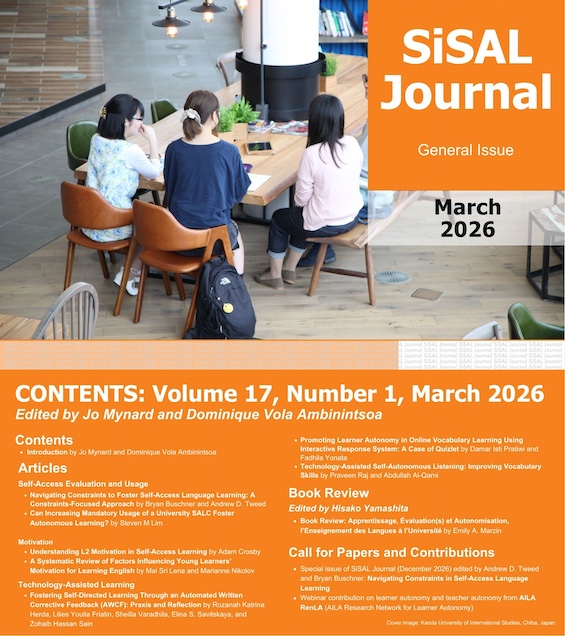
 SiSAL Journal