
Elina Maslo, Independent researcher, Tvis, Denmark
Maslo, E. (2024). “I’m a thing-finder” – Children’s engagement in meaningful activities and their language learning possibilities in out-of-class education. Studies in Self-Access Learning Journal, 15(2), 172–186. https://doi.org/10.37237/150204
![[This picture was generated using OpenAI’s DALL·E]](https://sisaljournal.org/wp-content/uploads/2024/06/maslo-pic.jpg)
Abstract
In this paper, I will focus on some of the situations observed during a pilot project in which opportunities for language and learning occurred or could occur, and either were—or were not–used by the pupils. Based on an ecological perspective whereby language and learning are interrelated, this paper assumes that language is learned when used, and that the engagement of the learner in semiotically meaningful activities create possibilities for language use and language learning. The starting point for this paper is therefore hypothetical, in that, based on the observed examples, the paper examines the language and learning potential that the activities at the outdoor school have to offer pupils.
How do you explore possibilities for language use and language learning? How do you discover correlations between possibilities for active engagement in meaningful activities and possibilities for language and learning? How can you tell if children are learning—and whether they are learning language—in the outdoor school? Many such theoretical and methodological questions appeared during the pilot project. This paper offers insight into a researcher’s reflections on the research into ‘opportunities for language use and language learning.’ What happens when a researcher is allowed to participate in outdoor-school activities on an equal footing with other participants? This paper attempts to answer these questions.
Keywords: language learning, ecological approach, meaning, activity, affordances, out-of-class education
“What are we going to do now?” asked Tommy.
“I don’t know what you are going to do,” said Pippi, “but I know I can’t lie around and be lazy. I am a Thing-Finder, and when you’re a Thing-Finder you don’t have a minute to spare.”
(Astrid Lindgren, Pippi Longstocking)
This is Pippi Longstocking speaking in one of Astrid Lindgren’s fairy tales. Pippi has just finished baking cookies. She is on her way out into the real world with Tommy and Annika. They are going out to find things.
Going out into the real world to find things, to think about things, to make sense of things, to put words to things, put these words into a context and use the words to talk about the things… and much, much more …; this is what language acquisition is all about: To generate meaning from the information available in the sociocultural environment you are part of. To become actively engaged in activities that make sense to you.
The 2013 Danish public-school reform, with its notion of the open school—a kind of out-of-class education—opened up new possibilities for establishing learning environments in which children can become actively engaged in meaningful activities, across subjects. The open school encourages individual schools to “open up towards society,” e.g., to provide children greater possibilities to learn. Against this backdrop, the author of this paper and her colleague Bergthora Kristjansdottir from the Department of Educational Theory and Curriculum Studies at the Danish School of Education, Aarhus University, observed several different activities established in connection with the 2013 Danish public-school reform.
This paper is based on empirical material gathered in a pilot project on children’s participation in an outdoor school; one of the ways in which to organise an open-school approach to teaching. Outdoor school is the name of a special initiative at a primary and lower secondary school south of Copenhagen, Denmark. With the outdoor school initiative, a team of enthusiastic teachers want to make a cross-disciplinary connection between the subjects taught at the school and the school’s immediate surroundings. The objective is to create new possibilities for language and learning, as required by the open-school ideal. The project is a pilot project stemming from the inquisitiveness of the teachers regarding whether the children learn enough from outdoor-school activities, and whether they develop their language skills in the outdoor school. The data used in this article comes from observations of children (6th grade) using Danish language-in-the-outdoor-school project in Denmark.
In this paper, I will focus on some of the situations observed during the pilot project in which opportunities for language use and language learning occurred or could occur, and either were—or were not—used by the pupils. Based on an ecological perspective on language and learning (Kramsch, 2004; van Lier, 2004, 2008, 2010), this paper assumes that language is learned when used, and that the engagement of the learner in semiotically[1] meaningful activities create possibilities for language use and language learning. The starting point for this paper is therefore hypothetical, in that based on the observed examples the paper examines the language and learning potential that the activities at the outdoor school have to offer pupils.
How do you explore possibilities for language and learning? How do you discover correlations between possibilities for active engagement in meaningful activities and possibilities for language use and language learning? How can you tell if children are learning and whether they are learning language in the outdoor school? Many such theoretical and methodological questions appeared during the pilot project. This paper offers insight into a researcher’s reflections on the research into ‘opportunities for language use and language learning.’ What happens when a researcher is allowed to participate in outdoor-school activities on an equal footing with participating children? This paper attempts to answer these questions.
I will begin by introducing the phenomena of language and learning as interconnected concepts from an ecological, social, and sociocultural perspective. Then, I will develop and exemplify a theoretical framework for the concept of ‘opportunities for language and learning,’ based on James Gibson’s concept of affordance. Throughout the paper, I will describe the consequences that this approach can have for learning and pedagogy. This will enable me to explore the possibilities for language use and language learning available in the activities we observed during our fieldwork in the outdoor-school initiative. The two stories presented in this paper illustrate how opportunities for language use and language learning can arise in an outdoor-school setting, and how these possibilities can be leveraged by children and their teachers. In conclusion, I will reflect on how teachers and social educators can create learning environments that offer children high-quality language and learning opportunities within the framework of the open school.
Language and Learning – An Ecological Understanding
Language educators and researchers Leo van Lier and Claire Kramsch recommend that we perceive language, learning, and the individual in the same way as we perceive the biological world: as a relationship of mutual interdependence between organisms and their environment. “How can we tell the dancer from the dance?” says Kramsch in the introduction to her book about ecological perspectives and learning (Kramsch, 2004, p. 1), hereby illustrating that language, the individual language user, other language users and their sociocultural environment should be perceived of as interrelated and interacting in a complex, dynamic system. By transferring the concept of ecology to language learning, you therefore investigate “language learners as language users in natural environments where their active engagement in semiotic – not just linguistic – and interactional activity creates the affordances (or not) for language acquisition” (Candlin & Serangi, 2004, p. xi).
In an ecological perspective, language is not a static, abstract and delimited system; nor is it merely a product of human actions. According to van Lier, language is rather to be understood as a process that creates meaning and which takes place between individuals who interact in a specific historical and cultural context: “a process of creating, co-creating, sharing, and exchanging meanings across speakers, time and space” (van Lier, 2010, p. 599). Language is thus an integral part of what we understand as learning – and vice versa.
Ecology understands learning as an extremely complex, multidimensional process, which plays out in different ways for different people, and which contains several subjective factors such as the individual’s perception of the world, emotions, attitudes and values. This process takes place as an interaction between individuals and their surroundings and is based on the experience of the individual (van Lier, 1996, 2000).
So, when applying an ecological understanding to language learning, our general perception of the world is, therefore, the core element. Language is created when individuals interact with the surrounding world and when they begin to reflect on this world and on their interaction with the world and with other individuals. Thus, language is created between the individual and the surrounding world as the individual actively engages in interactions with this world. “While being active in the learning environment, the learner detects properties in the environment that provide opportunities for further action and hence for learning” (van Lier, 2010, p. 598).
These opportunities for action, and, later, for language use and language acquisition, are called affordances in the ecological theory of language and learning. In the following section I will describe the theory of affordances, which applies an action perspective on the way we perceive the world, and which is regarded as the first step in language acquisition.
Affordances – Perception as an Active Process
Theoretically, this project was inspired by an observation that the psychologist James J. Gibson made back in 1954 (Gibson, 1979), which led to the development of his theory about visual perception. He discovered that all cognitive research about human perception at the time was conducted with the human eye fixed in a certain position during experiments; what he came to call snapshot vision, because the eye is like a camera locked in a fixed position. The longer the exposure, the more details our brain records. In such a set-up, researchers studied the cognitive processes that take place in the brain while the subject studied observes a still image through an immobile eye.
Gibson, in 1979, “sets the eye free” and invites the test subjects to move their heads while they observe the world around them. Gibson called this vision for ambient and described some different processes of perception, in which choosing where to focus suddenly gains a central role. Finally, the person is allowed to move around in the three-dimensional space and observe objects in the room from different perspectives. It is our natural vision; what Gibson calls ambulatory vision (or panoramic vision). The three models of seeing are summarised in Figure 1.
Figure 1
Three Basic Modes of Seeing
- Snapshot (an immobile perceiver)
- Ambient (a perceiver looking around)
- Ambulatory or panoramic (a perceiver moving around)
(Gibson, 1950, p. 2)
The panoramic perspective is the perception of the world that we, as human beings, need in our lives. We need to be able to see the whole picture, to be able to choose a perspective, point of view and focus.
The single, frozen field of view provides only impoverished information about the world. The visual system did not evolve for this. The evidence suggests that visual awareness is in fact panoramic and does in fact persist during long acts of locomotion. (Gibson, 1979, p. 2).
The basis was made for a new theory about human perception—differentiation theory (Gibson & Pick, 2000)—which, in contrast to a traditional understanding of perception, does not regard perception as a purely cognitive activity that takes place in the mind, but as an active process which takes place in the physical environment, that takes place between the humans and their physical environment. We perceive the world by entering interactions with the affordances in our environment. Hereby Gibson applies an interactional perspective on human perception and demonstrates that human beings are not passive absorbers of information, but that we actively interact with the surroundings in which information exists, and actively make this information accessible via active action.
Gibson’s three ways of looking at the world can be compared to a child’s physical position in the classroom, and outside the classroom: a stationary placed child observing a still image, a stationary placed child observing moving images, and a child who moves around in the room and choose his or her own perspective.
Van Lier (2008) illustrates the differences in the three ways of perceiving the world with two examples from language teaching. According to van Lier, grammar-based teaching that focuses exclusively on form will speak to the child’s snapshot vision. This type of teaching will be characterised by closed questions and therefore not a lot of real language use. In contrast, the panoramic way of perceiving the world will be applied in project-based sessions, which involves the children moving around, discovering, exploring, sharing, and creating concrete projects together. Such situations offer far better opportunities for language and learning; or as van Lier puts it: “quite simply, you see more when you move around” (van Lier, 2008, p. 54). This is where the outdoor school really has something to offer. It can create opportunities for the panorama perspective.
The concept of affordances is difficult to explain in exact terms. Possibly because it is not a static concept. Affordances is a process; a process of interaction in time and space, a complex and contingent process. This is a process which occurs based on several other processes which outsiders do not have insight into, for example, experience, state of mind, current needs, interests, etc. However, for this reason, it is very important to be able to understand the concept, because it has the potential to explain the complexity of language and language learning. We are used to thinking that language is linked to an object. We are used to thinking that words denote objects. The term affordance invites us to leave this simplified understanding behind and instead look at language as something which exists between people and objects, and between people and their environment. Gibson created the noun ‘affordance’ from the verb ‘to afford’ to illustrate the interaction between an organism and its environment. Here is how Gibson himself defines the concept: “The affordances of the environment are what it offers the animal, what it provides or furnishes, either for good or ill” (Gibson, 1979, p. 127). How we perceive the world is our reflection to this world. Language occurs in our encounter with the world around us.
Let’s illustrate how reflection on the world around us can play out as an inner dialogue that is initiated when we explore an object. I gave a little girl a camera and asked her to explore an object—a cement mixer—as if she had never seen or heard of such an object before. The girl made a short film (2 minutes), which I have transcribed here:
Image 1
Still From the Film About an Unknown Object
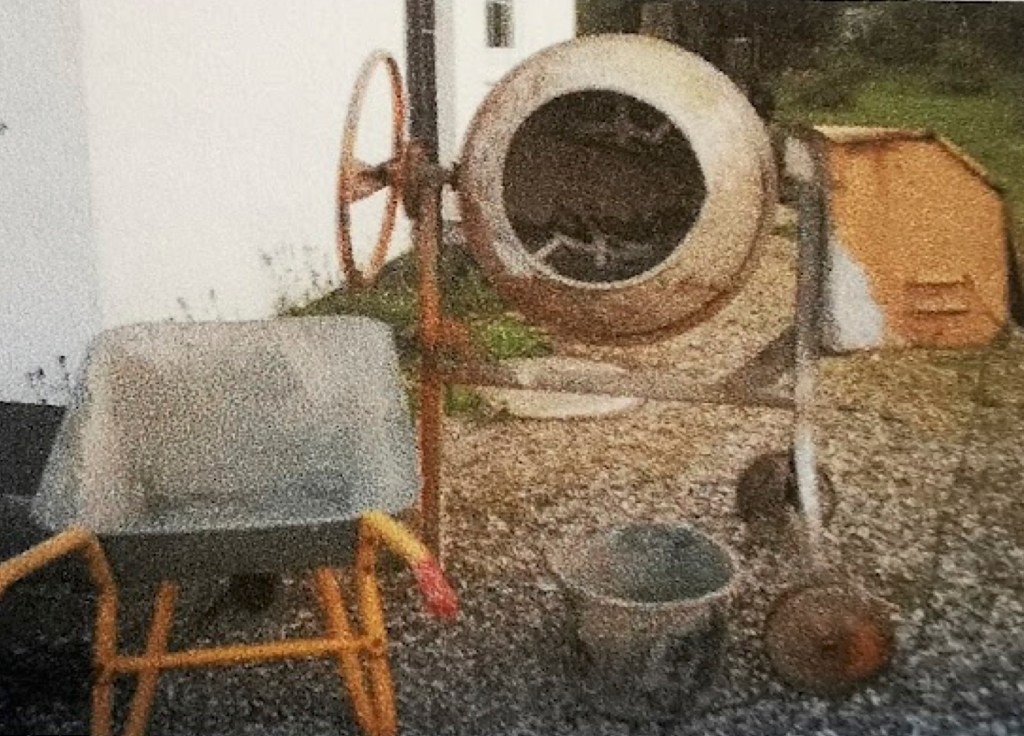
| Oooo. What’s that? What’s that? Exciting. There’s a bucket. What’s inside? That’s really cool. This is something which I’ve never seen before. Uhhm. I wonder what it could be. And then it has a handle here that you can turn. Oooo. I wonder what it could be. And then there is a bag here. I don’t actually know what that is. Then there’s something here, a wheelbarrow. I remember what that is. But this one – that’s a strange thing. And then there’re some gloves on top. And then there’s some kind of engine-like thing. I don’t really know what that is either. There’s some kind of engine down there. And then there’s a handle and I think that, maybe, I can move it a bit. And then there are wheels down there. And there’s a chord on the engine there. Comes straight from the engine. Then there’s something here. And a… Exciting. Ooooo! There’re these handles inside, too. Cool. I’ve never seen anything like this before. This is a good fessor, this is. A very good fessor. Hmmm. This is something I’ve never seen before – that thing! That thing there. I’ve never seen that before. No, I can’t say I have. I actually can’t say that I have. Well… bye, bye. Goodbye thing. |
In the example with the cement mixer, the girl explores the unknown object based on her existing experience. The girl was asked to reflect on her encounter with an object as if it was foreign to her. She does this by including elements of drama. She walks around the ‘unknown’ object, explores it and its surroundings, and expresses her thoughts about it. She pretends she does not know what the object is. She zooms in and out with her camera, while she puts her thoughts into words. She looks at, behind and into the object. She names and describes the things that she knows, and she uses language creatively to describe the things she does not know. For example, when she fails to find a word for the metal arms inside the mixer, she lets shape of the object decide the name of the phenomenon, calling them “handles.” She invents her own concept, i.e., “fessor” to name the object without having to use the word ‘cement mixer.’ She generally produces a lot of language that illustrates her reflections; language she already has, and which can be developed.
In only two minutes, the girl produces a film which completely makes sense. She produces a story with a beginning and an end. She uses around 250 words in her narrative. How many words would she have produced if her teacher had asked her the more traditional teacher’s question: “What is this?” I can’t help but compare the girl’s film with a test situation, in which the tester asks a closed question about a single word which belongs to a single object. What would the girl in the example say if she was shown a still image of a cement mixer?
This example serves to illustrate that language is not simply a tool to achieve certain goals, but a process in which meaning is created between individuals and their surroundings. In a social semiotic understanding, meaning is created by individuals with their own unique history, experiences and objectives, and this process of creating meaning takes place through social practices (Laursen, 2013b, p. 692).
The example is an attempt to illustrate the internal dialogue that takes place when we explore objects and phenomena using the panorama perspective. In this section I have defined the concept of affordances as the property of language and situations that opens for possibilities for learning and encourages action. However, learning does not happen automatically, nor does action. Whether affordances occur depends on what the individual does, what the individual needs, and for what this something is to be used (van Lier, 2004). The questions in terms of learning theory therefore concern how to establish an environment in which it makes sense for the individual to engage actively with affordances. The situations will be different for different people; depending on their experience, needs, objectives, etc. The situation can offer the child language use and language learning opportunities but does not in itself trigger learning. Not until the child actively engages with their environment, can they detect these opportunities, engage in interplay with them and initiate a process that can become learning.
Why is the concept of affordance so important for teaching and learning in the ecological approach? Because the concept of affordance makes a new connection between perception and action. The replacement of the concept of input with that of affordances illustrates that perception—or perception of the world—is an active process. To find and use affordances is a step towards further action, which has the potential to lead to learning. To discover affordances and engage with them, is the first step towards creating meaning (van Lier, 2010).
Opportunities for Language Use and Language Learning: Two Examples From Fieldwork
Empirical material was collected while observing open-school activities at a school south of Copenhagen in Denmark. The researchers (the author of this article and her colleague) followed sixth-grade pupils in an outdoor-school activity in which the children had to examine the water quality in a small river. We collected documentation of what we call “space for language use and language learning opportunities.” The collected material comprises teacher interviews, pupil interviews, field observations, video recordings and photo material.
We had the opportunity to participate in two ‘sessions’ that took place outdoors in a forest. In the first session, the children were sent out into the forest to complete a task. This was repeated in the second session. However, there were considerable differences between the two sessions. In the following, I will describe two different narratives about two different boys. The two narratives are based on my subjective experience of the two sessions. They are narratives of language and learning opportunities that are exploited differently in two different situations.
The Boy With the Luminous Shoes
Excerpt From Research Diary 1:
It is our first day with the children in the woods. My colleague is instructing one of the children in the use of camera. This is because we want to ask the children to do their own video recording. My attention is caught by a boy wearing luminous shoes. His eyes are on the camera that my colleague is holding and showing to another pupil. The teacher is explaining the assignment. Several other pupils are listening and are ready to immerse themselves in the assignment. The boy with luminous shoes looks around. He cannot take his eye off the camera. Finally, it is his turn. He cannot conceal his excitement. Here are the first seconds of his discovery of nature, which takes up approx. one hour of the video footage:
| Look at that, man, have a look over there, it’s waterfall-ish! – Oh waterfall! Now! – Nice! There’s a raft on the other side! – Wow! The craziest stream ever! – We have found the craziest stream! – Look at that! |
The boy throws himself into the task of describing nature. His language is spontaneous, and, after closer analysis, also creative. He uses the languages available to him – Danish and English. Phrases “look at that,” “nice.” and “wow” are used in English. The other phrases are in Danish. He uses specialist terms. He moves freely within several different semantic networks. His language is varied and detailed. He finds the things that the class have been asked to find according to the assignment they have been given, and lots of other things. He is really enthusiastic about this activity.
The Boy With the Green Jacket
Excerpt From Research Diary 2:
Then, there was another session. On this day, the teachers and pupils were not alone in the woods. There were also two people from a local fisherman’s association, the chairman and his colleague. This time my attention fell on a boy in a green jacket. I clearly remember him on the way into the woods. He had a spark in his eye. “YES, let’s go!” The boy listens closely to the chairman’s instructions: “You are to measure the water level like this and then this,” says the chairman.
The chairman’s colleague takes the yardstick and begins to measure. The boy is still waiting, excitedly. At one point, I see the boy with the green jacket standing next to the yardstick that the chairman is holding in his hand while explaining. The last thing I look at is the yardstick as it disappears with the chairman, and I see the boy with the green jacket turn around. I just barely heard what he said. “Oh, we’re not going to do anything on our own anyway,” he says in a disappointed manner, turns around and begins to walk away from his classmates, teachers, the chairman and his colleague. We find him later in a playground making trouble. The teachers are not happy. One of the girls is given permission to hold the yardstick, but otherwise the children have been doing nothing other than listening.
These two stories illustrate two very different situations in the forest. On the first day, the children were sent out to find things. They were tasked with finding things that had been defined for them beforehand as part of the assignment; however, the situation provided possibilities to find other things as well. There were possibilities for all of the children to find the affordances that they could potentially engage with, and which therefore held the potential to become language and learning. There were possibilities for the panorama perspective. At the second session, the chairman took over the stage completely, talking to the children all day. The children´s role was to listen. The teacher-led classroom had been transferred to the woods, but with the chairman as teacher. Instead of using the possibilities for reflection that occur between the children and their surroundings in the woods, the children were left in an observer position. The possibilities provided by the woods were not exploited. And the boy in the green jacket found other ways to be a thing-finder – making trouble at the playground.
The Interplay Between Children’s Active Engagement in Meaningful Activities and Their Opportunities for Language Use and Language Learning
The descriptions above show that the possibility of being able to engage actively in meaningful activities has a direct impact on children’s opportunities for language and learning. We know from research that we learn languages by using languages; and we use languages in situations that make sense to us in a specific context. We use languages when there is an opportunity to use those. We learn languages when we take part in conversations on equal terms about content that is relevant to us; something we can relate to, based on our experience, interests, needs, objectives, etc.
In the fieldwork in the outdoor school, we have seen situations in which children have met more or less high-quality affordances, which include the opportunity of perceiving the world more linearly or more multi-modally with one or more senses. We have seen children who can easily make sense of a school situation, and we have seen children who require an authentic context to create meaning. We have seen children who crave possibilities to engage with their environment, but who cannot always make sense of the activities offered to them.
Differentiation theory presented above (Gibson & Pick, 2000) tells us that people react to rich and varied data from their surroundings and use the data for further action. Therefore, it is extremely important that children are provided with rich opportunities to explore the world, and this is precisely what an outdoor school can do; the opportunity to discover the world from the panorama perspective.
I began the article with the example from Astrid Lindgren’s Pippi Longstocking. Encouraged by Tommy and Annika, Pippi elaborates on the meaning of her invented word, thing-finder:
“What did you say you are?” asked Annika.
“A Thing-Finder.”
“What’s that?” asked Tommy.
“Somebody who hunts for things, naturally. What else could it be?” said Pippi as she swept all the flour left on the floor into a little pile. “The whole world is full of things, and somebody has to look for them. And that’s just what a Thing-Finder does,” she finished.
The world is full of things, and it is important that somebody finds them. The quotation could just as well have come from a book on the ecological understanding of language learning. For what could be better than enthusiastic children who interact actively with their external environment?
The outdoor school can provide a wealth of possibilities for what Finkbeiner (2005) and Legutke (1996) call Handlungsorientierter Unterricht, or action-based teaching, which stresses that learning experiences are created when the body is active, all senses are applied and you are together with others (Finkbeiner, 2005; Legutke, 1996). In the real world and in language learning we perceive the world through several senses. For instance, when we listen to another person speaking, it is not only his or her words which form the basis for our understanding, but also everything accompanying the words (gestures, facial expressions, movements of the lips, the situation, etc.). We combine data that we have obtained through various senses to advance our understanding. This is precisely what the outdoor school does really well! That is to provide the children the opportunity to discover the world with all their senses. So, why not see the outdoor school as the first step in a learning process; a place where, on the basis of the affordances available in the specific place and the material possibilities, with all the senses and together with other children and adults, children can explore the world, experience and perceive, and, then, subsequently describe their experiences with words and, together with the teachers, begin to work with language and the subject of the course?
Final Remarks
In this paper, I have focused on one of the elements of an ecological view of language use and language learning, perception. I have discussed how perception changes when people are released from an immobile position and how a broader overview can give us more food for thought and thus, language, than still images. Furthermore, I have illustrated how the outdoor school can create such possibilities.
The outdoor school succeeds when it is incorporated as a part of teaching in which objectives and activities have been carefully considered in relation to the possibilities available in the respective environments. We do not have to transfer the classroom out into the woods; nor do we have to transfer the woods to the classroom. Each environment has something unique to offer. The role of the teacher is to incorporate the possibilities available in the specific environment into the overall didactic reflection on objectives and means.
Finally, if, like in this paper, we consider the outside school as the phase in a language learning process in which experiences are formed and reflections initiated, we must remember two things. Firstly, the child should be allowed the opportunity to be active. The child should be allowed to be a thing-finder and choose the perspective. Secondly, the child should learn how to discover affordances and engage with them.
What better way to achieve this than by playing thing-finder?
Notes on the Contributor
Elina Maslo is second language teacher (Danish), task developer, teacher trainer and independent researcher. She researches the interconnection between language, learning and pedagogy in transformative learning spaces. You can read about her research on the blog elinamaslo.com, as well as by visiting her YouTube channels for second language learners and second language teachers.
References
Candlin, C. N., & Serangi, S. (2004). Foreword. In C. Kramsch (Ed.), Language acquisition and language socialization: Ecological perspectives (pp. xi–xiv). Continuum.
Finkbeiner, C. (2005). Handlungsorientierter Unterricht [Action-based teaching]. In M. Byram (Ed.), Routledge encyclopedia of language teaching and learning (pp. 225–258). Routledge.
Gibson, J. J. (1979). The ecological approach to visual perception. Houghton Mifflin Company.
Gibson, E. J., & Pick, A. D. (2000). An ecological approach to perceptual learning and development. Oxford University Press.
Kramsch, C. (2004). Introduction: “How can we tell the dancer from the dance?” In C. Kramsch (Ed.), Language acquisition and language socialization: Ecological perspectives (pp. 1–30). Continuum.
Laursen, H. P. (2013a). Literacy og sproglig diversitet. [Literacy and language diversity]. Aarhus Universitetsforlag.
Laursen, H. P. (2013b). Umbrellas and angels standing straight: A social semiotic perspective on multilingual children’s literacy. International Journal of Bilingual Education and Bilingualism, 16(6), 690–706. https://doi.org/10.1080/13670050.2012.709818
Legutke, M. (1996). Redesigning the language classroom. In H. Christ & M. Legutke (Eds.), Fremde Texte Verstehen. Festschrift für Lothar Bredella [Understanding Foreign Texts: Celebrating Lothar Bredella] (pp. 1–14). Gunther Narr.
Lindgren, A. (2020). Pippi Longstocking. Oxford University Press.
van Lier, L. (1996). Interaction in the language curriculum: Awareness, autonomy and authenticity. Longman.
van Lier, L. (2004). The ecology and semiotics of language learning. A sociocultural Perspective. Kluwer Academic Publishers.
van Lier, L. (2007). Action-based teaching, autonomy and identity. Innovation in language learning and teaching, 1(1), 46–65. https://doi.org/10.2167/illt42.0
van Lier, L. (2008). The ecology of language learning and sociocultural theory. In N. H. Hornberger (Ed.), Encyclopedia of language and education. Springer. https://doi.org/10.1007/978-0-387-30424-3_221
Van Lier, L. (2010). Ecological-semiotic perspectives on Educational Linguistics, In B. Spolsky & F. M. Hult (Eds.), The handbook of educational linguistics (pp. 596–605). Wiley Blackwell.
[1] Leo van Lier defines semiotics as “the study of sign-making and sign-using practices” (van Lier, 2004, p. 55) and emphasizes that the central question is how meaning is created between people and their environment.
 SiSAL Journal