
Balázs Fajt, Budapest Business University, Hungary. https://orcid.org/0000-0003-4983-3962
Fajt, B. (2024). Extramural German activities and motivation to learn German as a foreign language in the secondary education context. Studies in Self-Access Learning Journal, 15(2), 148–171. https://doi.org/10.37237/150203
Abstract
This study investigates the motivation for learning German as a Foreign Language (GFL) of Hungarian secondary school students, in particular, their extramural activities and the impact of these activities on their learning motivation in second language (L2) acquisition. While much existing research on L2 learning motivation focuses on English, less attention is paid to other languages such as German, despite its economic and cultural importance in Hungary. Utilising Dörnyei’s (2005) L2 Motivational Self System framework, this paper explores how extramural German activities, such as interaction on social media, and consumption of German media, contribute to GFL learning motivation and GFL proficiency. Using the quantitative research paradigm, this paper analyses data collected from 546 Hungarian secondary school students assessing their motivation and the frequency of their engagement in different extramural German activities. The results indicate that these activities are generally pursued infrequently, however, certain types, particularly digital and interactive ones, have a positive effect on GFL learning motivation. Gender differences in frequency of engagement in extramural German activities were also found. The pedagogical implications of this paper suggest that the integration of certain extramural German activities into GFL learning may enhance learners’ motivation. The article also offers directions for future research to further explore the intricate dynamics of extramural activities and L2 learning motivation.
Keywords: extramural activities, German as a Foreign Language, L2 learning, motivation, individual learner differences
Several individual learner differences (e.g., L2 learning motivation, L2 anxiety, L2 willingness to communicate) have been identified in the literature as important predictors of the success of the second language (L2) learning process; however, one of the most significant of these variables is the motivation to learn a L2 (Dörnyei, 2005). If a learner is not motivated to learn a L2, it is quite likely that they will not be successful and become competent L2 speakers, or at the very least not in the long run. L2 learning motivation has been investigated in most empirical studies in the context of English as a Foreign Language (EFL) learning; therefore, most findings and results centre around EFL learning, while very few studies focus on other, less frequently taught and learned languages. This is also the case in Hungary where, in addition to English, the dominance of which is unquestionable, German is a historically important L2, which has long functioned as a lingua franca. The importance of German is still relevant for the economy of the country, especially in the western part, which borders Austria. It is also the second most commonly taught L2 in secondary schools in Hungary. Despite this, the research on motivation to learn GFL is relatively scarce (cf. Csizér & Kormos, 2008; Horváth, 2022). In fact, this is the research gap this paper intends to fill, namely, to investigate secondary school students’ motivation for learning GFL, with a special focus on students’ extramural German activities and the impact of these activities on their motivation for learning it.
In the subsequent sections, the theoretical underpinnings are first introduced, including the main theories of L2 learning motivation along with the results of previous empirical research on GFL learning motivation. This is followed by the brief overview of the role of leisure time or in other words “extramural” activities in learning German as a Foreign Language (henceforth GFL). Finally, the research methods and the results of the study are presented followed by some concluding remarks along with possible future research directions.
Theoretical Background
L2 Learning Motivation
A landmark in the research of L2 learning motivation is the seminal paper by Gardner and Lambert (1972). In Canada, Gardner and Lambert (1972) studied the English-speaking and the French-speaking communities and investigated why members of each community learn the language of the other one. The findings of this research suggested that, on the one hand, interest and positive attitudes towards the other community may lead to a desire to be part of it, which has been called ‘integrative motivation.’ Gardner and his associates also identified another, rather utilitarian aspect of motivation, which focuses on the benefits (e.g., a potential better standard of living, a better job, a better salary) that can be gained from learning the other community’s language, which was then called ‘instrumental motivation’.
Due to the increasing global dominance of the English language, it has become an important means of communication, a lingua franca. As a result, being a global language, the vast majority of its speakers are non-native speakers, and the original Gardnerian concept of integration into an imagined homogenous Anglo-Saxon culture has become rather questionable, and it has been necessary to refine the original motivational models (see Gardner, 2005). In the early 2000s, reflecting on this issue and drawing on mainstream psychology, Dörnyei (2005) created his L2 Motivational Self System (L2MSS) framework. This theory, based on Markus and Nurius’ (1986) well-known psychological possible selves’ theory, attempts to define L2 learning motivation at the level of the self, and based on the original possible selves, Dörnyei (2005) created the ideal L2 self and the ought-to L2 self. However, since, as previously mentioned, context is by no means negligible, Dörnyei (2005) tried to emphasize the role of context by adding a third component, the language learning experience.
The first pillar of the theory is the ideal L2 self, which refers to “the L2-specific aspect of one’s ideal self” (Dörnyei, 2005, p. 106). The ideal L2 self denotes the language learner’s ideal future image of themselves, i.e., the extent to which a learner can imagine themselves as an effective and competent L2 speaker and user who can use the given L2 in their studies or at work. Drawing on traditional psychology, and Higgins’ (1987) discrepancy theory, Dörnyei (2005) suggests that at the beginning or during the L2 learning process, L2 learners are, in most cases, not yet as competent speakers as they would like to be. This realization of the “discrepancy” or gap between their current L2 knowledge and skills and the desired level of L2 proficiency, and the intention to bridge this gap, can motivate the learner to “reduce the discrepancy between the here-and-now or actual self and this ideal image” (Papi, 2010, pp. 468-469). The realization and intention trigger L2 motivated learning behaviour. In the long run, L2 self-focus on the future can sustain language learners’ L2 learning motivation.
On the contrary, the second component of the theory, the ought-to L2 self, focuses more on the present and refers to the “representation of the attributes that someone (yourself or another) believes you should or ought-to possess (i.e., a representation of someone’s sense of your duty, obligation, or responsibilities)” as stated by Higgins (1987, pp. 320–321). In contrast to the ideal L2 self, the ought-to L2 self plays an important role in avoiding negative outcomes and consequences, such as failing exams or receiving negative feedback from parents or teachers. In light of this, since the ought-to L2 self is always focused on a specific situation, it plays less of a role in sustaining L2 learning motivation in the long term.
The third component is the language learning experience, which refers to the learner’s “immediate learning environment and experience” (Dörnyei, 2005, p. 29). This includes all attitudes and feelings that the learner feels and experiences during L2 learning, so it typically refers to the atmosphere of foreign language classes. Findings from previous research (e.g. Csizér & Kormos, 2009; Dörnyei et al., 2006) in the Hungarian context found that, of the two components of the self-level, it is the ideal L2 self that plays a major role in shaping the L2 learning motivation. In addition, previous research (Lamb, 2017; Papi, 2010; Taguchi et al., 2009) also found that the language learning experience is the strongest predictor of L2 learning motivation in most contexts, and it may be the same in Hungary.
L2 Learning Motivation and Languages Other Than English
Given the prominence of English as a frequently studied foreign language, much of the research on L2 learning motivation is centred around English. Dörnyei and Al-Hoorie (2017) point out that languages other than English often receive less attention, existing “in the shadow of global English,” (p. 457) leading to a scarcity of research on less commonly studied languages (L2s). However, the motivations that drive learners of these languages often diverge from those of EFL learners.
In the case of languages that are internationally and frequently used, such as English, learners often emphasise, among the various motivational factors, that they learn these languages in order to gain social esteem, to obtain a degree in some fields of education, or to be able to communicate more easily in international communication (Csizér & Dörnyei, 2005; Masgoret & Gardner, 2003). In contrast, L2 learners of less frequently learned L2s often have more personal interests and motivations. Williams et al. (2002) investigated English secondary school learners of German and French and identified that language choice may be affected by gender, and that boys found French less “cool” than German. In another study, Oakes and Howard (2018) examined Swedish and Polish university students learning French and identified a strong form of integrative motivation. Similarly, another study by Kissau et al. (2010) investigated learners of Spanish in the US and found that males were less motivated to learn a foreign language than females. In the case of German, Liu and Li (2018) found that, among other things, Chinese college students learn German in order to be able to continue their studies in Germany, to learn more about German culture, and to later learn other languages. In addition, some students also reported that it is important for them to be able to communicate with other German speakers, which suggests an international posture (cf. Dörnyei, 2009) and also emphasises the regional importance of German (e.g., in Europe). In the same study, learners also reported that they learned German because they had already studied it. Busse and Williams (2010) also found that learners of German in the UK, in the higher educational context, were motivated to attain a higher level of German proficiency by their strong ideal self. This research also found that the ought-to L2 self is not a predictor of motivated language learning behaviour. In addition, Humphreys and Spratt (2008) investigated Hong Kong tertiary education students and found that the motivations of learners of German were more integrative than instrumental. In another study, Csizér and Kormos (2008) investigated Hungarian learners of English and German and found that learners with high levels of motivation tend to have intercultural contact more frequently, and learners of German have a lower level of L2 learning motivation than learners of English, which Csizér and Kormos (2008) explain by the amount of direct and indirect contact with the target language: since English is the language of the Internet, (social) media, and science, etc., learners have much more contact with this language than with other; therefore, English learners have more contact to the English language through media products than German learners have with the German language.
Extramural L2 Activities
In applied linguistics and language pedagogy, the term “extramural” (English) was introduced by Sundqvist (2009) in her doctoral dissertation, in which she used it to refer to any (English) leisure time activity in which (EFL) learners engage for mainly entertaining purposes. It is worth noting, however, that later, Sundqvist and Sylvén (2016) use the term ‘extramural English’ activities, when referring to English-language activities, but of course ‘English’ may be replaced by any other language. In light of this, in the present research project, I will use the term extramural German activities, meaning leisure activities in German that GFL learners undertake outside of school in their free time.
Although a plethora of research has pointed to the positive impact of extramural activities on L2 proficiency, a great deal of it has focused almost exclusively on English (cf. Grau, 2009; Kuppens, 2010; Piirainen-Marsh & Tainio, 2009; Simensen, 2010; Sundqvist & Sylvén, 2016). Consequently, there is little research on the potential positive impact of extramural German activities on GFL learners’ German proficiency. A relatively recent review by Zhang et al. (2019) found that only two studies (Scholz, 2017; Scholz & Schulze, 2017) published in all the leading journals in education, applied linguistics and language pedagogy indexed in Scopus and Web of Science Core Collection databases examined the potential positive impact of extramural German activities on GFL learners’ German proficiency. Consequently, the present research aimed to examine secondary school GFL students’ extramural German activities in Hungary, and the potential impact of these activities on learners’ GFL learning motivation.
Naturalistic Self-Directed Learning Through Extramural Activities
Krashen (2006) emphasizes the concept of the autonomous language acquirer, defining this individual as one who understands the mechanisms of language acquisition and can make use of comprehensible L2 input independently of formal educational structures. This perspective suggests that the role of L2 education should transcend merely aiming to produce proficient second language (L2) speakers but in addition to it, L2 education should also foster learner autonomy. Complementing this, Benson (2011) describes self-directed learning as a process where learners engage in L2 activities for enjoyment or interest, but with a conscious goal of improving L2 skills. These learners actively seek out L2 exposure opportunities to facilitate their L2 learning. Lee (2019) further extends this idea to digital environments, positing that regular engagement in extramural L2 activities in such contexts can aid in acquiring L2 linguistic elements. In the context of German, for instance, learners might immerse themselves in German movies, podcasts, and social media interactions, to naturally absorb the language through contextualized use and cultural immersion. Supporting this, Boyer and Usinger (2015) along with Grover (2015) highlight the necessity of learner control and active participation in this type of learning, underscoring the learner’s role in the success of self-directed language learning. This proactive approach not only enriches the learning experience but also deepens the learner’s connection to the target language through practical, real-world application.
Methods
Based on the literature reviewed and in line with the research aims, the following research questions were formulated (RQs):
RQ1 How often do participants engage in the different extramural German activities?
RQ2 Which extramural German activities predict participants’ motivated GFL learning behaviour?
RQ3 What components of Dörnyei’s (2005) L2 motivational self-system framework predict participants’ motivated GFL learning behaviour?
In order to find answers to the above research questions, the quantitative research paradigm was chosen. My choice was motivated by the fact that quantitative methods can be used to collect large amounts of data with many participants; furthermore, with the quantitative data collected, it is possible to run different statistical procedures to identify potential relationships among the variables investigated. In the present paper, it seemed logical to use statistical procedures to investigate which components of Dörnyei’s (2005) theory have an impact on motivated GFL learning behaviour and which extramural German activities have an impact on GFL learning motivation.
Participants
The present research was conducted among Hungarian secondary school GFL learners. Altogether, 546 participants were recruited through convenience and snowball sampling procedures to participate in the study. All participants learned German in secondary school and were recruited from four different secondary schools. The gender distribution was as follows: 42.3% (n=231) males and 57.7% (n=315) females. The average age of the respondents was 16.68 (SD=1.36) years old with the youngest participant being 14 and the oldest 19 years old.
The Instrument
As a research instrument, a previously validated questionnaire (Fajt, 2021) was used (see Appendix). This questionnaire was developed for similar purposes: it was designed to measure secondary school students’ engagement of frequency in extramural English activities and individual learner differences. For the present investigation, the original questionnaire was modified so that it would be suitable to measure learners’ engagement of frequency in extramural German activities. Consequently, the word “English” was replaced with the word “German” in all the extramural activities, and in the scales related to L2 learning motivation (e.g., the phrase “English lessons” was replaced by “German lessons”). The scales measuring L2 learning motivation (altogether four scales) were based on Dörnyei’s (2005) L2MSS and were adopted from Dörnyei and Taguchi (2010) and modified in a manner that they would be suitable to measure GFL learning motivation. Participants’ responses were measured on a five-point Likert scale ranging from “1: Strongly disagree” to “5: Strongly agree”. The scales used in the study were as follows:
- Ideal L2 self (6 items): attributes that an GFL learner would like to possess in order to become a competent GFL speaker.
- Ought-to L2 self (6 items): attributes that the GFL learner thinks their environment (i.e., parents, peers) might expect them to have.
- Language learning experience (5 items): motives related to the immediate learning environment (i.e., the GFL lessons at school) and experience.
- Motivated language learning behaviour (4 items): participants’ GFL learning motivation and how much effort and time they are willing to invest into GFL learning.
In addition, based on the findings of previous research (Fajt, 2021), frequency of engagement in 18 extramural German activities (for a list of the activities, see Table 1) was also investigated using the following Likert scale: (1) never, (2) less, than once a week, (3) once a week, (4) several times a week, (5) every day.
As for the four multi-item scales (Ideal L2 self, Ought-to L2 self, Language learning experience, Motivated language learning behaviour), the Cronbach’s alpha coefficients (α) were calculated to investigate the internal consistency of scales. This was important to ensure that the four scales are reliable.
Extramural German activities were measured using single-item scales. Although the use of single-item measures in research has been subject to heavy criticism (Rossiter, 2002), they are suitable for use if a construct is concrete, if it is unidimensional, and unambiguous to all respondents. This is to ensure that all respondents understand the construct the same way. As all GFL learners know and understand what it means to scroll through Instagram every day, or several times a week, using single-scale items to measure engagement in extramural activities seemed a reasonable approach. In addition, several questions aimed to elicit background information (age, gender, etc.) about participants.
Data Collection and Data Analysis
Data collection started in May 2022 and lasted for one month and an online questionnaire in Google Forms was used as a tool. The questionnaire was distributed to four secondary schools, which collectively have approximately 2,500 students, and the response rate for the questionnaire was around 22%. The language of the questionnaire was the mother tongue of participants. The collected data were analysed in SPSS 28.0. For the analysis of the data, Mann-Whitney U tests and linear regression analyses were used at the p<.05 level of statistical significance.
Results
When presenting the results, first the reliability of the multi-item scales is checked, then the frequency with which participants engage in extramural German activities is presented; this is followed by the overview of statistically significant gender-related differences in engagement in extramural German activities. Next, the different extramural German activities determining GFL learning motivation are presented. Finally, it is reported which components of Dörnyei’s (2005) L2MSS model determine GFL learning motivation.
First of all, the internal consistency of scales was checked by calculating the Cronbach’s alpha coefficients for each multi-item scale, i.e. the motivational scales (Table 1).
Table 1
Internal Consistency of Scales
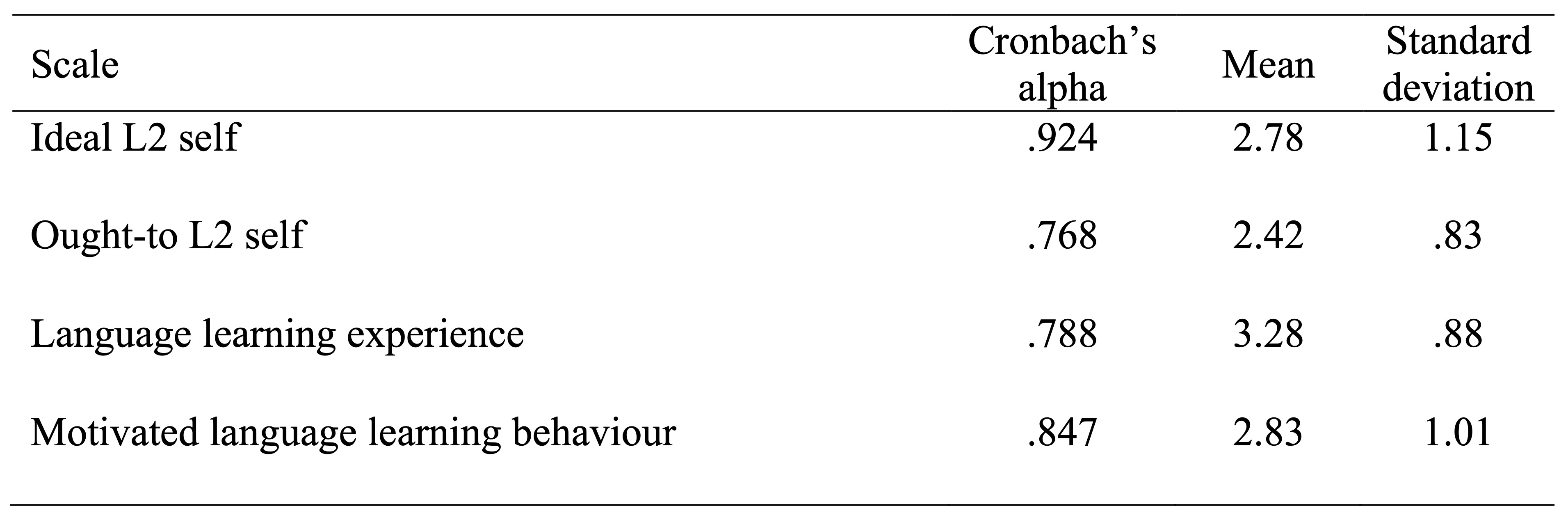
The results clearly show that the Cronbach’s alpha coefficients of all scales exceed the minimum threshold value (.70) prescribed in the literature (Dörnyei & Taguchi, 2010). Consequently, it may be concluded that the four multi-item scales measure reliably.
As a next step the frequency with which participants engage in extramural German activities are summarised in Table 2.
Table 2
Frequency of Engagement in Extramural German Activities (n=546)
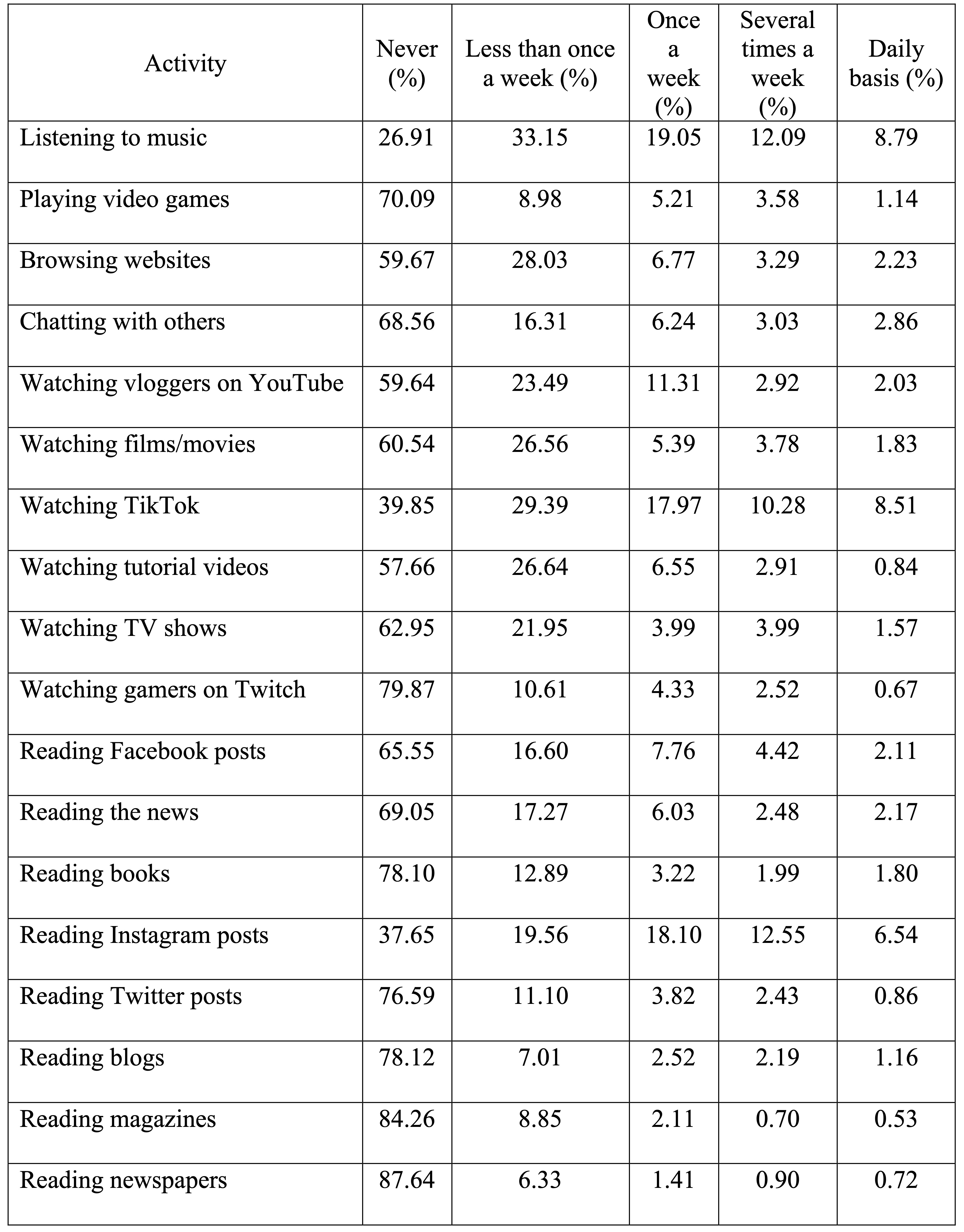
Regarding extramural German activities reported in Table 2, most extramural activities are very rarely pursued by participants. Three extramural activities, namely listening to music, watching TikTok videos and reading Instagram posts, are somewhat more popular with participants; however, all other activities seem to be relatively infrequently pursued by participants: for most activities, the majority of responses on the 5-point Likert scale were 1, with the second most common response being 2.
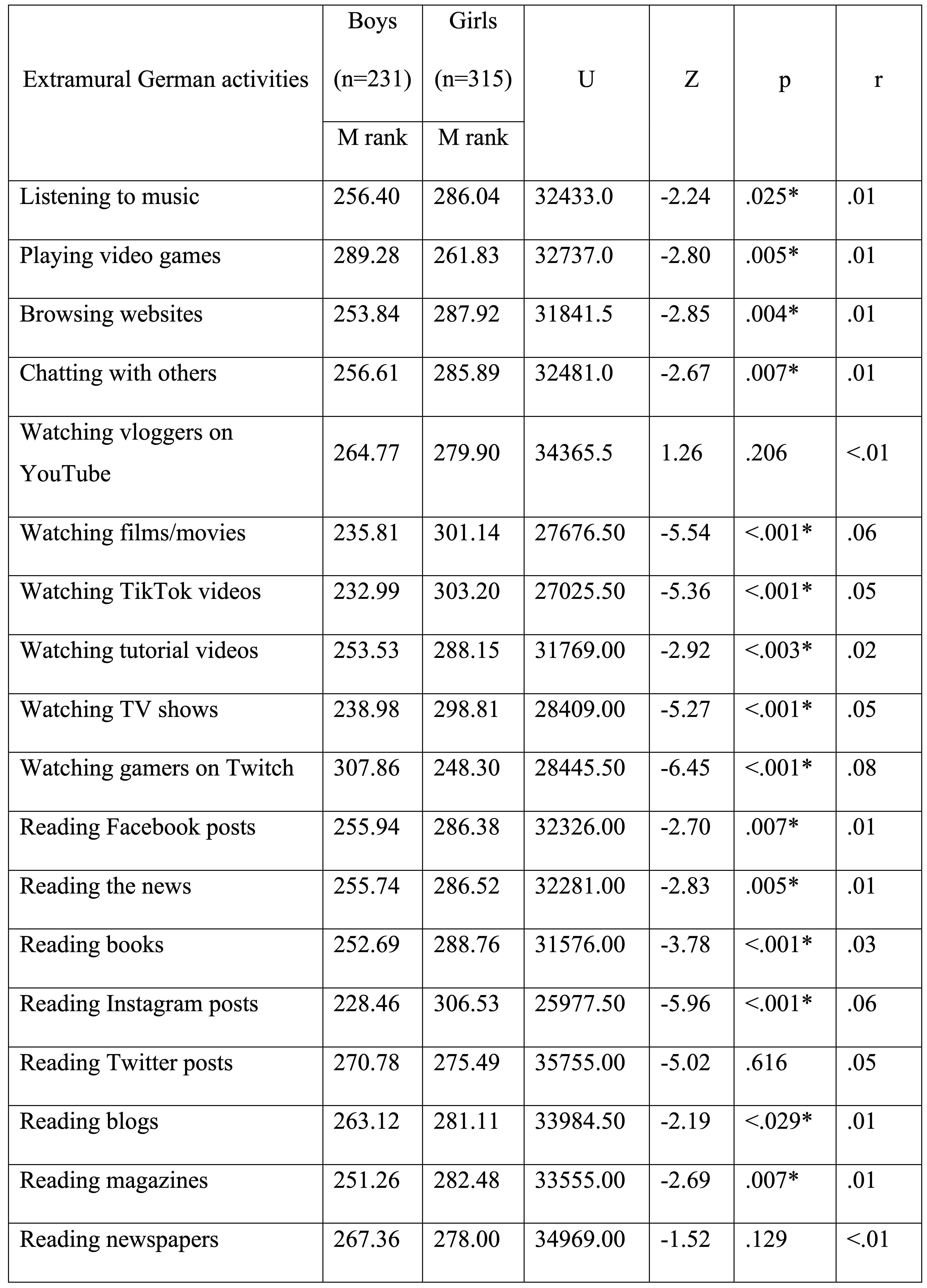
As a second step, statistically significant differences between genders in the frequency of engaging in extramural German activities were investigated by running non-parametric tests, more precisely Mann-Whitney U tests. Non-parametric tests, such as the Mann-Whitney U test, are more appropriate for analysing ordinal data (e.g. the data in this study measuring frequency of engagement in extramural activities) as such statistical procedures do not require the data to meet the stringent assumptions of parametric tests (e.g. the normality of the data).,The results of Mann-Whitney U tests are reported in Table 3.
Table 3
Statistically Significant Differences between Boys’ and Girls’ Frequency of Engagement in Extramural German Activities
Note. Level of statistical significance. *p<.05
The results in Table 3 show that there are statistically significant differences between boys’ and girls’ frequency of engagement in case of fifteen extramural German activities. This means that girls listen to more music, browse websites more frequently, chat more with others in German. They also watch vloggers on YouTube more often and watch German-language TV shows, films, videos and TikTok videos as well as tutorial videos more frequently, too. Girls read more German-language Facebook and Instagram posts, books, and blogs and magazines Girls also tend to read the news more frequently than boys. Only two activities that are otherwise closely related (playing video games in German and watching German-language gamers on Twitch) are practised significantly more frequently by boys than girls.
It is important to note, however, that since statistically significant results (p<.05) on their own do not allow for the estimation of the strength of relationship between variables, therefore, the effect sizes (r) for the results of Mann-Whitney U tests were also computed. This was important because effect sizes tell whether relationships are strong or weak and in the literature Rahlfs and Zimmermann (2019) refer to Cohen’s benchmark (1988) values when determining the strength of relationships, and claim that these values can be translated into corresponding Mann-Whitney values, i.e., d<.20 indicates a negligible effect size. Between 20 and 50 there is a small, between 50 and 80 there is a medium, and d>.81 indicates a large effect size. Based on the literature, it may be concluded that for all extramural German activities the significant gender differences have a negligible effect size.
As a next step, linear regression analysis (at the p<.05 level of statistical significance) was run to determine which extramural German activities (independent variables) have an impact on motivated GFL learning behaviour (dependent variable) (see Table 4). To facilitate linear regression analysis, dummy coding was employed for the ordinal independent variables: the responses were recoded into binary variables where “never” was coded as 1, and all other values were coded as 2. This dummy coding process converts the ordinal Likert scale into a format suitable for linear regression, allowing for the assessment of the individual impact of different extramural German activities on motivated GFL learning behaviour.
Table 4
Results of Regression Analysis Regarding Extramural German Activities Predicting Motivated GFL Learning Behaviour
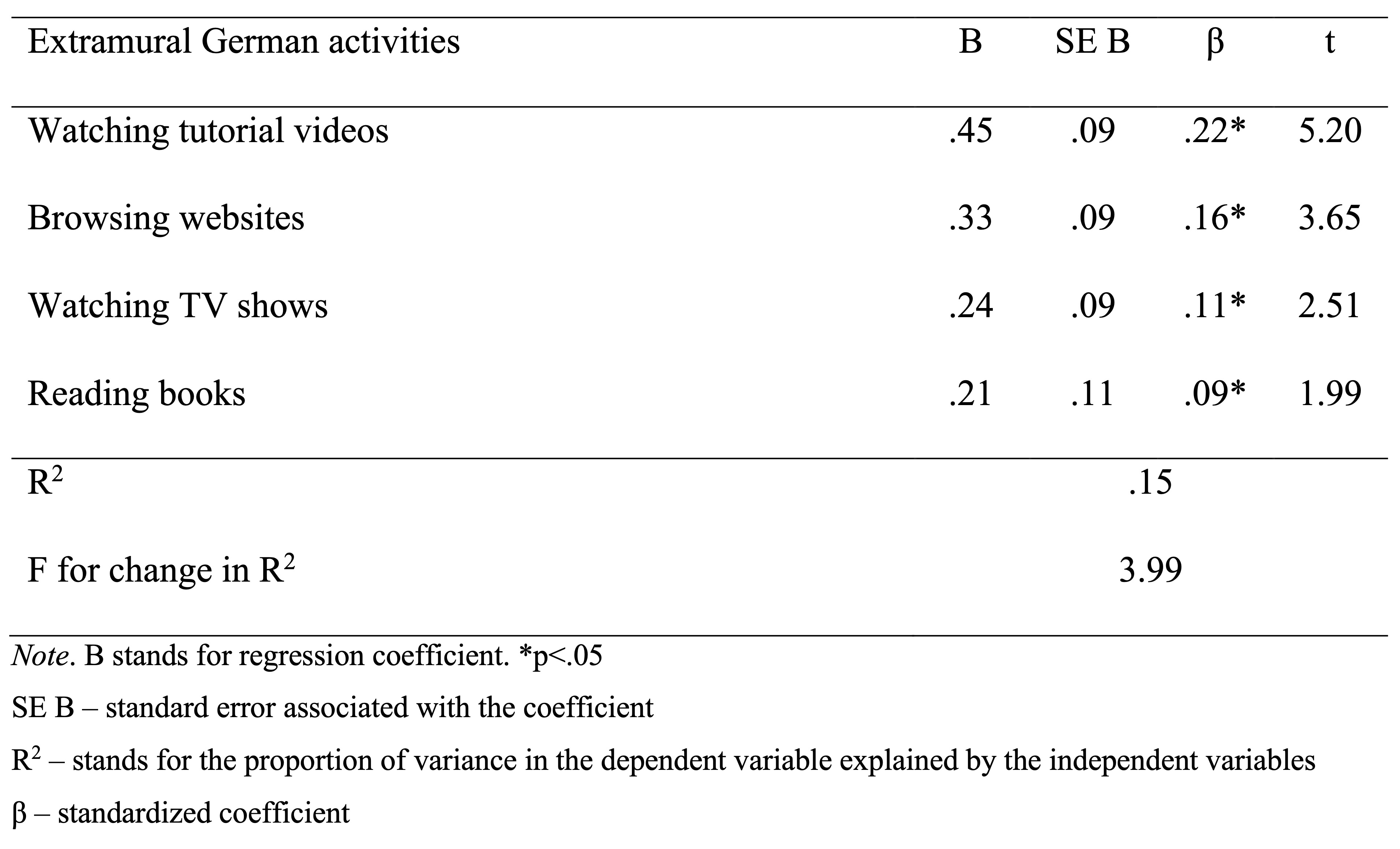
Of all extramural German activities, four extramural German activities have an impact on motivated language learning behaviour, but the explanatory power of the regression model is only 15% (R2=.15), i.e., only 15% of motivated language learning behaviour is predicted by engagement in different extramural German activities. Among the activities, three activities have a β value higher than .10 (watching tutorial videos, browsing webpages and watching TV shows), which is still considered relatively low. The last activity has an even lower β value (β<.10), therefore, it predicts an even smaller proportion of motivated GFL learning behaviour.
Finally, it was also investigated which of the components of Dörnyei’s (2005) L2MSS (independent variables) determine participants’ motivated GFL learning behaviour (dependent variable) using linear regression analysis (see Table 5).
Table 5
Results of Regression Analysis Regarding Components of the L2MSS Predicting Motivated GFL Learning Behaviour
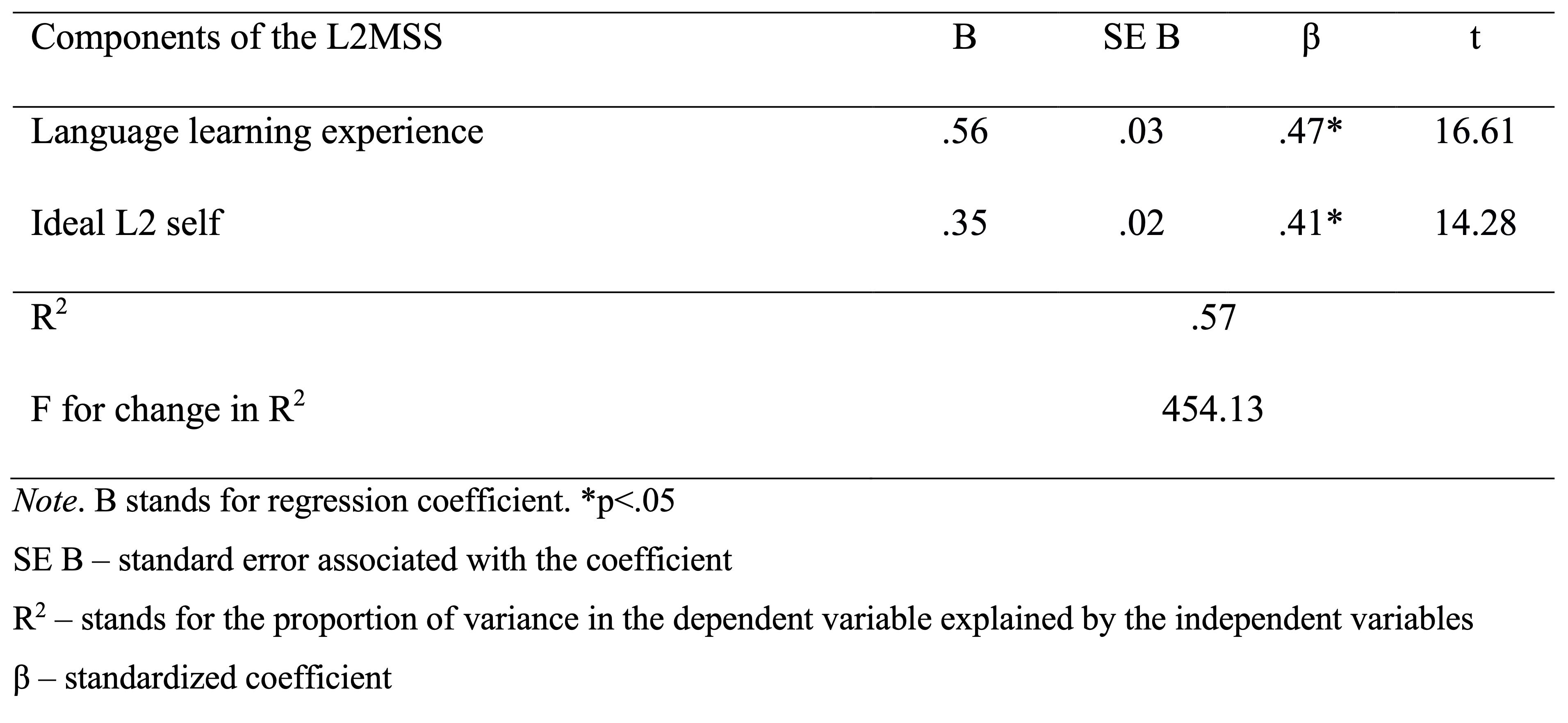
The results show that language learning experiences and the ideal L2 self are predictors of motivated language learning behaviour. The explanatory power of the regression model is 57% (R2=.57), i.e., the two components together predict 57 percent of motivated GFL learning behaviour.
Discussion
The results show a relatively low engagement in extramural German activities, which raises questions about their role in enhancing GFL proficiency. These findings are in contrast with the results of previous research on extramural German activities (Csizér & Lukács, 2010), as well as results of research on extramural English activities in the international (Grau, 2009) and the Hungarian contexts (Fajt, 2021; Józsa & Imre, 2013; Lajtai, 2020). These results show that EFL learners are more likely to engage in all types of extramural English activities than GFL learners in extramural German activities. It also seems that even some of the most popular extramural German activities (reading German-language Instagram posts and watching German-language TikTok videos) are also related to social media, for which previous research (Sundqvist & Olin-Scheller, 2013) found that today’s teenagers frequently engage in various social media activities and often not only consume, but also produce content on social media; Sundqvist and Olin-Scheller (2013) refer to such users as ‘prosumers’. Online and digital environments may also prove to be a useful resource for L2 development because, as Barton and Potts (2013) point out, learning and using a L2 in digital environments often cannot be separated, and a plethora of implicit and unnoticed changes in the learner’s L2 proficiency may take place. Barton and Potts (2013) label this as “language-as-social-practice”, which is the 21st century, digital and online form of Bialystok’s (1981) notion of “functional practice”, by which she means that learning and using a language may not be separated, and learning also takes place when communicating with interlocutors. Social media platforms, by definition, are considered ideal for interactions with others speaking the same L2. This approach, consequently, may allow for a naturalistic (self-directed) acquisition of German and perhaps also fosters a deeper, more personal connection to the language.
Similarly to the social media-related activities, listening to German-language music is another relatively popular extramural German activity. Both listening to music and using social media are activities which do not necessarily require a high attention span and can be carried out as background activities. Regarding the other activities, it may be concluded that activities that require reading are rarely or almost never done. This is not a surprising result, as the findings of a relatively recent representative survey (Bernát & Hudácskó, 2020) show that only 3% of the Hungarian population read on a daily basis in their native language, 53% never or almost never read, and 18% read only monthly or less frequently than monthly in their native language. It is, therefore, not surprising that participants do not read often in their mother tongue, let alone in an L2. The minimal engagement of Hungarian GFL students in extramural German reading activities is particularly worrisome, given previous research findings. Maxim (2002), for instance, noted that students who frequently read in German in their free time experience significant improvements in their grammatical and communicative competencies. Moreover, Bond (2016) highlighted that through reading, students learn to infer the meaning of words from their textual context, which not only enhances learners’ vocabulary but also boosts their confidence in using the language. This suggests that reading in German may not only foster the development of language skills but may also be crucial in building self-confidence in language use; therefore, a lack of engagement in reading activities may be a significant obstacle to maximizing the potential benefits of L2 learning. Hence, it is crucial that GFL teachers actively encourage learners to engage in extramural reading activities to improve learners’ L2 proficiency and confidence.
In terms of gender differences, boys are significantly less likely to pursue extramural German activities than girls, except for playing video games in German and watching German speaking gamers on Twitch. These two extramural German activities are stereotypical activities that boys are more likely to pursue (Kemp, 2022a), so it is not surprising that this gender difference is also detectable in the present research. In contrast, other extramural German activities, such as watching movies and TV shows and TikTok videos in German are more typical extramural German activities for girls (Kemp, 2022b), so it is not surprising that they are, in the scope of the present study, also significantly more likely to be pursued by female participants. In the case of gender differences, it may be concluded that the learning of GFL by female participants may be more facilitated by engagement in extramural German activities than that of male participants, as the results show that girls simply have a higher frequency of engagement in these activities and consequently a relatively higher exposure to the German language. However, it is to be noted that the effect size in the case of gender differences is negligible.
Regarding the components of Dörnyei’s (2005) L2MSS theory of motivation, the ideal L2 self and the language learning experiences are predictors of motivated GFL learning behaviour. These are fully consistent with the results of previous research (Csizér & Kormos, 2009; Csizér & Lukács, 2010; Dörnyei et al., 2006) investigating EFL and GFL learning motivation as in both cases, these two variables determine L2 learning motivation. Moreover, the results of previous research also showed that the language learning experience is the most important factor predicting L2 learning motivation, which was also the case in the present investigation. In addition, the results show that extramural German activities explain only a very small percentage of the motivated behaviour to GFL learning, but to a small extent they may also contribute to an increase in the participants’ motivation to learn GFL. These findings are partly in line with the results of previous research (Fajt, 2021), which investigated extramural English activities and their impact on EFL learning motivation, and found that only listening to music can influence EFL learning motivation positively. However, in contrast to these results, the present study found that several activities (four in total) had a positive effect on GFL learning motivation.
It has also been discovered that three of the extramural German activities (watching tutorial videos in German, surfing websites in German on the Internet) have a higher beta value (β). Two of these activities may be closely associated with instrumentality and the utilitarian dimension of language use. In these cases, students may be more likely to use their knowledge of German when they cannot access information in their mother tongue and may not be able to find it other languages either. The other two activities were watching films and reading books in German, which may be predominantly done for entertainment purposes. These results suggest that, on the one hand, in order to develop the Ideal L2 self and to improve the language learning experience, it would be worthwhile to incorporate extramural German activities in the GFL lessons, too. In addition, as previous research carried out by Adolphs et al. (2018) suggests, digital extramural activities could also increase learners’ ideal L2 self; consequently, digital extramural German activities could also help improve learners’ ideal L2 self.
Conclusion
This paper investigated the extramural German activities performed by secondary school students in Hungary and the potential impact of such activities on students’ motivation to learn GLF. With regard to the first research question (RQ1), based on the results of the study, it may be concluded that participants engage in extramural German activities relatively infrequently, and that these activities are more likely to be less time-consuming and less attention-demanding activities, such as listening to music in German and using social media in German. The gender differences pertaining extramural German activities indicate that girls tend to invest more time in these activities than boys, with the exception of computer games and watching video game players on Twitch, so these two activities may be more useful for boys in terms of GFL learning. As for the second and third research questions (RQ2 and RQ3), the results show that GFL learning motivation is predicted by the ideal L2 self and language learning experiences, which is fully in line with the findings of previous research. Furthermore, it was also revealed that, even if only to a small extent, extramural German activities do have a positive effect on GFL learning motivation. The incorporation of such activities could also have an awareness-raising role, as it could show students the benefits of extramural German activities, i.e., they can contribute to improving proficiency in GFL. In addition, this naturalistic (self-directed) engagement enhances the ideal L2 self and enriches the language learning experience, which are significant predictors of motivated learning behaviour.
As far as future research directions are concerned, it would be worthwhile to further investigate German learners’ extramural activities through large-scale quantitative studies, possibly with a sample aiming for representative results. In addition, it would also be worthwhile to use qualitative interview methods to find out more about students’ extramural German activities as well as GFL learning motivation, and the relationship between these two. Finally, as a limitation of the present research, it should be noted that although it is a relatively large-scale study (n=546), the sample was collected using convenience sampling and snowball sampling; consequently, the results obtained here are, by no means, representative and do not allow for generalisations.
Notes on the Contributor
Balázs Fajt is a senior lecturer at Budapest Business School University of Applied Sciences, Hungary. He obtained a PhD in Language Pedagogy from Eötvös Loránd University, Faculty of Education and Psychology. His research interests include EFL learning motivation and EFL learning beyond the classroom, especially through different extramural English activities including especially films, series, video games, music.
References
Adolphs, S., Clark, L., Dörnyei, Z., Glover, T., Henry, A., Muir, C., Sánchez-Lozano, E., & Valstar, M. (2018). Digital innovations in L2 motivation: Harnessing the power of the Ideal L2 Self. System, 78, 173–185. https://doi.org/10.1016/j.system.2018.07.014
Barton, D., & Potts, D. (2013). Language learning online as a social practice. TESOL Quarterly, 47(4), 815–820. https://doi.org/10.1002/tesq.130
Benson, P. (2011). Teaching and researching: Autonomy in language learning (2nd edition). Routledge. https://doi.org/10.4324/9781315833767
Bernát, A., & Hudácskó, S. (2020). Könyvolvasási és könyvvásárlási szokások, 2020 [Book purchasing and book reading habits, 2020]. Tárki Social Research Institute.
Bialystok, E. (1981). The role of conscious strategies in second language proficiency. The Modern Language Journal, 65(1), 24–35. https://doi.org/10.1111/j.15404781.1981.tb00949.x
Bond, M. (2016). The text-based approach in the German as foreign language secondary classroom: Text-based research and teaching. In P. Mickan, & E. Lopez (Eds.), Text-based research and teaching (pp. 193–219). Palgrave Macmillan. https://doi.org/10.1057/978-1-137-59849-3_11
Boyer, N. R., & Usinger, P. (2015). Tracking pathways to success: Triangulating learning success factors. International Journal of Self-Directed Learning, 12(2), 22–48.
Busse, V., & Williams, M. (2010). Why German? Motivation of students studying German at English universities. Language Learning Journal, 38(1), 67–85. https://doi.org/10.1080/09571730903545244
Cohen, J. (1988). Statistical power analysis for the behavioral sciences. Routledge. https://doi.org/10.4324/9780203771587
Csizér, K., & Dörnyei, Z. (2005). The internal structure of language learning motivation and its relationship with language choice and learning effort. The Modern Language Journal, 89, 19–36. https://doi.org/10.1111/j.0026-7902.2005.00263.x
Csizér, K., & Kormos, J. (2008). The relationship of intercultural contact and language learning motivation among Hungarian students of English and German. Journal of Multilingual and Multicultural Development, 29(1), 30–48. https://doi.org/10.2167/jmmd557.0
Csizér, K., & Kormos, J. (2009). Learning experiences, selves and motivated learning behavior: A comparative analysis of structural models for Hungarian secondary and university learners of English. In Z. Dörnyei, & E. Ushioda (Eds.), Motivation, language identity and the L2 self (pp. 98–119). Multilingual Matters. https://doi.org/10.21832/9781847691293-006
Csizér, K., & Lukács, G. (2010). The comparative analysis of motivation, attitudes and selves: The case of English and German in Hungary. System, 38(1), 1–13. https://doi.org/10.1016/j.system.2009.12.001
Dörnyei Z., & Al-Hoorie A. H. (2017). The motivational foundation of learning languages other than Global English. The Modern Language Journal, 101(3), 455–468. https://doi.org/10.1111/modl.12408
Dörnyei, Z. (2005). The psychology of the language learner: Individual differences in second language acquisition. Lawrence Erlbaum. https://doi.org/10.4324/9781410613349
Dörnyei, Z. (2009). The L2 Motivational Self System. In Z. Dörnyei & E. Ushioda (Eds.), Motivation, language identity and the L2 self (pp. 9–42). Multilingual Matters. https://doi.org/10.21832/9781847691293-003
Dörnyei, Z., & Taguchi, T. (2010). Questionnaires in second language research: Construction, administration and processing (2nd ed.). Routledge. https://doi.org/10.4324/9780203864739
Dörnyei, Z., Csizér, K., & Németh, N. (2006). Motivation, language attitudes and globalization: A Hungarian perspective. Multilingual Matters. https://doi.org/10.21832/9781853598876
Fajt, B. (2021). Hungarian secondary school students’ extramural English interests: The development and the validation of a questionnaire. Working Papers in LanguagePedagogy, 16, 36–53. https://langped.elte.hu/WoPaLParticles/W16Fajt.pdf
Gardner, R. C. (2005). Integrative motivation and second language acquisition. Canadian Association of Applied Linguistics/Canadian Linguistics Association Joint Plenary Talk, London, Canada. [Online]. http://publish.uwo.ca/~gardner/docs/caaltalk5final.pdf.
Gardner, C. R., & Lambert, E. W. (1972). Attitudes and motivation in second language learning. Newbury House.
Grau, M. (2009). Worlds apart? English in German youth cultures and in educational settings. World Englishes, 28(2), 160–174. https://doi.org/10.1111/j.1467-971X.2009.01581.x
Grover, K. (2015). Online social networks and the self-directed learning experience during a health crisis. International Journal of Self-Directed Learning, 12(1), 1–15.
Higgins, E. T. (1987). Self-discrepancy: A theory relating self and affect. Psychological Review, 94(3), 319–340. https://doi.org/10.1037/0033-295X.94.3.319
Horváth, L. (2022). The validation process of questionnaires to assess motivation for and attitudes towards German as a learning a third language. Alkalmazott Nyelvtudomány, 22(2), 66–88. http://dx.doi.org/10.18460/ANY.2022.2.005
Humphreys, G., & Spratt, M. (2008). Many languages, many motivations: A study of Hong Kong students’ motivation to learn different target languages. System, 36, 313–335. https://doi.org/10.1016/j.system.2007.09.010
Józsa, K., & Imre, I. A. (2013). Az iskolán kívüli angol nyelvű tevékenységek összefüggése a nyelvtudással és a nyelvtanulási motivációval [The relationship between out-of-school English language activities and language proficiency and language learning motivation]. Iskolakultúra, 23(1), 38–51.
Kemp, S. (2022a). TikTok users, stats, data & trends. Datareportal. https://datareportal.com/essential-tiktok-stats?rq=tiktok
Kemp, S. (2022b). Looking ahead: Key digital themes for 2023. Datareportal. https://datareportal.com/reports/looking-ahead-to-what-2023-holds?rq=games%20gender
Kissau, S. P., Kolano, L. Q., & Wang, C. (2010). Perceptions of gender differences in high school students’ motivation to learn Spanish. Foreign Language Annals, 43(4), 703–721. https://doi.org/10.1111/j.1944-9720.2010.01110.x
Krashen, D. S. (2006). The autonomous language acquirer (ALA). In E. M. Skier & M. Kohyama (Eds.), More autonomy you ask! (pp. 1–8). Japan Association for Language Teaching.
Kuppens, H. A. (2010). Incidental foreign language acquisition from media exposure. Learning, Media and Technology, 35(1), 65–85, https://doi.org/10.1080/17439880903561876
Lajtai, Á. (2020). Hungarian EFL learners’ extramural contact with English. In R. Geld, & S. L. Krevelj (Eds.), UZRT 2018: Empirical studies in applied linguistics (pp. 128–149). FF Press.
Lamb, M. (2017). The motivational dimension of language teaching. Language Teaching, 50(3), 301–346. https://doi.org/10.1017/S0261444817000088
Lee, J. S. (2019). EFL students’ views of willingness to communicate in the extramural digital context. Computer Assisted Language Learning, 32(7), 692–712. https://doi.org/10.1080/09588221.2018.1535509
Liu, M., & Li, M. (2018). A study of changes in German learning motivation by Chinese university learners. College Student Journal, 52, 49–64.
Markus, H., & Nurius, P. (1986). Possible selves. American Psychologist, 41(9), 954–969. https://doi.org/10.1037/0003-066X.41.9.954
Masgoret, A. M., & Gardner, R. (2003). Attitudes, motivation and second language learning: A meta-analysis of studies conducted by Gardner and associates. Language Learning, 53, 123–163. https://doi.org/10.1111/1467-9922.00212
Maxim, H. H. (2002). A study into the feasibility and effects of reading extended authentic discourse in the beginning German language classroom. The Modern Language Journal, 86(1), 20-35. https://doi.org/10.1111/1540-4781.00134
Oakes, L., & Howard, M. (2019). Learning French as a foreign language in a globalised world: An empirical critique of the L2 Motivational Self System. International Journal of Bilingual Education and Bilingualism, 25(1), 166–182. https://doi.org/10.1080/13670050.2019.1642847
Papi, M. (2010). The L2 motivational self-system, L2 anxiety, and motivated behavior: A structural equation modeling approach. System, 38(3), 467–479, https://doi.org/10.1016/j.system.2010.06.011
Piirainen-Marsh, A., & Tainio, L. (2009). Other-repetition as a resource for participation in the activity of playing a video game. The Modern Language Journal, 93(2), 153–169. https://doi.org/10.1111/j.1540-4781.2009.00853.x
Rahlfs V., & Zimmermann, H. (2019). Effect size measures and their benchmark values for quantifying benefit or risk of medicinal products. Biometrical Journal, 61, 973–982. https://doi.org/10.1002/bimj.201800107
Rossiter, J. R. (2002). The C-OAR-SE procedure for scale development in marketing. International Journal of Research in Marketing, 19(4), 305–335. https://doi.org/10.1016/S0167-8116(02)00097-6
Scholz, K. W. (2017). Encouraging free play: Extramural digital game-based language learning as a complex adaptive system. Calico journal, 34(1), 39–57. https://doi.org/10.1558/cj.29527
Scholz, K. W., & Schulze, M. (2017). Digital-gaming trajectories and second language development. Language Learning Technology, 21(1), 100–120.
Simensen, A. M. (2010). English in Scandinavia: A success story. In D. Wyse, R. Andrews, & J. Hoffman (Eds.), The Routledge international handbook of English, language and literacy teaching (pp.472–483). Routledge.
Sundqvist, P. (2009). Extramural English matters: Out-of-school English and its impact on Swedish ninth graders’ oral proficiency and vocabulary [Unpublished doctoral dissertation]. Karlstad University.
Sundqvist, P., & Olin-Scheller, C. (2013). Classroom vs extramural English: Teachers dealing with demotivation. Language and Linguistics Compass, 7(6), 329–338. https://doi.org/10.1111/lnc3.12031
Sundqvist, P., & Sylvén, L. K. (2016). Extramural English in teaching and learning: From theory and research to practice. Palgrave Macmillan. https://doi.org/10.1057/978-1-137-46048-6
Taguchi, T., Magid, M., & Papi, M. (2009). The L2 Motivational Self System among Japanese, Chinese and Iranian Learners of English: A Comparative Study. In Z. Dörnyei, & E. Ushioda (Ed.), Motivation, Language Identity and the L2 Self (pp. 66–97). Multilingual Matters. https://doi.org/10.21832/9781847691293-005
Williams, M., Burden, R., & Lanvers, U. (2002). “French is the language of love and stuff”: Student perceptions of issues related to motivation in learning a foreign language. British Educational Research Journal, 28(4), 503–528. https://doi.org/10.1080/0141192022000005805
Zhang, R., Zou, D., Cheng, G., Xie, H., Wang, F. L., & Au, O.T. S. (2021) Target languages, types of activities, engagement, and effectiveness of extramural language learning. PLoS ONE, 16(6). e0253431. https://doi.org/10.1371/journal.pone.0253431
Appendix
How often do you do the following activities in German?
1 – never
2 – less frequently than once a week
3 – once a week
4 – several times a week
5 – on a daily basis
- Listening to music
- Reading Instagram posts
- Reading Facebook posts
- Reading the news
- Reading books
- Reading Twitter posts
- Reading blogs
- Reading magazines
- Reading newspapers
- Playing video games
- Watching gamers on Twitch
- Watching films/movies
- Watching tutorial videos
- Watching TV shows
- Watching TikTok
- Watching vloggers on YouTube
- Browsing websites
- Chatting with others
Please indicate on a scale of 1 to 5 how much you agree with the following statements.
- I do not agree at all.
- I disagree.
- I both agree and disagree.
- I agree.
- I agree completely.
Motivated language learning behaviour
- I focus more on learning German than on any other subject.
- I am ready to invest energy in getting even better results from German in school.
- I think I do my best to learn German really well at school.
- I try to spend more time learning German.
Ideal L2 self
- I can imagine myself studying in a university where all my courses are taught in German.
- Whenever I think of my future career, I imagine myself using German.
- I can imagine a situation where I am speaking German with foreigners.
- I can imagine myself living abroad and using German effectively for communicating with the locals.
- I can imagine myself speaking German as if I were a native speaker of German.
- The things I want to do in the future require me to use German.
Ought-to L2 self/own
- I study German because close friends of mine think it is important.
- Learning German is necessary because people surrounding me expect me to do so.
- I consider learning German important because the people I respect think that I should do it.
- If I fail to learn German, I’ll be letting other people down.
- I have to study German, because, if I do not study it, I think my parents will be disappointed with me.
- Studying German is important to me because other people will respect me more if I have a knowledge of German.
Language learning experience
- I like the atmosphere of my German classes.
- I find learning German really interesting.
- I really enjoy learning German.
- I would you like to have more German lessons at school.
- I always look forward to German classes.
 SiSAL Journal