
Sanae Katagiri, Institute for the Promotion of Higher Education, Hirosaki University, Japan
Katagiri, S. (2024). Connecting faculties and the SALC: A special lecture series. Studies in Self-Access Learning Journal, 15(4), 466–476. https://doi.org/10.37237/150407
Abstract
This summary article describes the development of a special lecture series called The English Lounge (EL) Forum in Hirosaki University’s SALC. First, I outline the topics covered by the lecturers who come from various faculties at the university as well as individuals from outside the university. The goal is to develop a hub at the SALC for interdisciplinary learning and the sharing of new research and ideas through a “push-pull” framework that provides students activities that “pull” them back to the SALC throughout the year. Then, using data collected from the EL forum, I report on the number of participants, the diversity of the lecturers, and participation feedback. Finally, I provide some reflections and discuss future possibilities for the EL Forum.
Keywords: Interdisciplinary, lectures, on-demand
Hirosaki University’s Self-Access Learning Center (called the “English Lounge”) has been actively evolving over the past 10 years to provide better language learning services and cultural understanding opportunities for students. In this summary article, I discuss a special lecture series called the “English Lounge Forum.” I start by explaining the background and design of the forums, then discuss data collected from the forums, and finally reflect and explore possible future directions.
Background and Design
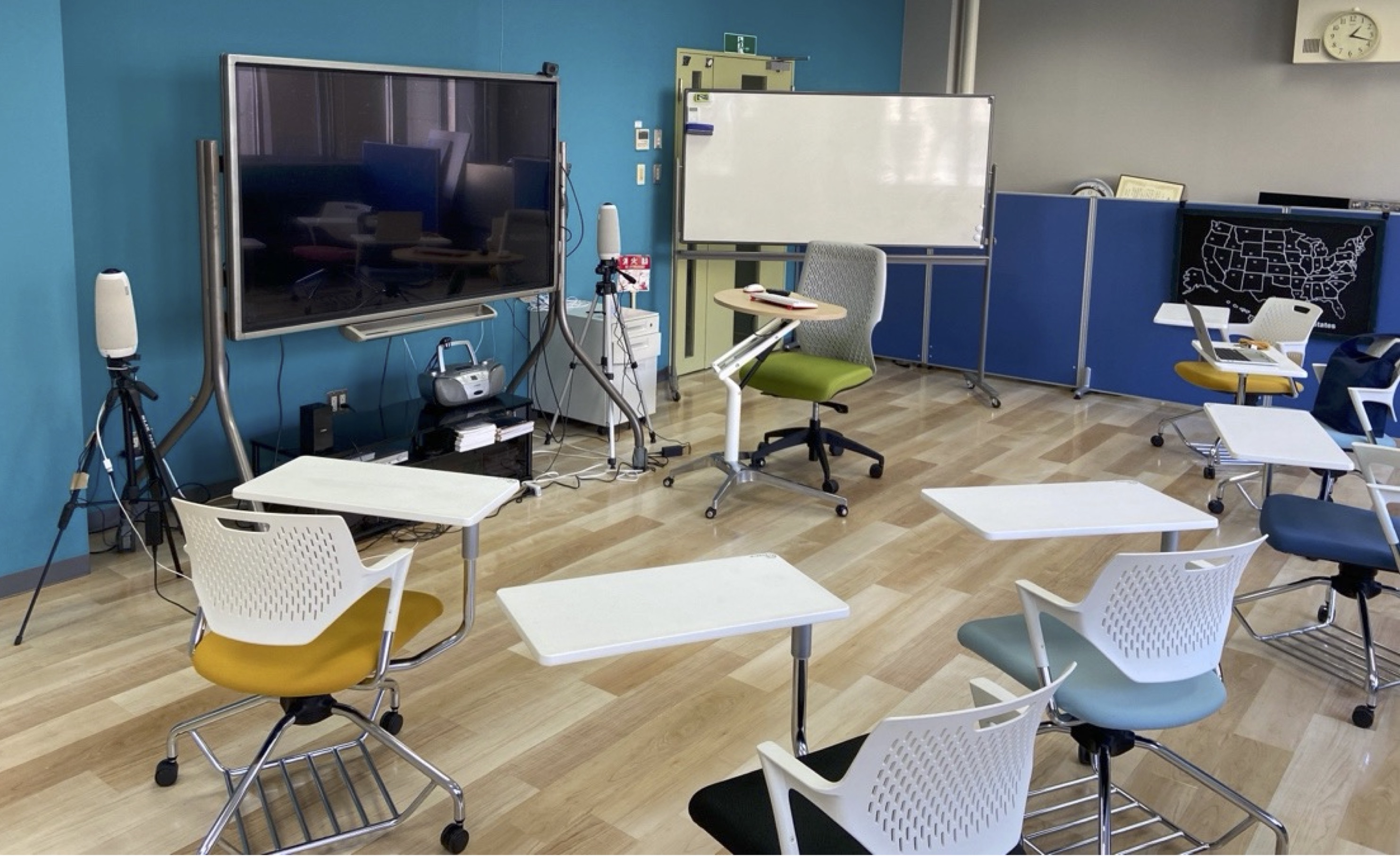
There are two main rooms in the English Lounge: a conversation space and a seminar room. The forums are held in the seminar room, which can hold about 15-20 students. A Sharp big pad is used as the projector in the room and there are many moveable desks on wheels (see Figure 1). Additionally, the forums are live-streamed online through Microsoft TEAMS, and they are also accessible as on-demand videos for viewing after the event. Any student, faculty member, or office staff at the university can access these recorded videos. The language used in the lectures is English, Japanese, or a mixture of both. Speakers can choose whichever language is most comfortable for them, and often the case is that they switch between both languages while observing the reaction of the attendees. Sometimes printed handouts are provided.
Figure 1
The Seminar Room in the SALC Where the EL Forums Are Held
Before 2022
In the past, The English Lounge hosted various types of cultural presentations by international students, introductions to study abroad programs by visiting lecturers, and career development lectures by businesspeople since its establishment in 2012 (Nakamura, 2015). The primary purpose of these early presentations was to promote study abroad programs at the university and provide a wider variety of language learning opportunities for students while they are on campus. A recent goal is to strengthen the connections between the Liberal Arts (LA) English education program and the SALC by encouraging students to participate in various activities there where they can practice their English skills outside of the classroom in a more casual and relaxed setting. Students have often viewed the SALC as a suitable place for those with higher language proficiency, while lower-level students often hesitate or even avoid using the facility. To facilitate the use of the SALC by lower-level students, Tada (2021) introduced a series of presentations geared toward all levels of language learners. The series was delivered online during the COVID-19 pandemic and represented a positive movement toward the integration of SALC activities and the LA curriculum. This lecture series motivated me and other faculty members to begin developing the English Lounge Forum the following year.
2022: The First Year of the English Lounge Forum
After 10 years of operation, management of the English Lounge was passed into the hands of the second generation of faculty members. Building on the previous managers’ efforts, we developed a presentation series called the English Lounge Forum, with an academic focus divided between the two pillars of language learning and cultural understanding. One of the goals in the SALC’s mission statement is to improve language learning skills and foster learner autonomy. Thus, the title of the first lecture series was “New Perspectives on Foreign Language Learning,” and we invited language teaching professionals from various departments at the university to talk about research-based learning approaches that students could include in their own study habits. A second goal of the SALC is to raise cultural awareness in the increasingly diverse Japanese society, and therefore, we developed the second series of talks called “International Hirodai.” Table 1 provides the full list of topics.
Table 1
English Lounge Forum Topics, 2022

As one can see in the list above, the presenters come from a wide range of departments, corporations, and faculties, which shows the flexibility of these forums to connect people across the entire campus and even beyond. The English Lounge does not belong to any of the traditional faculties on campus. Thus, it is important for us to proactively reach out to connect with the various departments. In practical terms, the lack of rooting in a faculty can be a point of vulnerability for the SALC, in that we must continue to demonstrate a need for the facility’s continued existence. At the same time, this lack of rootedness allows us to bring people together to share, collaborate, and provide effective and innovative learning opportunities for the students.
2023 English Lounge Forum
Since the start of the 2023 school year, the forum was unified into a single “English Lounge Forum” by eliminating the division between “New Perspectives on Foreign Language Learning” and “International Hirodai.” However, we continued to host presentations on the same three main topics: methods of language learning, understanding diverse cultures, and career development with a focus on language skills. The following table shows the breadth of topics from that year.
Table 2
EL Forum Topics, 2023
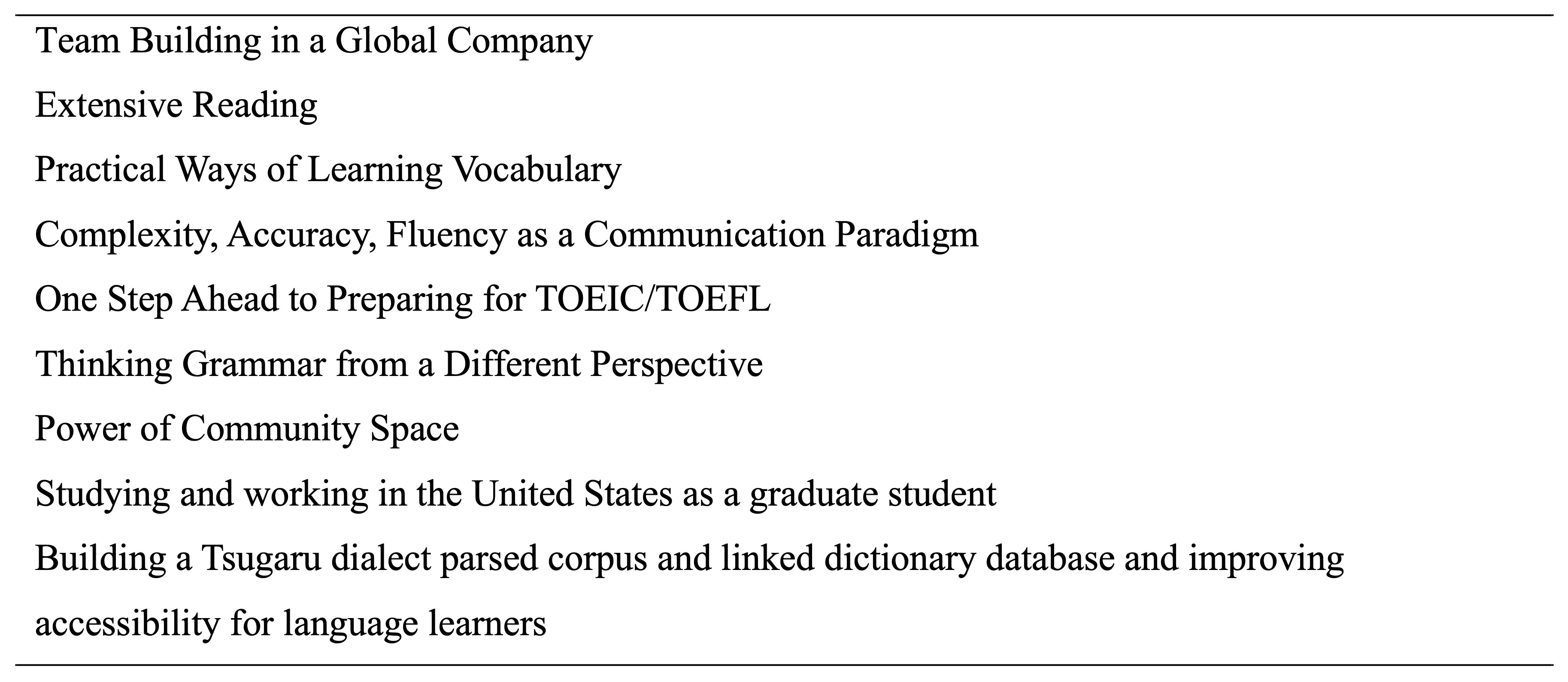
The lectures on a variety of topics pulled students from across the campus to the SALC. Involving the faculties is one way we can reach students beyond those highly motivated language learners who use the facility on a daily or weekly basis. Therefore, the goal is really to attract students who might not know about the SALC or are hesitant to enter it. Therefore, these forums follow the “push-pull” method of attracting students to the SALC as a place where they are pulled back by these events throughout the year.
2024 English Lounge Forum
For the most recent series, the core topic of learning methods stayed on the list. However, this year, we invited three new lecturers, including an office staff member who deals with international programs and a teacher who facilitates the multicultural resource room in the faculty of education (see Figure 2 for the full list in a poster format). This gave younger students an opportunity to learn about the official university study abroad programs and a chance to meet older students who had studied abroad. We hope this sets a precedent for future talks by office staff regarding their specialties, such as the students’ special support office and career support office. Finally, after several years of managing this program, we realized the importance of advertising to get students to become aware of these forums and to maintain attendance throughout the year.
The Need for Advertisement
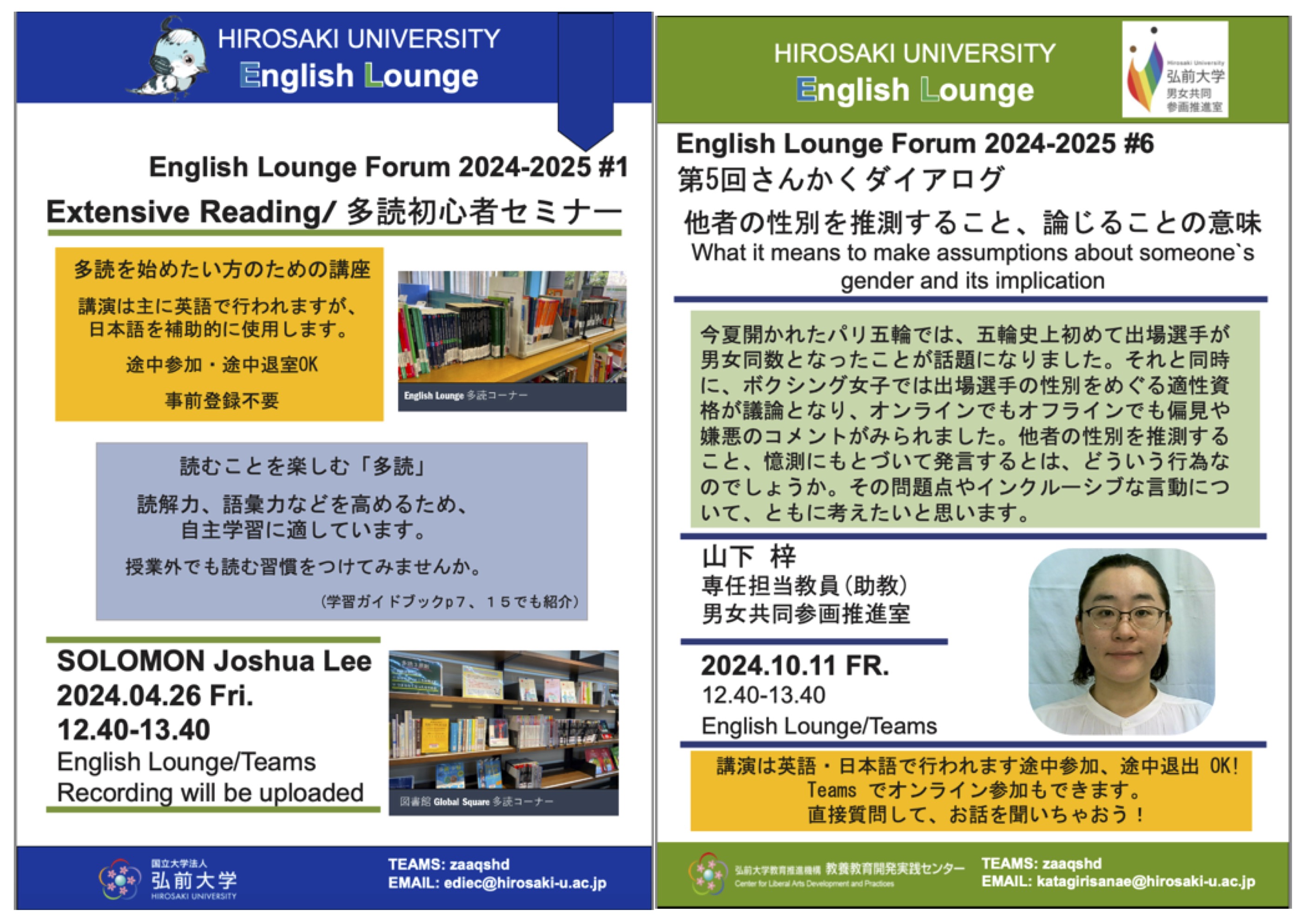
Over the last several years managing the forums, I realized the importance of broadly advertising them on campus. This is because they are held on an irregular schedule. For this reason, the date and time and the on-demand option must be emphasized in the advertisements. We employ a blended paper-digital strategy to inform potential participants of the EL Forum, including paper posters, Microsoft Teams announcements, the university electronic bulletin board (CampusSquare), and the SALC homepage. We also produce an annual overview poster (see Figure 2). As for individual forums, we use bi-color poster designs to indicate the content of the forum. For example, blue represents “learning methods” and green “cultural understanding” (see Figure 3 for an example of both types of advertisements). Special event schedules are always shared with Liberal Arts English teachers to announce in their classes. This is an important avenue for accessing a wide audience, as the first-year English classes have a mix of students from all the departments. However, one of the difficulties has been in explaining the purpose of the lecture series to the teachers and justifying the use of their class time to encourage their students to attend. E-mails are sent out at the beginning of the semester to inform the teachers, but we have found that personal contact and individual explanations, when possible, seem to be more effective. Such personal contact has also opened doors in the past to invite new speakers to present their own EL Forum.
Figure 2
Example of Annual Plan Poster for 2024
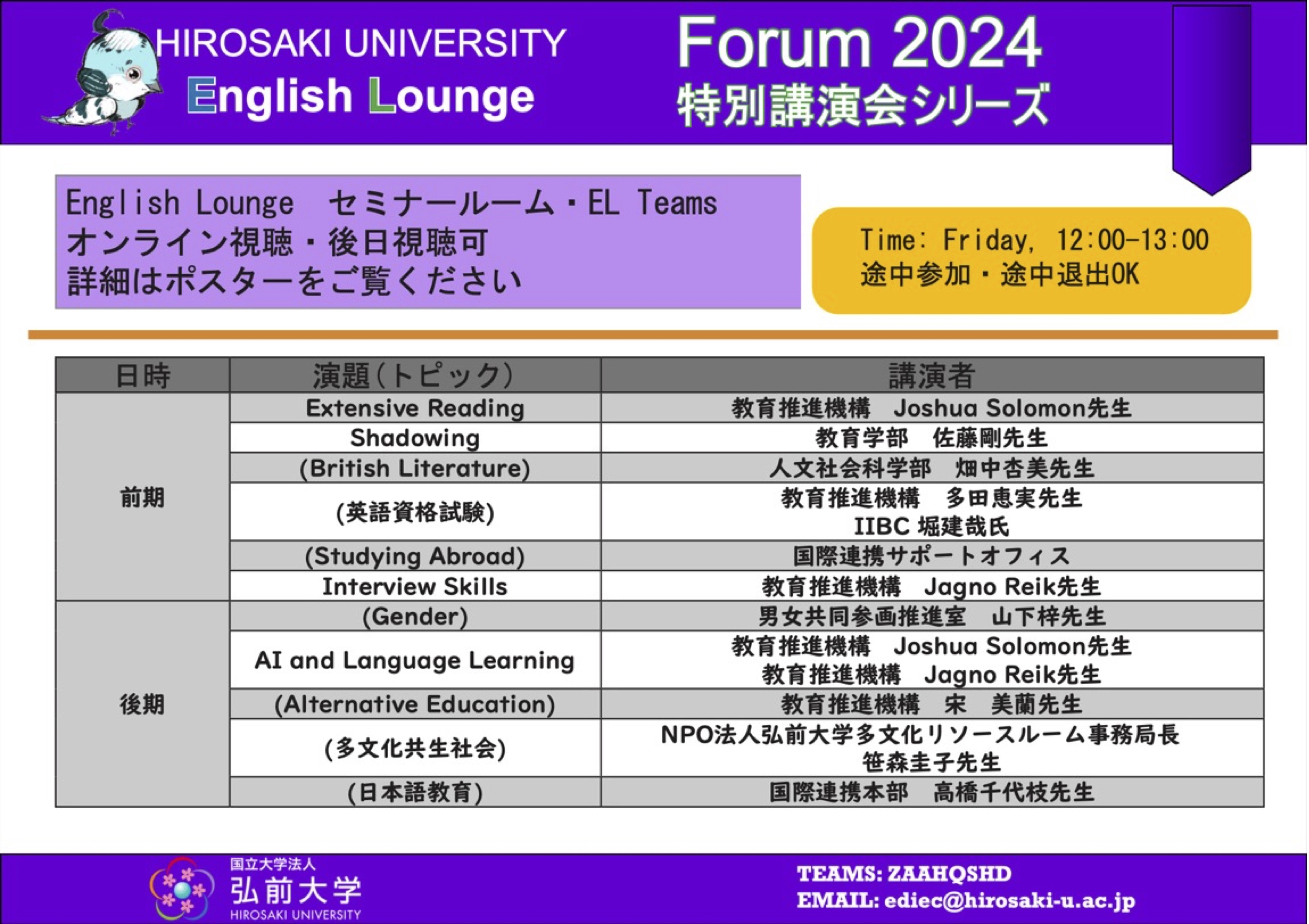
Figure 3
Example of Individual Forum Poster Designs
Data From the Forums
Method of Participation and Number of Participants
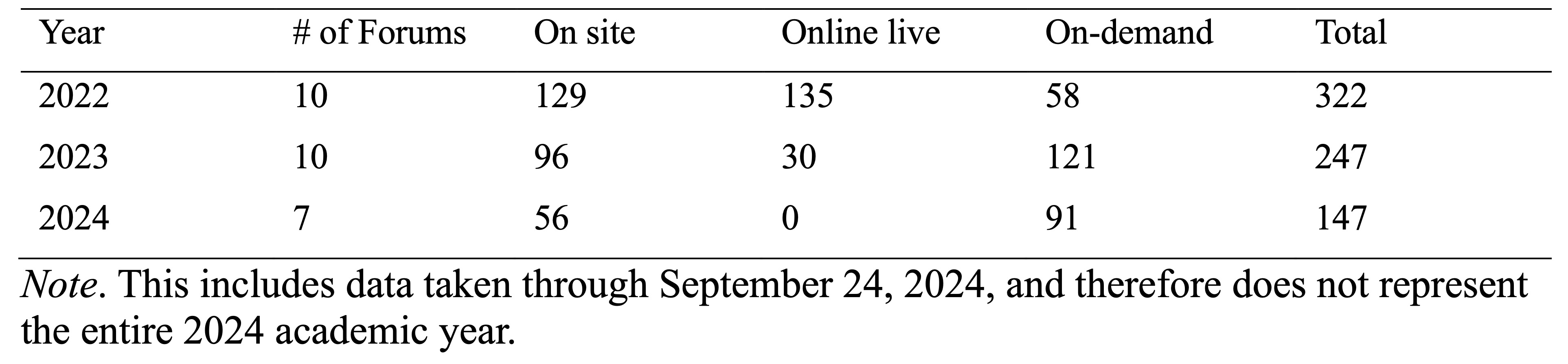
Speakers at the EL forums have the option to participate in two different ways. In some cases, the speakers have physically visited the English Lounge to give their presentations; in others, they have presented through a Microsoft Teams online meeting. One presenter was an alumnus who was working abroad, and another was an ex-colleague of a university faculty member from their time working for a large corporation. All the outside speakers presented online, so the transportation costs did not have to be considered. Beyond the financial advantage, an additional benefit of the online option is that students also can join online, which can be convenient for some. For example, The English Lounge is located on the university’s main campus, which hosts four of its five faculties, except for the School of Medicine. Coming to the main campus from the medical faculty takes about 20 minutes by bicycle. With only a ten-minute break time between classes, it is more realistic for students to stay on the medical campus and connect online. Another benefit of having online meetings using Teams is that it is easy to record the lectures and make them available on-demand. As for recording the EL Forum, a 360-degree camera (Meeting Owl) with a built-in microphone is used. This camera is adaptable for both traditional-style lectures and interactive presentations involving group work and Q&A sessions with the audience. English Lounge has its own Team with an “EL Forum” channel archiving videos for on-demand learning. The data below demonstrates a clear demand for these asynchronous lectures.
According to Table 3, the number of students who watch the video recordings is increasing, doubling from 2022 to 2023, and the trend seems to be continuing in 2024. One reason could be scheduling. For example, during the first year, the series occurred during the lunch break. Subsequently, a variety of different time slots were tried during different days of the week. The schedules of the speakers also needed to be adjusted, and this caused some confusion for the students. Beginning in the academic year 2023, the EL forum began to be held regularly during the first half of the third period (12:40-13:40). This means that the forum is held at the same time as other classes. A second possible reason is student awareness of the EL Forum. Since the academic year 2024, all the first-year students started being automatically added to the English Lounge Team, and this may also have contributed to the increase in views of the videos, which are only accessible through that platform. If students continue to demonstrate a desire for on-demand resources, we may be able to justify the development of an original archived lecture series for the university.
Table 3
EL Forum Attendance by Method of Participation
Diversity of Speakers
The facilitators of the EL belong to the Institute for the Promotion of Higher Education, whose main task is to plan, manage, and evaluate liberal arts education for the university. As Table 4 shows, some of the presentations have been given by members in this division. In addition, we have had presentations by faculty members specializing in language or literature belonging to the faculties of Humanities and Social Sciences and Education, as well as from the Department of International Education and Collaboration and Office for the Promotion of Gender Equality. We collaborated with these faculties because they have strong specializations in language education and were able to present research or projects they already had underway. As a result, we have been able to invite more professors from those faculties than from Science and Technology, Agriculture and Life Sciences, or Medicine.
Table 4
EL Forum Presenter Faculties, 2022–2024
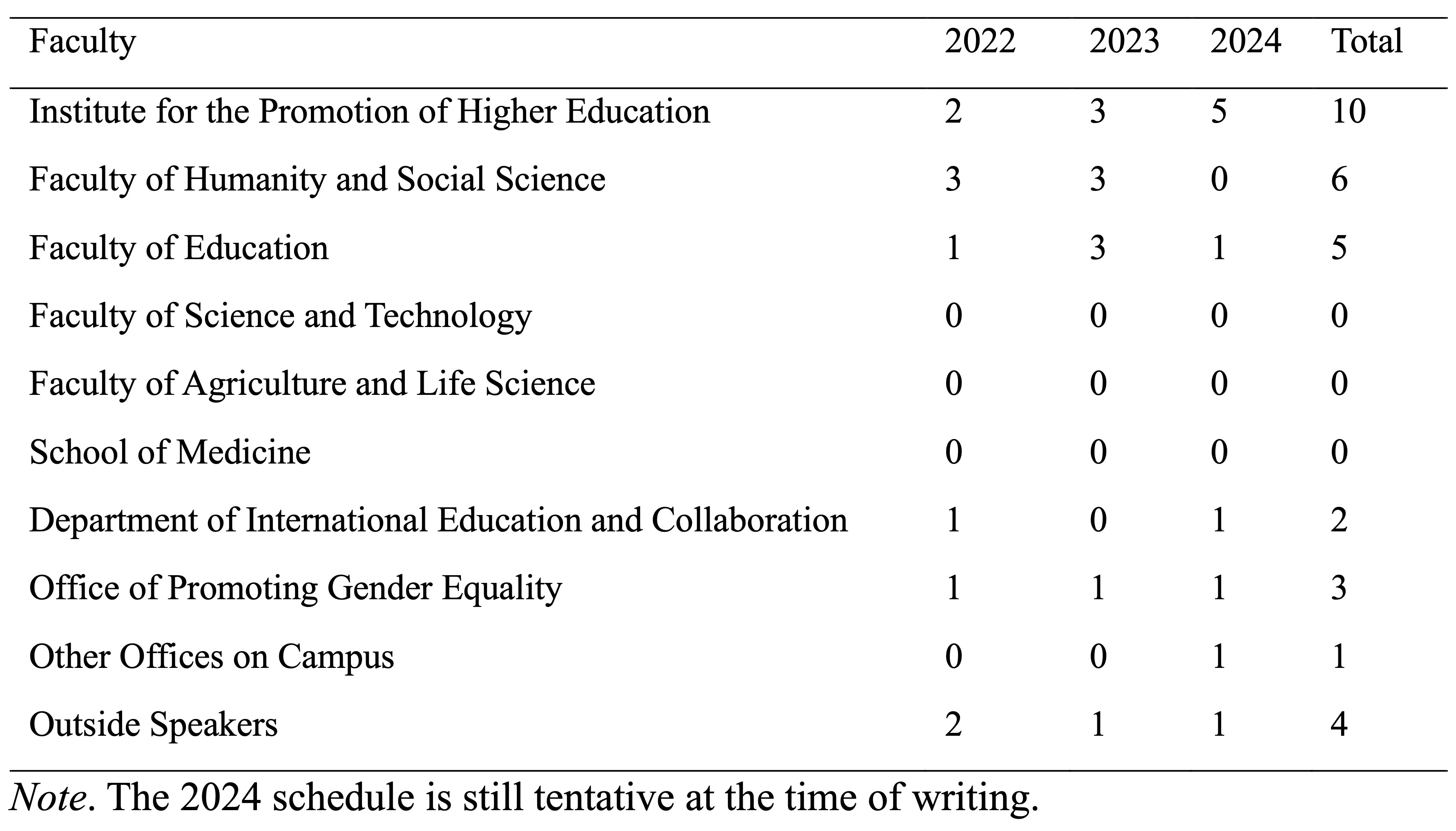
We have also had speakers from outside the university. For example, during the 2022 and 2023 academic years, a businessperson who has had a long career working in a globally renowned company that manufactures computer hardware spoke at an EL forum. This forum attracted many students not only due to his unique experiences, but also because his career path is a successful model for them. After our event, the speaker was officially invited to be a special lecturer in the university. Also, we annually host gender-related topics to deepen students’ understanding of these pressing social issues. These topics appeal to the students, and we have observed active discussion afterwards. Due to the success of these forums on gender-related topics, The English Lounge and The Office for the Promotion of Gender Equality have begun to cohost the “Sankaku Lounge,” a monthly space in the SALC for anybody in the university to use where they can discuss gender-related issues and feel safe to be whoever they want to be.
Feedback From Participants
From 2022, we started asking students to provide feedback after attending a forum to improve them in the future. Microsoft Forms was used to collect the data, and responses were voluntary. Three Likert scale questions were used in this survey. Question one asked how much the participant understood using a 5-point scale ranging from 1 (“0%”) to 5 (“100%”). On average, participants marked that they could understand over 75% of the content of these forums over the last 3 years (2022, N = 63, 4.27; 2023, N = 72, 4.39; 2024, N = 41, 4.51). Additionally, a second question asked if they are going to incorporate the method or knowledge that they learned from the forum into their lifelong learning using a 5-point scale ranging from 1 (“Not likely”) to 5 (“Highly likely”). On average, participants marked “likely” and above to this question over the last 3 years (2022, N = 63, 4.11; 2023, N = 72, 4.36; 2024, N = 41, 4.83). Finally, the last question using the same type of scale asked how likely they would recommend an EL Forum to a friend. Responses indicate that they would “likely” do this (data was not collected in 2022; 2023, N = 72, 4.31; 2024, N = 41, 4.63).
Besides the three Likert-scale questions, the survey also had an open-ended feedback item for students to share what they thought about the forum, topics that they are interested in for future forums, and ways that we could improve it. Based on this feedback, students indicated that the learning method forums (Shadowing, Vocabulary, and Extensive Reading) had the strongest impact on them and how they could apply these methods to their own learning. These positive comments motivated us to continue covering these same topics over several years. Moreover, students indicated that the forums by invited speakers who have experience in the field are highly appreciated. Students seem to seek out the opportunity to listen to talks backed by actual experience and research. Also, gender related talks attracted students, as they indicated a keen interest to learn about the issues related to diversity and equality. Some of the students commented that they wanted to have more opportunities to discuss these topics with other students. These comments are the reasons why we continue to invite a faculty member from the Office of Promoting Gender Equality to provide new perspectives that are current and relevant to our students.
Reflection and Future Directions
Over the three years of running the EL Forum, I have found that planning is one the most difficult aspects of the whole experience. To manage the EL Forum, one faculty member is the main organizer of the event, plans the schedule, invites the lecturers, negotiates the topics with the speakers, asks the speakers to provide abstracts for the poster, prepares questionnaires, uploads the recorded videos to the system, and takes care of all advertising. A second faculty member designs the posters and takes care of setting up the camera equipment for live streaming and recording. The other members involved in the EL help to search for potential speakers or give lectures themselves. In other words, to make such a forum series a sustainable endeavor in any SALC, a cooperative working environment among the various faculty and staff is critical.
It is a continuing challenge to broaden our network beyond language and education, but we feel that students would benefit from having speakers from the sciences talk about their experience using English in their respective fields, or experiences living abroad as a science major or conducting research overseas. By expanding the range of speakers in the future, we hope to appeal to students who might have never heard of the EL.
Notes on the Contributor
Sanae Katagiri is an assistant professor in the Hirosaki University Institute for the Promotion of Higher Education. She teaches in the university SALC and liberal arts English program. She plays an active role in managing the day-to-day operations of the SALC and developing reading materials for the facility. Her research interests include cooperative learning, teacher and learner autonomy, and classroom management.
References
Nakamura, H. (2015). Implementing a new English education program「新たな英語教育の取り組み」. In H. Nakamura, Y. Murayama, & M. Tada (Eds.), Hirosaki University’s International Education Center: English Education Group’s Activity Report (2012-2014). 「弘前大学国際教育センター 英語コミュニケーション部門活動報告書2012-2014年度」. Hirosaki University’s International Education Center「弘前大学国際教育センター」.
Tada, M. (2021). SALC for beginners: Establishing links with liberal arts classes. Journal of Liberal Arts Development and Practice, 5, 105–110
 SiSAL Journal