
Studies in Self-Access Learning Journal plans to publish a special issue on Navigating Constraints in Self-Access Language Learning in December 2026 (Volume 17, Issue 4).
Editors: Andrew D. Tweed and Bryan Buschner
Information for Potential Contributors
While constraints are a common feature of educational institutions, self-access language learning (SALL) presents its own set of distinctive challenges (e.g., Andersson & Nakahashi, 2019; Croker & Ashurova, 2012; Parsons & Warrington, 2020; Taube-Shibata & Lorentzen, 2023; Warrington, 2018). One broad concern relates to the difficulty of offering and sustaining successful language learning beyond the classroom. Unlike traditional classroom learning, SALL is characterized by considerable variation in approaches to learning, the spaces and resources used, the forms of support provided, and the types of assessment employed (Baker, 2022; Reinders & Lázaro, 2008). In addition, successful SALL programs depend critically on the alignment of key stakeholders, including students, teachers, self-access professionals, and university administrators. Differences in values and viewpoints may contribute to misalignment, leading to self-access initiatives that struggle to achieve their intended goals (Buschner & Tweed, in preparation; Wichayathian & Reinders, 2015).
We seek contributions for a special issue that focuses on navigating constraints in SALL. To better understand the complex nature of self-access—and to illustrate how SALL practitioners respond to challenges in their own contexts—this special issue invites work that examines both the constraints faced by self-access educators and the strategies they employ to navigate them. Some key questions to consider include:
- What constraints do SALL practitioners face?
- What strategies do SALL practitioners use to address constraints, and where do these strategies originate?
- To what extent are SALL practitioners’ efforts to navigate constraints successful?
Self-access takes many forms, ranging from modest, small-scale programs to well-resourced, comprehensive centers. There is also considerable variation across contexts in terms of:
- Learners and their needs
- Programs and resources offered
- Spaces used
- Organizational structure
- Budget allotments
- Administrative sophistication
- Educational support
Constraints may emerge in these and other areas. While some challenges are unique to particular self-access contexts, sharing approaches to navigating constraints can offer valuable insights for the wider SALL community.
Self-access involves both hierarchical constraints and constraints that cut across levels (Buschner & Tweed, in preparation). Together, these can present a diverse set of challenges for learners, educators, and staff seeking to create and sustain positive learning environments and programs. With this in mind, the following questions are also relevant:
- How do different constraints intersect with one another?
- What challenges arise when attempting to foster SALL under particular constraints?
- What factors limit efforts to navigate constraints in self-access contexts?
The editors invite submissions from colleagues engaged in navigating constraints in SALL. Successfully navigating constraints is often time-consuming, and contributors are therefore encouraged to write from different stages of this process. Some authors may focus on understanding their contexts and planning future actions, while others may report on the outcomes of strategies that have already been implemented.
Submissions may describe successful, mixed, or unsuccessful attempts to address constraints in self-access. Contributions may take the form of research papers, theoretical papers, and/or practice-oriented papers.
Themes related to constraints may include, but are not limited to:
- Institutions and policy
- Coordination
- Learner dispositions
- Teacher dispositions
- Time
- Place
- Use
- Resources
- Ecology
- Human-Centered Design
This special issue will include:
- Full research articles
- Summaries and works in progress
- Practice-oriented descriptions of approaches to dealing with constraints
- Perspectives (opinions and reflections)
- Reviews of events, academic books, articles, or website resources related to this topic
Submissions will follow the usual blind peer review process. Please refer to the following page for a detailed description of submission types and format:
https://sisaljournal.org/for-authors/submission-guidelines/
Deadline: June 1, 2026
Articles can be submitted via the usual channels outlined on the SiSAL Journal website: https://sisaljournal.org/
References
Andersson, S., & Nakahashi, M. (2019). Establishing online synchronous support for self-access language learning. Studies in Self-Access Learning Journal, 10(4), 323–338. https://doi.org/10.37237/100402
Baker, J. R. (2022). Going beyond brick and mortar self-access centers: Establishing a satellite activity self-access program. Studies in Self-Access Learning Journal, 13(1), 129–141. https://doi.org/10.37237/130107
Croker, R., & Ashurova, U. (2012). Scaffolding students’ initial self-access language centre
experiences. Studies in Self-Access Learning Journal, 3(3), 237–253. https://doi.org/10.37237/030303
Parsons, A., & Warrington, S. (2020). Have a look around: The effect of a ‘push’ activity on future SAS use. Studies in Self-Access Learning Journal, 11(1), 4–22. https://doi.org/10.37237/110102
Reinders, H., & Lázaro, N. (2008). The assessment of self-access language learning: Practical challenges 1. Language Learning Journal, 36(1), 55–64. https://doi.org/10.1080/09571730801988439
Taube-Shibata, J., & Lorentzen, A. (2023). Maker conversation: Successes and challenges in a university SALC. Studies in Self-Access Learning Journal, 14(2), 232–239. https://doi.org/10.37237/140207
Warrington, S. (2018). Push, don’t pull: One self-access centre’s struggle for an identity. Studies
Wichayathian, N., & Reinders, H. (2018). A teacher’s perspective on autonomy and self-access: From theory to perception to practice. Innovation in Language Learning and Teaching, 12(2), 89–104. https://doi.org/10.1080/17501229.2015.1103245
in Self-Access Learning Journal, 9(2), 147–155. https://doi.org/10.37237/090207
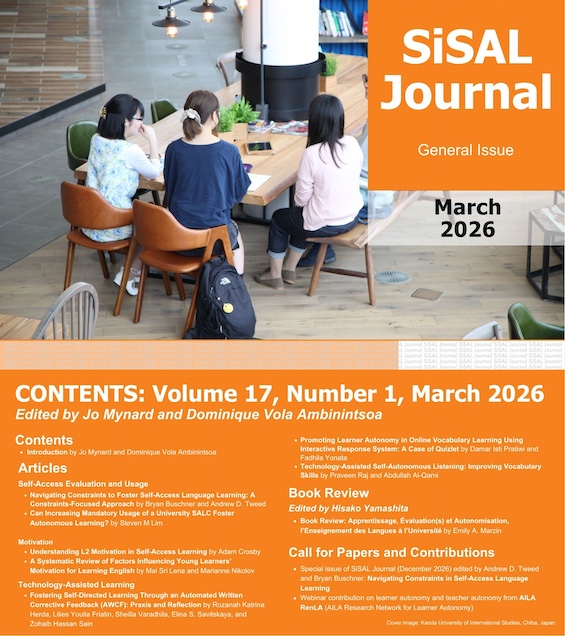
 SiSAL Journal