
SiSAL Journal is planning to publish a special issue on Teacher Education for Self-Access and Outside-Class Support in September 2025 (Volume 16, Issue 3).
Editor: Dominique Vola Ambinintsoa
Information for potential contributors
Learning beyond the classroom is essential for learners to succeed, as the opportunities within the classroom are often limited by time constraints and an inflexible curriculum (Richards, 2015). This highlights the importance of equipping students with autonomous learning skills through self-access and self-directed learning. To effectively promote these skills, it is ideal for teachers (and advisors) to have firsthand experience using them in their own learning (Little, 1995; Magno e Silva, 2018), or at the very least, to be aware of their benefits. Teacher education, therefore, plays a crucial role in fostering learner autonomy and also preparing (future) teachers to provide outside-class support.
This issue focuses especially on teacher education for outside-class contexts. Some key questions to consider include:
- How are (student) teachers prepared to offer students outside-class support?
- What can be done to help them promote self-access to better engage their (future) students with outside-class learning?
Teacher education extends beyond formal training at teacher training colleges. It also encompasses both formal and informal professional development through activities such as sharing, collaboration, and mentoring among colleagues. These processes contribute to teachers’ and advisors’ professional development or “continual growth” (Mercer & Gregersen, 2020, p. 5). Therefore, the following questions are also relevant:
- What practices can help teachers and advisors with their professional development so that they can help their students learn more effectively beyond the classroom?
- How are teachers and advisors supported in their role of fostering self-access learning?
- What are the roles of institutions in helping teachers and advisors promote self-access learning?
The editor invites submissions from colleagues who are involved in some way in supporting (future) educators in the promotion of learner autonomy, self-access, self-regulated, and self-directed learning. The papers can be research papers, theoretical papers, and/or practical papers. Themes may include (but are not restricted to):
- Promoting self-access in teacher education
- Advisor education
- Practices and tools for supporting teachers / advisors to promote self-directed learning
- Student teachers’ experiences with self-access
- Advisor educator-Advisor trainee relationship
- Training teachers for writing support
- Teacher or advisor peer mentoring for continuing professional development
- Issues related to outside-class support
This special issue will publish the following:
- Full research articles
- Summaries and works in progress
- Descriptions of practice and practical applications of research on advising
- Perspectives (opinions and reflections)
- Reviews of events, academic books, articles or website resources
Submissions will follow the usual blind peer review process. Please refer to the following page for a detailed description of submission types and format:
https://sisaljournal.org/for-authors/submission-guidelines/
Deadline for submissions: March 1, 2025
Articles can be submitted via the usual channels outlined on the SiSAL Journal website: https://sisaljournal.org/
References
Little, D. (1995). Learning as dialogue: The dependence of learner autonomy on teacher autonomy. System, 23(2), 175–181. https://doi.org/10.1016/0346-251X(95)00006-6
Magno e Silva, W. (2018). Autonomous learning support base: Enhancing autonomy in a TEFL undergraduate program. In G. Murray & T. Lamb (Eds.), Space, place and autonomy in language learning (p. 219–232). Routledge
Mercer, S., & Gregersen, T. (2020). Teacher wellbeing. Oxford University Press.
Richards, J. C. (2015). The changing face of language learning: Learning beyond the classroom. Relc Journal, 46(1), 5–22. https://doi.org/10.1177/0033688214561621
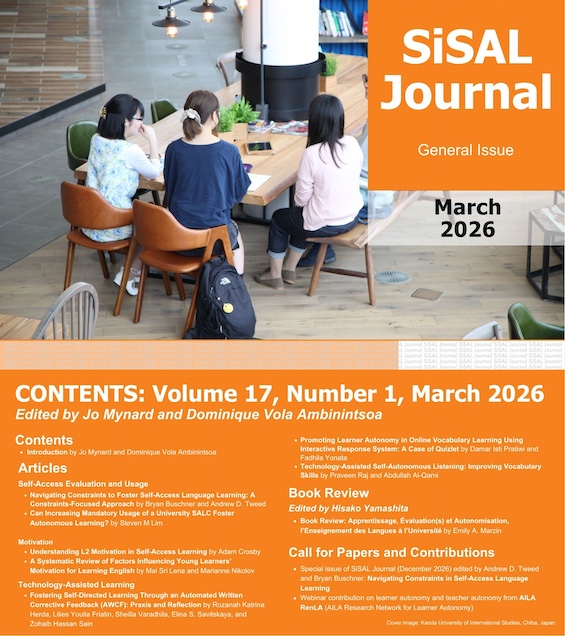
 SiSAL Journal