Haruka Ubukata, Kanda University of International Studies, Chiba, Japan. https://orcid.org/0009-0005-1902-1586
Emily A. Marzin, Kanda University of International Studies, Chiba, Japan.
https://orcid.org/0000-0003-2737-4945
Ubukata, H., & Marzin, E. A. (2026). Facilitating reflection using AI-generated visual representations of metaphors. Studies in Self-Access Learning Journal, 17(3), 415–439. https://doi.org/10.37237/170308
Abstract
Reflection plays a crucial role in self-directed learning (SDL), enabling learners to connect past experiences, understand present actions, and set future goals. Metaphors can support this reflective process by offering a way to conceptualize learning that may be difficult to express directly, particularly when affective dimensions are involved. As generative AI has become prevalent in educational settings, its application has been increasingly explored. However, research on AI use for supporting learners’ reflective processes in SDL remains limited. This study therefore investigated students’ experiences with a metaphor-based reflection activity that incorporates an AI text-to-image generator. Participants were 24 Japanese university students who engaged in SDL through Massive Open Online Courses (MOOCs). They created metaphors representing their SDL experiences and used OpenArt, a free online artificial intelligence (AI) text-to-image model, to generate visual representations. Data were collected through open-ended questionnaire items and analyzed using frequency counts and thematic analysis. Findings showed that AI-generated visual metaphors may provide an additional resource for reflective practice, while highlighting the need for scaffolding in metaphor creation, prompt writing, and critical evaluation of AI-generated representations. The study offers implications for educators exploring GenAI as a resource for promoting reflection.
Keywords: self-directed learning, reflection, metaphor, generative AI, text-to-image generation
The advancement of artificial intelligence (AI) technologies has brought dramatic changes in the way we live. They have a far-reaching impact, and education is no exception. As AI tools become increasingly embedded in educational settings, many students and teachers alike face the question of how to utilize them to maximize learning, along with more traditional materials. Recent developments in generative AI (GenAI), such as ChatGPT, are particularly notable for their ability to produce not only text but also images, expanding possibilities for creativity and productivity.
Reflection, a critical component of self-directed learning (SDL), often presents challenges for learners in articulating their thoughts and feelings in depth. AI’s capacity to provide visual representations based on written prompts may offer a means of lowering this hurdle by providing an additional way to express ideas that may be difficult to articulate solely through language. This study explored this possibility by examining how AI-generated images of students’ metaphors may support reflective processes, with a particular focus on perceived challenges and affordances. Specifically, we integrated OpenArt, an AI-driven text-to-image generator, into a metaphor-based reflective task focused on learners’ SDL experiences with Massive Open Online Courses (MOOCs). The findings provide empirical insights into the potential and limitations of AI-mediated reflection, contributing to ongoing discussions on the pedagogical role of GenAI in language learning.
Literature Review
Self-Directed Learning and the Role of Reflection
With the increased career changes and rapid technological advancement around the world, formal education has been placing its focus more on fostering SDL skills, instead of merely providing a set of knowledge (Botha et al., 2025; Francom, 2010). The concept of SDL first gained prominence in adult education in the 1960s and 70s, and became a central concept and practice in the field (Morris et al., 2025). It is described as “a process in which a learner assumes responsibility to control their learning objectives and means in order to meet their personal goals or the perceived demands of their individual context” (Morris, 2019, p. 634). Its multifaceted nature essentially involves all the “cognitive, metacognitive, affective, and social processes that govern learning” (Curry et al., 2017, p. 17). Individuals need to harness a range of skills to effectively take charge of their own learning, such as goal setting, choosing appropriate resources, monitoring progress, and evaluating outcomes.
One essential component that runs through all these phases of SDL is reflection (Thornton, 2010). It can be defined as “the intentional examination of experiences, thoughts and actions to learn about oneself and inform change or personal growth” (Mynard, 2023, pp. 23–24). It is a means to transform experiences into purposeful future action, guiding learners to raise awareness of what is going well and what needs adjustment in their learning process. The concept has been explored extensively in literature, with findings suggesting it brings considerable benefits to learners, including greater metacognition, increased self-awareness and control over learning processes, strengthened motivation and higher academic achievement (e.g., Boud et al., 2013; Kato & Mynard, 2016; Pemberton & Mynard, 2023).
At the same time, research indicates that reflection is not necessarily intuitive, and learners need ongoing support to develop reflective skills (e.g., Ambinintsoa & MacDonald, 2023; Marzin & Ubukata, 2025; Sampson, 2023). Learners’ reflective process could be facilitated by using cognitive tools (e.g., journals, questionnaires, charts and graphs) (Kato & Mynard, 2016). Classroom activities designed to foster reflective practice, which could be centered on using those tools, are also shown both as effective and perceived as useful by learners (e.g., MacDonald, 2023; Yamashita & Kato, 2012). These reflection tools and activities support learners in widening their perspectives and making connections between thoughts, feelings, and behaviors. However, research exploring how emerging AI tools might function as mediators within such activities remains limited. This study therefore brings together two strands of research in the context of SDL: the use of metaphor as a reflective tool and AI as a mediating technology. In the following, we review the concept of metaphor and use of AI technology, with particular attention to their potential roles in fostering reflective thinking.
Metaphor and Learning Process
Metaphors are “the characterisation of a phenomenon in familiar terms” (Dickmeyer, 1989, p. 151). From a conceptual metaphor perspective, they are not merely poetic language but rather provide a framework through which we understand abstract experiences (Lakoff & Johnson, 1980). In the educational context, they are seen as a useful tool to explore students’ understanding of learning, as they can “bring implicit assumptions into awareness, or encourage personal reflection, and as a result provide some insights into individuals’ perspectives on given topics” (Wan et al., 2011, p. 404). They help learners examine abstract or emotionally complex ideas, such as learning processes or feelings, by relating them to more concrete, familiar experiences (Kövecses, 2003).
Studies report that visual and linguistic metaphors function as cognitive scaffolds that enhance comprehension, regulate thought processes, and foster emotional engagement, motivation, and persistence, as well as support meaning-making and interaction (Buckley & Nerantzi, 2020; Wegner et al., 2020). Kato and Mynard (2016) highlight the value of encouraging learners to express their learning experiences by using metaphors. For example, they compare these two statements made by a learner: “I am tired because I cannot get things done as I want.” and “I feel like I am going against the moving walkway.” While expressing the same experience, a struggle in completing tasks in this case, the second statement captures and conveys the essential nature of the experience more distinctly. For example, learners may describe learning as “climbing a mountain” or “getting lost in a forest,” illustrating both the challenges they face and the gradual development of their understanding over time. Beyond describing progress, metaphors can also give shape to emotions that are otherwise difficult to name, such as anxiety, frustration, or excitement, by anchoring them in concrete images and actions (Kövecses, 2003).
Language learning is inherently an affective experience, involving a range of emotions intertwined with cognitive and social processes (Oxford, 2015). Opportunities to reflect on emotions in language learning thus offer a valuable experience for growth and transformation (Castro & Shelton-Strong, 2024). Although potential issues such as cross-cultural interpretation and the risk of oversimplification of complex ideas should be taken into consideration (e.g., Birdsell et al., 2019), metaphors allow learners to express their thoughts and feelings in a personally meaningful way, and they can serve as a useful tool for reflective practice.
Furthermore, when presented in a visual form, they can represent learners’ perspectives even more vividly and in greater detail (Farías & Veliz, 2016). One practical challenge of making use of metaphors, however, would be that not all learners may feel comfortable or confident with drawing. This practical consideration led us to explore the integration of GenAI into the classroom. Recent developments in GenAI may offer a potential means of addressing this issue by enabling learners to transform their metaphorical expressions into visual representations. Accordingly, in the following section, we review the current state of AI use in SDL.
AI in SDL
AI technologies are rapidly transforming education by offering tools that support personalization and improve learning performance (e.g., Wong & Viberg, 2024; Yunas et al., 2025). In the context of SDL as well, the development of GenAI models such as ChatGPT and Gemini are seen as a promising means to support learners. This is not surprising given that technology use in general has been shown to have a positive effect on the learning process and student engagement (Rashid & Asghar, 2016). According to the scoping review of 18 studies on GenAI and SDL by Roe and Perkins (2024), potential benefits of GenAI were reported in enhancing different phases of SDL, such as finding resources, setting goals, choosing strategies, and creating learning plans, although very few examined the reflective phase. GenAI can also provide instant, continuous feedback, which may help learners guide their learning process. Fostering learner motivation and interest is another positive effect that research suggested. Even though potential issues such as over-reliance, limited accuracy, not up-to-date information, difficulty of prompt-tuning, and monotonous output are consistently noted in multiple studies, overall, various benefits of utilizing GenAI are observed in facilitating SDL.
Advances in AI have extended beyond text-based applications. There are now text-to-image generators available, enabling users to create visual representations from written prompts. One study by Reed et al. (2023) suggested that creating a visual using AI can prompt self-reflection, helping learners to elaborate on their thoughts as well as feelings about their learning experiences.
At the same time, the use of such AI-driven tools require critical consideration of their limitations, including bias related to gender (e.g., over-representation of men in certain roles), race/ethnicity (e.g., dominance of light-skinned or white figures), culture and religion (e.g., European-looking religious figures in Bible-related context), age (e.g., dominance of young adult and middle-aged figures), body (e.g., a default of thin, conventionally attractive bodies, described as “aesthetic violence” by Vargas-Veleda et al., 2025), content and epistemic bias (e.g., scientifically, historically or contextually inaccurate representation) (Alon et al., 2026). Beyond representational concerns, to reiterate, the use of AI involves other challenges such as over-reliance, reduced opportunities for interpersonal interaction, ethical considerations, and learners’ digital literacy (Bonner et al., 2025). When integrating AI tools into classroom activities, educators need to be aware of their limitations, carefully consider their use, and guide students to work with AI-generated content critically (Wang et al., 2024).
Taken together, existing research seems to suggest that GenAI, despite its limitations and challenges, can provide learners with a valuable tool to facilitate their SDL. However, limited research investigates how it could be integrated into learners’ reflective processes. Given its capacity to generate visual representations, in the present study, we explored the use of an AI-driven text-to-image generator in a reflection activity where learners created metaphors of their SDL experiences and made visual representations with an AI tool.
Methodology
This exploratory study examined students’ reported experiences of a visual metaphor-based reflection activity that incorporated an AI tool. Data were collected through two open-ended questions in our questionnaire addressing these research questions (RQs):
RQ1: What challenges do students experience when using GenAI to create visual representations of their metaphors to reflect on SDL experiences?
RQ2: What affordances do students perceive in using GenAI in this reflection process?
In the following section, we outline the instructional context and participants, the integration of AI into a classroom activity, and the procedures for data collection and analysis.
Context and Participants
The study was conducted at a Japanese university that specializes in languages and cultures, where we, the authors of the present publication, work in the self-access learning center. Our university offers Content and Language Integrated Learning (CLIL) courses to enhance students’ academic, language, and cognitive skills. We taught one of those courses, in which students engaged in online learning using MOOCs, which are designed for a virtually unlimited audience online to provide access to various learning content, offered by renowned universities or other institutions, often free of charge or at a low cost (Voudoukis & Pagiatakis, 2022). Our CLIL course utilized MOOCs as a resource of SDL for students to learn about topics of their interest in their target language, English. During the first half of the semester, students learned about and developed SDL skills to guide their online learning (e.g., strategies for understanding lectures) through various classroom activities. In the second half, they pursued MOOC study of their chosen topic (e.g., education, marketing, psychology), which was reported and discussed through individual weekly journals and class discussion sessions.
The 24 Japanese students enrolled in our class had intermediate to advanced English proficiency levels. Participation in the study was voluntary and had no impact on course grades. All students provided consent.
Data Collection Procedure
The reflection activity in which we examined students’ experiences was conducted at the end of the semester, following a seven-week SDL with MOOCs. The 50-minute activity consisted of five stages. First, students were introduced to metaphors as a way of representing and reflecting on their learning experiences. We provided examples and guided questions, such as “If your language learning were a mountain, how big would the mountain be?” and “Where are you on the mountain?” to illustrate how metaphors could represent learning processes and emotions. Second, students individually created a metaphor describing their SDL, supported by an example on the worksheet (see Appendix A for the worksheet). Third, they adapted their metaphorical description into an OpenArt prompt. The worksheet instructed students to specify the subject, write in the third person, and describe the background, and provided a model prompt. Fourth, students generated an image with OpenArt and refined their prompts until satisfied with the result (see Appendix B for examples of students’ work). Finally, they responded to questions we created about their experience of using AI to visualize their metaphor. The activity therefore positioned students as the creators of the metaphor and integrated AI to generate its visual representation. We monitored students’ progress, answered questions, and provided support when needed, particularly during prompt refinement. Data was collected from participants’ responses to two of the questions provided in a handout (see Appendix C for all the questions we provided):
- Did you encounter any challenges in creating the prompt? Please explain.
- Was the tool useful for visualizing your MOOC learning?
Data Analysis
The two questionnaire items generated both quantitative and qualitative data. Responses to the closed-response component were counted and are reported as percentages in Figures 1 and 2. The quantitative data were not intended for statistical inference but rather for providing a descriptive overview of responses. Participants were also invited to explain their responses, and these explanations were analyzed qualitatively using thematic analysis. Specifically, following Braun and Clarke’s (2021) coding steps, we first familiarized ourselves with the data, generated initial codes, and looked for emerging themes. We then reviewed codes and themes, defined and summarized them to report them as findings.
Results
In this section, we present findings regarding the difficulties encountered during the AI-facilitated metaphor reflection activity and the tool’s usefulness reported by the participants. Pseudonyms are used to refer to individual students.
Challenges in Creating Prompts
To examine the challenges that students faced in visualizing their metaphor with the AI tool, we analyzed participants’ responses to the question, “Did you encounter any challenges in creating the prompt? Please explain.” Figure 1 shows the number and percentage of students who responded positively and negatively.
Figure 1
Students’ Answers Regarding the Challenges Experienced in Creating a Prompt
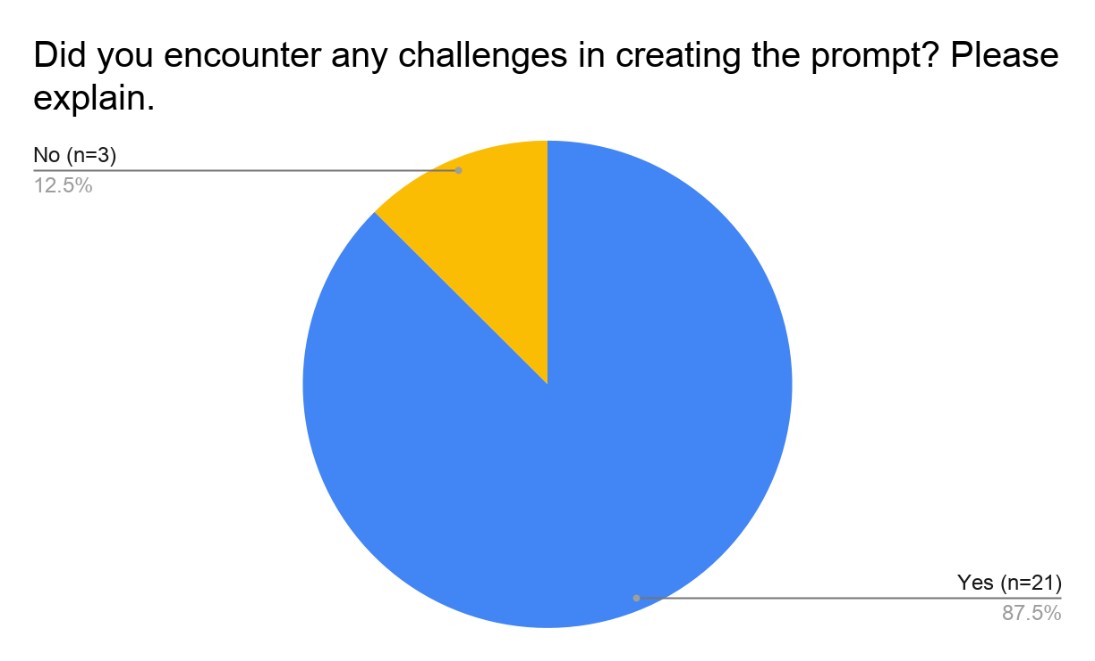
The majority of the 24 participants (21 students, 87.5%) experienced some challenges in creating a prompt for the AI tool to generate an image based on their metaphor. Several themes emerged from the analysis, as shown in Table 1 below.
Table 1
Challenges Students Described
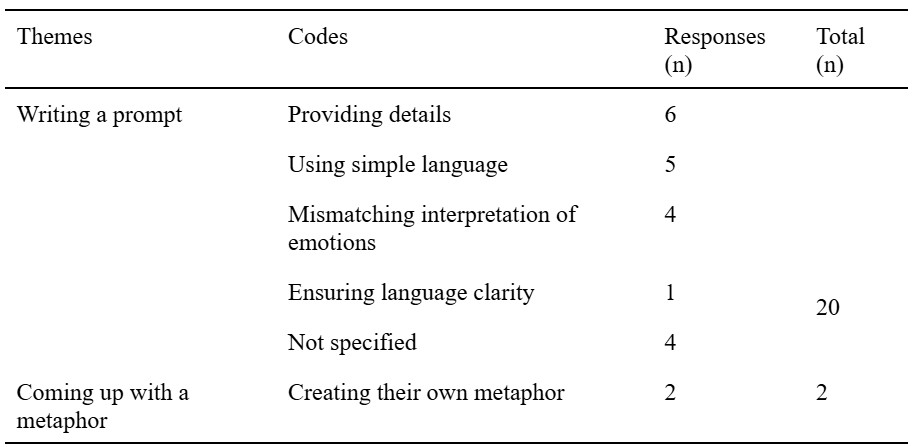
Note. The comments from 21 students yielded 22 codes, as one entry contained more than one code.
Writing a Prompt
Six students noted that providing details in their prompt was challenging. Four of these students seemed to realize the necessity of providing specifics in the process of using the AI tool. For example, “When I create this image, I have to write more details. At first, I didn’t write so I couldn’t get an image […]. So I fixed my sentence.” (Sae). There was one student who, while commenting on the challenge of writing a detailed prompt, highlighted the perceived difference between communication with other human interlocutors and that with AI: “I have difficulties explaining things that I don’t need explaining when communicating with humans. It was a little difficult for me to explain the details.” (Sogo). Similarly, Sayumi noted the necessity to distinguish what needs to be articulated for AI: “I have to think about whether [something is] a common understanding [or not] …” (Sayumi). Her response indicates that she was carefully considering what AI can and cannot understand without explicit information.
Another five students reported experiencing difficulty in reducing language complexity for AI. Saeko wrote, “I was puzzled to build grammar to try to make a simple one. I supposed AI couldn’t create the image with long sentences, so I tried short and detailed sentences.” Her comment suggests that she had an assumption that AI can work more effectively with simple language and thus attempted to adjust her English. Of the other four students, one expressed having the same assumption, and one indicated having the same perspective as the knowledge that she had gained before: “I know that if I write long sentences for a prompt, AI tends to make some mistakes” (Hina). The other two students seemed to have drawn the conclusion based on their experience during the class activity: “I put ‘the library was established recently’ first, but maybe AI didn’t understand it. So describe ‘the library is modern’ instead of it. I think AI tends to like simple sentences.” (Rumi).
Another code that emerged in students’ responses was difficulty in communicating emotions to AI, commented on by four students. They attempted to translate the emotions they encountered in their MOOC learning into their image, but AI did not always successfully reflect the emotions described. For example, one of the students, who described how her learning resembled being caught in quicksand, pointed out an oddity in the AI-generated image considering her context: “At first, the woman in the image had a smile. But I don’t think there are people who smile when they are caught in quicksand. So it was a little difficult to search for a different image.” (Fuka). While not all the students reported issues with this matter, those students’ accounts may raise questions about the extent to which AI tools can effectively support students with the emotional dimension of learning.
Finally, one student mentioned the importance of language clarity in a prompt: “In order to make art by AI, I have to describe my image more directly. It was kind of difficult, but when I could make a good explanation, the image completely matched with [the] image in my head” (Chika).
Coming up With a Metaphor
Even though the question explicitly asked about prompt writing for AI, two students commented on the difficulty in coming up with a metaphor to begin with. Riki wrote, “… I realized that metaphors broaden our expressions but at the same time, found it difficult to describe something by saying that it is like something else.” The challenge of the activity may lie not only in using AI but also in reflecting on their own learning through metaphor itself. If the question had asked about the overall activity, more students may also have reported this difficulty.
No Challenge Experienced
There were three students who responded that they did not face any particular challenge in generating an image using the AI tool. While one student did not provide any specific reasons or thoughts on being able to interact with the AI with ease, writing specifics seemed to be perceived as a factor in successfully using the AI image generator by the two other students. Saya reported, “I gave detailed instructions to the AI to make it closer to the image I had in mind.” Another student, Shota, commented on this point in relation to his own experience using AI. He wrote:
I have been using [an] AI image generator in our [seminar] so I didn’t face any challenges this time. I am familiar with how it works. Giving AI very very very specific information is the key to mak[ing] a great picture.
Existing research shows educational interventions can have significant impact on students’ AI literacy (Liu et al., 2026). We did not collect data on the specific training or instruction the student had received, but Shota’s response suggests that he had had some experience and gained the skill, allowing him to engage in the task without difficulty.
To summarize, the majority of students experienced challenges in writing a prompt to create an image with AI. Some struggled with using English effectively, and others found that AI-generated images sometimes did not represent the emotions they wanted to express. Still others expressed difficulty formulating a metaphor to describe their learning experience.
Usefulness of the Tool and AI-Generated Images
Participants’ feedback on the usefulness of the AI tool revealed varied responses, as illustrated in Figure 2.
Figure 2
Students’ Answers Regarding Their Perceived Usefulness of the AI Tool
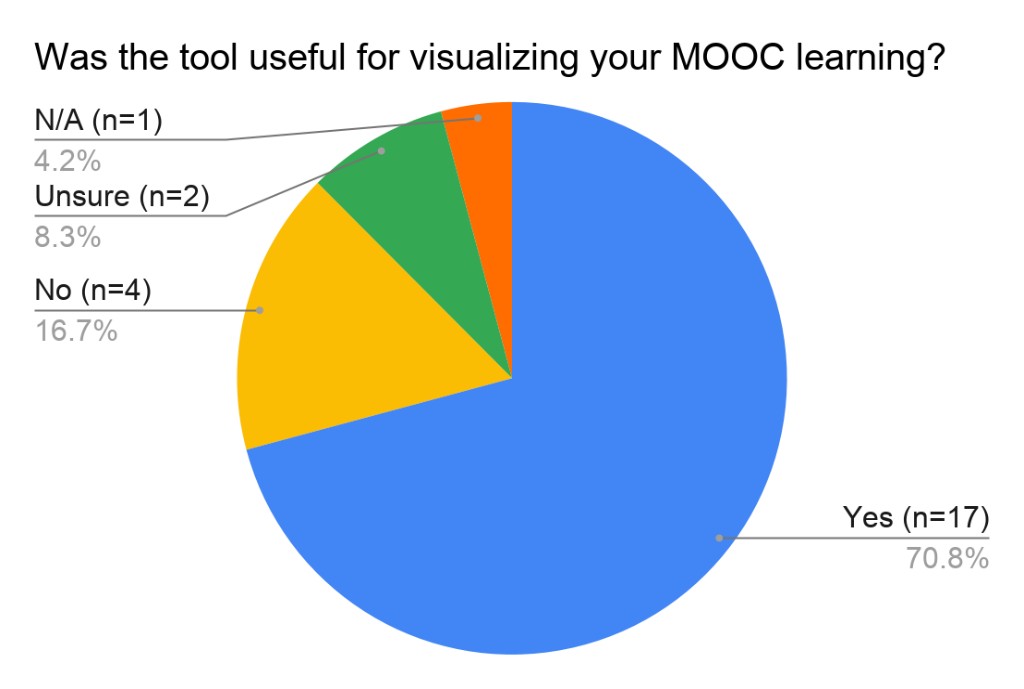
Despite the challenges many students faced, seventeen students (70.8%) found the tool helpful, noting that it supported reflection and clarified their thinking. Four students (16.7%) did not find it useful, two (8.3%) were unsure, and one (4.2%) provided no relevant answer. Analysis of the 17 students’ responses revealed four types of benefits, as shown in Table 2.
Table 2
Students’ Explanations of the Usefulness of the AI Tool
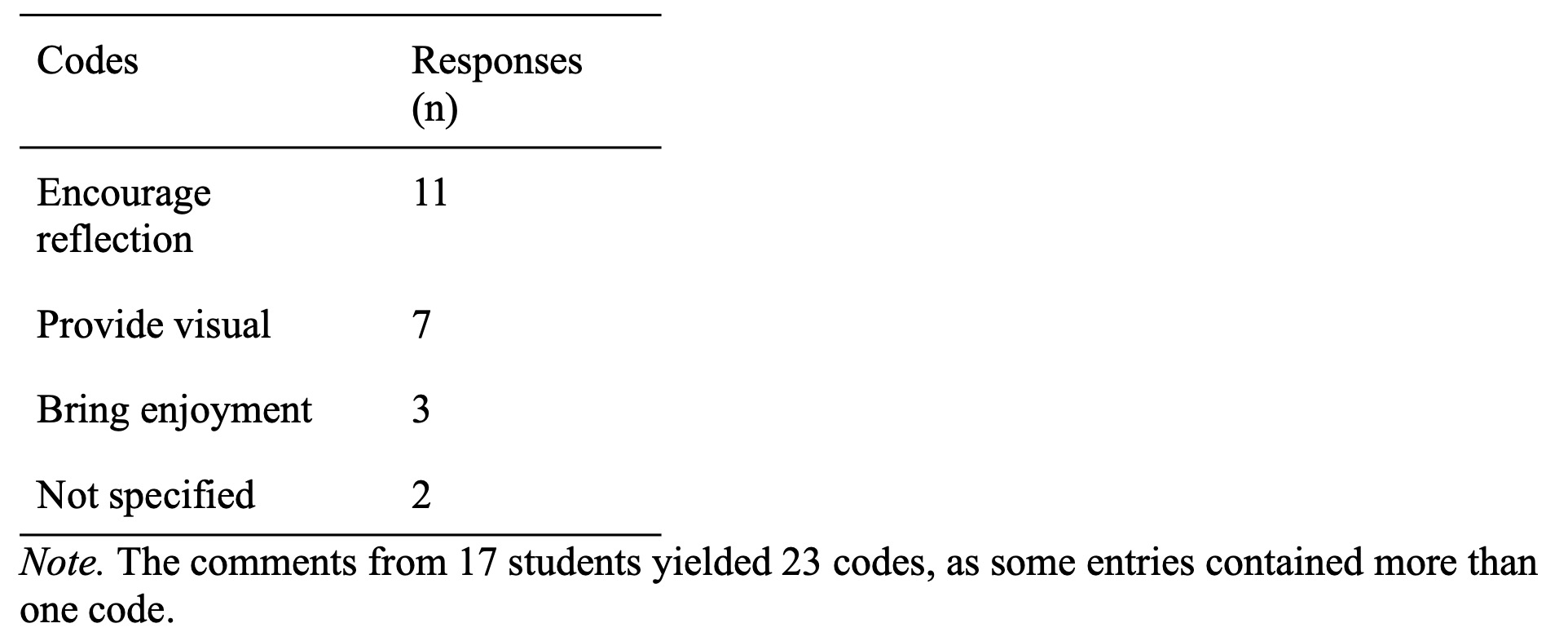
Eleven participants reported that the AI-image activity encouraged them to reflect more deeply on their SDL experiences. Here, the reflective benefit refers primarily to the process of creating the image, which prompted students to revisit, examine, and evaluate their learning experiences. Kaori, for example, commented, “It is really important to understand feelings for evaluating MOOC learning.” Similarly, Saeko explained, “[…] I can introspect by visualizing. Visualizing enables me to remember the milestones of studying. Also, I can come up with measurements for achieving my goals of studying.” These comments suggest that the act of translating their learning experiences into an image provided a prompt for introspection and self-evaluation, rather than reflection being attributed solely to the resulting image.
In addition to encouraging reflection, seventeen students valued the AI-generated images for providing a concrete visual representation of thoughts and feelings that could otherwise remain abstract. Himari explained, “I think it is useful because it makes my feelings and what I want to say [clear], and we can see people’s minds by images,” while Fuka commented that “[…] it makes my thoughts more realistic and detailed.” These comments highlight a distinct function of visualization: the resulting images helped students externalize, clarify, and make their internal experiences more tangible. Although these images were not necessarily perfect, students still valued them to some extent, suggesting a positive view of the resulting visual representations through which their thoughts and emotions could be articulated and examined.
Beyond their reflective and cognitive benefits, AI-generated images also contributed to students’ enjoyment of the learning process. Three participants mentioned this feeling: “Making it visible is always fun” (Shota), “It was not stressful at all, and I could enjoy creating a prompt” (Seitaro), and “It was a really fun activity” (Masaki). Those comments highlight positive experiences. While this may partially be due to the novelty of using the AI-images for a reflection purpose as indicated by some students (e.g., “I had never used a tool like that before,” Riki), given that reflection can often be demanding, effortful work in practice, the enjoyment that AI integration can bring may be worth highlighting.
Finally, two participants acknowledged benefits from using AI-generated images. However, they did not specify how these benefits were linked to visualization. At the same time, it should be noted that a few students mentioned a need for practice or guidance on how to use the tool, as Shizuka explained, “it is important to use it correctly. Some classmates couldn’t create a picture that matched the image in their minds. AI isn’t always right, so I want to use it wisely in the future.” There were also students with a more neutral attitude, saying they could already visualize internally without AI. Kotoha said, “There is no need to actually create an image.” Overall, however, participants’ reflections on using AI-generated images to visualize their MOOC learning were largely positive, with students describing the tool as having helped them clarify thoughts and make abstract ideas more tangible, though not uniformly across learners.
Discussion
RQ1: What Challenges do Students Experience When Using GenAI to Create Visual Representations of Their Metaphors to Reflect on SDL Experiences?
The results showed that most students experienced challenges in creating an effective prompt to generate an image with AI. Difficulties L2 learners may face in creating effective prompts and the importance of guidance in this regard are reported in the existing literature (e.g., Warschauer et al., 2023). Additionally, research suggests that prior knowledge of the learners can successfully facilitate the continued use of AI resources in SDL (Younas et al., 2025). In our study, it was also observed that prior experience and knowledge of AI could be attributed to success in effectively engaging with an AI tool. Overall, our findings build on earlier studies, supporting the value of providing opportunities for students to learn about and practice with AI tools.
As Sogo noted, learners must articulate “the details that aren’t normally necessary with humans.” This goes beyond prompt wording: identifying assumptions that would remain unstated with a human interlocutor engages metacognitive processes central to SDL (Curry et al., 2017) and reflection, as the intentional examination of one’s thoughts and assumptions (Mynard, 2023). Students’ difficulty communicating with AI would therefore itself provide an opportunity for self-examination. Questions such as “What did the AI misunderstand?” and “What did I assume it would ‘just know’?” would be useful to recognize the gap between shared human understanding and machine interpretation. At the same time, such examination could extend to consider what they usually assume their human interlocutors understand without explicit explanation. Interaction with AI may encourage students to make otherwise implicit assumptions visible. Instead of viewing the challenge of conveying ideas to AI as a mere limitation, educators and learners may consider its potential to serve as a trigger for further reflection and metacognitive engagement.
A related challenge, reported by a small number of students, was the difficulty generating a metaphor. While some metaphors are lexicalized in our language (e.g., LIFE IS A JOURNEY), others involve more creative use of metaphor, for example by making a new mapping between two elements or bringing more detail into a conventional metaphor to introduce new perspectives, which are suggested as particularly useful in describing more personal, idiosyncratic emotional experiences (Turner & Littlemore, 2023). Creative metaphor production is argued to involve the ability to move beyond conventional associations and a motivation to seek unfamiliar, unique connections (Birdsell, 2018). While the collected data in the present study did not reveal the reasons for the students’ difficulty, it hints at the necessity of providing greater scaffolding and opportunities for students to experiment with metaphorical associations, as suggested by existing research (e.g., Zhou et al., 2022).
At the same time, it is important to acknowledge current limitations in AI’s ability to interpret natural language. Although GenAI technology has become increasingly capable of producing expressions that reflect human emotions, its accuracy remains uneven and varies across emotion types (Lomas et al., 2024). Thus, students’ difficulty conveying emotional content may be unsurprising. Considering the centrality of emotions in reflection, this could represent a significant disadvantage. However, the majority of students viewed their use of GenAI positively. From the students’ perspectives, the benefits they gained appeared to outweigh the limitations and challenges they encountered. With that in mind, we now turn to the affordances identified and consider their implications.
RQ2: What Affordances do Students Perceive in Using GenAI in This Reflection Process?
Regarding students’ impressions of the usefulness of AI-generated images, many found the tool valuable, especially for encouraging reflection. Participants’ comments revealed that responses of AI based on their own language served as a sounding board in a sense, useful in gaining a deeper understanding of and evaluating their own perspective.
In classroom settings, peer discussions are often used to support reflective processes (Curry et al., 2023). Although AI cannot replace the human element in fostering reflection (Mynard et al., 2025), our findings suggest generative AI tools can serve as an additional tool for meaningful reflection, enabling students to step back and view their thoughts objectively.
In addition, the playful nature of using the AI tool reported by students is noteworthy. Enjoyment is a key positive emotion in learning and is associated with well-being and engagement (Fredrickson, 2013). Literature highlights the importance of enhancing positive emotions because they can lead to broader perspectives, “widen[ing] the array of thoughts and actions that come to mind” (Fredrickson, 2001, p. 221). Activities, whether conducted in class or beyond the classroom, can be more effective when they evoke positive emotions. Particularly given the demanding nature of reflection, the potential for fostering a more positive attitude of students may be worth acknowledging as possibly enhancing learners’ engagement. As AI tools seem limited in addressing emotional aspects of learning, findings together may indicate that rather than treating AI-generated images as an accurate representation of their experience, teachers may position them as starting points for engaging students in a reflective process, providing an accessible and enjoyable entry point from which they can further examine their learning experiences.
Finally, we should note that not everyone found the tool particularly useful. Beyond prompt-wording difficulties, some students encountered mismatches between their intentions and the people, settings, objects, or cultural contexts depicted. This would reiterate the point that the usefulness of AI tools should not be taken for granted. Further research may investigate to what extent GenAI could be useful, especially when learners are given sufficient training, in providing images or other means for fostering reflection on SDL experiences.
Conclusion
The students’ response to this classroom activity showed that combining metaphor with AI-generated imagery can be a beneficial and creative way to reflect on their SDL experiences. Findings suggested that while students faced notable challenges—particularly in writing clear, specific prompts and conveying emotional nuances—AI image generation provided meaningful support for reflection by helping learners visualize and articulate abstract learning experiences. For many, the process appeared to encourage them to deepen their awareness of their learning and a degree of metacognitive engagement, adding an element of enjoyment to reflective work.
For language educators, the key pedagogical insight is how AI-generated visuals can function as reflective artifacts, or at least an accessible starting point for them, when paired with structured guidance. Effective implementation would require scaffolding through explicit instruction in prompt-writing, such as specifying detail, perspective, and background; prior considerations of differences between human and machine interpretation; and opportunities to extend reflection from the images generated by AI, which could take such a form as pair discussions.
The present study has several limitations. Its relatively small number and specific context limit the transferability of the findings to learners from different backgrounds and settings. The data also relied on students’ self-reported perceptions from a brief post-activity survey, rather than direct measurement of AI output or a comparison of reflective outcomes with and without the AI-generated image. Finally, as most participants were using an AI image generator for the first time, the reported outcomes may partly reflect a novelty effect. Longitudinal research or repeated use could help determine whether these effects are sustained over time.
In terms of the activity design, future implementations might include more structured prompt-writing guidance, peer feedback, and reflection on AI’s role as a learning partner, alongside larger and more diverse samples, and direct measures of reflective quality. With thoughtful design, AI could serve as a valuable addition to traditional reflective practices, enriching SDL experiences when used thoughtfully and in combination with human guidance.
Notes on the Contributors
Haruka Ubukata is a Learning Advisor at the Self-Access Learning Center at Kanda University of International Studies. She has completed the Learning Advisor Education Program at the Research Institute for Learner Autonomy Education. She holds an MSEd from Temple University, Japan Campus.
Emily A. Marzin is a learning advisor and a lecturer at Kanda University of International Studies, Japan. She completed a master’s in didactics at Jean Monnet University and an EdD at The Open University. Her research interests are self-directed learning and intercultural communication.
References
Alon, L., Hadar Shoval, D., & Levkovich, I. (2026). Bias and representation in AI generated text-to-image in education: A systematic review. Computers and Education: Artificial Intelligence, 10, 100587. https://doi.org/10.1016/j.caeai.2026.100587
Ambinintsoa, D. V., & MacDonald, E. (2023). A reflection intervention: Investigating effectiveness and students’ perceptions. In N. Curry, P. Lyon, & J. Mynard (Eds.), Promoting reflection on language learning: Lessons from a university setting (pp. 112–131). Multilingual Matters. https://doi.org/10.21832/9781800415591-011
Birdsell, B. (2018). Creative metaphor production in a first and second language and the role of creativity. [Unpublished doctoral dissertation]. University of Birmingham.
Birdsell, B., Tatsuta, N., & Nakamura, H. (2019). Making metaphors: A quantitative analysis of metaphor production and interpretation in Japanese using a multimodal task. In Proceedings of the 33rd Pacific Asia Conference on Language, Information and Computation (pp. 334–344). https://waseda.repo.nii.ac.jp/records/48097
Bonner, E., Lege, R., & Frazier, E. (2025). Beyond basics: A ten-lesson in-depth unit on generative AI for language students. JALTCALL Trends, 1(1), 2146. https://doi.org/10.29140/jct.v1n1.2146
Botha, A., du Toit-Brits, C., & Blignaut, J. H. (2025). Charting new pathways: Unleashing the potential of self-directed learning and the transformative role of teachers in education. Education Sciences, 15(5), 524. https://doi.org/10.3390/educsci15050524
Boud, D., Keogh, R., & Walker, D. (2013). Reflection: Turning experience into learning. Routledge.
Braun, V., & Clarke, V. (2021). Thematic analysis: A practical guide. Sage Publications.
Buckley, C. A., & Nerantzi, C. (2020). Effective use of visual representation in research and teaching within higher education, International Journal of Management and Applied Research, 7(3), 196–214. https://doi.org/10.18646/2056.73.20-014
Castro, E., & Shelton-Strong, S. J. (2024). Exploring emotions in language learning: Learners’ self-awareness, personal growth, and transformation on a CLIL course. Language Teaching Research. 1–22. https://doi.org/10.1177/13621688241267366
Curry, N., Lyon, P., & Mynard, J. (2023). Promoting reflection on language learning: Lessons from a university setting. Multilingual Matters.
Curry, N., Mynard, J., Noguchi, J., & Watkins, S. (2017). Evaluating a self-directed language learning course in a Japanese university. International Journal of Self-Directed Learning, 14(1), 17–36.
Dickmeyer, N. (1989). Metaphor, model, and theory in education research. Teachers College Record: The Voice of Scholarship in Education, 91(2), 151–160. https://doi.org/10.1177/016146818909100204
Farías, M., & Véliz, L. (2016). EFL students’ metaphorical conceptualizations of language learning. Trabalhos Em Linguística Aplicada, 55(3), 833–850. https://doi.org/10.1590/010318135146185751
Francom, M. G. (2010). Teach me how to learn: Principles for fostering students’ self-directed learning skills. International Journal of Self-Directed Learning, 7(1), 29–44.
Fredrickson, B. L. (2001). The role of positive emotions in positive psychology: The broaden-and-build theory of positive emotions. American Psychologist, 56(3), 218–226. https://doi.org/10.1037//0003-066x.56.3.218
Fredrickson, B. L. (2013). Updated thinking on positivity ratios. American Psychologist, 68(9), 814–822. https://doi.org/10.1037/a0033584
Kato, S., & Mynard, J. (2016). Reflective dialogue: Advising in language learning. Routledge. https://doi.org/10.4324/9781315739649
Kövecses, Z. (2003). Metaphor and emotion: Language, culture, and body in human feeling. Cambridge University Press.
Lakoff, G., & Johnson, M. (1980). Metaphors we live by. University of Chicago Press.
Lomas, J. D., Van der Maden, W., Bandyopadhyay, S., Lion, G., Patel, N., Jain, G., Litowsky, Y., Xue, H., & Desmet, P. (2024). Evaluating the alignment of AI with human emotions. Advanced Design Research, 2(2), 88–97. https://doi.org/10.1016/j.ijadr.2024.10.002
Liu, S., Lin, Z., Ng, O. L., Yang, Y., & Dai, Y. (2026). AI literacy interventions in education: A meta-analysis of effects and moderators. Educational Research Review, 52, 100813. https://doi.org/10.1016/j.edurev.2026.100813
MacDonald, E. (2023). Tools and techniques for helping language learners manage their target language use in the classroom. In N. Curry, P. Lyon, & J. Mynard (Eds.), Promoting reflection on language learning: Lessons from a university setting. (pp. 93–111) https://doi.org/10.21832/9781800415591-010
Marzin, E. A., & Ubukata, H. (2025). Exploring Japanese EFL learners’ reflection skills: Insights from their reflections on MOOC-based peer discussions. rEFLections, 32(3), 1515–1537. https://doi.org/10.61508/refl.v32i3.284872
Morris, T. H. (2019). Self-directed learning: A fundamental competence in a rapidly changing world. International Review of Education, 65(4), 633–653. https://doi.org/10.1007/s11159-019-09793-2
Morris, T. H., Bremner, N., & Sakata, N. (2025). Self-directed learning and student-centred learning: A conceptual comparison. Pedagogy, Culture & Society, 33(3), 847–866. https://doi.org/10.1080/14681366.2023.2282439
Mynard, J. (2023). Promoting reflection on language learning: A brief summary of the literature. In N. Curry, P. Lyon, & J. Mynard (Eds.), Promoting reflection on language learning: Lessons from a university setting (pp. 23–37). Multilingual Matters. https://doi.org/10.21832/9781800415591-005
Mynard, J., Shelton-Strong, S., Ambinintsoa, D. V., Marzin, E., Lee, E., & Takada, S. (2025, October 10). Considering the role of AI in advising language learners [Conference Presentation]. JASAL National Conference, Beppu, Japan.
Oxford, R. L. (2015). Emotion as the amplifier and the primary motive: Some theories of emotion with relevance to language learning. Studies in Second Language Learning and Teaching, 5(3), 371–393. https://doi.org/10.14746/ssllt.2015.5.3.2
Pemberton, C., & Mynard, J. (2023). Promoting and evaluating students’ development of self-directed language learning and reflective abilities. In N. Curry, P. Lyon, & J. Mynard (Eds.), Promoting reflection on language learning: Lessons from a university setting (pp. 150–166). Multilingual Matters. https://doi.org/10.21832/9781800415591-013
Rashid, T., & Asghar, H. M. (2016). Technology use, self-directed learning, student engagement and academic performance: Examining the interrelations. Computers in Human Behavior, 63, 604–612. https://doi.org/10.1016/j.chb.2016.05.084
Reed, J., Alterio, B., Coblenz, H., O’Lear, T., & Metz, T. (2023). AI image-generation as a teaching strategy in nursing education. Journal of Interactive Learning Research, 34(2), 369–399. https://doi.org/10.70725/729255gdiorw
Roe, J., & Perkins, M. (2025). Generative AI in self-directed learning: A thematic scoping review. Interactive Learning Environments, 1–12. https://doi.org/10.1080/10494820.2025.2603431
Sampson, R. (2023). Encouraging introspection on speaking performance in class: Findings from student reflections. In N. Curry, P. Lyon, & J. Mynard (Eds.), Promoting reflection on language learning: Lessons from a university setting (pp. 81–90). Multilingual Matters. https://doi.org/10.21832/9781800415591-009
Thornton, K. (2010). Supporting self-directed learning: A framework for teachers. Language Education in Asia, 1(1), 158–170. https://doi.org/10.5746/leia/10/v1/a14/thornton
Turner, S., & Littlemore, J. (2023). Literal or metaphorical? Conventional or creative? Metaphor and the Social World, 13(1), 37–58. https://doi.org/10.1075/msw.00028.tur
Vargas-Veleda, Y., del Mar Rodríguez-González, M., & Marauri-Castillo, I. (2025). Visual representations in AI: A study on the most discriminatory algorithmic biases in image generation. Journalism and Media, 6(3), 110. https://doi.org/10.3390/journalmedia6030110
Voudoukis, N., & Pagiatakis, G. (2022). Massive Open Online Courses (MOOCs): Practices, trends, and challenges for the higher education. European Journal of Education and Pedagogy, 3(3), 288–295. https://doi.org/10.24018/ejedu.2022.3.3.365
Wan, W., Low, G. D., & Li, M. (2011). From students’ and teachers’ perspectives: Metaphor analysis of beliefs about EFL teachers’ roles. System, 39(3), 403–415. https://doi.org/10.1016/j.system.2011.07.012
Wang, N., Wang, X., & Su, Y.-S. (2024). Critical analysis of the technological affordances, challenges and future directions of Generative AI in education: A systematic review. Asia Pacific Journal of Education, 44(1), 139–155. https://doi.org/10.1080/02188791.2024.2305156
Warschauer, M., Tseng, W., Yim, S., Webster, T., Jacob, S., Du, Q., & Tate, T. (2023). The affordances and contradictions of AI-generated text for writers of English as a second or foreign language. Journal of Second Language Writing, 62, 101071. https://dx.doi.org/10.2139/ssrn.4404380
Wegner, E., Burkhart, C., Weinhuber, M., & Nückles, M. (2020). What metaphors of learning can (and cannot) tell us about students’ learning. Learning and Individual Differences, 80, Article 101884. https://doi.org/10.1016/j.lindif.2020.101884
Wong, J., & Viberg, O. (2024). Supporting self-regulated learning with generative AI: A case of two empirical studies. In Joint Proceedings of LAK 2024 Workshops, Co-Located with the 14th International Conference on Learning Analytics and Knowledge (pp. 223–229). https://urn.kb.se/resolve?urn=urn:nbn:se:kth:diva-350557
Yamashita, H., & Kato, S. (2012). The wheel of language learning: A tool to facilitate learner awareness, reflection and action. In J. Mynard & L. Carson (Eds). Advising in language learning: Dialogue, tools and context (pp. 164–169). Pearson.
Younas, M., Abdel Salam El-Dakhs, D., & Jiang, Y. (2025). A comprehensive systematic review of AI-driven approaches to self-directed learning. IEEE Access, 13, 38387–38403. https://doi.org/10.1109/access.2025.3546319
Zhou, X., Younas, M., Omar, A., & Guan, L. (2022). Can second language metaphorical competence be taught through instructional intervention? A meta-analysis. Frontiers in Psychology, 13. 1–16. https://doi.org/10.3389/fpsyg.2022.1065803
Appendix A
Reflection Activity Worksheet
Explore your MOOC learning with metaphors
You will reflect on your MOOC learning journey and describe your experiences using a metaphor. A metaphor is a way of describing something through another object, action, or idea, and it helps you to be creative and widen your perspective.
Part A: Creating a metaphor
How is your MOOC learning going so far?
Use a metaphor and describe your MOOC learning in detail
Example:
| My MOOC learning is like climbing a mountain. I am wearing shorts and a T-shirt. It is sometimes sunny and other times rainy. However, I can see the sun shining on top of the mountain. The road is bumpy and difficult to walk on. I have a backpack filled with snacks and water. I am worried when the road seems challenging, but excited to get to the top! |
Your turn:
Part B: Writing a prompt for OpenArt
Edit your description above to create a prompt.
- Describe what you are (e.g. a woman)
- Write from a third-person perspective (e.g. He walks).
- Describe the view in detail (e.g. background).
Example:
| A guy is climbing a mountain. He is wearing shorts and a t-shirt. It is sometimes sunny and other times rainy. However, he can see the sun shining on top of the mountain. The road is bumpy and difficult to walk on. He has a blue backpack filled with snacks and water. He is worried when the road seems challenging, but excited to get to the top! |
Your turn:
Open https://openart.ai/create and paste your text into the ‘prompt’ section.
Click the ‘Create’ button. Paste the picture you created below.
Example:

Your image:
Appendix B
Examples of Students’ Metaphors and AI-Created Images
Student: Sogo
| Metaphor | Prompt for OpenArt |
| My MOOC learning is like baking a cake because I have basic ingredients and simple tools. These are vocabu[lary] and knowledge[s]. Sometimes, I struggle with the recipe and make mistakes, but I keep going because I can imagine the delicious cake at the end and I feel happy. The process requires a little patience, but I am excited to taste the final result. | There is a guy baking a cake in the kitchen. He has basic ingredients and simple tools. These are vocabulary and knowledge. Sometimes, he struggles with the recipe and makes mistakes. Also, the process requires a little patience. But he keeps going because he is looking forward to biting the cake. |
Generated Image:

Student: Rumi
| Metaphor | Prompt for OpenArt |
| My MOOC learning is like walking in the big library. It was established recently. I am wearing glasses. It’s very quiet there, everyone focuses on something. Variety books and big windows there. I feel it is difficult to find what I want to read due to many books. However, when I find it, I can focus in a great environment. If I borrow the book, I can read it everywhere. Don’t need money to do it. When I got bored, I can always change the book. | There is a young cute woman walking in the big library. She is wearing glasses. The library is modern. It’s very quiet there, everyone focuses on something. Variety books and big windows there. She feels it is difficult to find what she wants to read due to many books. However, when she finds it, she can focus in a great environment. If she borrows the book, she can read it everywhere. Don’t need money to do it. When she get bored, I can always change the book. |
Generated Image:

Student: Hina
| Metaphor | Prompt for OpenArt |
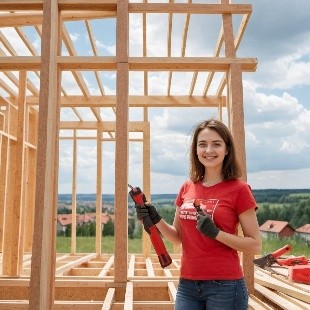
| My MOOC learning is like building a house. I am considering what materials are the best for my house. It is hard to make the base of the house. I just started building the framework of the house. The weather is almost sunny but sometimes cloudy or rainy. I am wearing a T-shirt. I have a toolbox for architecture and there are snacks, water, and towels. I sometimes feel scared to challenge building high places. However, I am excited to complete it. | There is a woman building a house. She is wearing a t-shirt. She has a red box with tools for architecture. She looks happy. The weather is sunny with few clouds. The house is only framed with wood. The house just finished frameworks. |
Generated AI Art:
Appendix C
Handout for Students to Share Their Thoughts on Using the AI Tool
1. Is the AI-generated version of your metaphor close to the image you had in your head? Please explain.
2. Did you encounter any challenges in creating the prompt? Please explain.
3. Was the tool useful for visualizing your MOOC learning?
4. Would you use this AI tool in the future? For what purpose?