Christine Pemberton, Kanda University of International Studies, Japan, https://orcid.org/0009-0006-2935-9182
Emily A. Marzin, Kanda University of International Studies, Japan. https://orcid.org/0000-0003-2737-4945
Sina Takada, Kanda University of International Studies, Japan. https://orcid.org/0009-0006-4950-0104
Pemberton, C., Marzin, E. A., & Takada, S. (2026). Emotional and behavioral insights and impacts from a digital reflective tool for learning advisors. Studies in Self-Access Learning Journal, 17(3), 335–361. https://doi.org/10.37237/170305
Abstract
While several studies have examined the use of reflective tools to enhance the well-being of teachers and other helping professionals, little research exists on their use with learning advisors (LAs). To address this gap, we developed EmotioNote, a digital application-based tool, based on Gibbs’ Reflective Learning Cycle (1988) and incorporating Brackett’s (2025) Mood Meter, refined through multi-stage piloting. This study examined the perceived influence of EmotioNote on the emotions and advising practice of six LAs at Japanese university self-access centers. Using a multi-stage mixed-methods design, participants used the application multiple times to reflect on advising sessions within a semester. A post-intervention survey collected quantitative and qualitative responses, followed by optional interviews. The qualitative data from both the surveys and interviews were thematically analyzed to explore the reasons behind the quantitative results. Results indicate that the application facilitated deeper awareness of emotions and advising behaviors and prompted concrete adjustments to practice. These findings suggest that the development and refinement of digital reflective tools like EmotioNote offer a practical framework to scaffold the reflective process of LAs. EmotioNote serves as an innovative, adaptable instrument with implications for LA training and professional practice.
Keywords: advising in language learning, reflective practice, reflective tool, virtual application, SDG 3: Good health and well-being
The United Nations Sustainable Development Goal 3, to “Ensure healthy lives and promote well-being for all at all ages” [United Nations General Assembly, 2015], has drawn attention to the mental health of educators. While research on well-being in academic settings has increased over the past two decades, studies in English as a foreign language contexts remain scarce and focus largely on teachers rather than other staff supporting learner development (Ebadijalal & Moradkhani, 2022; Li, 2021; Morris & Mercer, 2019; Pentón Herrera et al., 2023). One underexplored group is learning advisors (LAs).
LAs work primarily in self-access learning centers (SALCs) in higher education. Originating from Europe’s learner autonomy movement, SALCs now operate worldwide, particularly in Japan since the late 1990s (Dam, 2023; Gardner & Miller, 2021; Mynard, 2016). Defined as “person-centered social learning environments that actively promote language learner autonomy both within and outside the space” (Mynard, 2019, p. 186), these facilities differ in structure and pedagogy (Thornton et al., 2021), and a vast majority depend on LAs to foster students’ autonomy, confidence, and motivation. LAs routinely address learners’ emotions using tools like the Motivation Graph and the Confidence Building Diary (Kato & Mynard, 2016). Although a growing body of research has explored language advisors’ roles, identities, and experiences (Tassinari, 2017), there is no widely adopted tool for LAs to reflect on their own emotions. Recently, advisors’ reflective practice on their emotional experiences during advising has pointed to the importance of advisors’ emotions (Marzin et al., 2022).
In other helping professions, practitioners are often encouraged to engage in structured reflection to better understand how their thoughts, emotions, and experiences influence their professional practice. For example, Thompson and Thompson (2018) recommend techniques including chunk up, chunk down (shifting between detailed and big picture perspectives), the RED approach (recognizing, evaluating, and dealing with conflict), think-feel-do (intentionally focusing on thoughts and feelings rather than just actions), and mind mapping (visually depicting interconnected ideas and issues) for those working in social work and related fields. The use of reflective journals, professional development plans, and portfolios has also been explored for health service and business professionals (Bolton, 2010; Moon, 2006). These approaches suggest that structured reflection can support greater self-awareness and intentionality in professional interactions. However, comparable tools for supporting reflection on advisors’ emotional experiences remain largely absent from the learning advising literature. The present study addresses this gap by introducing EmotioNote, a digital reflective tool designed to help LAs explore their emotions and behaviors in advising sessions (https://emotionote.web.app/), intending to enhance self-awareness and intentionality in practice.
Theoretical Background
Advising in Language Learning
While the role of LAs varies depending on the context, Carson and Mynard (2012) describe LAs as educators who help advisees become more effective and autonomous language learners. A prominent model, transformational advising, seeks to challenge learners’ beliefs, foster metacognitive awareness, and promote action toward meaningful change in learning (Kato & Mynard, 2016). Typically conducted in an advising room or SALC, advising draws heavily from language teaching and humanistic counseling, especially with its non-directive approach and focus on self-actualization and autonomy (Carson & Mynard, 2012). It also incorporates strategies and tools from life coaching, emphasizing goal-oriented action (Kato & Mynard, 2016; Starr, 2011; Whitworth et al., 2007). Through intentional reflective dialogue (i.e., guided conversations that promote metacognitive awareness), LAs help learners identify goals, select resources, and monitor progress, while also providing emotional support and raising awareness of the learning process (Kato & Mynard, 2016; Carson & Mynard, 2012).
Carson and Mynard (2012) describe advising as a relatively new field still “in the process of defining itself” (p. 6) with no single unifying theory. Since then, advising has become more established through the development of Intentional Reflective Dialogue and transformational advising (Kato & Mynard, 2016). Mynard (2020) revised the Dialogue, Tools and Environments Model and proposed stronger links between advising and Self-Determination Theory through autonomy-supportive advising. These developments have provided a more established conceptual foundation and shared terminology for advising research and practice. Recent work has also expanded the field’s focus to include the impact of AI on self-directed learning (Dizon, 2026; Lashari & Umrani, 2023; Li et al., 2024), the use of AI as an advisor training tool (Takada et al., 2026), and a greater emphasis on diversity and inclusion (Pemberton, Marzin, et al., 2023; Watkins et al., 2023), reflecting the field’s continued evolution.
Impacts of Emotional Intelligence on Well-Being for Educators
Emotions and emotional intelligence are vital aspects of educators’ well-being. Figure 1 presents a conceptual model illustrating how emotional intelligence supports self-efficacy, problem solving, positive relationships, and reduced burnout, thereby enhancing overall well-being and professional effectiveness, developed by the authors to summarize the relevant literature as explained in the following sections. Due to limited research specifically addressing advisors’ well-being and emotions, literature on teachers is used to offer insights into the areas that appear relevant to advisors.
Figure 1
Conceptual Model of Educator Emotional Intelligence and Well-Being
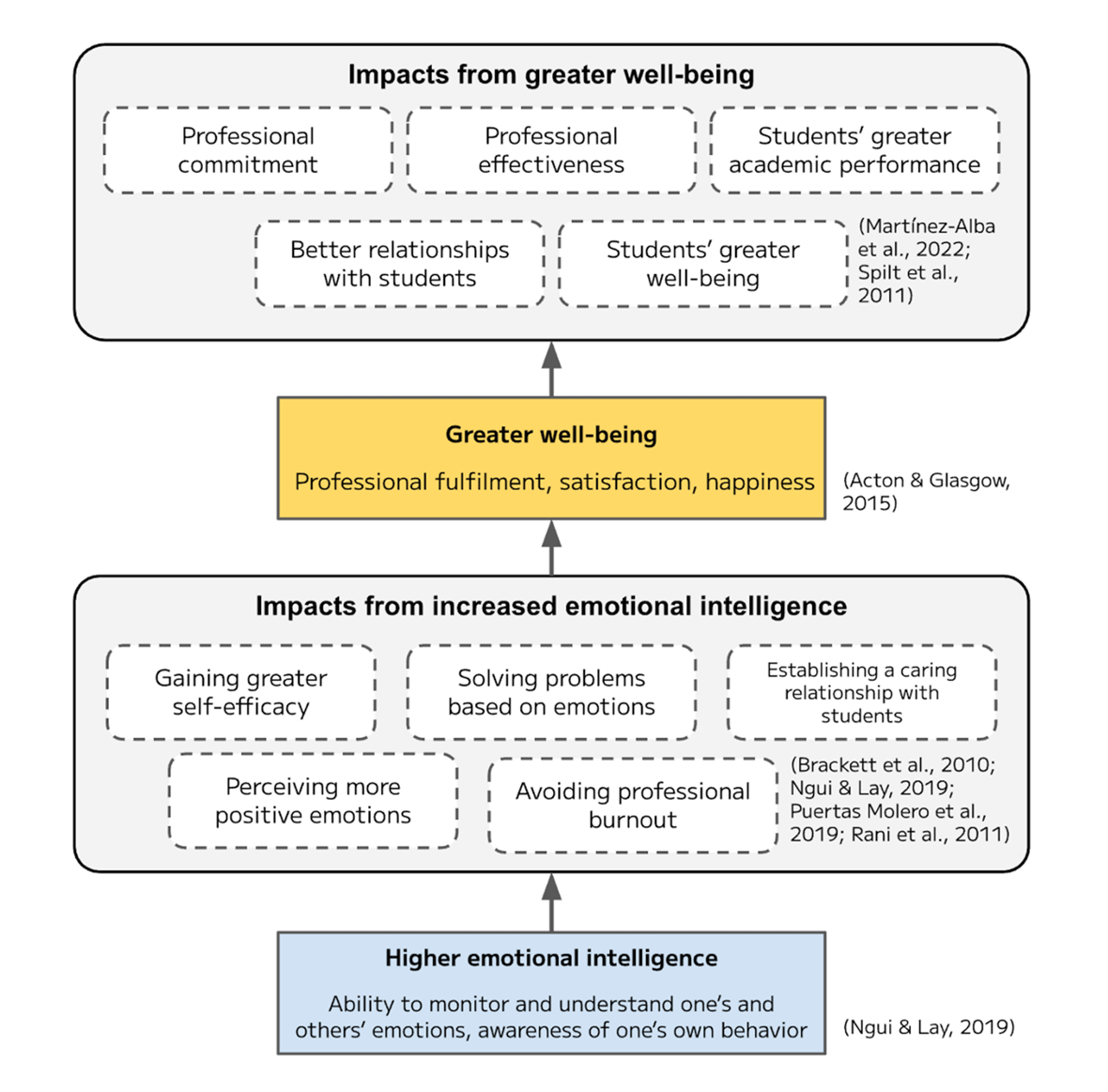
Figure 1 Alt Text: A flowchart showing that higher emotional intelligence leads to increased self-efficacy, problem solving, better relationships, positive emotions, and reduced burnout, which contributes to greater well-being. In turn, greater well-being enhances professional commitment, effectiveness, relationships with students, and student performance and well-being.
Teachers’ Well-Being
Teacher well-being is defined as “an individual sense of personal professional fulfilment, satisfaction, purposefulness, and happiness, constructed in a collaborative process with colleagues and students” (Acton & Glasgow, 2015, p. 102). Not only is it natural for an individual to seek well-being, but it also has a significant influence on the quality of their efficacy as an educator. Studies suggest that well-being affects teachers’ commitment and effectiveness, their relationships with students, and students’ well-being and academic performance (Martínez-Alba et al., 2022; Spilt et al., 2011). These outcomes are illustrated in Figure 1 under “Impacts from greater well-being.”
Teachers’ Emotions
Teachers’ emotions affect various aspects of their professional lives. For example, positive emotions are associated with higher job satisfaction and reduced exhaustion, while negative emotions often demoralize teachers (Chen, 2018; Wang et al., 2019). These emotional states have been shown to influence student engagement, particularly in terms of deeper cognitive processes (Chen, 2018). In other words, achieving greater emotional well-being leads to professional outcomes. Additionally, expression of honest emotions has been linked to emotional well-being; teachers who frequently express genuinely positive emotions tend to report higher job satisfaction and lower emotional exhaustion (Taxer & Frenzel, 2015).
Emotional Intelligence and Regulating Emotions
Regulating emotions involves the ability to evaluate, modulate, and respond to emotional experiences (Thompson, 1994), and is closely tied to emotional intelligence, i.e., the capacity to recognize, understand, and manage one’s own and others’ emotions (Ngui & Lay, 2019). Teacher-student interactions significantly shape teachers’ emotions, with long-term effects (de Ruiter et al., 2021; Spilt et al., 2011). While advisors often consider regulating their feelings and empathizing with students to be part of their duties, the process of regulating their own emotions may become so habitual that they fail to reflect on and acknowledge their own feelings (Snyder-Duch, 2018). Therefore, becoming more aware of their own emotional regulation processes needs to be made an explicit part of advisors’ duties.
Emotional intelligence not only supports well-being (Acton & Glasgow, 2015) but also influences educators’ competences and experiences in multiple ways. This includes perceptual benefits such as achieving a better sense of self-efficacy, avoiding professional burnout (Puertas Molero et al., 2019), and feeling more positive emotions (Brackett et al., 2010). Additionally, there is a connection between emotional intelligence and cognitive capability: People with higher emotional intelligence are more effective at self-monitoring and attending to situational clues (Rani et al., 2011), and they are more likely to identify meaning behind emotions and solve problems based on them (Ngui & Lay, 2019). Furthermore, effectively regulating emotions helps avoid conflict and tension and forge caring relationships with students (Brackett et al., 2010). Such impacts are summarized in Figure 1, “Impacts from increased emotional intelligence.”
Reflective Practices and Models
Reflective practice encourages practitioners to build awareness of their own ways of thinking and acting by challenging their assumptions and critically evaluating their responses to practice situations (Finlay, 2008). Reflection can help teachers and advisors identify emotional triggers and biases, thereby improving effectiveness (Snyder-Duch, 2018). Schön (1983) distinguished between reflection-in-action (during a task) and reflection-on-action (after a task), with Killion and Todnem (1991) later adding reflection-for-action (planning future action).
Various cyclical models support reflection as a process of ongoing learning and improvement. These include the Experiential Learning Model (Kolb, 1984), Gibbs’ Reflective Learning Cycle (1988), the What? So What? Now What? Model (Rolfe et al., 2001), the 5 R Framework (Bain et al., 2002), and the Integrated Reflective Cycle (Bassot, 2013) (see Mynard, 2023, for an extensive overview of reflective models). In addition, Brackett et al. (2019) describe the systematic, evidence-based approach to social and emotional learning: Recognize, Understand, Label, Express, and Regulate emotions. Combined with tools like the Mood Meter, it offers a structured method to build emotional awareness and well-being. A version of Gibbs’ Reflective Learning Cycle in combination with the Mood Meter was adapted to be used in the context of the present study, as explained in the following section.
Development of the EmotioNote Application
The application introduced in this study emerged from a practitioner-driven process. We, the researchers, in-service LAs at Kanda University of International Studies, first began by reflecting informally on our own advising experiences, which revealed the need for structured emotional support (Marzin et al., 2022).
We created a Google Form based on Gibbs’ Reflective Learning Cycle (1988), selected for its emphasis on emotion and clear, scaffolded structure, allowing for intentional and sustainable reflective habits. We altered the questions to apply directly to the advising context and to include questions about LAs’ emotional dissonance, i.e., the gap between what they feel and what they express to advisees, informed by Totterdell and Holman’s (2003) emotional labor framework.
Following two pilot rounds, the tool was refined into an online application called EmotioNote (Pemberton, Takada, et al., 2023; Takada et al., 2024). Based on feedback, revisions included simplified wording, added optional questions, improved access to prior logs, and shifted focus to emotions more broadly rather than emotional labor (see Appendix A). To help users identify emotions, Brackett’s (2025) Mood Meter, a chart that categorizes emotions by energy level (high/low) and valence (pleasant/unpleasant), was added. Appendix B shows the content of a session log on EmotioNote.
Aim and Research Questions
This research examines insights about and impact on LAs’ emotions and advising practice as a result of using the EmotioNote app through the following research questions:
RQ1. How did LAs evaluate their ability to monitor and differentiate their emotions and behaviors through the use of an emotion-focused reflection tool?
RQ2. How did LAs describe the experience of monitoring and differentiating their emotions and behaviors?
RQ3. How did LAs evaluate the impact of the tool on their emotions and advising practice?
RQ4. How did LAs describe the impact of using the tool on their emotions and advising practice?
Materials and Methods
Research Design
A multi-stage mixed-methods design evaluated participants’ experiences with the EmotioNote intervention, integrating both outcome measures and contextual factors (Creswell & Clark, 2017). Stage one was a convergent parallel design: Quantitative data, addressing RQs 1 and 3, provided descriptive information about participants’ ratings of their ability to monitor and differentiate emotions and behaviors and the perceived impact of the tool on their emotions and advising practice, while qualitative data, addressing RQs 2 and 4, were gathered to explore and contextualize these perceptions in greater depth. Although the sample size was small and the quantitative results were not intended to be generalizable, they were included to provide a structured framework through which to triangulate and interpret the qualitative findings. The integration of quantitative ratings and qualitative accounts enabled a more comprehensive understanding of participants’ experiences with the tool than either form of data could provide independently. In stage two, additional qualitative data were collected to clarify, elaborate on, and extend the previous results.
Context, Participants, and Ethics
This study is situated within the context of four university-based SALCs in Japan. These centers varied in size, services, and pedagogy, but all aimed to support autonomous language learning. Participants were in-service LAs. Given the limited number of such positions nationwide, convenience sampling was used. Recruitment involved professional networks, online searches of SALCs, and consultation of the Japan Language Learning Spaces Registry hosted by the Japan Association for Self-Access Learning. Of the eight LAs initially recruited, six completed the study (two withdrew due to practical constraints). Pseudonyms are used to refer to the participants in the results section. Ethical approval was obtained through Kanda University’s review process. All participants gave informed consent, and participation was voluntary and uncompensated.
Instruments and Data Collection
Data collection involved a post-intervention survey and semi-structured interviews. The survey assessed participants’ insights about their emotions and advising behaviors gained through the use of the tool, and the tool’s perceived impact on those areas. It included both quantitative Likert-scale items and open-ended qualitative prompts (see Appendix C).
All six participants were invited to a follow-up interview, and four participated. Interviews conducted online (30-60 minutes) included the same prompts as the survey and required participants to expand on their survey responses, allowing for deeper exploration of each participant’s experience.
Intervention Design
Participants were asked to use EmotioNote a minimum of five times over 10 weeks. This specific frequency and timeframe were selected to fit naturally within a standard academic semester. The minimum of five sessions was chosen to ensure multiple engagements with the tool—allowing for a cumulative impact on reflective practice—while deliberately keeping the requirement low to respect participants’ professional workloads and ensure the task was realistic. After viewing a short tutorial video, they were encouraged to complete reflections soon after advising sessions to enhance recall accuracy. Users could choose to answer only the required questions or respond to the optional prompts as well.
Data Analysis
Quantitative data from the survey responses were reported descriptively without additional analysis. Qualitative data from the survey responses and interviews were combined and analyzed using thematic analysis (Braun & Clarke, 2022) with a combination of emerging and predetermined codes (Creswell & Creswell, 2018). In order to remain responsive to the data, rather than relying on a predetermined framework, initial codes were generated inductively by summarizing and labeling meaningful segments of data. These initial codes were found to align with the Conceptual Model of Teacher Emotional Intelligence and Well-Being (see Figure 1), specifically the “higher emotional intelligence” and the “impacts from increased emotional intelligence” portions of the model. The researchers then generated a codebook based on the components of these two parts of the model and proceeded to code all data deductively. This involved refining, relabelling, and consolidating the initial codes. The final codes were subsequently organized into two main themes aligned with the qualitative research questions: insights about emotions and advising (RQ2) and impacts on emotions and advising (RQ4). In both the inductive and deductive stages, the researchers independently coded all data and resolved discrepancies through discussion, ensuring credibility through investigator triangulation (Brown, 2014).
Results
Findings from the six participants are presented using both survey and interview data. Quantitative and qualitative responses are reported together, with qualitative data helping to explain and extend survey results. Qualitative comments from the survey are marked (S), and those from interviews are marked (I).
Insights About Emotions and Advising Practice
This section addresses RQ1 and RQ2 by presenting insights participants gained about emotions and advising practice through using the tool. Table 1 shows the quantitative responses from the survey rated on a Likert scale from 1 (strongly disagree) to 5 (strongly agree), indicating the extent to which participants perceived that they gained insights about their emotions and advising behaviors. It also presents the corresponding qualitative codes from combined survey and interview data explaining the type of insights each participant gained.
Table 1
EmotioNote’s Role in Understanding Emotions and Advising Behaviors
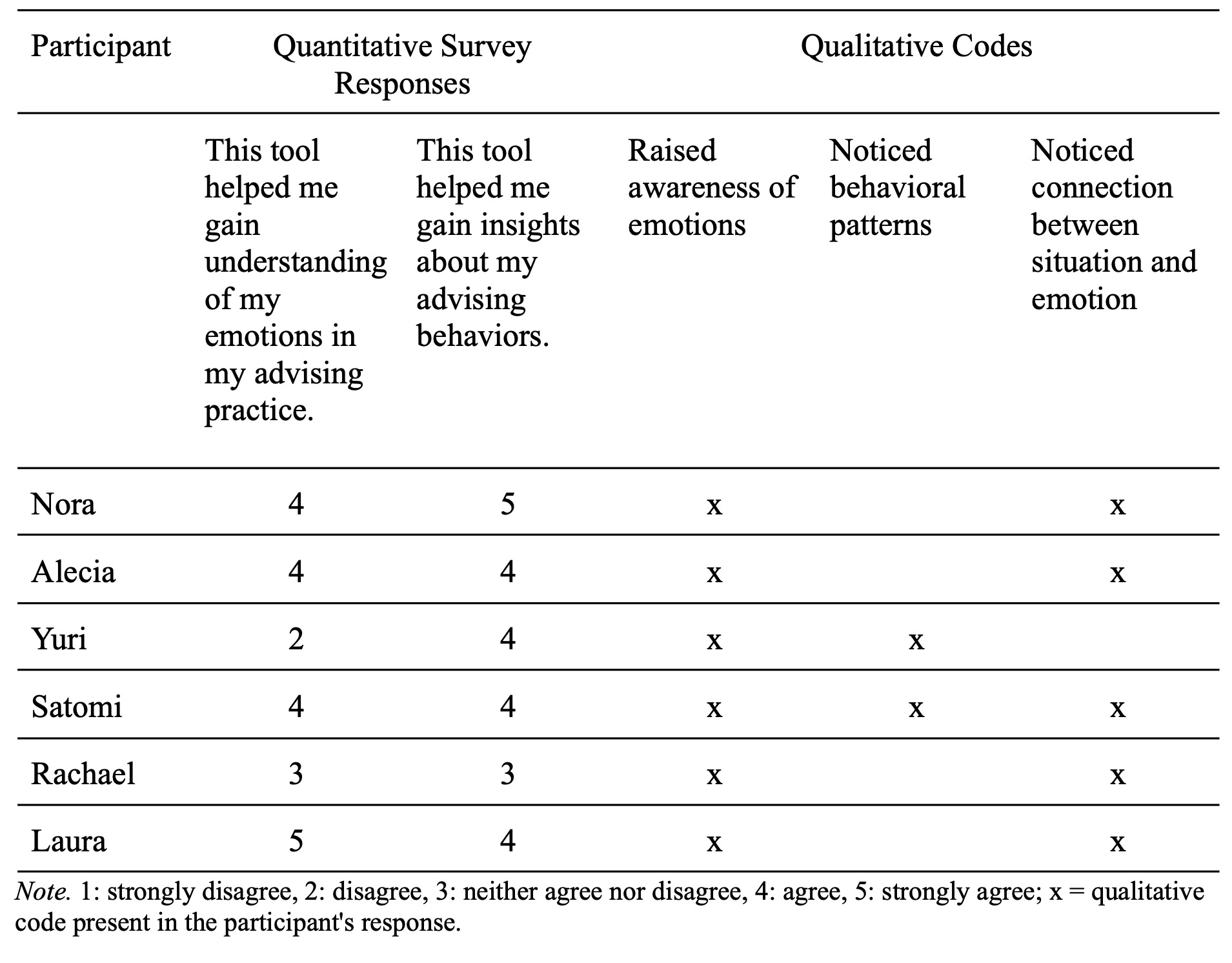
Most participants agreed EmotioNote helped them gain insights into their advising practice and emotions, though experiences varied. Expanding upon the first quantitative statement, “This tool helped me gain understanding of my emotions in my advising practice,” the code raised awareness of emotions emerged. It refers to comments that indicate advisors identified particular emotions through the use of EmotioNote. All six participants’ responses corresponded to this code, with some noting that the tool provided the opportunity to reflect on emotions consciously. Alicia wrote, “It made me think about them [emotions] at all (it’s not usually something I consciously focus on)” (S). Likewise, Nora wrote, “I think being visiblity [sic] aware of my own emotions helped my [sic] notice what I was experiencing as we are trained to be focused only on the learner” (S).
Yuri, who disagreed with the prompt “This tool helped me gain understanding
of my emotions in my advising practice,” attributed this to lack of time: “There was no time at all between regular sessions, and this prevented me from using the tool afterwards” (S). However, she found the tool itself useful: “It was really helpful for me to see all the emotions, and it’s easier to choose too, especially if it’s divided by sorted by color” (I). The usefulness of the Mood Meter (Brackett, 2025) was echoed by Laura:
… when I’m just thinking about what emotions I’m feeling, it’s like, “Oh, I’m angry. Oh, I’m sad.” But when I’m seeing the different more complex and nuanced emotions laid out in front of me, and I’m able to choose between them, and think, “Okay, this is different than this,” and “why would I choose this over this one?” (I)
As some participants suggested, EmotioNote facilitated explicit reflection on emotions to an extent they might not have otherwise reached.
Relating to the second survey item, “This tool helped me gain insights about my advising behaviors,” is the code noticed behavioral patterns. This code represents when participants observed how they tended to behave during advising sessions. Two participants provided corresponding comments. Yuri mentioned, “I realized after using this, I tend to speak too much and sort of overtake what the students want to say” (I). Similarly, Satomi explained that writing her reflection led her to notice patterns in how she handles sessions: “Maybe, because I’ve been doing this job . . . almost seven years … there’s my belief that when this happens, I should do like this. But I never actually written down on such a thing [sic]” (I). Thus, EmotioNote prompted reflection on habitual behaviors often overlooked.
A third code, noticed the connection between situation and emotion, linked both quantitative survey items. Five participants described recognizing how particular events influenced their emotional states or how emotions shaped their advising behaviors. Rachael said, “I think this tool helped me notice how my emotions are tied to how much I was able to help the student and my confidence in answering their questions” (S). In addition, effects from students’ behavior were reported; Nora explained that a student’s emotionally intense attitude later caused her to associate the person with negative emotions: “I found each time that student was present, I would type whatever I clicked with the darker colors [sic] [selected unpleasant emotions on the mood meter]” (I). Laura, on the other hand, noticed how emotions affect her behavior during advising:
If I’m really tired, I might not be able to think of a better way to phrase something in a way that will kind of guide the student, so maybe accidentally being more direct, because it’s the only thing my brain can do in that moment. (I)
Thus, most participants seem to have gained insights about the relationship between their emotions and behaviors during advising sessions.
Impact on Emotions and Advising Practice
This section shows the impact EmotioNote had on participants’ emotions and advising practice, addressing RQ3 and RQ4. Table 2 presents the quantitative survey responses rated on a Likert scale from 1 (strongly disagree) to 5 (strongly agree), revealing the extent to which participants perceived the tool as positively impacting their emotions and advising practice. It also shows the corresponding qualitative codes from the combined survey and interview data about the type of impacts perceived by each participant.
Table 2
Tool’s Impact on Emotions and Advising Practice
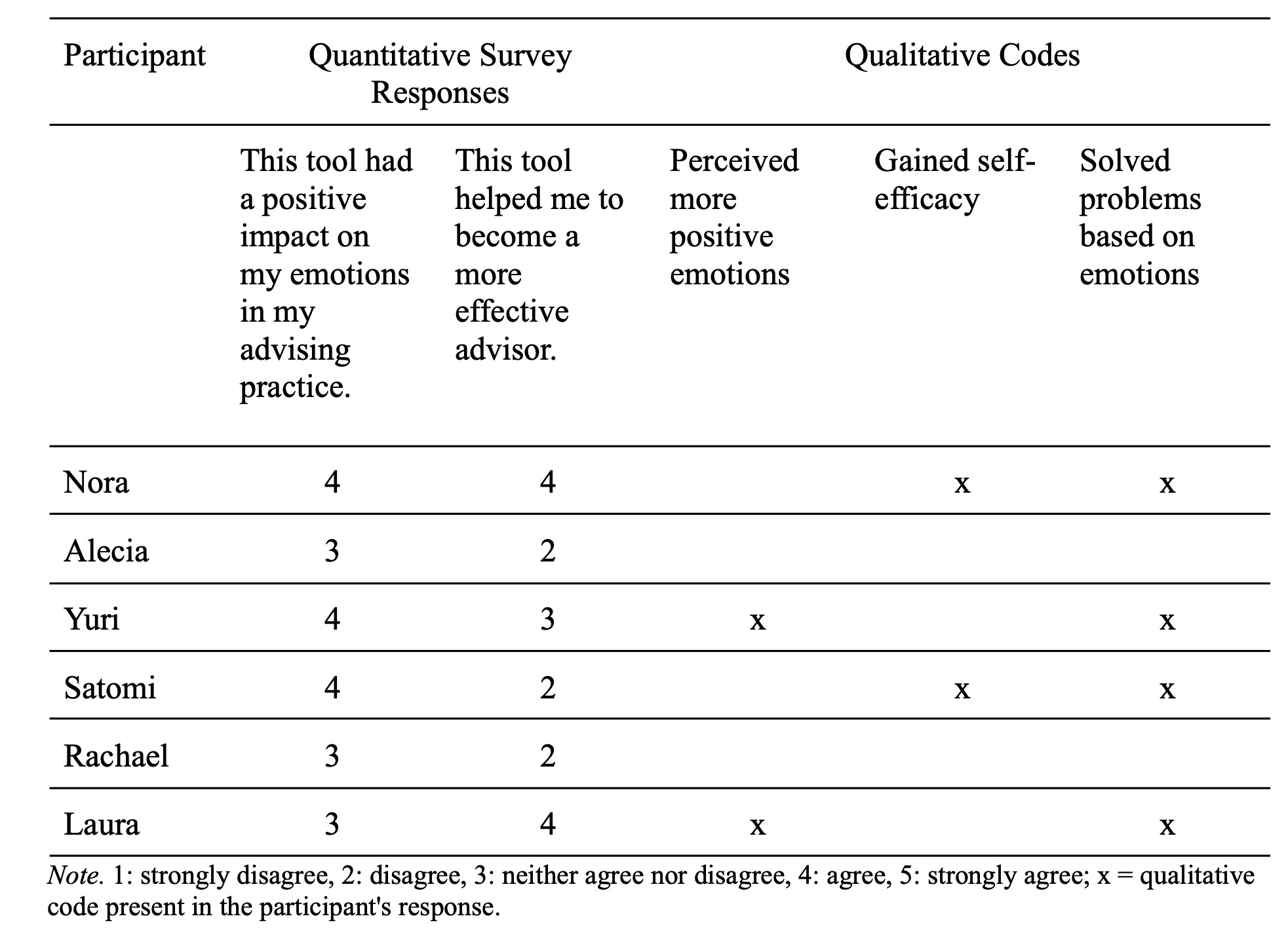
Results of the quantitative survey items indicate that the tool may have had a moderately positive impact on participants’ emotions in their advising practice. However, its perceived impact on advising effectiveness appears more limited, with responses leaning slightly toward disagreement.
Corresponding to the quantitative item “This tool had a positive impact on my emotions in my advising practice” was the code perceived more positive emotions, indicated by two respondents. They experienced a shift toward more positive feelings in their advising practice. Laura observed, “The last month or so of the semester, I felt much calmer in my sessions” (I), though she acknowledged that this emotional shift might also have reflected reduced workload and greater teaching familiarity. Still, she considered that using the app may have contributed to this change. In contrast, Yuri expressed a clearer connection between emotional reflection and well-being, explaining, “That would help me feel better in a way when I get really stressed from doing sessions in a way that I wanted to do” (I). These extracts suggest that while the tool may have supported more positive emotional experiences, attributing these changes solely to EmotioNote remains uncertain.
Corresponding to the quantitative item “This tool helped me to become a more effective advisor” was the code gained self-efficacy. Two participants stated that using the tool led to increased confidence in their advising abilities. Nora highlighted learning to navigate complex student behaviors with greater skill, describing, “With the realization, I could take greater actions in a proactive way to provide guidance” (S), indicating a shift toward more deliberate and confident advising strategies. Satomi indicated disagreement with the prompt, “This tool helped me to become a more effective advisor,” explaining, “I did not see any changes” (S). However, her statement, “I realized that yeah, sometimes my own way is really working very well” (I), indicates that the tool helped her to validate her current approach, which is linked to self-efficacy. These answers suggest that the increase in self-efficacy may manifest as reinforcement of current practices or development of new strategies.
Corresponding to both quantitative items was the code solved problems based on emotions. It suggests that using the tool prompted adjustments to advising practice to address issues that derive from emotions. Four participants described how the tool prompted reflection that led to specific adjustments in their interactions with advisees. Nora emphasized the importance of facing rather than suppressing emotions: “We’ve got to do some solutions and not mask the emotions, but address what’s going on … the app really helped me … I might have never, or it would have taken a longer time” (I). Although Satomi disagreed with the prompt, “This tool helped me to become a more effective advisor,” she stated: “When I reflected on my sessions using the tool, I remembered both positive and negative emotions” (S). She followed up by adding, “By writing down on that record, then, ‘Okay, next time if the students come to me again, that maybe I should deal with the students like this’” (I). This indicates that reflecting on her emotions did help her to plan future sessions. Their comments underscore the tool’s role in accelerating emotional processing and enabling constructive action.
Discussion
Understanding and Differentiating Emotions and Behaviors Through Reflective Practice
This study examined whether EmotioNote served as a practical tool for guiding advisors’ awareness of emotions and behaviors and how they described the insights gained. Most participants reported that the tool effectively scaffolded their ability to recognize links between emotions and professional actions. These findings align with prior research on the role of structured reflection in professional practice. Consistent with Snyder-Duch’s (2018) concern that habitual emotion regulation may reduce conscious reflection, this tool appears to provide a tangible mechanism for prompting this reflection. Importantly, participants’ recognition of emotion-behavior connections underscores the practical value of reflective tools that move beyond emotion identification toward systematically planning professional actions.
Emotional Intelligence as a Path to Professional Development
The study also examined how participants perceived that the design and use of EmotioNote impacted their emotions and advising behaviors. Quantitative responses ranged from neutral to moderately positive regarding its perceived impact on emotions, aligning with evidence that genuine positive expression promotes satisfaction and reduces exhaustion (Taxer & Frenzel, 2015). Perceptions were somewhat less favorable regarding its influence on advising effectiveness. Nonetheless, several participants reported gains in self-efficacy and problem-solving, indicating that heightened emotional awareness may have contributed to more confident and reflective advising practices. The divergence between quantitative and qualitative findings suggests that participants may not have always recognized how addressing problems through emotional awareness shaped their practice. Alternatively, this discrepancy may stem from the limitations of the survey instrument itself. Broad, quantitative Likert-scale items may not have been sensitive enough to capture the subtle, nuanced shifts in self-efficacy and professional confidence that participants were able to articulate more clearly during the open-ended interviews. Taken together, these results indicate a potential relationship between developing emotional intelligence and enhancing professional practice, echoing prior studies connecting systematic reflection and emotional insight with self-efficacy (Puertas Molero et al., 2019).
Positioning Findings within the Conceptual Model
The qualitative findings strongly suggested that the tool encouraged participants to monitor and raise awareness of emotions, which is particularly connected to higher emotional intelligence, as shown in Figure 1. Participants’ descriptions of gaining insight into how emotions affect advising practice highlight the potential of EmotioNote in reinforcing reflective behaviors for professional growth. Additionally, some codes also align with areas connected to increased emotional intelligence, such as solving problems, gaining self-efficacy, and feeling positive emotions. On the other hand, no conclusive evidence of greater well-being and impacts from greater well-being was reported. These findings indicate that EmotioNote is more strongly connected to the earlier stages of the model (Figure 1), and additional research will be needed to verify its capability in fostering advisors’ well-being.
Implications
This study offers practical, theoretical, and methodological implications for the development and use of reflective tools in advisor education. EmotioNote can be used in advisor training or for personal reflection, peer mentoring, or institutional initiatives. While designed for LAs, the tool can be adapted for coaches, mentors, counselors, or teacher educators.
One theoretical implication is the possibility of creating alternative versions of the tool. Minor changes could refine prompts or adjust components for different advising contexts or professional roles, while major revisions could include other reflective models, such as Bain et al.’s 5R Framework or Bassot’s Integrated Reflective Cycle, to suit individual needs and preferences.
Another theoretical implication is the potential for refinement of the Dialogue, Tools, and Environments Model (Mynard, 2020) to include the role of emotions. As shown in the current study, systematically utilizing a tool like EmotioNote to reflect on emotions can foster insights and have an impact on advisors’ emotions and practice. Recognizing advisors’ emotions as a fundamental part of advising could encourage greater emphasis on integrating targeted, practical tools into LA training programs.
Future research could employ larger samples and longitudinal designs to assess sustained impact and incorporate more objective measures of emotional intelligence to strengthen validity. Additionally, exploring how advisors’ emotional growth affects learner experiences would broaden understanding of the impact. Comparative studies of different reflection tools could also clarify which designs best support advisor growth.
Limitations
This study offers initial insights into the potential of an emotion-focused reflection tool for LAs; however, several limitations should be acknowledged. The small sample size (six participants) constrains generalizability. However, participants’ varied backgrounds offered valuable perspectives on how the tool functioned across different levels of experience and training. Recruitment through professional networks may also have introduced self-selection bias, as participants were likely more motivated or reflective than average.
The study’s 10-week duration precluded observations of long-term effects, though repeated tool use provided richer insights than one-time reflections. Reliance on self-reported data introduces potential bias, particularly without direct analysis of the reflection entries themselves. Nevertheless, triangulation through surveys and interviews enhanced the credibility of the findings. These limitations suggest the need for further research using a larger, more diverse sample and triangulated data sources across a longer timeframe.
Conclusion
Recognizing and reflecting on emotions is integral to LAs’ professional development. This study demonstrates that structured tools like EmotioNote can support advisors’ reflection on emotion. The findings suggest that the tool facilitated reflective behaviors that are deeply connected to emotional intelligence, such as intentional monitoring and reflection on emotions, and raising awareness about the affective relationship between emotions and advising practice. Stakeholders, including advisor educators, SALC managers, and institutional leaders, can benefit from integrating such tools into professional development programs to foster emotionally intelligent, reflective practitioners. Embedding emotional reflection into advisor training holds promise for more responsive learner support and healthier educational environments.
Acknowledgements
ChatGPT, a large language model developed by OpenAI, was lightly used to improve the linguistic quality of writing, i.e., obtaining lexical or grammatical suggestions where the original text lacked clarity.
Statements and Declarations
The data that support the findings of this study are available from the corresponding author upon reasonable request.
Disclosure Statement
The authors report that there are no competing interests to declare.
Notes on Contributors
Christine Pemberton is a learning advisor at Kanda University of International Studies. She holds a master’s degree in TESOL and a RILAE Advisor Educator certification and has more than a decade of teaching experience. Her research interests include learner autonomy, diversity and inclusion, CLIL, and the psychology of language learning.
Emily A. Marzin is a learning advisor and a lecturer at Kanda University of International Studies, Japan. She completed a master’s in didactics at Jean Monnet University and an EdD at The Open University. Her research interests are self-directed learning and intercultural communication.
Sina Takada is a learning advisor at Kanda University of International Studies. He holds a master’s degree in TESOL and is a RILAE-certified learning advisor. He has worked as an English teacher and consultant. His academic interests are learner autonomy, second language acquisition, applied linguistics, and English phonetics.
References
Acton, R., & Glasgow, P. (2015). Teacher wellbeing in neoliberal contexts: A review of the literature. Australian Journal of Teacher Education, 40(8), 99–114. http://dx.doi.org/10.14221/ajte.2015v40n8.6
Bain, J. D., Ballantyne, R., Mills, C., & Lester, N. C. (2002). Reflecting on practice: Student teachers’ perspectives. Post Pressed.
Bassot, B. (2013). The reflective journal. Palgrave.
Bolton, G. (2010). Reflective practice: Writing and professional development. SAGE Publications.
Brackett, M. A. (2025). How we feel app. Dr. Marc Brackett. https://marcbrackett.com/how-we-feel-app-3/
Brackett, M. A., Bailey, C. S., Hoffmann, J. D., & Simmons, D. N. (2019). RULER: A theory-driven, systemic approach to social, emotional, and academic learning. Educational Psychologist, 54(3), 144–161. https://doi.org/10.1080/00461520.2019.1614447
Brackett, M. A., Palomera, R., Mojsa‐Kaja, J., Reyes, M. R., & Salovey, P. (2010). Emotion‐regulation ability, burnout, and job satisfaction among British secondary‐school teachers. Psychology in the Schools, 47(4), 406–417. https://doi.org/10.1002/pits.20478
Braun, V., & Clarke, V. (2022). Thematic analysis: A practical guide. SAGE.
Brown, J. D. (2014). Mixed methods research for TESOL. Edinburgh University Press.
Carson, L., & Mynard, J. (2012). Introduction. In J. Mynard & L. Carson (Eds.), Advising in language learning: Dialogue, tools and context (pp. 3–25). Routledge. https://doi.org/10.4324/9781315833040
Chen, J. (2018). Exploring the impact of teacher emotions on their approaches to teaching: A structural equation modelling approach. British Journal of Educational Psychology, 89(1), 57–74. https://doi.org/10.1111/bjep.12220
Creswell, J. W., & Clark, V. L. P. (2017). Designing and conducting mixed methods research. Sage Publications.
Creswell, J. W., & Creswell, J. D. (2018). Research design: Qualitative, quantitative, and mixed methods approaches (5th ed.). Sage Publications.
Dam, L. (2023). Making space for autonomy in an institutional environment: The past, the present, and the future. In K. Schwienhorst & J. Ramos-Gonzalez (Eds.), Making space for autonomy in language learning (pp. 9–19). Candlin & Mynard. https://doi.org/10.47908/28
De Ruiter, J. A., Poorthuis, A. M. G., & Koomen, H. M. Y. (2021). Teachers’ emotional labor in response to daily events with individual students: The role of teacher-student relationship quality. Teaching and Teacher Education, 107, 103467. https://doi.org/10.1016/j.tate.2021.103467
Dizon, G. (2026). ChatGPT as a tool for self-directed foreign language learning. Innovation in Language Learning and Teaching, 20(2), 334–350. https://doi.org/10.1080/17501229.2024.2413406
Ebadijalal, M., & Moradkhani, S. (2022). Understanding EFL teachers’ wellbeing: An activity theoretic perspective. Language Teaching Research, 29(6), 1–22. https://doi.org/10.1177/13621688221125558
Finlay, L. (2008). Reflecting on reflective practice. Practice-Based Professional Learning
Paper 52, The Open University. https://oro.open.ac.uk/68945/1/Finlay-%282008%29-Reflecting-on-reflective-practice-PBPL-paper-52.pdf
Gardner, D., & Miller, L. (2021). After “establishing…”: Self-access learning then, now and into the future. Relay Journal, 4(2), 55–65. https://doi.org/10.37237/relay/040202
Gibbs, G. (1988). Learning by doing: A guide to teaching and learning methods. Oxford Polytechnic.
The Japan Association for Self-Access Learning (n.d.). LLS Registry. https://jasalorg.com/lls-registry/
Kato, S., & Mynard, J. (2016). Reflective dialogue: Advising in language learning. Routledge.
Kolb, D. A. (1984). Experiential learning: Experience as the source of learning and development. Prentice Hall.
Killion, J. P., & Todnem, G. R. (1991). A process for personal theory building. Educational Leadership, 48(6), 14–16. https://files.ascd.org/staticfiles/ascd/pdf/journals/ed_lead/el_199103_killion.pdf
Lashari, A. A., & Umrani, S. (2023). Reimagining self-directed language learning in the age of artificial intelligence: A systematic review. Grassroots, 57(1), 92–114. https://sujo.usindh.edu.pk/index.php/Grassroots/article/view/6571/4336
Li, B., Bonk, C. J., Wang, C., & Kou, X. (2024). Reconceptualizing self-directed learning in the era of generative AI: An exploratory analysis of language learning, IEEE Transactions on Learning Technologies, 17, 1489–1503. https://doi.org/10.1109/TLT.2024.3386098
Li, Z. (2021). Teacher well-being in EFL/ESL classrooms, Frontiers in Psychology, 12, 1–4. https://doi.org/10.3389/fpsyg.2021.732412
Martínez-Alba, G., Herrera, L. J. P., & Trinh, E. (2022). Situating teacher well-being in English language teaching. In L. J. P. Herrera, G. Martínez-Alba & Trinh (Eds.), Teacher well-being in English language teaching (pp. 29–42). Routledge eBooks. https://doi.org/10.4324/9781003314936-4
Marzin, E. A, Pemberton, C., & Takada, S. (2022). Happy to help: Reflections on learning advisors’ emotions, JASAL Journal, 3(2), 33–41. https://jasalorg.com/happy-to-help-reflections-on-learning-advisors-emotions/
Moon, J. A. (2006). Learning journals: A handbook for reflective practice and professional development (2nd ed.). Routledge.
Morris, S., & Mercer, S. (2019). An interview with Sarah Mercer on language learner and teacher well-being. Relay Journal, 2(2), 459–463. https://doi.org/10.37237/relay/020219
Mynard, J. (2016). Self-access in Japan: Introduction. Studies in Self-Access Learning, 7(4), 331–340. https://doi.org/10.37237/070401
Mynard, J. (2019). Self-access learning and advising: Promoting language learner autonomy beyond the classroom. In H. Reinders, S. Ryan, & S. Nakamura (Eds.), Innovation in language teaching and learning: The case of Japan (185–209). Palgrave Macmillan. https://doi.org/10.1007/978-3-030-12567-7_10
Mynard, J. (2020). Advising for language learner autonomy: Theory, practice, and future directions. In M. Jiménez Raya & F. Vieira (Eds.), Autonomy in language education: Theory, research and practice (pp. 46–62). Routledge. https://doi.org/10.4324/9780429261336
Mynard, J. (2023). Promoting reflection on language learning: A brief summary of the literature. In N. Curry, P. Lyon, & J. Mynard (Eds.), Promoting reflection on language learning (pp. 23–37). Multilingual Matters. https://doi.org/10.21832/CURRY5584
Ngui, G. K., & Lay, Y. F. (2019). The predicting roles of self-efficacy and emotional intelligence and the mediating role of resilience on subjective well-being: A PLS-SEM approach. Pertanika Journal of Social Sciences & Humanities, 27(T2), 1–25. http://www.pertanika.upm.edu.my/
Pemberton, C., Marzin, E. A., Mynard, J., & Wongsarnpigoon, I. (2023). Evaluation of SALC inclusiveness: What do our users think? JASAL Journal, 4(1), 5–31. https://jasalorg.com/evaluation-of-salc-inclusiveness-what-do-our-users-think/
Pemberton, C., Takada, S., & Marzin, E. A. (2023). Polishing the mirror: Developing a reflection tool for learning advisors [Poster presentation]. PanSIG conference 2023, Kyoto, Japan. https://pansig.org/node/133
Pentón Herrera, L. J., Martínez-Alba, G., & Trinh, E. (2023). Teacher well-being in English language teaching: An ecological approach. Routledge.
Puertas Molero, P., Zurita Ortega, F., Ubago Jiménez, J. L., & González Valero, G. (2019). Influence of emotional intelligence and burnout syndrome on teachers’ well-being: A systematic review. Social Sciences, 8(6), 185. https://doi.org/10.3390/socsci8060185
Rani, S. C., Priyadharshini, R. G., & Kannadasan, T. (2011). The influence of the emotional intelligence on self monitoring. African Journal of Business Management, 5(21), 8487–8490. https://doi.org/10.5897/AJBM11.640
Rolfe, G., Freshwater, D., & Jasper, M. (2001). Critical reflection in nursing and the helping professions. Palgrave Macmillan.
Schön, D. A. (1983). The reflective practitioner: How professionals think in action. Basic Books.
Snyder-Duch, J. (2018). Relational advising: Acknowledging the emotional lives of faculty advisors. New Directions for Teaching and Learning, 2018(153), 55–65. https://doi.org/10.1002/tl.20281
Starr, J. (2011). The coaching manual: The definitive guide to the process, principles, and skills of personal coaching. Pearson.
Spilt, J. L., Koomen, H. M. Y., & Thijs, J. T. (2011). Teacher wellbeing: The importance of teacher-student relationships. Educational Psychology Review, 23(4), 457–477. https://doi.org/10.1007/s10648-011-9170-y
Takada, S., Pemberton, C., & Marzin, E. A. (2024, October 26). Reflection tool (web app) for advisors’ emotions and practices [Conference presentation]. JASAL 2024, Tokyo, Japan. http://dx.doi.org/10.13140/RG.2.2.12940.73604
Takada, S., Kato, S., Marzin, E. A., Mynard, J., & Ambinintsoa, D. V. (2026). Developing the learner interaction simulation app (LISA): An AI-powered tool for advisor education. JASAL Journal, 7(1), 122–143, https://jasalorg.com/developing-the-learner-interaction-simulation-app-lisa-an-ai-powered-tool-for-advisor-education/
Tassanari, M. G. (2017). How language advisers perceive themselves: Exploring a role through narratives. In C. Nicolaides & W. M. e Silva (Eds.), Innovations and challenges in applied linguistics and learner autonomy (pp. 305–336). Pontes.
Taxer, J. L., & Frenzel, A. C. (2015). Facets of teachers’ emotional lives: A quantitative investigation of teachers’ genuine, faked, and hidden emotions. Teaching and Teacher Education, 49, 78–88. https://doi.org/10.1016/j.tate.2015.03.003
Thompson, R. A. (1994). Emotion regulation: A theme in search of definition. Monographs of the Society for Research in Child Development, 59, 25–52. http://dx.doi.org/10.1111/j.1540-5834.1994.tb01276.x
Thompson, S., & Thompson, N. (2018). The critically reflective practitioner (2nd ed.). Red Globe Press.
Thornton, K., Taylor, C., Tweed, A. D., & Yamashita, H. (2021). JASAL and the self-access learning center movement in Japan. In E. Lavolette & A. Kraemer (Eds.), Language Center Handbook 2021 (pp. 31–61). International Association for Language Learning Technology.
Totterdell, P., & Holman, D. (2003). Emotion regulation in customer service roles: Testing a model of emotional labor. Journal of Occupational Health Psychology, 8(1), 55–73. http://dx.doi.org/10.1037/1076-8998.8.1.55
United Nations General Assembly. (2015). Transforming our world: The 2030 Agenda for sustainable development. Resolution A/RES/70/1. https://www.unfpa.org/sites/default/files/resource-pdf/Resolution_A_RES_70_1_EN.pdf
Wang, H., Hall, N. C., & Taxer, J. L. (2019). Antecedents and consequences of teachers’ emotional labor: A systematic review and meta-analytic investigation. Educational Psychology Review, 31, 663–698. http://dx.doi.org/10.1007/s10648-019-09475-3
Watkins, S., Marzin, E. A., & Hooper, D. (2023). Opening doors for all in self-access. JASAL Journal, 4(1), 1–4. https://jasalorg.com/opening-doors-for-all-in-self-access/
Whitworth, L., Kimsey-House, K., Kimsey-House, H., & Sandahl, P. (2007). Co-active coaching: New skills for coaching people toward success in work and life (2nd ed.). Davies-Black.
Appendix A
Adaptation of Gibbs’ Reflective Learning Cycle (1988) in the Development of the EmotioNote Application
| Gibbs’ Reflective Learning Cycle (1988) | Initial design(piloted by 12 LAs) | Revised design (piloted by two LAs) | Final Design (used by the participants of this study) |
| Description: What happened? | Think of a moment during an advising session that brought up your negative emotions. Description of the moment: What was the student doing or saying that you found emotionally challenging as an advisor? | Description of the moment: What happened during the advising session? Include as much relevant detail as you think is appropriate (for example: Who was there? When did it happen? How long did it last? What were you and the advisee doing and saying?). | Description of the moment: What happened during the advising session? Include as much detail as you think is relevant. (For example: Who was there? When did it happen? How long did it last? What were you and the advisee doing and saying?) |
| Feelings: What were you thinking and feeling? | Your emotion(s): How did you feel in the moment? Why? Your displayed emotion(s): What emotion(s) did you display, how and why? | Your emotion(s): Use the mood meter to identify all the emotions you felt during the session and write them below. | Your emotion(s): Refer to the mood meter and choose the one(s) that best represents your emotion. |
| Congruence: How big was the gap between the emotion you felt and the emotion you displayed? | |||
| Evaluation: What was good and bad about the experience? | Evaluation of your displayed emotion(s): What was good or bad about your response? | Evaluation of the session: What do you think went well in the session? What do you think did not go well in the session? | Evaluation of the session: What do you think went well, and how did it impact your emotions? What do you think did not go well, and how did it impact your emotions? |
| Analysis: What sense can you make of the situation? | Analysis: What can you learn about yourself through this experience, if anything? | Analysis: Look back at the emotions you selected in Step 2. Why do you think these emotions came up for you during the session? What impact, if any, did your feelings have on the advisee and/or the advising dialogue? What can you learn about yourself through this experience, if anything? | Analysis: Why do you think these emotions came up for you during the session? |
| Conclusion: What else could you have done? | Alternatives: How could you have displayed your emotions differently? What do you think the outcome would have been? | Conclusions/Alternatives: What other ways could you have handled this session, if any? Action plan: If you had a similar session again, what would you do? | Conclusion: What can you learn about yourself through this experience, if anything? |
| Action plan:If it arose again, what would you do? | Action plan: If this challenge arises again, what will you do? | Action plan:If you had a similar session again, what would you do? | Action Plan: How could you handle a similar session differently in the future? |
Appendix B
EmotioNote Application Session Log
Title of the record
Set a short and explanatory title to help you look back at this entry.
Tags
Adding tags (topics) to your records can help you sort and find records with similar topics.
*Description of the moment:
What happened during the advising session? Include as much detail as you think is relevant. (For example: Who was there? When did it happen? How long did it last? What were you and the advisee doing and saying?)
*Your emotion(s):
Refer to the mood meter and choose the one(s) that best represents your emotion.
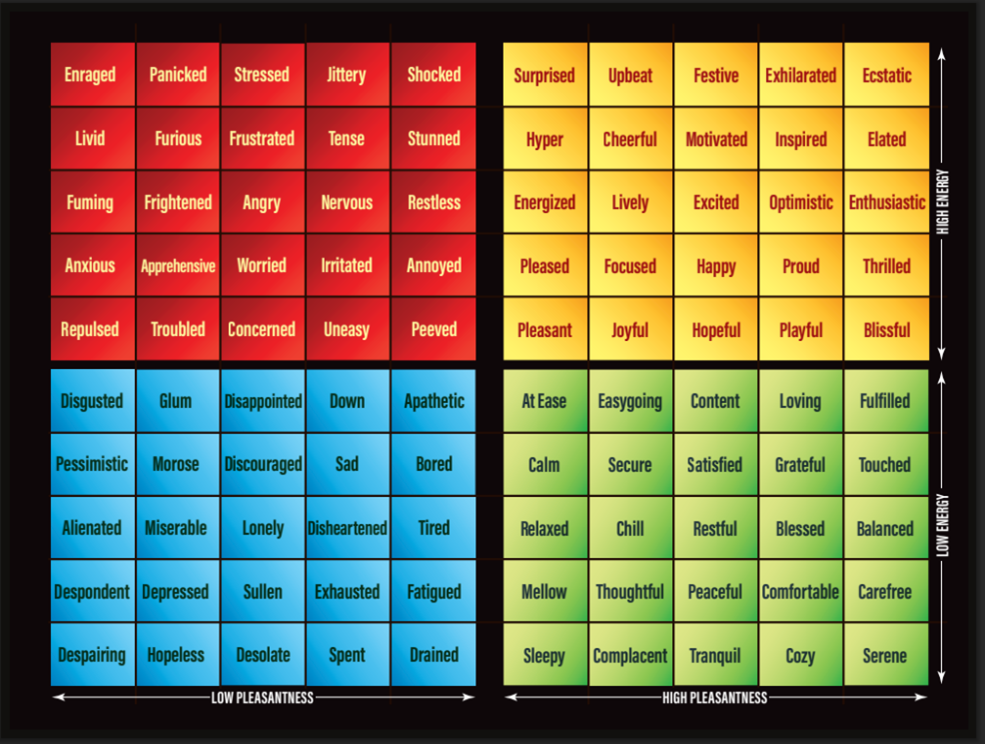
(Brackett, 2025)
Evaluation of the session:
What do you think went well, and how did it impact your emotions? What do you think did not go well, and how did it impact your emotions?
Analysis:
Why do you think these emotions came up for you during the session?
Conclusion:
What can you learn about yourself through this experience, if anything?
Action Plan: How could you handle a similar session differently in the future?
*required section