Noriko Nakanishi, The University of Osaka, Japan. https://orcid.org/0009-0004-1406-2437
Yuka Muraoka, Seigakuin University, Japan. https://orcid.org/0009-0003-7326-6221
Toshie Agawa, Hoshi University, Japan. https://orcid.org/0000-0002-5723-9261
Nakanishi, N., Muraoka, Y., & Agawa, T. (2026). Maintaining oral proficiency through shadowing: Adaptive goal setting and self-efficacy in self-regulated learning. Studies in Self-Access Learning Journal, 17(3), 362–382. https://doi.org/10.37237/170306
Abstract
This mixed-methods study investigates the mechanisms supporting persistence in autonomous shadowing during a 47-day academic break. Temporal process analyses of 12 university students (6 Full participants and 6 Partial participants) identified the roles of adaptive goal setting (GS) and self-efficacy (SE). Oral proficiency results (Versant) indicated that sustained participation led to significant gains in listening and manner of speaking, while withdrawal was associated with rapid attrition in speaking skills. Qualitative analysis of weekly reports revealed that successful completion was characterized not by rigid SMART goal adherence, but by flexible and affective strategies, such as self-rewards and future-oriented reflection. In contrast, withdrawal was associated with rigid time-bound stressors and regret-based reflection. Tracking individual SE trajectories suggested a possible functional threshold around 3.0 in this dataset; falling below this level was consistently followed by dropout. Furthermore, lower-proficiency participants in the Full group maintained an optimistic bias in SE, potentially reflecting the Dunning–Kruger effect, which may have functioned as a protective form of academic buoyancy. These case-based insights suggest that sustaining autonomous practice is a developmentally contingent process of adaptive regulation. The study provides a practical framework for educators to support student persistence through psychological monitoring and flexible, affect-focused goal-setting strategies.
Keywords: oral proficiency; self-regulated learning; goal setting; self-efficacy; shadowing
Securing sufficient exposure to the target language is a perennial challenge for learners of English as a foreign language. In Japanese universities, where opportunities for daily English use are limited, long academic breaks often result in language attrition. Oral skills, particularly listening and speaking, are notoriously vulnerable to decay without consistent practice (Bardovi-Harlig & Stringer, 2010; Weltens, 1987). Shadowing, the immediate vocal repetition of auditory input, has gained popularity as an effective strategy for maintaining oral proficiency. Building on this approach, the Summer Shadowing Marathon has been implemented since 2021 as a voluntary self-access program in which university students engage in daily shadowing activities during the summer vacation.
However, shadowing is cognitively demanding. When implemented as a self-access or autonomous learning program without classroom supervision, dropout rates have historically been high. The core problem, therefore, is not the efficacy of the method itself, but the sustainability of learner participation. Thus, the 2025 version examined in this study added weekly reports to track learners’ goal setting (GS) and self-efficacy (SE) over time. The authors first examined whether sustained summer participation helped prevent oral proficiency attrition. Second, they analyzed individual weekly reports to determine how the quality of GS differed between learners who completed the Marathon and those who withdrew. Third, they investigated SE fluctuations, focusing on learners’ capacity to recover from temporary declines and sustain participation.
Literature Review
Shadowing and Oral Proficiency Maintenance
Shadowing facilitates phonological perception and prosodic control through sustained auditory-verbal processing (Hamada, 2019; Kadota, 2019). Theoretically, this process occurs within the “phonological loop” of working memory, which consists of a short-term store and an articulatory rehearsal process (Baddeley, 2003). As a form of overt subvocalization (Kadota, 2015, 2019), shadowing prevents the decay of auditory information and promotes its transfer to long-term memory. This continuous rehearsal reconstructs the learner’s phonological system, leading to greater automaticity in speech perception and reproduction. Ultimately, this “output effect” (Kadota, 2018) enables learners to process meaning simultaneously, simulating real-time speaking and keeping linguistic systems active for future production.
Previous iterations of the Summer Shadowing Marathon confirmed that regular practice mitigates the post-summer decline in listening, pronunciation, and vocabulary (Nakanishi et al., 2022). However, these benefits are exposure-dependent; sporadic practice is insufficient to trigger automaticity. Across four years of related programs, completion rates remained low (15.4%–41.9%), and dropouts often experienced significant oral proficiency attrition (Nakanishi & Minematsu, 2026). Therefore, persistence is a prerequisite for shadowing to counteract vacation-related attrition. For this reason, the 2025 version extended these earlier Marathon programs by adding weekly reports on GS and SE to examine the self-regulatory mechanisms supporting persistence.
Goal Setting and Self-Efficacy in Self-Regulated Learning
To ensure continuous practice, second language (L2) learners must take responsibility for their own learning. In this regard, self-regulated learning (SRL) provides a possible lens for examining autonomous L2 learning. It is conceptualized as a dynamic and cyclical process in which learners act as active agents (Zimmerman, 1986, 1998). Zimmerman (1998) proposed three SRL phases: planning (foresight), execution (volitional control), and reflection. These phases provide a structured framework for understanding how cognitive and psychological factors interact to sustain autonomous learning over time.
Within this framework, GS serves as a central component of the planning phase. Setting clear goals not only strengthens a learner’s commitment but also directly influences academic performance and the overall likelihood of success (Locke & Latham, 2002, 2013; Schunk, 2001). According to Locke and Latham’s (2002) goal setting theory, goals affect performance through several mechanisms: they direct attention toward necessary activities, elicit greater cognitive effort, and strengthen persistence when facing obstacles. Ultimately, the pursuit of challenging yet achievable goals fosters the development of effective strategies, which are essential for sustained practice.
SE corresponds primarily to the execution and reflection phases of the SRL cycle. As a belief in one’s capacity to organize and execute required actions (Bandura, 1997, 2001, 2023), SE is a pivotal determinant of volitional control and goal commitment (Locke & Latham, 2013; Schunk, 1990, 2012). Bandura (2023) identifies three reasons why SE is crucial: it directly influences thoughts, emotions, and behaviors when undertaking a task; it shapes other self-regulatory processes like aspirations; and it determines whether individuals are willing to engage in or avoid challenging activities.
Importantly, the relationship between GS and SE is reciprocal and dynamic throughout the SRL process. While learners with high SE are more likely to set ambitious goals, those with low SE often perceive effort as futile and are more prone to giving up (Bandura, 1993, 2013; Schunk & DiBenedetto, 2016). At the same time, the accuracy of SE is often mediated by the learner’s proficiency level. Dunning (2011) describes the Dunning–Kruger effect as a cognitive bias in which low-performing individuals fail to recognize their own incompetence, often leading to inflated self-assessments. Research further indicates that self-set goals enhance SE more than assigned goals (Schunk, 1985), and process-oriented goals support greater self-regulation (Schunk & Ertmer, 1999). In this context, both GS and SE are not static traits but malleable components of academic buoyancy (Martin & Marsh, 2008). This buoyancy, the ability to successfully navigate routine challenges like fatigue or missed deadlines, emerges when learners flexibly adjust their goals and proactively maintain their efficacy beliefs. Thus, the adaptive integration of GS and SE provides the psychological foundation necessary to prevent withdrawal in autonomous language learning.
Research Questions
To understand the dynamics of persistence and its outcomes, this study addresses three research questions.
RQ1. To what extent was sustained participation in the Summer Shadowing Marathon associated with the maintenance or improvement of oral proficiency?
RQ2. How did the quality and content of goal setting (GS) differ between learners who completed the program and those who withdrew?
RQ3. How did learners’ self-efficacy (SE) trajectories fluctuate over time, and how did these fluctuations relate to their persistence or withdrawal?
Method
The Summer Shadowing Marathon Procedure
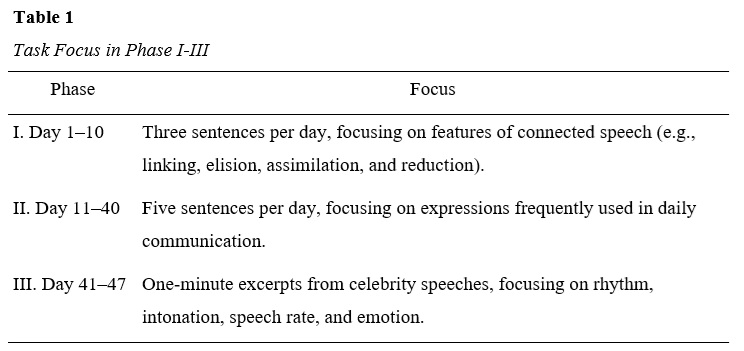
The program ran for 47 days (July–September 2025). Participants used Shadowing Saver, a web-based shadowing platform developed by the first author and colleagues (Nakanishi et al., 2022). The system provides audio presentation, recording, automated scoring, feedback, and submission management functions. Participants were instructed to follow a seven-step shadowing procedure daily (see Appendix). Using audio materials from Nakanishi (2023), the program was designed in three phases, each emphasizing different linguistic features and levels of task difficulty (Table 1). Phase I (Days 1–10) focused on features of connected speech, followed by Phase II (Days 11–40), which introduced everyday expressions. Finally, Phase III (Days 41–47) required higher sustained attention through authentic celebrity speeches.
The program also addressed the challenge of sustaining participation. Participants were asked to articulate a concrete goal at registration and to submit weekly reports during the seven-week training period. Each report included an open-ended prompt requiring participants to set a new goal for the following week, as well as quantitative items measuring self-efficacy for habit formation. By combining shadowing with structured goal setting and self-monitoring, the 2025 program sought to create a more supportive environment for continuous practice and meaningful oral skill development than that described by Nakanishi and Minematsu (2026).
Participants
Participants were recruited at the end of the 2025 spring semester from first- and second-year communication majors at a private university in western Japan, where the English conversation course was compulsory. In the final class, students were invited to join the Summer Shadowing Marathon. Based on scores obtained on the pre-program administration of the Versant English Speaking and Listening Test (Pearson Education, 2024), participants’ oral proficiency levels ranged from CEFR <A1 to A2 (Basic User). This relatively low proficiency suggests that continuous English speech processing likely posed a substantial cognitive challenge for this cohort. Participation was voluntary and unrelated to course grades, and only students providing consent for anonymized research use were included in the analysis.
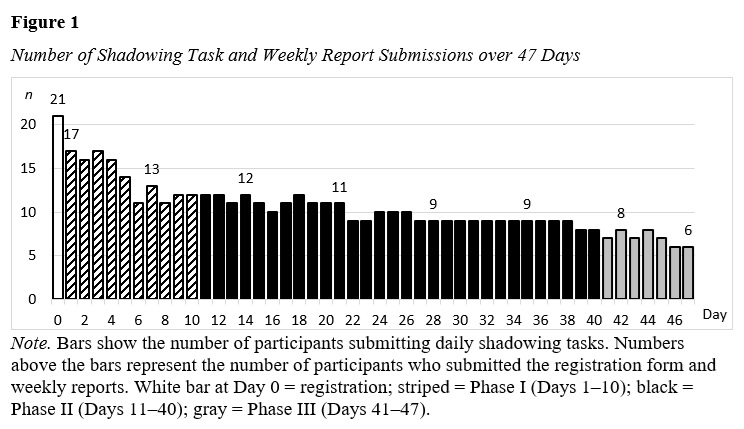
Following the three-phase structure described above, Figure 1 illustrates the number of students who were involved in the program. Of the 21 registrants, 17 initiated the practice. For the purposes of the present analysis, the 12 participants who submitted at least two weekly reports were included, as participants who submitted one or fewer reports did not provide sufficient longitudinal data for analysis. Based on their persistence across the different phases, participants were classified into two groups: Full (n = 6), who completed all three phases, and Partial (n = 6), who discontinued participation before completing all three phases.
Data Collection Instruments
Oral Proficiency Measure
The Versant English Speaking and Listening Test (Pearson Education, 2024) was used to assess oral proficiency. Participants completed the online test twice in university computer laboratories: once before the program (18 July 2025) and once after the program (19 September 2025). The test consists of six parts: (A) give a short answer to the question, (B) repeat the sentence, (C) answer a question about a conversation, (D) answer questions about a passage, (E) retell a passage, and (F) give an opinion. Based on these tasks, the following three scores were analyzed.
・Listening: The ability to understand specific details and main ideas from English speech (derived from parts A–E).
・Speaking: The ability to produce English phrases and clauses in complete sentences (derived from parts E and F).
・Manner of Speaking: The candidate’s pronunciation, fluency, and intelligibility in their speech, including rhythm and phrasing, accuracy of consonants, vowels, and stress, and understandability of speech (derived from parts B, E, and F).
To address RQ1, the analysis prioritizes mapping individual score trajectories to leverage the intensive nature of the data from the 12 participants, supplemented by non-parametric Wilcoxon signed-rank tests to identify broad group patterns.
Goal Setting (GS) Analysis
Participants were instructed to formulate goals using the Specific, Measurable, Achievable, Relevant, and Time-Bound (SMART) framework (Doran, 1981; Williams et al., 2015). At registration and each subsequent week, participants read short definitions and examples (Table 2) and wrote a personal goal designed to be slightly challenging yet attainable.
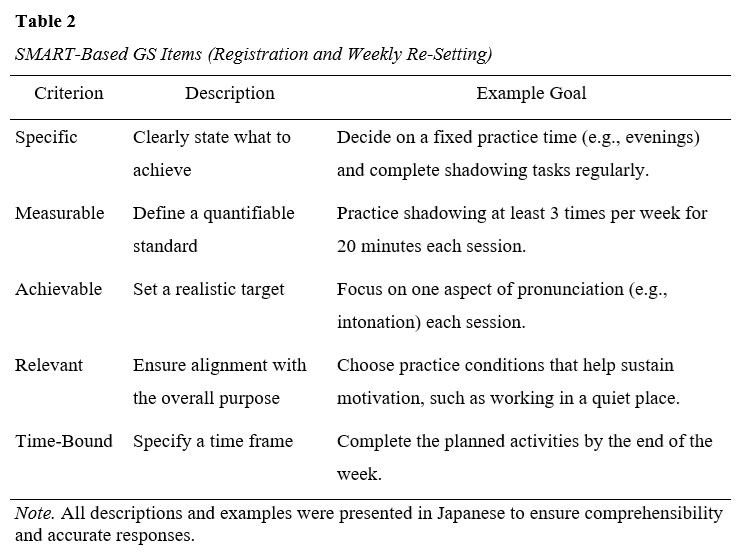
All GS statements were initially coded according to the five SMART categories. Two researchers, both experienced in second language acquisition research, coded the data independently to ensure a multi-perspective interpretation of the qualitative data. During the initial analysis, several statements turned out not to fit into these traditional categories. To address this, two additional categories were incorporated based on the learning strategies classification by O’Malley and Chamot (1990): Rewards (corresponding to self-reinforcement, e.g., self-promises of sweets or treats) and Self-Reflection (corresponding to self-evaluation, e.g., statements evaluating prior success or failure). This adaptation allowed for a more comprehensive analysis of the learners’ self-regulatory strategies. Inter-rater agreement was satisfactory: Specific (82.3%), Measurable (72.2%), Achievable (65.8%), Relevant (87.2%), Time-Bound (93.7%), Rewards (98.7%), and Self-Reflection (88.6%). During the reconciliation phase, the researchers met online and compared their coding results. When discrepancies arose, each researcher explained their rationale based on the established definitions until a 100% consensus was reached.
For RQ2, the proportions of GS codes across the training period were compared between the Full and Partial groups.
Self-Efficacy (SE) Scale
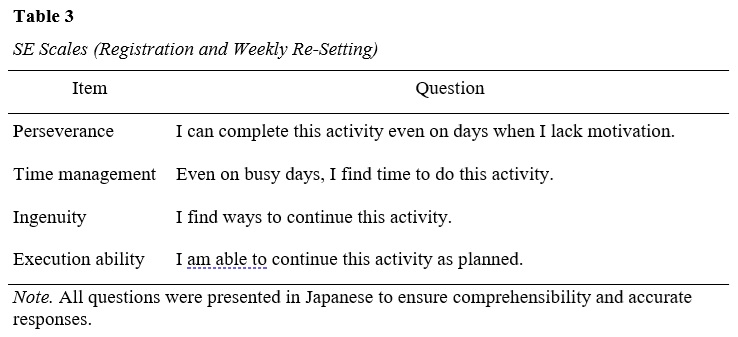
Each weekly report also included four items assessing SE for habit formation (Table 3), which were developed based on Bandura’s (2001, 2023) theory of SE. Items were rated on a five-point Likert scale (1 = strongly disagree, 5 = strongly agree). Descriptive statistics (means and standard deviations) were calculated for each week. Internal consistency was evaluated using Cronbach’s alpha (α), which ranged from .68 to .90, indicating acceptable to high reliability across administrations. Skewness and kurtosis values fell within ±2, suggesting no serious deviations from normality for descriptive purposes.
For RQ3, individual SE trajectories were plotted for each participant to track the weekly SE scores and to examine patterns of fluctuation and maintenance over time. Further, Spearman’s rank correlation coefficients were calculated separately for the Full and Partial groups to examine the relationship between English proficiency and SE. Confidence intervals for the correlation coefficients were then estimated using bootstrap resampling procedures.
Results and Discussion
Impact on Oral Proficiency (RQ1)
Figure 2 illustrates the pre- and post-program trajectories for three Versant sub-scores: Listening, Speaking, and Manner of Speaking. To assess these observed changes statistically, Wilcoxon signed-rank tests were conducted for both the Full (n = 6) and Partial (n = 6) groups.
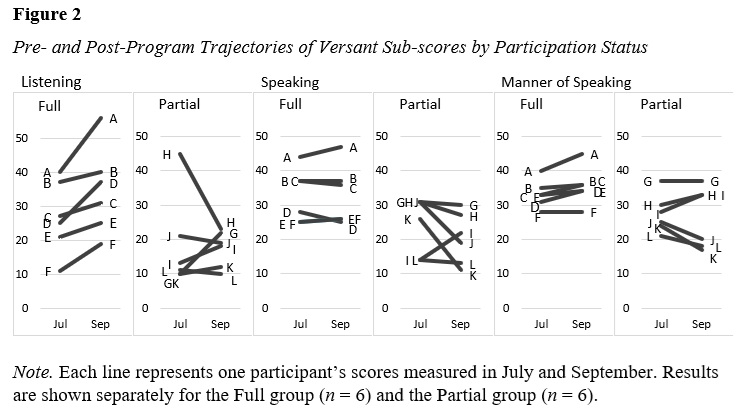
The Full group demonstrated significant gains in Listening (V = 0.0, z = 2.21, p = .027, r = .64), with all participants showing upward trajectories. In contrast, the Partial group showed no significant change (V = 9.5, z = 0.21, p = .834, r = .06) with high within-group variance. Although the sample size was small and the findings should be interpreted with caution, these results support the view that shadowing enhances perceptual processing (Hamada, 2019; Kadota, 2019). By functioning as overt phonological rehearsal within the working memory loop (Baddeley, 2003; Kadota, 2015, 2018), daily practice likely enhanced learners’ sensitivity to phonological detail, reconfirming findings from earlier iterations of the Marathon (Nakanishi et al., 2022).
In terms of Speaking scores, the Full group remained relatively flat (V = 6.5, z = 0.28, p = .783, r = .08), suggesting that while the program did not significantly enhance generative language control, it may have prevented its decay during the vacation. The lack of improvement may stem from a mismatch between repetition-based shadowing tasks and the generative nature of the assessment, or the seven-week duration being insufficient for measurable gains in lexical and syntactic control (Kadota, 2018, 2019). Conversely, the Partial group showed a trend in the direction of decline with a medium effect size (V = 17.0, z = 1.37, p = .172, r = .39). This decline mirrors documented patterns of rapid attrition in oral production skills when consistent practice is discontinued (Bardovi-Harlig & Stringer, 2010; Weltens, 1987).
For Manner of Speaking, which assesses articulatory and prosodic control, the Full group recorded significant gains (V = 0.0, z = 2.04, p = .041, r = .59). In contrast, the Partial group exhibited a small effect size toward decline (V = 10.0, z = 0.68, p = .496, r = .20). These findings highlight that prosodic sensitivity and articulatory accuracy are highly responsive to the auditory-verbal processing required by shadowing (Hamada, 2019; Kadota, 2019). Correspondingly, the downward trend in the Partial group underscores that these skills are also susceptible to attrition without consistent engagement.
In sum, the educational value of the program in this study lies in its dual role: facilitating gains in perceptual and prosodic skills while acting as a protective mechanism against the attrition of productive abilities. As noted by Nakanishi and Minematsu (2026), these benefits are exposure-dependent, making persistence a prerequisite for cognitive gains.
Qualitative Differences in Goal-Setting Strategies (RQ2)
To determine how GS behavior differed between the Full and Partial groups, we calculated the proportions of GS codes from the SMART framework (Doran, 1981; Williams et al., 2015) and two auxiliary codes used by each participant in their weekly reports (Figure 3).
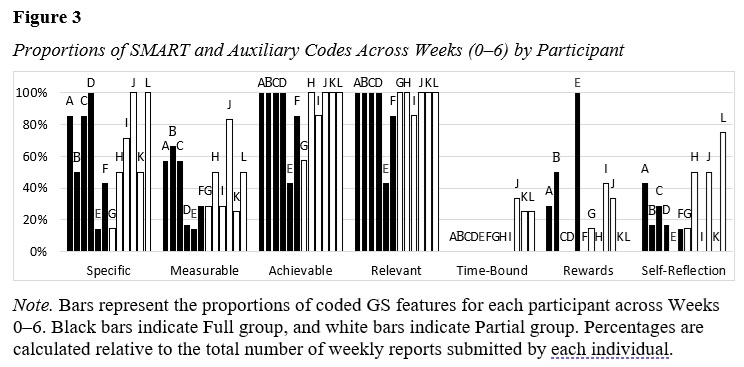
First, the results showed that Specific and Measurable dimensions were not primary factors distinguishing between the two groups. Instead, high individual variation was observed regardless of group membership, suggesting that the level of detail in planning was more a matter of personal style than a predictor of persistence. Although specific and challenging goals generally enhance performance (Locke & Latham, 2013), the present findings suggest that they may not ensure persistence in demanding autonomous tasks, where self-regulatory capacity may matter more than the goal’s initial form (Bandura, 2001).
Second, both groups generally set Achievable and Relevant goals. Most statements reflected a realistic assessment of the task load (e.g., Participant D in Week 2: “For listening practice, I will pay attention to understanding the gist of what is being said.”), indicating that students across both groups understood the relevance of the practice to their learning process.
The most striking difference between the Full and Partial groups emerged in their use of Time-Bound goals and Rewards. Notably, Time-Bound goals were employed exclusively by the Partial group; three participants showed a recurring concern with schedule adherence, which may have functioned as a stressor rather than a facilitator. For instance, in Week 4, immediately preceding her dropout, Participant J wrote: “I realized it is impossible to finish by 10 PM, so I will finish by 2 AM and also keep a notebook record every day.” While GS theory emphasizes the motivational benefits of clear deadlines (Locke & Latham, 2002), in the present context, rigid temporal constraints appeared to overwhelm the capacity for volitional control in low-proficiency learners. By contrast, Rewards in the Full group suggest that these participants used GS not only as a planning tool but also as a means of regulating affect and maintaining motivation. Participant E, for example, stated, “Every time I submit, I will buy a coffee or my favorite tea.” This use of self-reinforcement aligns with findings that self-generated rewards can bolster self-efficacy and support engagement more effectively than externally prescribed pressure (Bandura, 2013; Schunk, 1985).
Qualitative differences between the groups were also observed in Self-Reflection. While both groups engaged in reflective practices, the Full group tended to engage in adaptive, strategic reflection. Participant A (Week 4) noted: “I tended to get sick, so next week I will manage my health well… Recently, I have been getting nearly perfect scores, so I want to continue that.” Her focus on physical management and past success likely reinforced her self-efficacy (Bandura, 1997). In contrast, Partial participants often engaged in regret-based reflection. Participant L (Week 3) wrote: “There were sessions where I couldn’t meet the deadline, so next time I want to do my best to make it in time.” This fixation on past failures and missed deadlines corresponds with models of self-regulated learning (SRL), in which reflection that fails to facilitate forward-looking adjustments can undermine subsequent planning (Schunk, 2001; Zimmerman, 1998).
Individual cases further illustrate these differences beyond the standard framework. Participant F (Full) adopted a diary-like style, focusing on emotional state: “I continued even while having COVID-19… I won’t forget this feeling,” suggesting that emotional self-regulation was key to this participant’s persistence. Conversely, Participant G (Partial) consistently submitted vague goals such as “I will do my best,” which lacked the strategic depth required for self-regulation (O’Malley & Chamot, 1990). These cases suggest that persistence is less about adherence to a rigid SMART template and more about the learner’s ability to adapt GS to their psychological and situational needs, maintaining what Martin and Marsh (2008) describe as academic buoyancy.
In summary, the findings for RQ2 indicate that while both groups understood the basic requirements of the task, the Full group demonstrated more adaptive GS strategies. Persistence was characterized by the use of affective rewards and future-oriented reflection, whereas dropout was associated with rigid time-bound stressors and regret-based reflection. These qualitative differences suggest that the effectiveness of GS is mediated by learners’ internal states, leading to a deeper examination of the psychological mechanisms, specifically self-efficacy, underlying these behaviors.
Self-Efficacy Trajectories and Thresholds for Persistence (RQ3)
To examine how SE changed over the course of the program, weekly SE scores were averaged for each participant and then aggregated at the group level (Figure 4). These week-by-week trajectories illustrate the psychological fluctuations of the Full and Partial groups as they navigated the 47-day Shadowing Marathon.
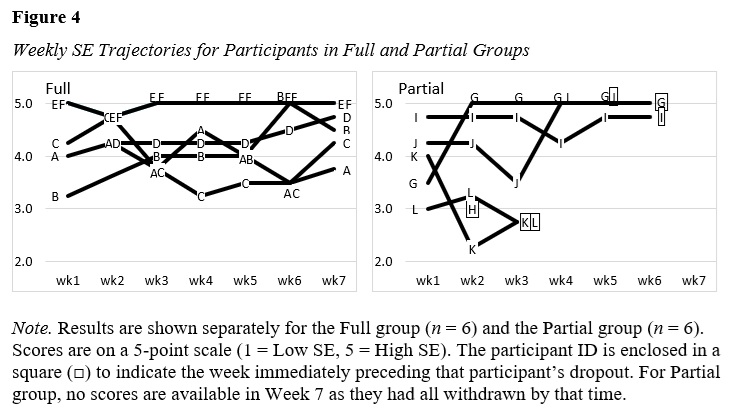
The initial SE scores in Week 1 showed a common pattern: all participants began the program with an SE score of 3.0 or higher. This suggests that students who voluntarily enrolled initially possessed a relatively positive sense of SE. As the program progressed, however, the two groups began to show different patterns. The Full group maintained an average SE score above the neutral point of 3.0 throughout the period, whereas two participants in the Partial group (K and L) saw their SE fall below this level and withdrew in the subsequent week. Although this pattern should be interpreted cautiously given the small sample size, it suggests that maintaining moderately positive SE, which Bandura (1997, 2013) links to beliefs about one’s agentic power to exercise control over overtaxing demands, may be associated with sustained autonomous training. When SE fell below this level, the perceived cost of effort may have outweighed perceived capability, leading to a breakdown in self-regulation (Schunk, 1990; Zimmerman, 1986).
Individual trajectories further highlight that SE is a dynamic and regulated process rather than a stable trait (Bandura, 2001, 2023). For example, Participant C experienced a mid-program decline (Weeks 3–6) but successfully recovered to complete the program, demonstrating the “academic buoyancy” needed to navigate everyday academic setbacks (Martin & Marsh, 2008). Conversely, Participants G and I were notable exceptions; they maintained high SE comparable to the Full group but withdrew during Phase III. As described earlier in Table 1, this phase introduced one-minute authentic speech excerpts, substantially increasing cognitive load. Their late-stage withdrawal suggests that high SE alone may not sustain participation when task difficulty exceeds learners’ current proficiency level.
The relationship between SE and persistence was further clarified by examining its correlation with post-program proficiency. Spearman’s rank correlation analysis revealed contrasting trends between the two groups. For the Full group (n = 6), a strong negative correlation was observed between SE and proficiency (ρ = -.812, p = .050, 95% CI [-.979, .000]). This suggests that among those who completed the program, lower-proficiency learners tended to report higher SE. One possible interpretation of this optimistic bias is the Dunning–Kruger effect, in which individuals with limited competence in a domain tend to overestimate their own ability due to a lack of metacognitive insight (Dunning, 2011). In the context of autonomous shadowing, this phenomenon may have functioned as a protective mechanism, allowing these learners in the present dataset to maintain effort despite their objective skill level (Bandura, 1993; Schunk & DiBenedetto, 2016). In contrast, the Partial group (n = 5) showed a strong positive correlation (ρ = .975, p = .005, 95% CI [.660, .998]), in which SE was positively related to proficiency. In this group, participants with lower proficiency (e.g., K and L) reported low SE and dropped out early, suggesting that their self-appraisal was more sensitive to their lack of skill, leaving them more vulnerable to the stressors of autonomous practice.
The findings for RQ3 suggest that SE functions not as a static predictor, but as a context-sensitive resource for persistence. In this dataset, persistence in autonomous shadowing was associated with maintaining SE above 3.0. Furthermore, maintaining SE despite low proficiency appeared to distinguish some Full participants from those who withdrew. These results indicate that SE may support the “staying power” required for sustained SRL (Schunk, 2001, 2012).
Synthesis: Conditions Associated with Successful Completion
The findings suggest that persistence in autonomous shadowing was not linked to a single factor but to interactions among learning outcomes, goal-setting strategies, and self-efficacy fluctuations. Table 4 synthesizes the tendencies observed in the present dataset that were associated with successful completion.
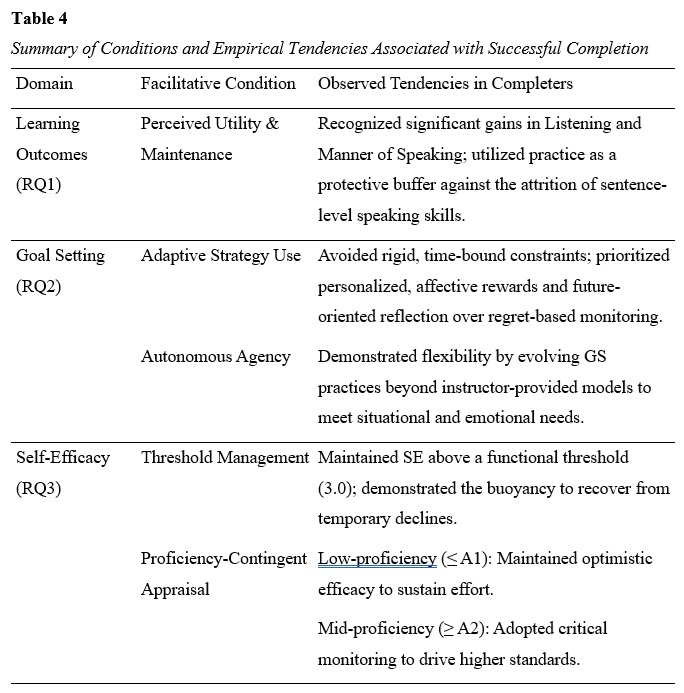
As shown in Table 4, successful completion appeared to be associated with adaptive self-regulation. Regarding learning outcomes, the divergence between the Full and Partial groups suggests that persistence may have served a dual function: supporting gains in receptive and articulatory-prosodic skills while helping prevent attrition in productive language control. Participants in the Full group may have recognized this utility, supporting their commitment to the daily task.
This persistence appeared to be supported by the interaction between GS quality and SE regulation. Unlike Partial participants, whose self-imposed deadlines appeared to create pressure, Full participants utilized flexible, self-generated rewards and strategic reflection. These adaptive GS practices appeared to support affective regulation and helped maintain SE at or above 3.0. Persistence did not appear to require consistently high SE, but rather the capacity to recover from temporary declines.
Furthermore, the role of SE appeared to vary by proficiency level. For learners at the CEFR A1 level or below, relatively optimistic SE may have helped them endure the cognitive load of shadowing. In contrast, A2-level learners appeared to persist through more critical, standards-based self-evaluation. This distinction suggests that SE may support continued engagement differently depending on proficiency level.
Overall, these findings suggest that sustaining demanding oral practice during academic breaks involves adaptive regulation. When learners are able to align their goal setting with their affective needs and maintain a resilient sense of efficacy suited to their proficiency level, they may move from task completion toward more agentic self-regulation. This interaction may help make a cognitively demanding autonomous task more sustainable and productive.
Conclusion
Pedagogical Implications
Although the findings should be interpreted cautiously given the small sample size, they offer several tentative implications for instructors seeking to support autonomous learning:
1. Encourage “Affective” Goal Setting: Instead of pushing for strictly measurable or time-bound targets, teachers should encourage learners to incorporate personalized rewards and adaptive reflections. Helping students view GS as a tool for emotional regulation, rather than just task management, may enhance long-term commitment.
2. Monitor Psychological Thresholds: Instructors should implement simple, weekly psychological check-ins (e.g., a single-item SE scale). A sustained drop in SE below a neutral point should be treated as a warning sign for potential withdrawal, prompting timely intervention or task adjustment.
3. Differentiate Support by Proficiency: Support should be tailored to the learner’s level. Lower-proficiency students may need more encouragement to maintain a “buoyant” sense of efficacy, while more advanced students may benefit from help in aligning their critical self-assessments with strategic planning.
Limitations and Future Outlook
While this study provides an in-depth look at the dynamics of persistence, it is not without limitations. The small sample size (n = 12) and the specific focus on shadowing within a Japanese university context limit the generalizability of the findings. The 7-week duration, while substantial for an intensive program, may not capture the long-term stability of the observed gains or the shifts in SE over an entire academic year.
Future research should explore these dynamics with larger, more diverse cohorts. Additionally, longitudinal studies could investigate whether the “adaptive regulation” skills developed during such intensive programs transfer to other areas of language learning.
In conclusion, sustaining autonomous practice is a sophisticated act of balance. By shifting the focus from mere task completion to learners’ psychological and emotional states, educators can better equip students to navigate the challenging but rewarding path of long-term language development.
Acknowledgments
This work was supported by JSPS KAKENHI Grant Numbers 22H00527, 23K17459, 24K04175, 25K04270, and 26K04206. The shadowing training interface used in this study was developed in collaboration with the research team led by Professor Nobuaki Minematsu of the Graduate School of Engineering, the University of Tokyo.
Notes on the Contributors
Noriko Nakanishi is a professor in the Language Education Support Research Division of the D3 Center at the University of Osaka. Her research interests include English phonetics, sociolinguistics, and education.
Yuka Muraoka is a professor in the Faculty of Humanities at Seigakuin University. Her research interests include shadowing, self-regulated learning, and English education.
Toshie Agawa is a professor in the School of Pharmacy and Pharmaceutical Sciences at Hoshi University. Her research interests include learner motivation, autonomy, engagement, and cooperative/collaborative learning.
References
Baddeley, A. (2003). Working memory and language: An overview. Journal of Communication Disorders, 36(3), 189–208. https://doi.org/10.1016/S0021-9924(03)00019-4
Bandura, A. (1993). Perceived self-efficacy in cognitive development and functioning. Educational Psychologist, 28(2), 117–148. https://doi.org/10.1207/s15326985ep2802_3
Bandura, A. (1997). Self-efficacy: The exercise of control. Freeman.
Bandura, A. (2001). Social cognitive theory: An agentic perspective. Annual Review of Psychology, 52, 1–26. https://doi.org/10.1146/annurev.psych.52.1.1
Bandura, A. (2013). The role of self-efficacy in goal-based motivation. In E. A. Locke & G. P. Latham (Eds.), New developments in goal setting and task performance (pp. 147–157). Routledge. https://doi.org/10.4324/9780203082744
Bandura, A. (2023). Social cognitive theory: An agentic perspective on human nature (D. Cervone, Ed.). Wiley.
Bardovi-Harlig, K., & Stringer, D. (2010). Variables in second language attrition: Advancing the state of the art. Studies in Second Language Acquisition, 32(1), 1–45. https://doi.org/10.1017/S0272263109990246
Doran, G. T. (1981). There’s a S.M.A.R.T way to write management’s goals and objectives. Management Review (AMA FORUM), 70(11), 35–36. https://www.eval.fr/wp-content/uploads/2020/01/S.M.A.R.T-Way-Management-Review-eval.fr_.pdf
Dunning, D. (2011). The Dunning–Kruger effect: On being ignorant of one’s own ignorance. In J. M. Olson & M. P. Zanna (Eds.), Advances in experimental social psychology (Vol. 44, pp. 247–296). Academic Press. https://doi.org/10.1016/B978-0-12-385522-0.00005-6
Hamada, Y. (2019). Shadowing: What is it? How to use it. Where will it go? RELC Journal, 50(3), 386–393. https://doi.org/10.1177/0033688218771380
Kadota, S. (2015). Shadōingu, ondoku to eigo komyunikeishon no kagaku [Science of shadowing, oral reading, and English communication]. Cosmopier.
Kadota, S. (2018). Gaikokugo wo hanaseru yōni naru shikumi [Mechanism of becoming a fluent L2 speaker]. SB Creative.
Kadota, S. (2019). Shadowing as a practice in second language acquisition: Connecting inputs and outputs. Routledge. https://doi.org/10.4324/9781351049108
Locke, E. A., & Latham, G. P. (2002). Building a practically useful theory of goal setting and task motivation: A 35-year odyssey. American Psychologist, 57(9), 705–716. https://doi.org/10.1037/0003-066X.57.9.705
Locke, E. A., & Latham, G. P. (2013). Goal setting theory, 1990. In E. A. Locke & G. P. Latham (Eds.), New developments in goal setting and task performance (pp. 3–15). Routledge. https://doi.org/10.4324/9780203082744
Martin, A. J., & Marsh, H. W. (2008). Academic buoyancy: Towards an understanding of students’ everyday academic resilience. Journal of School Psychology, 46(1), 53–83. https://doi.org/10.1016/j.jsp.2007.01.002
Nakanishi, N. (2023). Eigo shadōingu 100pon nokku [English shadowing 100-drill]. Cosmopier.
Nakanishi, N., & Minematsu, N. (2026). Preventing oral proficiency attrition during extended breaks: Longitudinal evidence from shadowing training in a Japanese EFL context. In P. Trofimovich, A. Bodea, T.-N. N. Le, R. Suzuki, & C. Teló (Eds.), Proceedings of the 16th Pronunciation in Second Language Learning and Teaching Conference (pp. 1–11). Concordia University, Montreal, Canada, October 2025. https://doi.org/10.31274/psllt.21332
Nakanishi, N., Minematsu, N., & Kunihara, T. (2022). Midoku passēji wo mochiita eigo shadōingu no kōka [Effects of English Shadowing Training Using Unlearned Passages on Listening and Speaking Skills]. Language Education & Technology, 59, 77–105. https://doi.org/10.24539/let.59.0_77
O’Malley, J. M., & Chamot, A. U. (1990). Learning strategies in second language acquisition. Cambridge University Press. https://doi.org/10.1017/CBO9781139524490
Pearson Education. (2024). Versant™ by Pearson English speaking and listening test: Test description and validation summary. https://www.pearson.com/content/dam/one-dot-com/one-dot-com/pearson-languages/en-gb/pdfs/versant-resources/validation-report-versant-by-pearson-english-speaking-and-listening-test.pdf
Schunk, D. H. (1985). Participation in goal setting: Effects on self-efficacy and skills of learning disabled children. Journal of Special Education, 19, 307–317. https://doi.org/10.1177/002246698501900307
Schunk, D. H. (1990). Goal setting and self-efficacy during self-regulated learning. Educational Psychologist, 25(1), 71–86. https://doi.org/10.1207/s15326985ep2501_6
Schunk, D. H. (2001). Social cognitive theory and self-regulated learning. In B. J. Zimmerman & D. H. Schunk (Eds.), Self-regulated learning and academic achievement: Theoretical perspectives (pp. 125–151). Lawrence Erlbaum Associates. https://doi.org/10.4324/9781410601032
Schunk, D. H. (2012). Social cognitive theory. In K. R. Harris, S. Graham, T. Urdan, C. B. McCormick, G. M. Sinatra, & J. Sweller (Eds.), APA educational psychology handbook, Vol. 1. Theories, constructs, and critical issues (pp. 101–123). American Psychological Association. https://doi.org/10.1037/13273-005
Schunk, D. H., & DiBenedetto, M. K. (2016). Self-efficacy theory in education. In K. R. Wentzel & D. B. Miele (Eds.), Handbook of motivation at school (2nd ed., pp. 34–54). Routledge.
Schunk, D. H., & Ertmer, P. A. (1999). Self-regulatory processes during computer skill acquisition: Goal and self-evaluative influences. Journal of Educational Psychology, 91(2), 251–260. https://doi.org/10.1037/0022-0663.91.2.251
Weltens, B. (1987). The attrition of foreign-language skills: A literature review. Applied Linguistics, 8, 22–37. https://doi.org/10.1093/applin/8.1.22
Williams, M., Mercer, S., & Ryan, S. (2015). Exploring psychology in language learning and teaching. Oxford University Press.
Zimmerman, B. J. (1986). Becoming a self-regulated learner: Which are the key subprocesses? Contemporary Educational Psychology, 11(4), 307–313. https://doi.org/10.1016/0361-476X(86)90027-5
Zimmerman, B. J. (1998). Developing self-fulfilling cycles of academic regulation: An analysis of exemplary instructional models. In D. H. Schunk & B. J. Zimmerman (Eds.), Self-regulated learning: From teaching to self-reflective practice (pp. 1–19). Guilford Publications.
Appendix
Tasks Assigned for Intensive Self-Training During Summer Vacation 2025
| Task | Description |
| 1) Shadowing (twice, normal speed) | Without script display, learners listen to the model audio and simultaneously repeat it aloud. The same utterance is shadowed and recorded twice. |
| 2) T/F Questions | Learners read sentences displayed on the screen and determine whether they match the content of the audio in Task 1 to check comprehension. |
| 3) Synchro-Reading (normal speed) | With the script visible, learners read aloud in sync with the model audio, guided by a waveform indicator. Listening accuracy is calculated by comparing recordings from Tasks 1 and 3. |
| 4) Synchro-Reading (slow audio) | Same as Task 3 but using slowed-down audio (0.5x and 0.8x speeds). Learners focus more closely on sound changes in connected speech. |
| 5) Synchro-Reading (normal speed) | Repeating Task 3 at normal speed. Learners may re-record as many times as desired to improve pronunciation. |
| 6) Overlapping (normal speed) | The script and real-time visual feedback (intensity and pitch patterns) are provided. Learners speak in unison with the model voice, aiming to exceed 60% in both pitch and intensity correlation scores. |
| 7) Reading Aloud | Without audio support, learners read the script aloud while following a visual pacing indicator. This task allows learners to check the final quality of their pronunciation and rhythm. |