Mayumi Kashiwa, Kanda University of International Studies, Japan https://orcid.org/0000-0003-0223-1710
Kashiwa, M. (2026). Bridging classroom and self-access learning: Teacher–advisor collaboration for learner autonomy. Studies in Self-Access Learning Journal, 17(3), 273–298. https://doi.org/10.37237/170302
Paginated version
Abstract
Ecological perspectives on language learning emphasize that learning develops through learners’ interactions with environments across multiple settings. This view is especially relevant to first-year university students, whose learning environments change as they enter higher education and who are expected to take greater responsibility for their learning. Drawing on spatial and ecological perspectives, this study examines how classroom-based practices helped students connect a compulsory English for Academic Purposes (EAP) course with a Self-Access Learning Center (SALC) and other out-of-class learning opportunities. SALC learning advisors collaborated with the classroom teacher through a team-teaching approach involving class visits, goal setting, action planning, e-Portfolio tasks, learning activity records, and reflection. Reflective questionnaire data from 37 students in the 2024 and 2025 cohorts and retrospective interviews with two focal learners were analyzed. The findings suggest that teacher–advisor collaboration helped make out-of-class learning more visible, approachable, and personally meaningful, while allowing students to decide whether and how to engage with the opportunities introduced. They also suggest that engagement beyond the classroom was shaped by emotional and relational support, routines, and changing learner identities. The study argues that teachers can support learner autonomy by positioning the classroom as a point of departure into wider learning spaces.
Keywords: learner autonomy, out-of-class learning, teacher–advisor collaboration, ecological perspective, self-determination theory
Language learning takes place across multiple spaces, including classrooms, self-access learning centers, online environments, peer networks, and everyday social contexts. From an ecological perspective, language learning environments are constructed through learners’ engagement with activities, resources, and relationships across settings (Barron, 2006; Benson, 2021). This is particularly relevant to first-year university students, who enter a new learning ecology in which they are expected to take greater responsibility for their learning and make decisions about how, where, and with whom to learn.
Self-Access Learning Centers (SALCs) can play an important role in this transition by providing resources, advising, study spaces, and opportunities for language use beyond the classroom. However, the availability of a SALC does not guarantee that students will recognize its value or connect it with their classroom learning. Entering a self-access environment can be daunting, particularly when students perceive a gap between their previous classroom-based learning experiences and the more socially and communicatively oriented practices of the SALC (Hooper, 2023). Students may therefore see the SALC as separate from required courses, feel uncertain about how to use it, or lack confidence in taking the first step. Their engagement with the SALC depends not only on the availability of resources, but also on whether they receive sufficient social and emotional support to recognize these resources as affordances and act on them.
Classroom teachers can foster such agency by helping students notice available resources, connect them to their own goals, and consider possible ways of engaging in out-of-class learning. In this study, the researcher, who was also the EAP classroom teacher, initiated collaborative sessions with learning advisors to make the relationship between the EAP classroom and the SALC more visible and accessible to students. These sessions were implemented alongside e-Portfolio tasks, learning activity records, and reflection activities.
The present study examines this classroom-based collaboration between a compulsory English for Academic Purposes (EAP) course and the SALC at a Japanese university. Drawing on questionnaire responses and retrospective interviews, it explores how students made sense of the relationship between EAP learning, SALC engagement, and other out-of-class learning opportunities. In doing so, it aims to clarify how classroom teaching, supported by learning advisors, can help students recognize and engage with wider language learning opportunities beyond the classroom.
Literature Review
Learning Ecologies, Spatial Perspectives, and Connected Language Learning
This study draws on ecological and spatial perspectives to understand how learners construct personal language learning environments across multiple settings. Barron (2006) defines a learning ecology as “the set of contexts found in physical or virtual spaces that provides opportunities for learning” (p. 195), with each context involving “a unique configuration of activities, material resources, relationships, and the interactions that emerge from them” (p. 195). This view shifts attention from learning in a single formal setting to how learning develops across interconnected settings.
In language learning research, a spatial perspective directs attention beyond fixed physical locations to how learning spaces are constituted through learners’ activities, interactions, movements, and use of resources across settings (Benson, 2017, 2021). From this perspective, classrooms, self-access centers, and other out-of-class settings form part of learners’ broader language learning environments rather than separate domains (Reinders & Benson, 2017). This framing allows the EAP classroom and the SALC to be understood as learning spaces that students may connect within their personal language learning environments.
Lai’s (2026) work on connected language learning further supports this view by showing how learning experiences across activity spaces can inform and transform one another over time. However, connections between learning spaces are not automatic. Learners need to perceive available resources as affordances, or “relationships of possibility” (van Lier, 2004, p. 105), and act on them in relation to their own goals. Previous studies have shown that learners may initially experience in-class and out-of-class learning as separate, but can come to perceive complementary or integrated relationships between them as they recognize affordances and act on them (Kashiwa & Benson, 2018; Lai, 2015; Lai et al., 2015). This suggests that the relationship between classroom learning and learning beyond the classroom is shaped by learners’ awareness of affordances, agency, and opportunities for meaningful participation.
Self-Access Learning, Advising, and Learner Autonomy
SALCs can extend classroom learning by offering resources, advising, study spaces, and opportunities for independent and collaborative language use. However, students may need guidance in understanding how these opportunities connect to their classroom learning and personal goals. Existing research has also shown that self-access learning can complement classroom learning and foster learner autonomy when students’ initial engagement is scaffolded through classroom-linked activities (Croker & Ashurova, 2012; Mayeda et al., 2016; Mynard & Stevenson, 2017; Reinders, 2007). Learning advising can mediate this process by encouraging learners to reflect on their needs, set goals, identify resources, make action plans, and take greater responsibility for their learning.
From a self-determination theory (SDT) perspective, self-access learning and advising can support learners’ basic psychological needs for autonomy, competence, and relatedness, understood respectively as a sense of volition and ownership, a sense of efficacy and effective engagement, and a sense of social connection and belonging (Mynard & Shelton-Strong, 2022; Shelton-Strong, 2022). Although the concepts are related, autonomy is conceptualized differently in learner autonomy research and SDT. In learner autonomy research, it generally concerns learners’ capacity to take responsibility for and make informed decisions about their learning (Benson, 2011), whereas in SDT, the need for autonomy refers more specifically to experiencing one’s actions as volitional and self-endorsed rather than externally controlled (Ryan & Deci, 2000). Advising has also been incorporated into classroom activities to raise learners’ awareness of their learning options and scaffold the development of learner autonomy (Horai & Wright, 2016).
From the perspective of the classroom teacher, Kashiwa (2021) illustrates how reflection on learning environments beyond the classroom can help learners recognize the value of the SALC and reconfigure their language learning environments. The present study extends this teacher-oriented discussion by examining classroom–SALC collaboration as a way of fostering learner autonomy.
Bridging Learning Spaces: Positioning the Present Study
The above literature points to the need to examine how connections between classroom learning and self-access learning are made visible in practice. This is particularly important for first-year university students, who may not yet know how to navigate institutional resources such as the SALC, and for teachers, who may not fully recognize how such spaces can support students’ learning. To help learners recognize the value of learning across multiple settings, teachers and SALC staff can work together to make these connections visible.
Recent research has called for pedagogical approaches that connect in-class and out-of-class language learning. Nguyen and Stracke (2021) argue that teachers should bridge classroom and out-of-class learning through tasks that encourage authentic language use, while Lai and Sundqvist (2026) emphasize teachers’ role in enabling learners to synergize in-class and out-of-class learning. The present study responds to this gap by examining teacher–advisor collaboration as a form of bridging that introduced first-year students to the SALC through the classroom while allowing them to decide whether and how to engage with it beyond class. The distinctive feature of this approach lies in integrating learning advising practices into a compulsory classroom-based course, so that students can become aware of self-access learning not simply as a separate institutional service, but as a possible resource within their developing personal language learning ecology.
In this study, bridging refers to classroom-based efforts to help learners recognize, access, and make personal meaning from language learning opportunities across classroom and out-of-class environments. It does not simply mean promoting SALC use, but involves helping students notice available resources, reduce emotional distance from unfamiliar spaces, set meaningful goals, reflect on their experiences, and consider possible pathways for engagement.
The study is guided by the following research questions:
- How did students retrospectively make sense of the connections between EAP classroom activities, SALC engagement, and out-of-class language learning?
- What kinds of classroom-based support helped students visualize and navigate these connections in ways that supported learner autonomy?
Methodology
Research Design
This study is a small-scale qualitative study supported by descriptive questionnaire data. It examines how students retrospectively made sense of a classroom-based attempt to connect a compulsory first-year EAP course with SALC-based and other out-of-class learning opportunities. Questionnaire responses provided contextual feedback on students’ perceptions, while interviews explored two focal learners’ experiences in greater depth. Rather than measuring autonomy development, the study examines how learners interpreted classroom-based guidance in relation to wider learning opportunities beyond the classroom.
Research Context and the EAP–SALC Bridging Approach
The study was conducted at a Japanese university where undergraduate English majors take a compulsory first-year EAP course. Although the course primarily aims to develop academic English skills, the researcher, who was also the classroom teacher, regarded the first-year EAP course as an important context for helping students become more aware of how they could continue learning beyond scheduled class time. This reflected the view that university language education should support not only academic English development, but also students’ capacity to identify relevant learning opportunities, make informed choices, and take increasing responsibility for their learning. The researcher therefore sought to support learner autonomy and engagement beyond regular classes without prescribing a particular pathway.
The university has a SALC that provides advising, study spaces, learning resources, and opportunities for language use. To help students connect the EAP course with these opportunities, learning advisors were invited to class at the beginning of each semester to introduce SALC resources, guide goal setting, and support students’ action planning. The bridging approach also included e-Portfolio tasks in which students kept learning activity records, and reflection activities designed to make out-of-class learning more visible, accessible, and personally meaningful. The approach was implemented over three academic years, but the present paper uses SALC-related questionnaire data from the 2024 and 2025 cohorts, when relevant questionnaire items were included.
Participants and Data Sources
The study draws on two forms of data. First, reflective questionnaire responses from 37 students in the 2024 and 2025 cohorts provided a broad overview of students’ perceptions of the EAP–SALC bridging activities, with analysis focused on SALC-related items and broader self-access learning activities.
Second, retrospective semi-structured interviews were conducted with two focal participants, Reona and Shiho, who were third-year students at the time of the interviews and had completed the EAP course two years earlier. They were selected as information-rich cases because they had engaged meaningfully with SALC resources and/or other out-of-class learning opportunities. Their cases were selected not to represent all students, but to provide insight into how classroom–SALC connections were interpreted by learners who took up these opportunities in different ways over time.
Questionnaire Data
At the end of the EAP course, students completed a reflective questionnaire as part of the teacher’s regular course reflection process. The 2024 and 2025 versions included items on SALC-related activities, learning advisor involvement, and autonomous learning beyond the classroom. These responses were treated as contextual feedback, not as a measure of effectiveness or as data for statistical testing. Relevant responses were summarized descriptively, and open-ended responses were reviewed for examples of how students described the usefulness of SALC-related activities, goal setting, and out-of-class learning guidance.
Retrospective Interviews and Recall Prompts
The main qualitative data source was retrospective semi-structured interviews with Reona and Shiho. During the interviews, they revisited learning records produced during the EAP course, including semester-based e-Portfolios and end-of-year questionnaire responses, which were used as recall prompts. The interviews explored how they remembered the EAP course, interpreted goal-setting and portfolio activities, engaged with the SALC and other out-of-class resources, and understood changes in their learning practices over time.
The interviews were conducted in Japanese, and the excerpts presented in the Findings section were translated into English by the author. The learning records were not treated as primary data for systematic document analysis, but as contextual materials for interpreting the interview accounts.
Data Analysis
Questionnaire responses were summarized descriptively to provide an overview of students’ feedback. Interview data were analyzed thematically, informed by ecological and spatial perspectives on language learning. Initial coding attended to people, places, tools, activities, affordances, constraints, and changes in engagement over time. Codes were then grouped into broader themes that captured patterns across the two cases while preserving differences between participants’ trajectories.
The researcher’s role as the EAP teacher was considered during analysis. Familiarity with the course context provided insight into the activities and institutional setting, but also required attention to how the researcher’s pedagogical interest in learner autonomy and classroom–SALC connections may have shaped interpretation. To address this, analysis was grounded closely in participants’ accounts through repeated readings and analysis of the transcripts.
Participation was voluntary, and informed consent was obtained from interview participants. Pseudonyms are used for all participants, and identifying information has been removed. The study followed the university’s ethical guidelines for research involving human participants.
Findings
This section first summarizes students’ course feedback on the EAP–SALC bridging approach, then presents interview findings from Reona and Shiho. The excerpts illustrate how they retrospectively interpreted their emotional engagement, perceptions of the SALC, and changing learning trajectories.
Questionnaire Overview: Students’ Feedback on the EAP–SALC Bridging Approach
The questionnaire responses from the 2024 and 2025 cohorts (N = 37) provide a broad overview of students’ course feedback. Students reported varying levels of engagement with self-access learning outside class: On a scale from 1 to 8, where 1 indicated “I did not use any of these activities” and 8 indicated “I actively engaged in self-access learning activities,” the mean score was 4.8 and the median was 5. Sixteen students reported relatively frequent engagement (scores 6–8), nine reported moderate engagement (scores 4–5), and twelve reported lower engagement (scores 1–3).
Because students could select multiple responses, Figure 1 reports the number of students who selected each option. Twenty-three students indicated that the SALC and learning advisors felt more familiar or approachable, sixteen felt encouraged to use the SALC, and thirteen found goal setting and planning useful. Only two reported little influence or limited SALC use.
Figure 1
Perceived Impact of Learning Advisor Class Visits
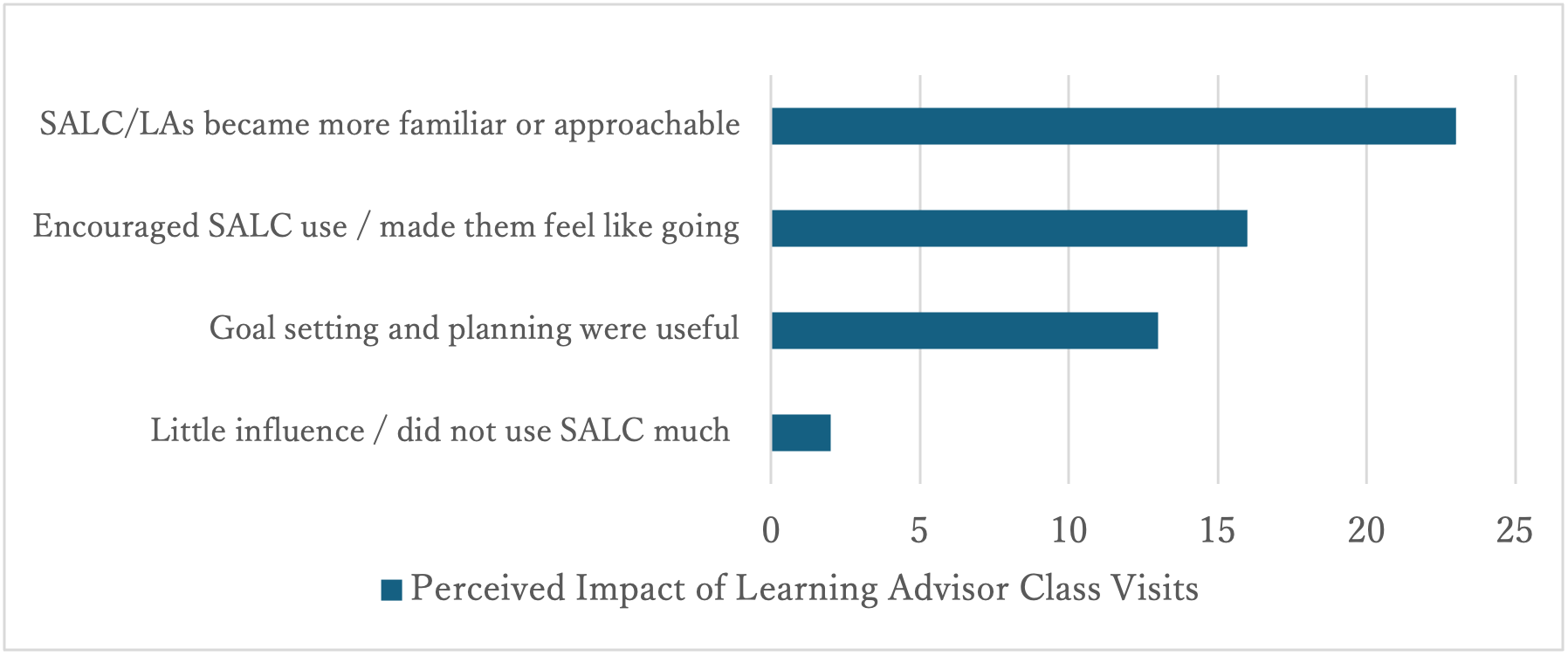
These responses suggest that the advisor visits and related class activities reduced many students’ perceived distance from the SALC and helped them see it as a possible learning space.
Students also described a range of self-access learning activities. These included SALC-related activities, such as speaking practice with teachers or international students and consultations with learning advisors, as well as independent learning activities such as TOEFL preparation, shadowing, listening to podcasts, and using films and English-language videos. These responses suggest that students’ self-access learning extended beyond the SALC and took place across institutional, digital, and personal spaces.
Overall, the questionnaire responses provide a descriptive context for understanding how students perceived the EAP–SALC bridging approach. They suggest that many respondents found the advisor visits useful in making the SALC and learning advisors more familiar and in connecting goal setting with concrete learning actions, while also showing variation in how students took up self-access learning opportunities. The following sections examine how Reona and Shiho made sense of these connections over time.
Making Out-of-Class Learning Visible and Approachable
Both focal participants described the EAP course as a relaxed and supportive environment that provided a low-risk starting point for exploring people and resources beyond the classroom, particularly through learning advisor involvement and SALC-related activities.
For Reona, seeing learning advisors in class made the SALC more familiar and emotionally accessible before approaching them individually:
Seeing them actually talk in class helped me feel reassured. I could think, “So these are the people in that place my senior talked about.” (Reona, interview)
This mattered because approaching the SALC required an initial step into an unfamiliar learning space. The in-class encounter reduced the distance between classroom learning and SALC support by turning an institutional facility into a space associated with recognizable people.
Shiho’s account also suggests that classroom-based exposure made SALC resources visible. She had some initial interest in out-of-class opportunities, but the EAP course helped her recognize specific options and consider which resources fit her goals. Importantly, she did not simply follow every suggestion. Instead, she selected what seemed useful and manageable for her, particularly Meet Teacher sessions for speaking practice.
I looked it up and thought about who was there and what kind of people they were. I wanted to work harder on my English, so I pushed myself and thought, “I have to do this.” (Shiho, interview)
These accounts indicate that bridging was not simply a matter of telling students that the SALC existed. Rather, the classroom helped make out-of-class resources socially and emotionally accessible. From an ecological perspective, the SALC began to function as an affordance when students perceived it as relevant to their needs and accessible to them.
Structuring Choice through Goal-Setting and Reflection
Goal-setting, e-Portfolios, and learning reflection enabled Reona and Shiho to transform general desires into concrete actions. Although both entered university wanting to improve their English, especially speaking, the EAP activities provided a structure for clarifying what they wanted to do and how to act on those goals.
Reona described the goal-setting activity as something she was unlikely to have done without classroom guidance:
I think it was really useful. If we had not had the chance to make those plans in class, I would definitely not have done it by myself. Doing it in class made me think more about my future, and it became clearer what I should do and what actions I should take. (Reona, interview)
Shiho also described goal-setting as helping her decide what action to take:
I think I probably wrote about listening and speaking. It was useful because it made things visible. I could understand, “This is what I should do.” (Shiho, interview)
These findings illustrate how autonomy-oriented pedagogy can structure learner choice without over-controlling it. The EAP course provided a framework for reflection and planning, while still allowing the two focal participants to select goals, choose resources, and decide how to engage. In this sense, classroom guidance scaffolded the development of learner autonomy.
Sustaining Participation through Relationships, Routines, and Emotional Engagement
Reona’s and Shiho’s accounts indicate that continued engagement with out-of-class learning was sustained not only by individual motivation, but also by relationships, routines, and repeated invitations to participate. For Reona, one learning advisor, Eric, became a key person in maintaining her motivation. She described weekly advising as a place where she could talk through her worries, especially when she compared her English with that of her classmates:
The person was definitely Eric. I talked with him throughout the year. Whenever I worried that I was in a lower position in the class because my English was not good enough, I went to talk to Eric every Tuesday. He encouraged me and gave me advice. He kept my motivation up. Tuesday became a reset day for me. (Reona, interview)
This account suggests that SALC engagement was not simply a matter of using a facility or completing an out-of-class activity. The repeated interaction with a trusted advisor provided emotional reassurance and helped Reona continue engaging with English at moments when anxiety or comparison with peers might otherwise have reduced her confidence.
Reona also explained that small interactional routines encouraged her to return. In particular, being invited to come back the following week helped turn one appointment into a continuing habit:
I think I continued because they said, “See you next week.” If they had only said, “See you,” I might have just thought, “Oh, okay…” (Reona, interview)
Although Reona later understood that this was probably a routine farewell, she experienced it at the time as a personal invitation to return. This small interactional routine highlights how continued participation can be supported through relational cues rather than formal requirements. She also recalled feeling nervous before going to advising or SALC-related sessions, although the interaction often became enjoyable once it began. This suggests that the emotional difficulty was often concentrated at the point of entry, before participation began.
Shiho’s engagement was also shaped by relationship and routine, although in a less intensive way. Her repeated meetings with one teacher, Chris, were connected to a shared interest in films. The teacher lent her DVDs, which gave her something to watch outside class and discuss in the following session. At the same time, Shiho emphasized that participation was emotionally demanding and required courage:
I was very nervous every time. Sometimes I even felt a little gloomy about going to those activities. After I went, it was fun, but before going I always felt, “What should I talk about?” or “What should I do?” (Shiho, interview)
She later described this first-year experience as a process of pushing herself beyond her comfort zone:
In my first year, there were times when I had to gather my courage. Mentally, I had to break out of my shell and push myself. (Shiho, interview)
These accounts suggest that autonomous learning was closely tied to social and emotional conditions. Rather than depending on individual determination alone, their engagement was supported through relationships, routines, and participation in a wider social ecology of learning.
Learning Ecologies and Learner Identities Change Over Time
Reona’s and Shiho’s accounts also indicate that classroom–SALC connections did not lead to a single stable pattern of autonomous learning. Their engagement shifted as their learning needs, confidence, schedules, interests, and life priorities changed.
Reona’s SALC engagement intensified after the first year. In her second year, she continued using Meet Teacher and learning advising frequently, partly because she felt pressure to keep up with classmates who seemed more proficient. By her third year, however, her engagement had decreased because of changing motivation, workload, hobbies, job hunting, and broader life priorities. Nevertheless, she still described the SALC as an important place in her English learning history:
The SALC was the reason I became able to have confidence in myself. It was a trigger that changed me. I could interact with people, borrow pronunciation books, and do many different things. I felt that I could get whatever I needed or wanted to do there. (Reona, interview)
For Reona, this change was not limited to learning behavior. She connected her SALC experiences to a broader change in confidence and identity:
My personality was probably completely different from now. At the beginning of first year, I was still very nervous and unsure, but after I started talking with people in the SALC, I changed. I became able to talk with people I did not know. My parents said, “You have changed! You have become brighter,” and my high school friends said, “What happened to you? You are so energetic.” I really feel that I changed. (Reona, interview)
Shiho’s trajectory was different. She used Meet Teacher and other opportunities in her first year, but did not continue the same activities in later years because of workload, scheduling, and changing priorities. Her engagement with English beyond regular classes did not disappear, but shifted toward other forms of participation, including interaction with international students and peer tutoring in English grammar:
I still want to do something related to international students or English. Now I am doing peer tutoring, teaching English grammar. I do not speak English outside class as much as before, but I try to continue doing something related to English, something beyond regular classes. (Shiho, interview)
Shiho also made sense of these experiences through a broader interest in communication. For her, the common thread across different activities was not only English practice, but learning how to relate to others:
I think the common point was communicating with others, doing something with someone rather than alone. Through doing many of those things, I experienced and learned different ways of relating to people. I came to feel that communication, in Japanese or English, was something I wanted to work harder on. (Shiho, interview)
These trajectories complicate a simple understanding of learner autonomy as continued participation in the same resource. Reona’s case highlights how SALC engagement became a source of confidence and identity change, while Shiho’s case illustrates how early SALC engagement could later be reconfigured into different forms of English-related participation. Viewed ecologically, learners’ pathways were shaped by changing configurations of people, places, activities, emotions, and priorities.
Discussion
In relation to the two research questions, this section first discusses how Reona and Shiho retrospectively made sense of connections among EAP classroom activities, SALC engagement, and later out-of-class learning. It then considers what kinds of classroom-based guidance helped them visualize and navigate these connections in relation to learner autonomy.
Students’ Retrospective Sense-making of Connected Learning Spaces
The first research question asked how students retrospectively made sense of connections between EAP classroom activities, SALC engagement, and out-of-class language learning. The findings suggest that the EAP classroom functioned not only as a site of formal academic English instruction, but also as a point of departure into a wider learning ecology. For Reona and Shiho, the SALC became meaningful when it was introduced through the classroom and linked to their goals, learning records, and personal concerns.
This is consistent with Reinders and Benson’s (2017) argument that language learning beyond the classroom connects with the classroom within broader social ecologies. It also extends Benson’s (2017, 2021) spatial perspective by showing how a self-access center can become connected with classroom learning through pedagogical mediation. In this study, learning advisor visits and classroom-based reflection strengthened the connection between the EAP classroom and the SALC, helping students experience their wider learning opportunities as more connected and meaningful.
Affordances, Agency, and Emotional Engagement
The findings also emphasize the role of both affordance perception and emotional engagement in students’ sense-making. A resource becomes an affordance when learners perceive it as a “relationship of possibility” and act on it in relation to their own goals (van Lier, 2004). Although the SALC was available to all students, Reona and Shiho needed to recognize particular people, activities, and routines as relevant and possible for them.
The findings add an emotional dimension to discussions of affordance perception and agency. Shiho’s account illustrated that SALC participation required courage, while Reona’s account highlighted how encouragement from a learning advisor helped her regain motivation. These findings develop Kashiwa and Benson’s (2018) argument that learners’ conceptions of in-class and out-of-class learning can shift as they become more aware of affordances and act on them. The present study suggests that such shifts may be facilitated not only by awareness raising, but also by emotionally supportive encounters with teachers, learning advisors, and peers.
Incorporating Advising Practices into Classroom-based Guidance
The second research question asked what kinds of classroom-based support helped students visualize and navigate connections across learning spaces in relation to learner autonomy. The findings indicate that goal setting, e-Portfolios, learning activity records, reflection, and learning advisor involvement supported students in transforming general intentions, such as wanting to improve speaking, into more concrete actions. These practices did not simply tell students to use the SALC; rather, they gave students a structure for noticing resources, clarifying goals, and deciding how to act.
Building on previous work on classroom-based advising (Horai & Wright, 2016), the present study shows how learning advisors’ advising techniques can be incorporated into classroom teaching through a team-teaching approach. Advisor-led goal setting and reflection created an initial pathway into SALC engagement without prescribing a single form of participation, leaving students to decide whether and how to use resources, construct personal language learning environments beyond the classroom, and adapt their engagement over time.
From an SDT perspective, these practices can be interpreted as supporting students’ basic psychological needs for autonomy, competence, and relatedness. Autonomy was supported by allowing students to identify personally meaningful goals and choose whether and how to engage with the SALC and other out-of-class learning opportunities. Competence was supported through structured reflection, action planning, and manageable initial steps that enabled students to translate broad intentions into feasible actions. Relatedness was supported through encounters and continuing relationships with learning advisors, teachers, and peers, which made unfamiliar learning spaces feel more approachable. These forms of support were interconnected, and the participants’ accounts suggest that feeling capable of participating and socially supported may have helped foster autonomous motivation to engage with personally meaningful learning opportunities.
This form of guided but open-ended classroom support responds to Reinders and Benson’s (2017) call for more research on how teachers prepare learners for learning beyond the classroom, and to Lai and Sundqvist’s (2026) argument that teachers play an essential role in enabling learners’ agentic actions in synergizing in-class and out-of-class learning. The present study adds a concrete example of how teachers can support learners in perceiving and acting on affordances beyond the classroom without prescribing a single pathway of engagement. For classroom teachers, this suggests that supporting learner autonomy does not necessarily require adding a separate autonomy-training component. It may begin with small classroom practices that help students identify available resources, set personally meaningful and realistic goals, and consider manageable first steps beyond the classroom.
Learner Autonomy as Relational Participation
The findings are consistent with established understandings of learner autonomy as socially mediated and compatible with collaboration and support from others (Dam et al., 1990). Reona’s and Shiho’s engagement was shaped by relationships with advisors, teachers, and peers, showing how learner autonomy was sustained through socially mediated participation. Support from others did not diminish their responsibility or capacity to make informed decisions about their learning; rather, it helped create the social and emotional conditions in which they could recognize possibilities and act on their intentions.
This relational understanding of learner autonomy can be connected to, but should be distinguished from, autonomy as a basic psychological need in SDT. In this framework, relatedness concerns feeling socially connected, included, and cared for (Mynard & Shelton-Strong, 2022; Shelton-Strong, 2022). In the present study, Reona’s continuing relationship with her advisor provided reassurance and encouragement when comparisons with her classmates undermined her confidence, while Shiho’s repeated interactions with a teacher gave personal and relational meaning to her participation despite her initial nervousness. These relationships appeared to support the participants’ need for relatedness and made continued engagement feel both possible and personally meaningful. This interpretation is also consistent with Hooper’s (2023) account of social support and low-anxiety forms of access as resources that help newcomers negotiate the discomfort of entering self-access environments.
Although the awareness-raising, goal-setting, and reflection activities were incorporated into a compulsory course, students were not required to use the SALC or participate in any particular service. They retained the choice of whether, how, and to what extent they would engage with the opportunities introduced. SALC participation could therefore be experienced as a volitional and self-endorsed form of engagement, supported rather than prescribed through classroom-based guidance. Classroom-based bridging supported learner autonomy by helping students enter relationships and routines through which they could exercise choice, develop confidence, and expand their learning possibilities. In this sense, learner autonomy was supported and enacted through relational participation within a wider learning ecology.
Changing Learning Ecologies and Learner Identities
Finally, the study suggests that bridging learning spaces does not produce a single linear trajectory. Reona’s and Shiho’s changing engagement supports Lai’s (2026) connected view of language learning across time and space, in which different learning experiences can inform and transform one another rather than remain fixed in one setting.
The findings also add an identity-related dimension to classroom–SALC bridging. Reona’s account that she had become a different person suggests that SALC engagement was meaningful not only because it increased her learning opportunities, but because she associated it with changes in how she saw herself and related to others. Shiho’s account similarly suggests that first-year SALC experiences contributed to a broader orientation toward communication and English-related participation, even though her later activities took different forms. Thus, the success of bridging should not be evaluated only by continued use of the same resource. In ecological terms, its value may also lie in helping learners develop confidence, recognize possibilities, and reconfigure their engagement with English as their learning ecologies change.
Conclusion
This study examined how students made sense of a classroom-based attempt to bridge EAP learning, SALC engagement, and out-of-class language learning. Course feedback from 37 students provided contextual evidence that many respondents perceived the advisor visits and related activities as making the SALC and learning advisors more familiar and approachable. Retrospective interviews with two focal learners showed how classroom-based guidance helped students recognize and engage with out-of-class learning opportunities in personally meaningful ways.
The study contributes to research on learner autonomy, self-access learning, and learning beyond the classroom by illustrating how a compulsory course can serve as a point of departure into wider learning spaces. It also highlights how learning advisors’ advising techniques can be incorporated into classroom teaching through a team-teaching approach, creating guided but open-ended opportunities for students to develop personal language learning environments beyond the classroom. The findings further suggest that students’ engagement with such environments is shaped by emotional engagement, relationships, routines, and changes in learner identity over time.
These findings suggest that learner autonomy is not fostered simply by asking students to become independent or by making self-access resources available. It can be encouraged when classroom teachers and learning advisors work together to make opportunities visible, reduce emotional distance from unfamiliar spaces, and support meaningful participation across learning settings. The value of such bridging should therefore not be judged only by continued use of the same resource, as engagement may intensify, decline, or shift as learners’ priorities, relationships, and identities change.
The study is limited by its small scale and retrospective design. The questionnaire data provide only a descriptive overview of students’ perceptions, while the interviews focus on two learners who engaged meaningfully with the SALC and out-of-class learning opportunities. Nevertheless, the findings offer insight into how students interpreted classroom–SALC connections in shaping their later engagement with wider learning ecologies. Future research could examine larger groups, include longitudinal data, or explore teacher–advisor bridge-building between classroom and out-of-class learning.
Notes on the Contributor
Mayumi Kashiwa is a lecturer in the Department of English at Kanda University of International Studies, Japan. Her research interests include language learning beyond the classroom, learner autonomy, multilingual learners’ identities and experiences, teacher psychology, and teacher professional development. Her research explores how learners and teachers engage with language learning across different contexts and experiences.
References
Barron, B. (2006). Interest and self-sustained learning as catalysts of development: A learning ecologies perspective. Human Development, 49(4), 193–224. https://doi.org/10.1159/000094368
Benson, P. (2011). Teaching and researching autonomy (2nd ed.). Routledge.
Benson, P. (2017). Language learning beyond the classroom: Access all areas. Studies in Self-Access Learning Journal, 8(2), 135–146. https://doi.org/10.37237/080206
Benson, P. (2021). Language learning environments: Spatial perspectives on SLA. Multilingual Matters. https://doi.org/10.21832/9781788924917
Croker, R., & Ashurova, U. (2012). Scaffolding students’ initial self-access language centre experiences. Studies in Self-Access Learning Journal, 3(3), 237–253. https://doi.org/10.37237/030303
Dam, L., Eriksson, R., Little, D., Miliander, J., & Trebbi, T. (1990). Towards a definition of autonomy. In T. Trebbi (Ed.), Third Nordic workshop on developing autonomous learning in the FL classroom, Bergen, August 11–14, 1989: Report (pp. 102–103). Institutt for praktisk pedagogikk, Universitetet i Bergen.
Hooper, D. (2023). Mind the gap: Student-developed resources for mediating transitions into self-access learning. JASAL Journal, 4(1), 32–54.
Horai, K., & Wright, E. (2016). Raising awareness: Learning advising as an in-class activity. Studies in Self-Access Learning Journal, 7(2), 197–208. https://doi.org/10.37237/070208
Kashiwa, M. (2021). “The SALC is mine!”: Supporting the development of learner agency and reconfiguration of language learning environments beyond the classroom. Studies in Self-Access Learning Journal, 12(4), 319–340. https://doi.org/10.37237/120402
Kashiwa, M., & Benson, P. (2018). A road and a forest: Conceptions of in-class and out-of-class learning in the transition to study abroad. TESOL Quarterly, 52(4), 725–747. https://doi.org/10.1002/tesq.409
Lai, C. (2015). Perceiving and traversing in-class and out-of-class learning: Accounts from foreign language learners in Hong Kong. Innovation in Language Learning and Teaching, 9(3), 265–284. https://doi.org/10.1080/17501229.2014.918982
Lai, C. (2026). Technology and connected language learning across time and space. Cambridge University Press. https://doi.org/10.1017/9781009657853
Lai, C., & Sundqvist, P. (2026). Research agenda: Synergizing in-class and out-of-class language learning with technology. Language Teaching, 59(1), 60–81. https://doi.org/10.1017/S026144482500014X
Lai, C., Zhu, W., & Gong, G. (2015). Understanding the quality of out-of-class English learning. TESOL Quarterly, 49(2), 278–308. https://doi.org/10.1002/tesq.171
Mayeda, A., MacKenzie, D., & Nusplinger, B. (2016). Integrating self-access centre components into core English classes. Studies in Self-Access Learning Journal, 7(2), 220–233. https://doi.org/10.37237/070210
Mynard, J., & Shelton-Strong, S. J. (2022). Self-determination theory: A proposed framework for self-access language learning. Journal for the Psychology of Language Learning, 4(1), 1–14. https://doi.org/10.52598/jpll/4/1/5
Mynard, J., & Stevenson, R. (2017). Promoting learner autonomy and self-directed learning: The evolution of a SALC curriculum. Studies in Self-Access Learning Journal, 8(2), 169–182. https://doi.org/10.37237/080209
Nguyen, V., & Stracke, E. (2021). Learning experiences in and outside class by successful Vietnamese tertiary students studying English as a foreign language. Innovation in Language Learning and Teaching, 15(4), 321–333. https://doi.org/10.1080/17501229.2020.1801692
Reinders, H. (2007). University language advising: Is it useful? Reflections on English Language Teaching, 5(1), 79–92.
Reinders, H., & Benson, P. (2017). Research agenda: Language learning beyond the classroom. Language Teaching, 50(4), 561–578. https://doi.org/10.1017/S0261444817000192
Ryan, R. M., & Deci, E. L. (2000). Self-determination theory and the facilitation of intrinsic motivation, social development, and well-being. American Psychologist, 55(1), 68–78. https://doi.org/10.1037/0003-066X.55.1.68
Shelton-Strong, S. J. (2022). Advising in language learning and the support of learners’ basic psychological needs: A self-determination theory perspective. Language Teaching Research, 26(5), 963–985. https://doi.org/10.1177/1362168820912355
van Lier, L. (2004). The ecology and semiotics of language learning: A sociocultural perspective. Kluwer Academic Publishers.