Jo Mynard, Kanda University of International Studies, Chiba, Japan. https://orcid.org/0000-0003-0363-6461
Dominique Vola Ambinintsoa, Kanda University of International Studies, Chiba, Japan. https://orcid.org/0000-0001-5987-3242
Mynard, J., & Ambinintsoa, D. V. (2026). Introduction. Studies in Self-Access Learning Journal, 17(3), 268–272. https://doi.org/10.37237/170301
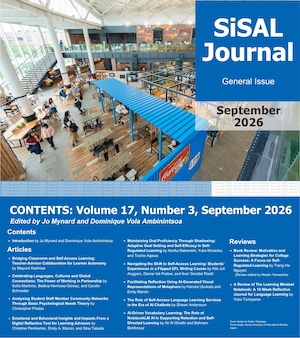
Welcome to the September 2026 issue of SiSAL Journal, featuring nine papers and two book reviews. The authors are based in Indonesia, Japan, Oman, Thailand, the United Kingdom, and Vietnam. The papers are excellent examples of current directions in the field of self-access, and we have organized them in a way that tells a story. The first two papers (Kashiwa; Martinho et al.) explore how self-access connects with wider learning spaces and communities. The subsequent two papers (Phelps; Pemberton et al.) explore the lives of people within self-access communities. Following this, two papers (Nakanishi et al.; Anggoro et al.) explore self-regulation and learning processes within self-access. The final three papers (Ubukata & Marzin; Andersson; Al Ghaithi & Behforouz) highlight the growing role of generative AI technologies in self-access language learning. We are also happy to include two book reviews related to the themes of self-regulated and self-directed learning (Nguyen; Tomiyama).
Contents
Articles
The first paper is by Mayumi Kashiwa from Kanda University of International Studies in Japan. The author draws on spatial and ecological perspectives to examine how classroom-based practices helped students connect a compulsory English for Academic Purposes (EAP) course with a Self-Access Learning Center (SALC) and other out-of-class learning opportunities.
Continuing with the theme of institutional collaboration and partnership, the second paper, by Sofia Martinho, Bettina Hermoso-Gómez, and Carolin Schneider from the University of Leeds in the United Kingdom, examines a strategic partnership in the UK. The authors present a case study of a fruitful collaboration between the Language Zone, a self-access language learning centre at the University of Leeds, and the 2025 Leeds City of Languages Festival.
The second theme examines the lives and well-being of people within a SALC. The third paper is by Christopher Phelps from Osaka Institute of Technology in Osaka, Japan. The author explores the internal dynamics of a community of learners in a self-access center in Japan using social network analysis through the lens of basic psychological needs theory. The results highlight how the organizational structure can impact motivation and general group well-being.
The fourth paper, by Christine Pemberton, Emily A. Marzin, and Sina Takada from Kanda University of International Studies in Japan, examines a reflective digital application-based tool called EmotioNote to enhance learning advisors’ well-being. The authors describe a mixed-methods study investigating the tool’s reported influence on the emotions and practices of six learning advisors at a Japanese university, with promising results.
Two papers in this issue investigate learning processes, starting with a contribution from Japan by Noriko Nakanishi (University of Osaka), Yuka Muraoka (Seigakuin University), and Toshie Agawa (Hoshi University). The authors report on a mixed-methods study investigating the mechanisms supporting persistence in autonomous shadowing during an academic break period. Insights from the findings suggest that sustained autonomous learning is influenced by adaptive regulation. The authors provide practical frameworks for educators interested in supporting learner persistence.
The sixth paper is by Kiki Juli Anggoro (Walailak University, Thailand), Damar Isti Pratiwi (Politeknik Perkeretaapian Indonesia Madiun, Indonesia), and Ikrar Genidal Riadil (Walailak University, Thailand). The authors discuss a study that explores how 58 Thai university students engaged in independent preparation before a flipped EFL writing class by choosing resources and strategies and recording their reflections over six weeks. The authors highlight the value of pedagogically self-access learning in developing self-regulated learning and AI literacy.
The final three papers explore how generative AI is being utilized in self-access learning. The seventh paper, by Haruka Ubukata and Emily Marzin from Kanda University of International Studies in Japan, employs generative AI tools to create visual metaphors intended to support learner reflection. Open-ended questionnaire responses indicated that AI-generated visual metaphors could be a useful resource for promoting reflection.
The eighth paper, by Shawn Andersson from the University of Osaka in Japan, investigates learners’ perceptions of the usefulness of AI for independent learning and of self-access services. Results of a survey containing both quantitative and qualitative measures administered to 172 students showed that learners viewed both kinds of services as valuable for different purposes and as complementary rather than competing resources for English learning.
The final paper in this section is by Behnam Behforouz (Sohar University, Oman) and Ali Al Ghaithi (University of Nizwa, Oman), who compare conventional classroom teaching with NotebookLM-supported learning among 70 Omani EFL students, finding that the AI-supported group achieved stronger vocabulary retention and self-directed learning skills. The authors emphasize the potential of NotebookLM to prepare learners for more active and independent participation in self-access learning environments.
Book Reviews
The first review, edited by Hisako Yamashita, was written by Trang Ha Nguyen, Vietnam National University. The author reviews the 7th edition of the book Motivation and Learning Strategies for College Success: A Focus on Self-Regulated Learning (Helena Seli, 2023) by highlighting the book’s clear organization of self-regulated learning and its effective integration of theory, reflective activities, and practical strategies for academic success.
The second review is by Yuko Tomiyama from Meiji University, Japan. She examines The Learning Mindset Notebook: A 12-Week Reflective Journal for Language Learning (Kato & Yoshinaga, 2026), a structured workbook that offers a series of activities that encourage learners to examine how they approach language learning and make informed decisions about their progress. The review highlights the value of the workbook as a practical resource for promoting reflection and learner autonomy.
Acknowledgements
Many thanks to members of our review and editorial teams for their insightful comments and helpful feedback. We would not be able to publish this issue without you. Appreciation also goes to all the authors who shared their work with us.
Notes on the Editors
Jo Mynard is a professor in the Faculty of Global Liberal Arts, Director of the Self-Access Learning Center, and Director of the Research Institute for Learner Autonomy Education at Kanda University of International Studies in Chiba, Japan. She has an M.Phil. in Applied Linguistics (Trinity College, University of Dublin, Ireland) and an Ed.D. in TEFL (University of Exeter, UK). Her research interests include advising in language learning, the psychology of language learning, and learning beyond the classroom.
Dominique Vola Ambinintsoa is a senior learning advisor and lecturer at Kanda University of International Studies in Japan. She holds a PhD in Applied Linguistics focusing on learner autonomy (Victoria University of Wellington, New Zealand) and an Ed.M in TESOL (State University of New York at Buffalo, US). Her research interests include learner autonomy, self-regulated learning, the psychology of language learning, and advising in language learning.