Kiki Juli Anggoro, School of Education, Research Center for Language Teaching and Learning, and Center of Excellence on Women and Social Security, Walailak University, ThaSala, Thailand. https://orcid.org/0000-0002-5519-3036
Damar Isti Pratiwi, Politeknik Perkeretaapian Indonesia Madiun, Madiun, Indonesia. https://orcid.org/0000-0002-8009-0215
Ikrar Genidal Riadil, School of Languages and General Education, and Research Center for Language Teaching and Learning, Walailak University, ThaSala, Thailand. https://orcid.org/0000-0003-0619-7054
Anggoro, K. J., Pratiwi, D. I., & Riadil, I. G. (2026). Navigating the shift to self-access learning: Students’ experiences in a flipped EFL writing course. Studies in Self-Access Learning Journal, 17(3), 382–414. https://doi.org/10.37237/170307
Abstract
Developing learner autonomy remains a central goal of self-access language learning, yet many English as a Foreign Language (EFL) learners experience difficulties regulating independent learning. This study investigated students’ experiences with a semi-structured pre-class self-access learning approach implemented in a flipped EFL writing course. During a six-week intervention, 58 undergraduate students in a Thai university independently selected learning resources and strategies, and synthesized information through reflective notebook writing. A mixed-methods descriptive design was employed, combining questionnaire data with focus group discussions to examine students’ perceptions, challenges, and learning strategies. Overall, students reported positive perceptions of learning preparation, information management, learning responsibility, and writing readiness. However, they also experienced challenges related to limited linguistic knowledge, evaluating multiple resources, and regulating independent learning. Students addressed these challenges through planning, reflective notetaking, strategic help-seeking, and critical use of multiple learning resources, including GenAI. The findings suggest that semi-structured self-access learning, supported by pedagogical scaffolding, can provide a structured context for exercising learner autonomy while promoting self-regulated learning and emerging GenAI literacy.
Keywords: EFL writing, flipped classroom, learner autonomy, self-access language learning, self-regulated learning
Learner autonomy has become a central objective of language education, reflecting the growing expectation that learners take greater responsibility for their own language development both inside and beyond the classroom. This emphasis has encouraged higher education institutions to promote self-access language learning, in which learners engage in supported learning outside formal classroom instruction (Mynard, 2024; Pratiwi & Yonata, 2026). Rather than simply providing additional learning opportunities, self-access language learning encourages learners to identify learning needs, select appropriate resources, monitor their progress, and reflect on their learning experiences. Consequently, learner autonomy is increasingly viewed as an essential graduate attribute in higher education (Anggoro, 2025; Raitskaya et al., 2021). However, participating successfully in self-access learning remains challenging, particularly for learners with limited experience in directing their own learning (Jin et al., 2023; Morris et al., 2025). Access to learning resources alone does not guarantee meaningful learning; rather, learners require the capacity to regulate and evaluate their own learning processes to benefit fully from self-access opportunities.
One theoretical perspective that explains how learners manage independent learning is self-regulated learning (SRL). According to Zimmerman (2008), SRL refers to the cognitive, motivational, behavioral, and metacognitive processes through which learners actively plan, monitor, and evaluate their learning. Closely related to SRL is metacognitive awareness, which enables learners to recognize their current understanding, identify knowledge gaps, select appropriate learning strategies, and adjust those strategies when necessary (Dahri et al., 2024; Elsayad, 2024; Karlen et al., 2023). Such competencies are particularly important in self-access language learning because learners assume greater responsibility for directing their own learning without continuous teacher guidance. Nevertheless, previous studies indicate that many learners struggle to regulate their learning effectively without appropriate scaffolding, suggesting that learner autonomy develops gradually rather than emerging automatically (Anggoro & Pratiwi, 2023; Wu, 2024). In many educational contexts, teacher-centered instruction continues to dominate classroom practice, making the transition toward independent learning challenging for both teachers and students (Busa & Chung, 2024; Woods & Copur-Gencturk, 2024). Developing learner autonomy therefore requires structured pedagogical support that gradually transfers responsibility from teachers to learners (Slabodar, 2024).
One instructional approach that may naturally support this gradual transition is the flipped classroom. By relocating initial knowledge acquisition to the pre-class phase, flipped learning encourages students to engage with learning resources independently before attending class, allowing classroom time to focus on application, collaboration, and feedback (Anggoro & Khasanah, 2022; Naing et al., 2023; Pratiwi & Anggraeni, 2026). This design creates opportunities for learners to assume greater responsibility for their preparation while enabling teachers to provide guidance during higher-order learning activities. However, many flipped classroom implementations continue to rely heavily on teacher-selected learning materials, such as recorded lectures, readings, quizzes, or instructional videos. Although these approaches have been shown to enhance student engagement, they often position teachers as the primary organizers of pre-class learning, leaving learners with relatively limited opportunities to make decisions about what resources to use and how to regulate their learning (Alsiyabi et al., 2026; Güven & Eğmir, 2026).
Recent technological developments have expanded opportunities for self-access learning by providing learners with immediate access to diverse learning resources. In particular, generative artificial intelligence (GenAI) has become an increasingly accessible learning tool capable of providing explanations, examples, grammar support, and writing assistance (Wilde, 2024). Together with other digital resources, GenAI can reduce barriers to accessing information and provide learners with personalized support during independent study (Gligorea et al., 2023; Lan & Zhou, 2025). However, greater access to information also creates new demands on learners. Rather than accepting AI-generated responses uncritically, learners must determine when GenAI is appropriate, evaluate the credibility of generated information, compare multiple sources, and avoid overdependence on GenAI-generated content (Vaccaro et al., 2024). Consequently, effective participation in contemporary self-access language learning requires not only self-regulation but also the GenAI literacy needed to use these technologies critically and responsibly.
Although flipped classrooms have frequently been associated with independent pre-class learning, previous research has primarily examined teacher-curated instructional materials, such as videos, quizzes, and interactive slides. Much less is known about how learners experience pre-class learning when they independently locate, evaluate, and synthesize learning resources within a structured self-access environment. Furthermore, although GenAI is becoming an increasingly common learning tool, relatively little research has explored how learners negotiate its use while simultaneously developing learner autonomy. Understanding these experiences is important because self-access learning increasingly occurs in digital environments where learners must manage abundant learning resources while making informed decisions about their own learning.
To address these gaps, the present study redesigned the pre-class component of a flipped EFL writing course by shifting responsibility for learning from the teacher to the learner while maintaining clear curricular objectives. Instead of relying on teacher-prepared materials, students independently selected learning resources, including textbooks, websites, educational videos, and GenAI tools, and synthesized their understanding through handwritten notebook summaries before attending class. This semi-structured pre-class SRL approach was designed to encourage learner-directed resource selection, metacognitive reflection, and responsible learning beyond the classroom while providing sufficient scaffolding for learners who were still developing autonomy. This study addresses the following research questions:
1) How do students perceive the structured pre-class self-access learning activities?
2) What constraints do students encounter during structured pre-class self-access learning?
3) How do students navigate these constraints while preparing for class?
Research Methodology
Research Design
This study forms part of a larger design-based research (DBR) project aimed at developing and refining a model of semi-structured self-access EFL learning. The larger project involves iterative cycles of design, implementation, evaluation, and refinement. The present article reports only the testing and evaluation component of the first cycle, focusing specifically on students’ experiences of the pre-class learning component.
The scope of the present study is therefore narrower than the larger DBR project. It examines (a) students’ perceptions of the pre-class self-access activities, (b) constraints they experienced while engaging in these activities, and (c) strategies they reported using to navigate those constraints. It does not examine the development or effectiveness of the complete self-access learning model, changes in learner autonomy across the six-week period, comparative learning gains, or the outcomes of subsequent DBR cycles. In addition, students’ course grades and the quality of their handwritten summaries are not analyzed as outcome measures in this article.
A mixed-methods descriptive design was used to integrate questionnaire data with students’ retrospective accounts from focus group discussions. The quantitative component describes students’ perceptions of the intervention, while the qualitative component provides contextualized accounts of their experiences, constraints, and reported ways of navigating the learning activities.
Context and Participants
The study was conducted in an undergraduate EFL writing course at a public university in Thailand. The participants included 58 second-year student teachers enrolled in the English Education study program. The writing course adopted a flipped classroom approach in which students completed pre-class learning activities before participating in weekly face-to-face lessons. All 58 participants completed the questionnaire, while 30 voluntarily joined the Focus Group Discussions (FGDs) following the intervention. For six weeks, the classes were held twice a week and focused on sentence-level writing, including sentence structures, grammar, and related writing concepts. Before each class, they had to complete the self-access learning intervention. One member of the research team served as the course instructor.
Ethical approval for the study was obtained from the relevant university research ethics committee prior to data collection. Participation was voluntary, and all students received an information sheet explaining the purpose of the study, data collection procedures, confidentiality measures, and their right to withdraw at any time without academic penalty. Written informed consent was obtained from all participants before the questionnaire and FGDs were conducted. All questionnaire responses were collected without names and were identified using participant codes. For the FGDs, participants were assigned codes (e.g., S4, S22) during transcription and reporting. Names and other potentially identifying information were removed from transcripts. Complete confidentiality among focus group participants could not be guaranteed because participants could hear one another’s contributions. However, participants were informed that the research team would anonymize the data in all analysis and reporting. The anonymized transcripts were used for thematic analysis and quotations were reported using participant codes only.
Researcher Roles and Qualitative Data Collection
Three researchers were involved in the study. One researcher served as the course instructor and was responsible for implementing the intervention and reviewing students’ pre-class summaries. The focus group discussions were conducted by the two researchers who were not the course instructor, thereby reducing the potential influence of the instructor–student relationship on participants’ responses. The two FGD facilitators also participated in the qualitative analysis. The transcripts were independently reviewed and coded by all three researchers, after which the researchers discussed the coding and interpretation of themes to reach agreement. To protect participants’ identities, personal names and potentially identifying information were removed during transcription, and participant codes were used in the analysis and reporting.
Self-Access Learning Intervention
The intervention was designed according to principles of SRL and metacognitive awareness and was informed by the self-regulated reading-to-write framework proposed by Bai and Wang (2020). Prior to implementation, three researchers collaboratively developed the intervention, which was reviewed by experts from the researchers’ institution with relevant expertise in EFL teaching and educational technology. The experts were selected based on their academic qualifications and teaching and/or research experience in these fields. Their review focused on the alignment, clarity, and feasibility of the intervention in relation to the course learning objectives. Unlike conventional flipped classroom models that provide identical pre-class materials, this intervention emphasized learner-directed resource selection. Before each lesson, students received a writing topic and independently selected learning resources and strategies that best suited their learning needs, including textbooks, websites, educational videos, online learning platforms, and GenAI tools. Students synthesized their learning by producing handwritten notebook summaries of what and how they had learned before attending class.
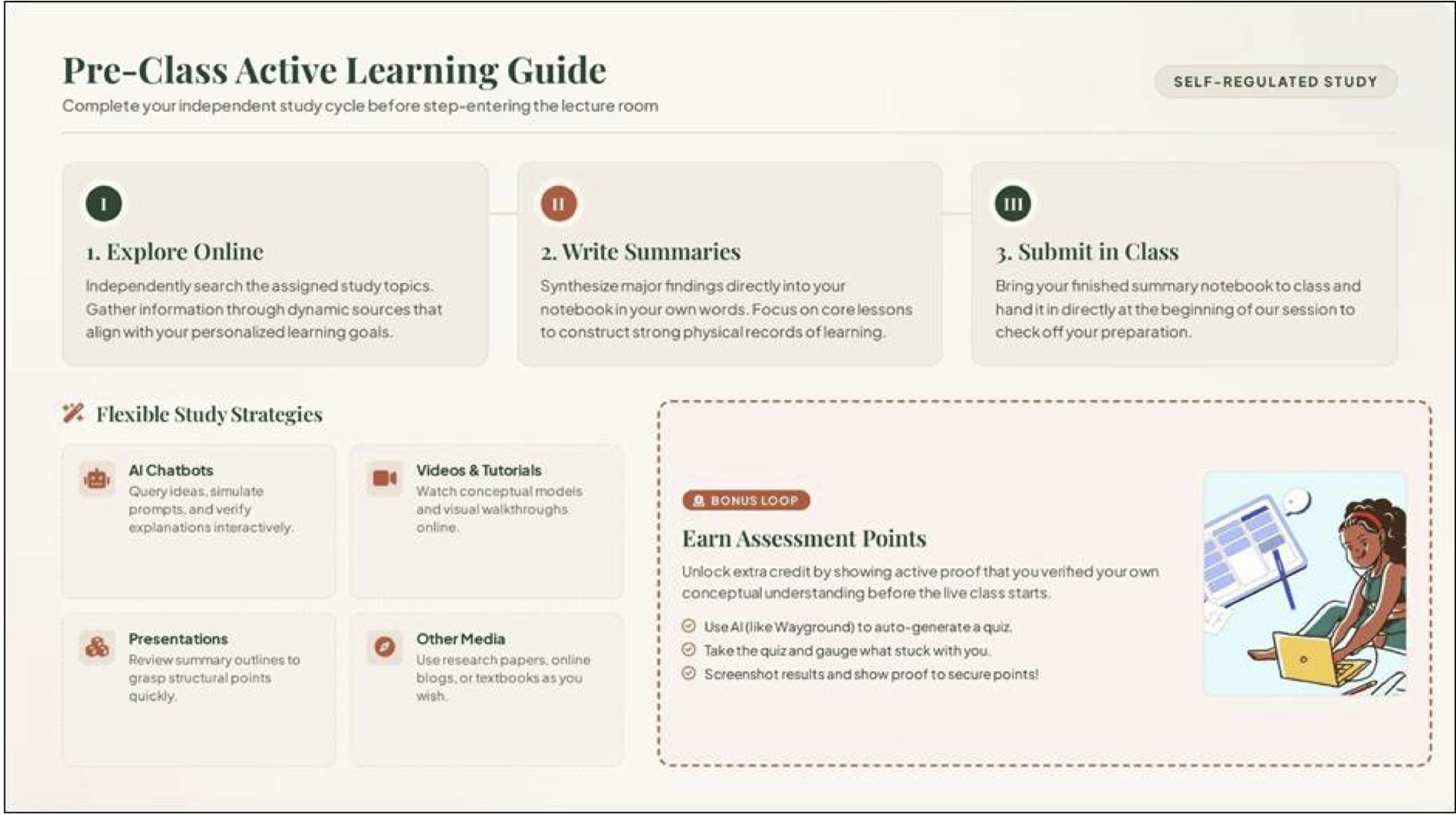
The pre-class activity contributed 10% of the overall course grade. The grade was assigned for completion of the required pre-class learning summary according to the course assessment criteria. The Bonus Loop shown in Figure 1 represented an optional opportunity for students to obtain additional course credit by providing evidence that they had verified their understanding using additional resources. This bonus component was intended as a motivational feature of the course rather than as a research outcome. Accordingly, students’ grades, bonus points, and the quality of their summaries were not analyzed in the present study.
At the beginning of each 2-hour face-to-face class, students turned in their summaries to the lecturer for review. After the review, students participated in a gamified, student-centered review activity that typically lasted 20–30 minutes, followed by approximately 80–90 minutes of writing practice. During the face-to-face activities, students were not allowed to use digital devices, including phones and GenAI tools; however, they were permitted to refer to their handwritten notes or share notes with their peers. Figure 1 shows the guide given to students in Week 1 about the pre-class activity.
Figure 1
Pre-class Learning Active Guide
Instruments
Self-Regulated Learning Questionnaire
At the end of Week 6, all 58 participants completed a questionnaire measuring perceptions of the pre-class self-access learning activities. The instrument consisted of seven dimensions: (1) Planning and Learning Preparation, (2) Information Management, (3) Notebook-Based Knowledge Construction, (4) Self-Monitoring and Reflection, (5) Learning Independence, (6) Responsible Use of GenAI, and (7) Writing Readiness. Responses were recorded using a five-point Likert scale ranging from 1 (Strongly Disagree) to 5 (Strongly Agree). Content validity was established through expert evaluation using the Index of Item-Objective Congruence (IOC), with values ranging from .67 to 1.00. Minor revisions were made following expert feedback, and the final questionnaire demonstrated reliable internal consistency (α = .81).
Focus Group Discussions (FGDs)
Following the intervention, 30 students voluntarily participated in six FGDs. The participants were divided into six groups of five students each. Group membership was determined by existing class groups. Each FGD lasted approximately 50 minutes. The discussions explored students’ perceptions of the pre-class self-access learning activities, the constraints they encountered, and the ways they addressed those constraints. The complete FGD protocol and follow-up prompts are provided in Appendix B. The questionnaire and FGD protocol were administered in English, with instructions and unfamiliar vocabulary or expressions clarified by the researchers when necessary. Participants were also encouraged to ask questions to ensure that they understood the intended meaning of each item.
Data Analysis
Questionnaire responses were analyzed using descriptive statistics, including means and standard deviations, to summarize students’ perceptions across the seven dimensions. The FGD transcripts were analyzed using inductive thematic analysis. The analysis involved repeated reading of the transcripts, initial coding of statements relevant to students’ perceptions, constraints, and ways of navigating the pre-class activities, grouping related codes into subthemes, and reviewing the resulting themes against the original transcripts.
The qualitative analysis also distinguished between reported enacted strategies and future-oriented intentions or suggestions. Statements describing actions that students reported actually undertaking during the intervention were coded as enacted strategies, whereas statements referring to what students intended, planned, or believed they should do were coded as future-oriented intentions. To provide greater transparency, the number of unique participants contributing evidence to each theme was recorded and reported as frequencies and percentages based on the 30 FGD participants. Individual participants could contribute to more than one theme; therefore, the frequencies are not mutually exclusive and do not sum to 30. Representative quotations are presented in the Results, while the FGD protocol and coding framework are provided in Appendix B.
Results
Students’ Perceptions of the Pre-Class Self-Access Learning Activities
Table 1 summarizes students’ perceptions of the pre-class self-access language learning activities across seven dimensions of SRL. Students reported positive perceptions of the activities. The highest ratings reflected intrinsic learning motivation, responsibility for learning, notebook-based knowledge construction, and information selection. Students also perceived the activities as supporting writing preparation and encouraging them to consult multiple learning resources before class.
Responses to several reverse-coded items, however, indicated considerable variation in learning behaviors. Moderate scores were observed for copying information into notebooks without fully processing its meaning (M = 3.11, SD = 1.18), accepting GenAI-generated information without verification (M = 3.00, SD = 1.24), and relying on GenAI instead of attempting to understand the topic independently (M = 2.95, SD = 1.20). In the same vein, students reported comparatively lower confidence in learning unfamiliar topics independently (M = 3.44, SD = 1.05). These findings suggest that although students generally viewed the intervention positively, differences remained in how they evaluated information, regulated their learning, and used GenAI during independent study.
Table 1
Highest-Rated Questionnaire Item by Dimension
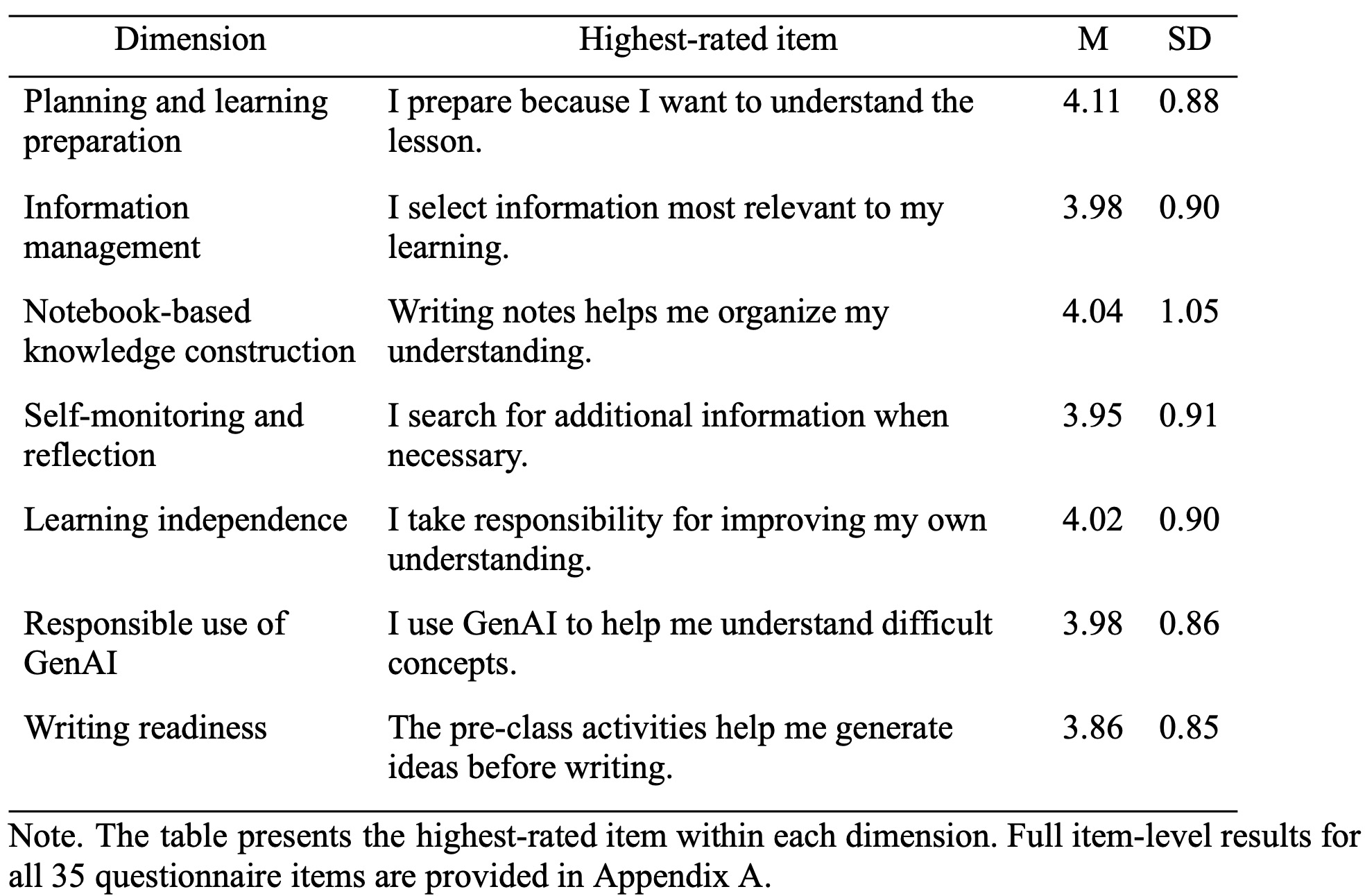
To provide a broader overview of students’ perceptions, the seven questionnaire dimensions were grouped into three categories: learning regulation (planning, information management, self-monitoring), learner autonomy (learning independence and notebook-based knowledge construction), and learning support (responsible GenAI use and writing readiness). The full item-level results in Appendix A provide a broader view of students’ responses across the seven dimensions. The highest-rated items within all seven dimensions were above the midpoint of the five-point scale, indicating generally favorable perceptions of the pre-class activities. The highest ratings were associated with intrinsic motivation to prepare before class and taking responsibility for learning, while comparatively lower ratings for confidence in learning independently and several reverse-coded items indicated areas in which students continued to experience difficulties. These quantitative patterns provide context for the constraints and strategies reported in the focus group discussions.
Constraints Encountered During Structured Self-Access Learning
The FGDs identified four interconnected constraints experienced during the transition from teacher-directed learning to structured self-access learning. These were 1) limited linguistic and background knowledge, 2) uncertainty without immediate teacher guidance, 3) evaluating and synthesizing multiple learning resources, and 4) negotiating the use of GenAI.
First, limited linguistic and background knowledge was reported by 22 of the 30 FGD participants (73%). Participants described difficulties involving vocabulary, grammar, sentence construction, and insufficient prior knowledge. One participant explained, “I cannot remember the words” (S4), while another stated, “I’m not good at writing sentences” (S47).
The second constraint was uncertainty without immediate teacher guidance. Eighteen participants (60%) described difficulties related to the absence of immediate teacher guidance. Students appreciated the opportunity to learn independently but continued to seek teacher support when encountering unfamiliar concepts. Eighteen of the 30 FGD participants (60%) expressed uncertainty about whether their understanding was accurate, with comments such as “I would like the teacher to explain the details more” (S11) and “Sometimes AI can’t answer my questions. I want to ask a professor” (S27). These responses suggest that learners valued autonomy while still relying on instructional guidance during challenging learning situations.
The third constraint was about evaluating and synthesizing multiple learning resources. Twenty participants (66%) reported difficulties evaluating or synthesizing information from multiple resources. Students generally welcomed the flexibility to select their own learning materials. Nevertheless, many reported difficulties determining whether the information they located was sufficiently accurate, complete, or relevant. One participant explained that “Sometimes I don’t understand, so I try to look up other platforms and check it” (S50), illustrating the challenge of evaluating and synthesizing information from multiple sources.
The fourth constraint was negotiating the use of GenAI. Sixteen participants (53%) mentioned difficulties related to GenAI use, including dependence, uncertainty, or the need to verify AI-generated information. GenAI emerged as both a valuable learning resource and a potential challenge. While students frequently used GenAI to clarify concepts and receive explanations, several acknowledged the temptation to depend excessively on AI-generated responses. For example, one participant admitted to “Rely on ChatGPT too much” (S44). Other participants reported comparing AI-generated information with textbooks, websites, or videos before incorporating it into their notes, indicating varying approaches to GenAI use.
Strategies for Navigating Self-Access Learning
Despite these challenges, students described four strategies that supported their participation in structured self-access learning. The first strategy is increasing learning effort. Fourteen of the 30 FGD participants (46%) reported actually using repeated practice or additional exposure to English to address linguistic difficulties. In contrast, 12 participants (40%) expressed increased practice as a future intention rather than a strategy they explicitly reported having implemented.
The second strategy is planning and self-regulation. They were reported as enacted strategies by 13 of the 30 participants (43%). These participants described actions such as setting study schedules, reviewing previous lessons, monitoring their understanding, and planning study before class. In addition, 17 participants (56%) expressed planning-related actions as future intentions rather than as practices they had already implemented.
The next strategy is using multiple learning resources. Twenty of the 30 participants (66%) reported actually consulting more than one learning resource when preparing for class. These resources included textbooks, educational videos, online materials, GenAI, classmates, and teachers. Among these participants, 13 explicitly reported comparing information across sources before incorporating it into their notebooks.
The last is strategic help-seeking. Twenty two of the 30 participants (73%) reported actually seeking clarification from classmates or instructors when they could not resolve a difficulty independently. Participants described help-seeking as a response to uncertainty rather than as a replacement for independent learning.
Discussion
The findings provide insights into how students experienced semi-structured pre-class self-access language learning and negotiated learner autonomy within a flipped EFL writing course. Importantly, this study did not measure changes in learner autonomy across the six-week intervention. Instead, the questionnaire and post-intervention FGDs captured students’ perceptions and retrospective accounts of how they managed learner choice, self-regulation, resource evaluation, GenAI use, and help-seeking within a structured learning environment. The findings therefore point to the potential of guided autonomy rather than demonstrating a measurable increase in autonomy over time.
Semi-Structured Self-Access Learning as Guided Autonomy
The findings suggest that the semi-structured pre-class activities provided students with opportunities to exercise learner autonomy while retaining access to teacher and peer support. Importantly, this study does not demonstrate a gradual increase in learner autonomy over the six-week period because autonomy was not measured longitudinally. Rather, the findings illustrate how students experienced and negotiated guided autonomy within a structured learning environment.
The balance between learner choice and instructional support is particularly relevant to self-access language learning. Although self-access learning emphasizes learner responsibility, autonomy does not necessarily require learners to work without guidance. In this study, students were given responsibility for selecting learning resources and organizing their pre-class preparation, while the teacher continued to establish learning objectives, provide classroom guidance, and support students when difficulties arose. This arrangement suggests that learner autonomy can be exercised within a structured pedagogical environment rather than being understood as complete independence.
These findings support the view that learner autonomy is not equivalent to the absence of teacher support but can be exercised through carefully designed opportunities for learners to assume responsibility while retaining access to appropriate guidance (Mynard, 2024; Pratiwi & Yonata, 2026). The semi-structured design therefore balanced teacher guidance with learner choice, allowing students to exercise agency while maintaining necessary instructional support. This interpretation is consistent with previous research emphasizing that autonomy involves negotiated relationships between learners, teachers, and learning resources rather than the complete withdrawal of teacher involvement (Anggoro, 2025; Raitskaya et al., 2021).
From a self-access perspective, the implication is not that learners should immediately become fully independent, but that learning environments can provide structured opportunities for students to make decisions about their learning while ensuring that appropriate support remains available. Semi-structured self-access learning may therefore provide a supportive context in which learners can exercise greater responsibility while retaining access to teacher and peer support.
Self-Regulated Learning and Notebook-Mediated Knowledge Construction
The findings suggest that self-access learning depends not only on access to resources but also on learners’ ability to regulate how they engage with those resources. Students reported developing strategies related to planning, monitoring understanding, selecting resources, and seeking additional information. These processes reflect core SRL mechanisms that enable learners to benefit from increased learning responsibility (Zimmerman, 2008).
A distinctive feature of this intervention was the integration of handwritten notebook summaries. Rather than simply recording information, students were expected to synthesize information from multiple sources and represent their understanding in their own words. This process supported knowledge construction by encouraging learners to identify key ideas, organize information, and reflect on their understanding (Hemmler & Ifenthaler, 2024; Teng et al., 2022). In this sense, notebook writing functioned as both a cognitive and metacognitive tool.
However, the findings also indicate that reflective learning behaviors cannot be assumed. The questionnaire also revealed that copying information without considering its meaning was reported to some extent (M = 3.11, SD = 1.18; Appendix A, Item C3), while 20 of the 30 FGD participants (66%) reported difficulties evaluating or synthesizing information from multiple resources. These findings suggest that access to multiple resources and notebook writing did not automatically ensure deep processing or effective information evaluation.
GenAI-Mediated Learner Autonomy and AI Literacy
A significant contribution of this study concerns the role of GenAI in self-access language learning. The findings suggest that students viewed GenAI as a support tool rather than simply a replacement for learning. Students used GenAI to clarify concepts, explain grammar, and generate examples, while some compared AI-generated responses with other learning resources before incorporating information into their notebooks.
These behaviors indicate emerging AI literacy, characterized by critical evaluation and adaptation of AI-generated information. This finding supports recent research emphasizing that responsible GenAI use requires learners to develop evaluative skills alongside technological competence (Dahri et al., 2024; Elsayad, 2024; Karlen et al., 2023). However, students demonstrated varying levels of AI literacy, with some learners still relying on AI outputs without sufficient verification.
Therefore, GenAI expands rather than replaces learner autonomy. In AI-mediated learning environments, autonomous learners must not only manage their learning processes but also evaluate the reliability, relevance, and ethical use of digitally generated information (Vaccaro et al., 2024; Wilde, 2024). Self-access learning in the GenAI era therefore requires both self-regulation and critical digital literacy.
Implications for EFL Self-Access Learning Design
The findings suggest several implications for EFL self-access learning design. First, self-access learning should provide structured opportunities for learner responsibility rather than assuming immediate independence. Semi-structured learning environments that combine clear instructional goals with learner choice may provide an effective balance between guidance and autonomy.
Second, instructors should explicitly develop students’ SRL strategies, including goal setting, monitoring comprehension, evaluating resources, and reflection. Providing access to learning materials alone is insufficient without supporting learners in regulating their learning processes.
Third, reflective notebook writing can serve as a practical tool for promoting deeper engagement with learning materials. Finally, GenAI literacy should become an essential component of self-access learning, with students being guided to verify AI-generated information, compare sources, and use AI as a support for learning rather than a substitute for understanding.
Conclusion
This study shows that semi-structured pre-class self-access learning can provide a workable context for students to exercise greater responsibility in preparing for EFL writing. Students generally responded positively to selecting learning resources, constructing knowledge through note-taking, and using GenAI as a learning support, while their experiences also highlighted the importance of linguistic support, resource evaluation, teacher guidance, and responsible AI use. The findings therefore suggest that self-access learning should combine learner choice with purposeful scaffolding, particularly for learners who are still developing independent learning capabilities. For self-access practitioners, this may involve explicit guidance on resource evaluation and AI use alongside opportunities for reflection and independent resource selection. As this study examined students’ retrospective experiences within a six-week implementation, it does not establish changes in autonomy over time. Future research should employ longitudinal designs, objective measures of learning and autonomy, and iterative interventions to examine how different levels of scaffolding influence learners’ development.
Notes on the Contributors
Kiki Juli Anggoro is an Assistant Professor at the School of Education at Walailak University, Thailand. He holds a B.Ed. in English Language Teaching from Yogyakarta State University, Indonesia. Additionally, he holds an M.Ed. and Ph.D. in Educational Technology and Communications from Naresuan University, Thailand. His research interests include technology-enhanced language learning (TELL), self-regulated learning, and applied linguistics.
Damar Isti Pratiwi is an Associate Professor at Politeknik Perkeretaapian Indonesia Madiun, Indonesia. She holds a Doctorate in English Education from Universitas Negeri Semarang, Indonesia. Her research focuses on Teaching English as a Foreign Language (TEFL), English for Specific Purposes (ESP), educational technology, and technology-enhanced language learning. She has published extensively in reputable international journals in these fields.
Ikrar Genidal Riadil is a Lecturer and Researcher at the School of Languages and General Education, Walailak University, Thailand. He earned his B.Ed. in English Language Education from Universitas Tidar, Indonesia and he earned his double degree B.SEd. in Secondary Education from Pangasinan State University, Philippines. Additionally, he holds an M.A. in Language and Culture from Prince of Songkla University, Thailand. His research interests include technology-enhanced language learning (TELL), Teaching English with Technology, Sociolinguistics, and Cultural Studies.
References
Alsiyabi, Z. N., Kamsin, A., & Abdullah, N. A. (2026). Students’ engagement challenges in the pre-class phase of flipped classrooms: A systematic review. Australasian Journal of Educational Technology, 42(4), 24–40. https://ajet.org.au/index.php/AJET/article/view/10706
Anggoro, K. J. (2025). Navigating the integration of generative AI in EFL teaching: An autoethnographic journey with the flipped classroom model. Studies in Self-Access Learning Journal, 16(1), 237–250. https://doi.org/10.37237/160112
Anggoro, K. J., & Khasanah, U. (2022). A flipped classroom model to improve students’ online EFL. TESOL Journal, 13(1), e631. https://doi.org/10.1002/tesj.631
Anggoro, K. J., & Pratiwi, D. I. (2023). Fostering self-assessment in English learning with a generative AI platform: A case of Quizizz AI. Studies in Self-Access Learning Journal, 14(4), 489–501. https://doi.org/10.37237/140406
Bai, B., & Wang, J. (2020). Conceptualizing self-regulated reading-to-write in ESL/EFL writing and investigating its relationships to motivation and writing competence. Language Teaching Research, 27(5). https://doi.org/10.1177/1362168820971740
Busa, J., & Chung, S. (2024). The effects of teacher-centered and student-centered approaches in TOEIC reading instruction. Education Sciences, 14. https://doi.org/10.3390/educsci14020181
Dahri, N. A., Yahaya, N., Al-rahmi, W. M., Aldraiweesh, A., Alturki, U., Almutairy, S., Shutaleva, A., & Soomro, R. B. (2024). Extended TAM based acceptance of AI-Powered ChatGPT for supporting metacognitive self-regulated learning in education: A mixed-methods study. Heliyon, 10, e29317. https://doi.org/10.1016/j.heliyon.2024.e29317
Elsayad, G. (2024). Drivers of undergraduate students’ learning perceptions in the blended learning environment: The mediation role of metacognitive self‑regulation. Education and Information Technologies, 29, 15737–15760. https://doi.org/10.1007/s10639-024-12466-9
Gligorea, I., Cioca, M., Oancea, R., Gorski, A.-T., Gorski, H., & Tudorache, P. (2023). Adaptive learning using artificial intelligence in e-learning: a literature review. Education Sciences, 13. https://doi.org/10.3390/educsci13121216
Güven, S., & Eğmir, E. (2026). Flipped classroom practices as contextual scaffolds for online self-regulated learning and academic achievement in secondary EFL education. Discover Education, 5, 1–26. https://doi.org/10.1007/s44217-026-01555-1
Hemmler, Y. M., & Ifenthaler, D. (2024). Self-regulated learning strategies in continuing education: A systematic review and meta-analysis. Educational Research Review, 45, 100629. https://doi.org/10.1016/j.edurev.2024.100629
Jin, S. H., Im, K., Yoo, M., Roll, I., & Seo, K. (2023). Supporting students’ self‑regulated learning in online learning using artificial intelligence applications. International Journal of Educational Technology in Higher Education, 20. https://doi.org/10.1186/s41239-023-00406-5
Karlen, Y., Hirt, C. N., Jud, J., Rosenthal, A., & Eberli, T. D. (2023). Teachers as learners and agents of self-regulated learning: The importance of different teachers competence aspects for promoting metacognition. Teaching and Teacher Education, 125, 104055. https://doi.org/10.1016/j.tate.2023.104055
Lan, M., & Zhou, X. (2025). A qualitative systematic review on AI empowered self-regulated learning in higher education. Npj Science of Learning, 10, 1–16. https://doi.org/10.1038/s41539-025-00319-0
Morris, T. H., Bremner, N., & Sakata, N. (2025). Self-directed learning and student-centred learning: A conceptual comparison. Pedagogy, Culture & Society, 33(3), 847–866. https://doi.org/10.1080/14681366.2023.2282439
Mynard, J. (2024). Self-access language learning support in Europe: Observations and current practices. Studies in Self-Access Learning Journal, 15(2), 258–279. https://doi.org/10.37237/150209
Naing, C., Whittaker, M. A., Aung, H. H., Chellappan, D. K., & Riegelman, A. (2023). The effects of flipped classrooms to improve learning outcomes in undergraduate health professional education: A systematic review. Campbell Systematic Reviews, 19. https://doi.org/10.1002/cl2.1339
Pratiwi, D. I., & Anggraeni, C. W. (2026). Exploring online flipped classroom utilizing interactive response system in vocabulary learning for low-proficiency students. The Electronic Journal for English as a Second Language Exploring (TESL-EJ), 29(4), 1–20. https://doi.org/10.55593/ej.29116int2
Pratiwi, D. I., & Yonata, F. (2026). Promoting learner autonomy in online vocabulary learning using an interactive response system: A case of Quizlet. Studies in Self-Access Learning Journal, 17(1), 106–127. https://doi.org/10.37237/170107
Raitskaya, L., Mekeko, N., & Golubovskaya, E. (2021). Enforcing L2 learner autonomy in higher education: the top 50 cited articles. Journal of Language and Education, 7(3), 213–226. https://doi.org/10.17323/jle.2021.13194
Slabodar, I. (2024). Learner autonomy transfer: the need for explicit teacher training. The Electronic Journal for English as a Second Language Learner (TESL-EJ), 28(1), 1–37. https://doi.org/10.55593/ej.28109a2
Teng, M. F., Qin, C., & Wang, C. (2022). Validation of metacognitive academic writing strategies and the predictive effects on academic writing performance in a foreign language context. Metacognition and Learning, 17(1), 167–190. https://doi.org/10.1007/s11409-021-09278-4
Vaccaro, M., Almaatouq, A., & Malone, T. (2024). When combinations of humans and AI are useful: A systematic review and meta-analysis. Nature Human Behaviour, 8. https://doi.org/10.1038/s41562-024-02024-1
Wilde, V. De. (2024). Can novice teachers detect AI-generated texts in EFL writing? ELT Journal, 78(4), 414–422. https://doi.org/10.1093/elt/ccae031
Woods, P. J., & Copur-Gencturk, Y. (2024). Examining the role of student-centered versus teacher-centered pedagogical approaches to self-directed learning through teaching. Teaching and Teacher Education, 138, 104415. https://doi.org/10.1016/j.tate.2023.104415
Wu, X. (2024). Unveiling the dynamics of self-regulated learning in project-based learning environments. Heliyon, 10, e27335. https://doi.org/10.1016/j.heliyon.2024.e27335
Zimmerman, B. J. (2008). Investigating self-regulation and motivation: historical background, methodological developments, and future prospects. American Educational Research Journal, 45(1), 166–183. https://doi.org/10.3102/0002831207312909
Appendices
Appendix A. Self-Regulated Learning Questionnaire and Item-Level Descriptive Results
A1. Participant Information
Purpose
The purpose of this study is to understand students’ experiences of structured pre-class self-access learning in an undergraduate EFL writing course, including their perceptions, challenges, and ways of navigating the learning activities.
Participation
You are invited to complete a questionnaire about your experiences of the pre-class self-access learning activities. Participation is voluntary.
Confidentiality
Your responses will be treated confidentially and reported using participant codes. No identifying information will be included in the research report. For focus group participants, however, complete confidentiality among participants cannot be guaranteed because participants hear one another’s contributions.
Voluntary Participation
You may choose not to participate or withdraw from the research without academic penalty or negative consequences.
Use of Data
The questionnaire responses will be used for research purposes. Your course grades and bonus points are not analyzed as research outcomes in this study.
A2. Informed Consent
Consent to Participate
Please confirm the following:
☐ I have read and understood the information above.
☐ I understand that participation is voluntary and that I may withdraw without academic penalty.
☐ I understand that my questionnaire responses will be anonymized and used for research purposes.
☐ I agree to participate in this research study.
Participant code: __________________
Date: ___________________________
A3. Questionnaire and Results
Questionnaire Instructions
The questionnaire was administered at the end of the six-week intervention to examine students’ perceptions of their self-regulated learning during the structured pre-class self-access learning activities. The questionnaire consisted of seven dimensions: Planning and Learning Preparation, Information Management, Notebook-Based Knowledge Construction, Self-Monitoring and Reflection, Learning Independence, Responsible Use of GenAI, and Writing Readiness. Please indicate the extent to which you agree or disagree with each statement based on your experience of the pre-class self-access learning activities.
Response scale:
1 = Strongly Disagree
2 = Disagree
3 = Neither Agree nor Disagree
4 = Agree
5 = Strongly Agree
Participants
N = 58
Note
(R) indicates a negatively worded item. Such items were reverse-coded for composite-score calculations. The descriptive statistics in A4 retain the original item wording and raw response direction. Therefore, a higher raw mean on an (R) item indicates stronger endorsement of the stated undesirable behavior.
| Dimension | No. | Questionnaire item | M | SD |
| A. Planning and Learning Preparation | A1 | Before studying, I set clear goals for what I want to learn. | 3.82 | 0.76 |
| A2 | I plan when I will complete the pre-class learning activities. | 3.81 | 0.93 | |
| A3 | I usually complete the pre-class activities at the last minute. (R) | 2.60 | 1.02 | |
| A4 | I allocate sufficient time to prepare before class. | 3.63 | 0.99 | |
| A5 | I prepare because I want to understand the lesson. | 4.11 | 0.88 | |
| B. Information Management | B1 | I use different learning resources to understand the assigned topic. | 3.68 | 0.97 |
| B2 | I include information in my notebook without considering whether it is important. (R) | 2.81 | 1.17 | |
| B3 | I compare information from different sources before writing my notes. | 3.56 | 0.91 | |
| B4 | I evaluate whether the information I find is reliable. | 3.77 | 0.85 | |
| B5 | I select information that is most relevant to my learning. | 3.98 | 0.90 | |
| C. Notebook-Based Knowledge Construction | C1 | Writing notes helps me organize my understanding of the topic. | 4.04 | 1.05 |
| C2 | I write notes using my own words. | 3.86 | 1.08 | |
| C3 | I copy information into my notebook without thinking about its meaning. (R) | 3.11 | 1.18 | |
| C4 | Writing notes helps me identify the key ideas. | 3.81 | 1.03 | |
| C5 | I revise my notes when my understanding improves. | 3.74 | 0.95 | |
| D. Self-Monitoring and Reflection | D1 | While studying, I monitor whether I understand the topic. | 3.77 | 0.85 |
| D2 | I recognize when I do not understand something. | 3.77 | 0.96 | |
| D3 | I continue studying even when I know I do not understand the topic. (R) | 2.39 | 1.06 | |
| D4 | I review my notes before class. | 3.56 | 1.04 | |
| D5 | I search for additional information when necessary. | 3.95 | 0.91 | |
| E. Learning Independence | E1 | I actively search for learning resources on my own. | 3.74 | 0.84 |
| E2 | I continue learning even when there is no graded assignment. | 3.72 | 1.10 | |
| E3 | I take responsibility for improving my own understanding. | 4.02 | 0.90 | |
| E4 | I wait for my teacher to explain the topic before I begin learning. (R) | 2.56 | 1.02 | |
| E5 | I am confident that I can learn new topics independently. | 3.44 | 1.05 | |
| F. Responsible Use of GenAI | F1 | I use GenAI to help me understand difficult concepts. | 3.98 | 0.86 |
| F2 | I accept GenAI-generated information without checking whether it is accurate. (R) | 3.00 | 1.24 | |
| F3 | I compare GenAI-generated information with other learning resources. | 3.70 | 0.80 | |
| F4 | I modify GenAI-generated information before writing it in my notebook. | 3.75 | 0.81 | |
| F5 | I rely on GenAI instead of trying to understand the topic myself. (R) | 2.95 | 1.20 | |
| G. Writing Readiness | G1 | The pre-class activities help me generate ideas before writing. | 3.86 | 0.85 |
| G2 | I feel more confident writing after completing the pre-class activities. | 3.65 | 0.95 | |
| G3 | I still find it difficult to begin writing even after completing the pre-class activities. (R) | 2.37 | 1.05 | |
| G4 | Preparing before class helps me organize my ideas for writing. | 3.82 | 0.87 | |
| G5 | The pre-class activities reduce my anxiety about writing in class. | 3.68 | 0.98 |
Note on participant comprehension. The questionnaire was administered in English. To support comprehension, participants were given an explanation of the instructions and were allowed to ask for clarification of unfamiliar words, expressions, or questionnaire items before responding.
Appendix B. Focus Group Discussion Protocol
Opening
- Can you describe your experience of completing the pre-class self-access learning activities?
Students’ perceptions
- What did you find useful about selecting your own learning resources?
- What did you find difficult about preparing before class?
Constraints
- What difficulties did you experience when learning independently?
- What did you do when you did not understand something?
- How did you decide whether information from different sources was reliable?
- How did you use GenAI during the pre-class activities?
Strategies
- What did you actually do when you encountered difficulties?
- Did you seek help from your teacher or classmates? If so, when and why?
- What strategies did you use to prepare for class?
Reflection
- Did you change anything about the way you prepared during the six-week period?
- What would you change about the pre-class activity if you were asked to do it again?
The facilitators used non-leading follow-up prompts to clarify participants’ responses and elicit concrete examples. These included: “Can you explain further?” “Can you give an example?” “What did you do when this happened?” “What happened next?” “How did you decide that?” “How often did this occur?” and “Was this something you actually did during the intervention, or something you intended to do?” Follow-up questions were used flexibly according to participants’ responses rather than being asked systematically to every participant.
Note on language and comprehension. The FGD questions were administered in English. The researcher explained the questions and provided clarification of unfamiliar vocabulary or expressions when necessary to ensure that participants understood the intended meaning before responding.
Appendix C. Qualitative Coding Framework and Evidence Matrix
This appendix presents the coding framework used to organize the qualitative data reported in the Results section. The framework corresponds to the four constraints and four strategies identified from the focus group discussions. The evidence-status distinction was used to clarify the meaning of participants’ statements. Experienced refers to a constraint explicitly described as having been encountered during the intervention. Enacted refers to an action explicitly described as having been undertaken during the intervention. Intended refers to a plan, intention, recommendation, or desired future action. Statements that did not clearly establish that an action had been completed were not treated as evidence of enacted behavior.
The distinction was supported by the FGD protocol and follow-up questioning. In particular, facilitators asked participants what they actually did when difficulties occurred and whether a reported strategy was something they had actually done during the intervention or intended to do. The framework therefore clarifies the analytic interpretation of the FGD statements rather than representing an additional component of the instructional intervention.
The frequencies and percentages reported in the Results are based on the 30 students who participated in the six FGDs. Participants could contribute evidence to more than one theme or strategy; therefore, the frequencies are not mutually exclusive and do not sum to 30. Appendix D provides the anonymized and condensed FGD evidence available for tracing the qualitative themes and coding decisions.
C1. Constraints Identified in the FGD Data
| Theme / subtheme | Operational definition | Analytic status | Evidence ID(s) | N (%) |
| 1. Linguistic and background knowledge – Vocabulary, grammar, and sentence construction | Difficulties with vocabulary, grammar, sentence construction, or insufficient background knowledge that constrained independent pre-class learning. | Experienced | D1–D5 | 22 (73%) |
| 2. Teacher guidance – Need for clarification | Difficulty proceeding independently when students needed explanation, confirmation, or assistance from teachers or others. | Experienced | D6–D8 | 18 (60%) |
| 3. Resource evaluation – Reliability, completeness, and understanding | Difficulty determining whether information was sufficiently detailed, understandable, accurate, or appropriate for learning. | Experienced | D9–D10 | 20 (66%) |
| 4. Responsible GenAI use – Dependence, limitations, and checking | Difficulties involving reliance on GenAI, limitations of AI responses, and the need to check or supplement AI-generated information. | Experienced | D11–D15 | 16 (53%) |
C2. Strategies for Navigating Self-Access Learning
| Theme / subtheme | Operational definition | Analytic status | Evidence ID(s) | N (%) |
| 1. Increasing learning effort – Practice, repetition, and reading | Practice, repetition, reading, or continued effort described as ways of addressing linguistic difficulties. | Enacted or Intended, according to wording and follow-up clarification | D16–D19 | Enacted: 14 (46%); Intended: 12 (40%) |
| 2. Planning and self-regulation – Goal setting, scheduling, reviewing, and persistence | Setting objectives, organizing study, reviewing lessons, monitoring understanding, or planning future learning. | Enacted or Intended, according to wording and follow-up clarification | D20–D22 | Enacted: 13 (43%); Intended: 17 (56%) |
| 3. Multiple learning resources – Resource use and cross-checking | Consulting additional resources and comparing or checking information when one source is insufficient or unclear. | Enacted when the statement explicitly describes completed resource use or checking | D23–D25 | Resource use: 20 (66%); Cross-checking: 13 (43%) |
| 4. Strategic help-seeking – Teacher and peer support | Seeking clarification or assistance from teachers or classmates when difficulties could not be resolved independently. | Enacted or Intended, according to wording and follow-up clarification | D26–D30 | Enacted: 22 (73%) |
The N (%) values reproduce the participant-level frequencies reported in the Results section and are based on all 30 FGD participants. The evidence IDs in this appendix identify representative statements contained in Appendix D. Appendix D presents anonymized and condensed FGD evidence rather than the complete participant-level transcripts; therefore, individual quotations should be understood as illustrative evidence rather than a complete enumeration of all coded instances. Participants could contribute evidence to more than one theme or subtheme; therefore, frequencies and percentages are not mutually exclusive.
C3. Evidence Classification Guide
| Evidence status | Coding rule | Example from available data |
| Experienced | Participant explicitly describes a difficulty encountered during the intervention. | “I cannot remember the words.” |
| Enacted | Participant explicitly describes an action already undertaken during the intervention. | “Sometimes I used AI to generate the answer… [and] try to look up other platform and check it.” |
| Intended | Participant describes what they will, should, want, or would do rather than clearly reporting a completed action. | “I’ll practice doing it over and over.” |
| Ambiguous | Statement does not clearly establish whether an action was completed; it is not counted as enacted without clarification. | “Ask friends.” |
C4. Complete Evidence Matrix
| Theme | Subtheme | Operational definition | Evidence status | Evidence IDs | N (%) |
| Linguistic and background knowledge | Vocabulary/ grammar | Difficulty understanding/ producing English or insufficient prior knowledge | Experienced | D1–D5 | 22 (73%) |
| Teacher guidance | Need for clarification | Difficulty proceeding without teacher explanation/ confirmation | Experienced | D6–D8 | 18 (60%) |
| Resource evaluation | Reliability/ completeness | Difficulty judging/ comparing/ synthesizing information | Experienced | D9–D10 | 20 (66%) |
| GenAI | Dependence/ verification | Difficulty using/ checking AI appropriately | Experienced | D11–D15 | 16 (53%) |
| Increasing learning effort | Practice/ repetition | Practice, repetition, reading, continued effort | Enacted / Intended | D16–D19 | 14 (46%) / 12 (40%) |
| Planning/self-regulation | Goal setting/ scheduling/ reviewing | Planning, scheduling, reviewing, monitoring | Enacted / Intended | D20–D22 | 13 (43%) / 17 (56%) |
| Multiple resources | Resource use | Consulting multiple resources | Enacted | D23–D25 | 20 (66%) |
| Multiple resources | Cross-checking | Comparing information across resources | Enacted | D24–D25 | 13 (43%) |
| Strategic help-seeking | Teacher/ peer support | Seeking clarification from others | Enacted / Intended | D26–D30 | 22 (73%) |
Appendix D. Anonymized and Condensed Focus Group Discussion Data
The following presents anonymized and condensed evidence from the focus group discussions. Participant names and potentially identifying information have been removed. Responses are presented at the focus-group level to protect participant confidentiality and are retained as closely as possible to the available source wording. The data are organized according to the areas addressed by the FGD protocol: (1) challenges encountered during pre-class learning, (2) strategies used or proposed to address these challenges, and (3) perceptions of learning independently before class. The evidence is provided to allow readers to trace the qualitative themes and coding distinctions presented in Appendix C. The evidence is not intended to reproduce the complete verbatim transcripts.
D1. Focus Group 1
Challenges Encountered
D1. “I cannot remember the words.”
D2. “I can’t remember vocabulary and structure.”
D3. “I’m not good at constructing sentences or keeping up with my classmates.”
D4. “I’m not good at writing sentences.”
D5. “The problem is that some information is missing or not detailed enough, making it difficult for me to understand the details correctly.”
D6. “I would like there to be activities or assignments during class so that the teacher can help provide guidance.”
Strategies Reported
D16. “I must practice to remember the words more.”
D17. “I should more practice and read more.”
D18. “I must practice to make sentence in routine and remember words.”
D19. “I’ll practice doing it over and over.”
D26. “I would like the teacher to explain the details more during the class, or to show the correct way to find the information.”
Perception
D30. “I think it is good for me than a problem.”
D2. Focus Group 2
Challenges Encountered
D7. “We did not see the SBL notification, so we missed the task.”
D11. “Rely on ChatGPT too much.”
D12. “Do not put enough effort cause lack of understanding.”
D8. “No one to help.”
Strategies Reported
D32. “We have to check the notification more often.”
D23. “Ask AI to create the task and evaluate the task.”
D20. “Set the objective and try harder.”
D27. “Ask friends.”
D3. Focus Group 3
Challenges Encountered
D13. “We don’t have enough background knowledge, and it makes self-study difficult both time management and understanding the content.”
Strategy Statement
D21. “I will start by learning the basic concepts first. I will make a study schedule, review my lessons regularly, watch educational videos, ask my teacher or friends when I have questions, and practice every day to improve my understanding.”
D4. Focus Group 4
Challenges Encountered
D14. “Some don’t have problem.”
D15. “I am not confident enough to write whether I have answered correctly or not.”
D9. “I am not understand the words meaning.”
D8. “Something that AI can’t answer my questions. / I want to ask a professor.”
D10. “Sometimes I used AI to generate the answer but sometimes I don’t understand so I try to look up other platform and check it up.”
D28. “I worried about grammar of the sentence, so AI can correct it for me.”
Strategies Reported
D29. “Keep going.”
D30. “Try to trust in myself more.”
D26. “I want to ask a professor.”
D27. “I think he can answer me.”
D24. “Sometimes I try to look up other platform and check it up.”
D25. “AI can correct it for me.”