Shawn Andersson, Division of Foreign Studies, The University of Osaka, Japan
Andersson, S. (2026). The role of self-access language learning services in the era of AI chatbots. Studies in Self-Access Learning Journal, 17(3), 440–463. https://doi.org/10.37237/170309
Abstract
Recent research has examined the role of artificial intelligence (AI) in self-access language learning (SALL) and self-directed learning. However, many studies have focused on the benefits of AI for independent learning while giving limited attention to SALL services. This study investigated learners’ perceptions of the usefulness of SALL services and AI chatbots for learning English, as well as their future roles. A survey was administered to 172 students at a national university in Japan. Quantitative data were analyzed using descriptive statistics and paired-samples t-tests, while qualitative responses were analyzed using content analysis. Results indicated that learners viewed both SALL services and AI chatbots as valuable for different purposes. Compared with AI chatbots, SALL services were rated significantly higher for speaking development, motivation, personalized guidance, and overall contribution to English learning, whereas AI chatbots were valued for convenience and accessibility. Participants believed that SALL services would remain important despite advances in AI and supported the combined use of both resources. Open-ended responses highlighted speaking practice, human interaction, motivation, and personal support as key contributions of SALL services. The findings suggest that learners view SALL services and AI chatbots as complementary rather than competing resources for English learning.
Keywords: AI Chatbots, Self-Access Language Learning (SALL), Self-access Learning Centers (SALCs), English as a Foreign Language (EFL), Self-directed Learning (SDL)
Self-access language learning (SALL) services have grown rapidly over the past two decades in Japan, both in terms of research interest and their presence within university language education (Andersson & Nakahashi, 2023). These services broadly encompass forms of language-learning support that encourage learners to engage in independent learning outside the classroom (Mynard, 2019). The goals of SALL include promoting learner autonomy, supporting motivation and self-regulation, and helping learners take greater ownership of their language learning (Gardner & Miller, 2011; Mynard, 2019). SALL also seeks to provide learners with individualized support and supplement classroom instruction. Learners are encouraged to make decisions about their learning, select materials that meet their needs, and develop strategies for independent study (Mynard, 2019). In this way, SALL helps learners gain greater control over their learning processes while receiving support tailored to their individual goals and needs (Wangdi & Shimray, 2022).
In Japan, SALL services are commonly implemented through university-based self-access learning centers (SALCs), which provide environments designed to support learner autonomy and independent learning (Wangdi & Shimray, 2022). These environments may include learning spaces, physical resources such as graded readers and media materials, and support services offered by trained instructors or advisors. Such services often include conversation practice, writing support, language advising, and guidance on effective learning strategies. Through these resources and services, SALCs serve as an important means of realizing the broader goals of SALL within university settings.
Technology has long played a role in SALL environments, and SALCs have traditionally incorporated various technologies to support learner development (Andersson & Nakahashi, 2023). However, compared to classroom language teaching, the role of technology in SALL has historically received relatively limited research attention (Reinders & White, 2016). As digital technologies have continued to evolve, researchers have increasingly explored how technology can support language learning outside formal classroom settings, including the use of technology-assisted consultations and digital learning resources within SALL environments (Har et al., 2023).
The continued development of technology-based tools has transformed the landscape of digital language learning resources, providing learners with greater access to materials and platforms that support interactive language practice and self-directed learning beyond the classroom (Mynard & Shelton-Strong, 2022). Researchers have also highlighted the need for universities to reconsider how emerging technologies can be leveraged to support learners’ autonomous learning (Li et al., 2024).
Historically, SALL services in Japan have been strongly associated with in-person interaction within SALCs. With the exception of the emergency shift to online consultations during the COVID-19 pandemic (Ohara & Ishimura, 2020), most SALL services in Japan have traditionally been delivered face-to-face through SALCs and have relied heavily on human interaction and support (Andersson & Nakahashi, 2023). However, recent advances in artificial intelligence (AI), particularly AI chatbots such as ChatGPT, have introduced new possibilities for language learning and are increasingly viewed as potentially transformative technologies within language education (Alrajhi, 2025).
As AI chatbot usage among students has increased rapidly, researchers have begun exploring how AI can be integrated into SALL environments. Previous studies have suggested that incorporating AI into SALCs may enhance learners’ overall language-learning experiences and provide additional forms of support within self-access environments (Har & Ma, 2023). In this sense, AI has been discussed not only as a learning tool for students but also as a potential resource that may complement existing SALL services.
At the same time, much of the recent research on AI and autonomous language learning has shifted away from university-based SALL environments altogether. Rather than examining how AI can support SALCs and SALL services, many studies focus on how learners can independently utilize AI chatbots for autonomous learning outside institutional support structures, which is known as self-directed learning (SDL). SDL researchers have explored the possibility of AI chatbots replacing functions traditionally fulfilled through human consultations and advising, particularly as AI increasingly takes on roles associated with tutoring, feedback, personalized guidance, and conversational support (Behforouz & Al Ghaithi, 2024; Huang et al., 2023). In effect, this line of research increasingly bypasses the human and institutional dimensions that have long characterized SALL. Comparatively fewer studies have examined how AI and SALL services might coexist in complementary roles or how AI could support, rather than replace, existing forms of learning support. Despite growing interest in AI-assisted language learning, researchers have noted the limited attention given to the relationship between AI and SALL services (Çakmak, 2022; Dizon & Tang, 2020; Wangdi & Shimray, 2025). In particular, little is known about how AI may influence the future role of university-based SALL services and SALCs.
Understanding how AI and SALL services can coexist is especially important given the limitations associated with AI chatbots. Despite growing interest in AI-supported language learning, concerns regarding AI chatbots remain. Previous research has identified shortcomings in AI interaction and computer-mediated communication, including negative user sentiment toward AI systems, limited communication quality, and broader concerns regarding human-computer interaction (Çakmak, 2022; Ciaunica et al., 2022; Martinez, 2015).
Learners are central stakeholders in self-access environments, making their perceptions particularly relevant when considering the future role of SALL services. Due to the voluntary nature of SALL participation, learners’ perceptions of usefulness and value may strongly influence whether they choose to engage with SALL services. Previous studies have also identified a lack of broader research examining students’ perceptions of AI for language-learning purposes (Aljohani, 2021; Pokrivakova, 2019), while other researchers have called for greater attention to learners’ attitudes and perceptions related to SALL and technology-supported learning environments (Cai et al., 2023; Liu & Ma, 2024).
These developments raise important questions regarding the future of SALL in the age of AI chatbots. As AI technologies continue to reshape language learning environments, questions remain regarding how learners perceive the respective roles of AI chatbots and institutionally supported SALL services and how they envision the future of SALL. Rather than determining whether one form of support is preferable to the other, the present study examines learners’ perceptions of the respective roles, usefulness, and limitations of SALL services and AI chatbots in university language-learning contexts, with particular focus on the future role of SALL in the age of AI chatbots. Accordingly, the research questions are as follows:
RQ1: How do learners perceive the usefulness and limitations of SALL services and AI chatbots for English language learning?
RQ2: How do learners perceive the future of SALL in the age of AI chatbots?
Literature Review
The Potential for AI in Autonomous Language Learning
AI is widely predicted to transform language education and reshape how learners acquire knowledge (Aithal & Aithal, 2023; Pokrivcakova, 2019; Rohalevych, 2020), both within formal educational settings and in autonomous language learning contexts. In particular, AI tools may foster learner autonomy by offering personalized support and extending learning opportunities beyond traditional classroom settings (Campbell-Howes, 2019), and the rapid advancement of AI has led educators to reconsider how such technologies can support self-directed and independent language learning (Li et al., 2024). Increasingly, AI is becoming capable of performing instructional functions that were previously associated with human tutors. For example, AI-driven multilingual tutoring systems can generate detailed records of learner progress, enabling both students and instructors to monitor language development over time (Huang et al., 2023). AI technologies can also tailor responses to learners’ individual needs and proficiency levels, providing customized learning support (Firat, 2023). As a result, AI may promote learner autonomy while extending opportunities for language learning beyond the classroom through a tailored and learner-centered approach (Kim & Kwon, 2012). These developments also have important implications for SALL, as AI increasingly takes on functions related to tutoring, feedback, and learning support, creating opportunities to integrate AI into existing SALL services while prompting reconsideration of the future role of human-supported SALL services and SALCs.
Artificial Intelligence in SALL and Self-Directed Learning
SALL has traditionally been associated with supporting learner autonomy, motivation, and self-regulation (Gardner & Miller, 1999), often through institutionally mediated forms of guidance, including advising, tutoring, and social learning opportunities provided through SALCs. However, recent developments in AI chatbots introduce alternative forms of support, such as immediate feedback, personalized interaction, and on-demand assistance (Çakmak, 2022). This raises important questions about whether these technologies complement or potentially assume the functions traditionally fulfilled by SALL.
While SALL has traditionally served as an institutional framework for supporting autonomous language learning, recent developments in AI have introduced alternative forms of language learning support that can perform functions traditionally associated with SALL services, including feedback, guidance, and conversation practice (Behforouz & Al Ghaithi, 2024). Research on AI-supported autonomous language learning can broadly be situated within both SALL and SDL contexts. Although both emphasize learner autonomy, SALL is more commonly associated with institutionally supported learning environments such as SALCs, whereas SDL generally refers to a more individualized and student-directed approach to learning outside formal support structures (Daley & Pennington, 2020).
Scholars have pointed out the potential merit of integrating AI into SALL services to assist SALL educators in addressing learners’ needs (Har et al., 2023). However, empirical research in this area remains limited. Existing studies have primarily focused on incorporating AI robots into administrative roles rather than as tutors (Har et al., 2023), while others have discussed the potential benefits of AI integration without collecting empirical data (Terantino, 2024).
By contrast, research conducted within SDL contexts has primarily examined either AI chatbots (Behforouz & Al Ghaithi, 2024), such as ChatGPT, or intelligent personal assistants (IPAs), which are voice-driven devices such as Alexa and Siri. Research on AI chatbots has produced particularly promising findings. Recent studies suggest that ChatGPT is capable of generating human-like responses (Susnjak, 2022), while also supporting open learning environments through flexible and accessible assistance that may foster learner autonomy and independent learning behaviors (Firat, 2024).
Empirical studies have also reported positive learner attitudes toward AI-assisted language learning. Haristiani and Rifai (2021) found that Indonesian learners perceived an interactive chatbot for Japanese grammar learning as motivating, helpful for increasing practice frequency, and beneficial for improving their perceived grammar ability. Similarly, Dizon and Tang (2020) reported that EFL learners generally viewed Alexa as an effective means of supporting autonomous language learning outside the classroom.
Behforouz and Ghaithi’s (2024) recent experiment involved learners interacting with a researcher-developed chatbot. Fifty EFL learners were divided into an experimental group that received chatbot feedback for writing tasks and a control group that received human feedback. The findings revealed that students who used the chatbot demonstrated significantly higher engagement and participation in learning activities compared to the control group. In addition, the experimental group showed significant improvements in abilities, including awareness, learning strategies, evaluation, and interpersonal skills. For further examples of the benefits of AI chatbots for SDL, see Behforouz and Ghaithi’s review of related studies.
Despite these promising findings, researchers have also identified several limitations associated with relying on AI chatbots as substitutes for human-supported language learning. For example, learners have experienced negative attitudes and frustration, especially when chatbots cannot understand the learners. For instance, Çakmak (2022) found that although learners in an experimental group who used a chatbot performed better than those in the comparison group, the chatbot often failed to understand participants, resulting in negative attitudes and failing to reduce speaking anxiety. AI-generated responses may also be inaccurate or irrelevant at times because the systems do not always fully understand the context of an interaction (Hwang et al., 2023). Furthermore, not all learners are familiar with AI chatbots or possess the digital skills necessary to use them effectively. Therefore, managing and monitoring technology-mediated learning can be challenging for some learners (Viberg & Kukulska-Hulme, 2021), raising concerns that AI may widen the gap between students who are proficient in using such technologies and those who are not (Warschauer et al., 2023).
IPAs have also received growing research attention in recent years (Daley & Pennington, 2020). Previous studies suggest that these devices may provide learners with a low-anxiety environment for practicing the target language (Dizon & Tang, 2020), encourage interaction in the L2 and awareness of linguistic gaps such as pronunciation issues (Dizon, 2020), and increase both the quantity and quality of language input learners receive (Moussalli & Cardoso, 2020).
Nevertheless, IPAs face important limitations in assuming roles traditionally associated with human-supported SALL tutoring. Because these systems rely primarily on voice-based interaction, they may struggle to adequately support writing-focused learning and often experience difficulty recognizing L2 speech accurately (Chen et al., 2020), which can lead to learner frustration and abandonment of interactions (Dizon & Tang, 2020). For these reasons, the present study focuses primarily on AI chatbots rather than IPAs.
Broadly speaking, the use of technology-mediated support in language learning has not always produced positive outcomes. Previous research suggests that technology-mediated forms of support may struggle to replicate the supportive and welcoming atmosphere associated with face-to-face human interaction, with computer-based exchanges sometimes being perceived as “cold, sterile, and unwelcoming” (Martinez, 2015, p. 190). These concerns have raised questions regarding the extent to which technology-driven support systems, including AI-based services, can effectively recreate the interpersonal and affective dimensions of traditional SALL environments (Ohara & Ishimura, 2020).
Beyond these interpersonal concerns, AI technologies also continue to face technical limitations. For example, AI-generated responses may at times fail to adapt appropriately to learners’ individual needs and proficiency levels compared with those of human instructors (Hwang et al., 2023). Furthermore, AI tools may struggle to accurately process or respond to more complex language structures (Roumeliotis & Tselikas, 2023).
Research Gaps and the Present Study
Researchers have highlighted the overall limited body of research concerning AI implementation within SALL services (Alrajhi, 2025; Dizon & Tang, 2020; Wangdi & Shimray, 2025), including learners’ attitudes toward the use of AI for language learning (Aljohani, 2021; Pokrivakova, 2019). Learner perceptions are especially important in the context of SALL, as students represent one of the primary stakeholders of SALCs. Accordingly, it is important to understand learners’ perspectives when considering the integration of AI chatbots into SALL services, including issues related to perceived usefulness and the extent to which such technologies align with learners’ needs and goals (Cai et al., 2023; Liu & Ma, 2024).
Despite growing interest in AI-assisted language learning, little is known about how learners perceive the relative roles of AI chatbots and institutionally supported SALL services or how they envision the future of SALL in the context of increasingly capable AI technologies. As AI technologies continue to reshape language learning environments, questions remain regarding the future role of institutionally supported SALL services. Therefore, the present study examines EFL learners’ perceptions of the usefulness of SALL services and AI chatbots, their perceived limitations, and the future role of each within English language learning. By identifying the relative strengths that learners attribute to each, the findings aim to inform the future development of SALL services in the era of AI.
Methodology
Participants
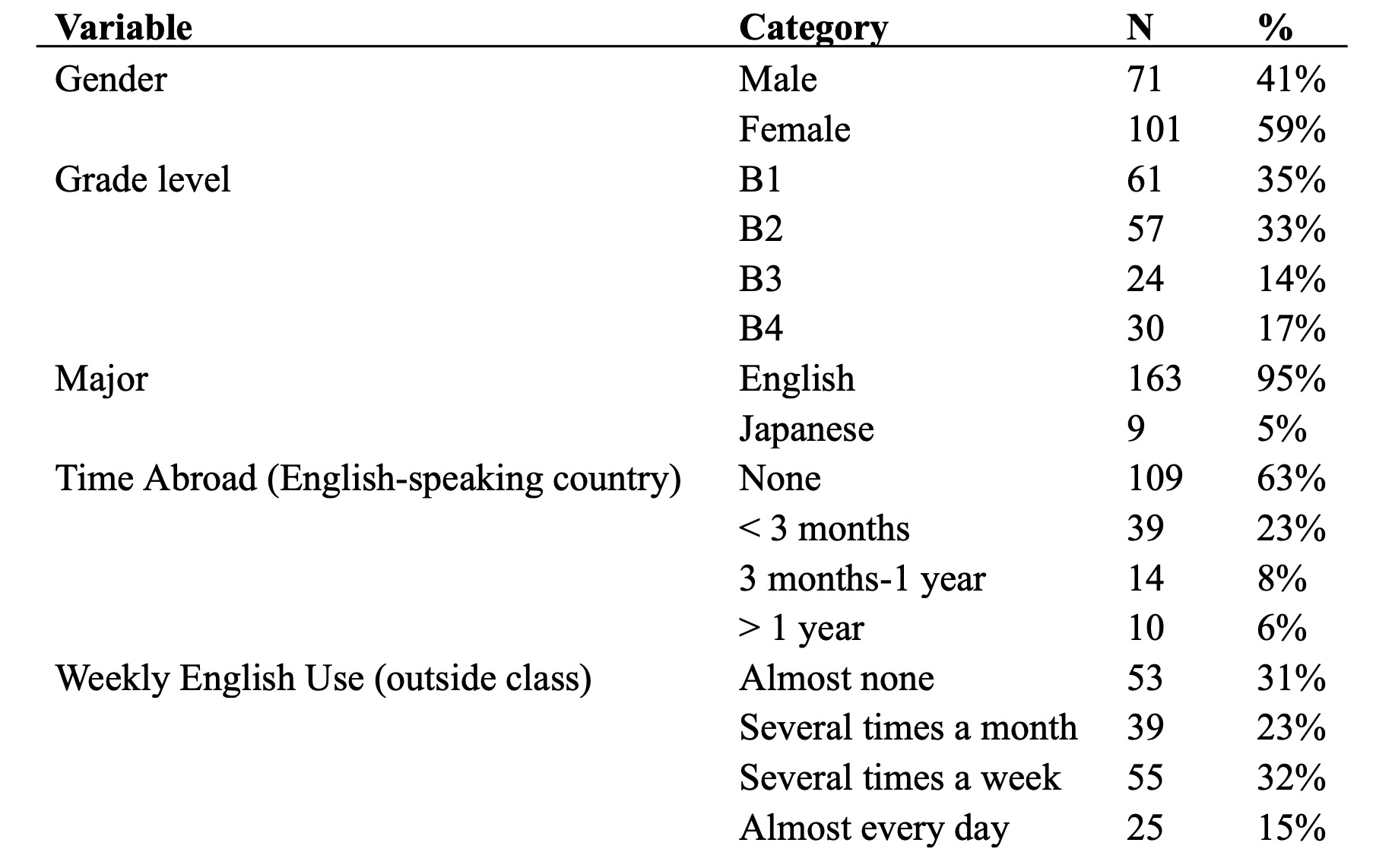
A total of 173 students were invited to participate in the study, and 172 completed the survey, yielding a response rate of 99%. Participant demographics are displayed in Table 1. The sample consisted primarily of first- and second-year undergraduate students, with a relatively balanced gender distribution of males (41.3%) and females (58.7%). Most participants were English majors (94.8%). Nearly half (46.5%) rated their English proficiency as intermediate, followed by upper-intermediate (29.1%). In addition, most participants (63.4%) reported having no experience staying in an English-speaking country. English use outside the classroom varied, with nearly one-third of participants (30.8%) almost never using English, while a similar proportion (32.0%) used English several times per week.
Table 1
Participant Demographics
Procedures and Survey Construction
The survey was written in Japanese and examined learners’ attitudes toward AI chatbots, SALL services, and their respective roles in English language learning. A four-point Likert scale (1 = strongly disagree to 4 = strongly agree) was used to avoid neutral responses, which Japanese respondents tend to select frequently (Wang et al., 2008). The survey was administered in person via Google Forms by the researcher in May 2026. Prior to completing the survey, participants received a brief five-minute presentation in English and a written explanation in Japanese introducing the purpose and functions of SALL services and SALCs. This step was necessary because the institution does not have a dedicated SALC. Instead, only limited SALL services are available through small self-access desks, and most students have little or no prior familiarity with such programs. As the researcher had an existing educational relationship with the participants, care was taken to minimize any perceived pressure to participate. Participation was voluntary, responses were anonymous, and participants were informed that their decision to participate would have no effect on their course or assessment. The survey concluded with two open-ended questions exploring (a) learners’ perceptions of the usefulness and limitations of SALL services and AI chatbots for English language learning and (b) their views on the future of SALL in the age of AI chatbots (see the Appendices for the complete instrument). These questions were developed based on the objectives of the study and previous research on SALL and AI-assisted language learning.
Items related to perceived usefulness were conceptually grounded in the Technology Acceptance Model (TAM; Davis, 1989) and used as a general measure of learners’ evaluations of the functional contributions of both SALL services and AI chatbots to English learning. Several perceived usefulness items were designed as parallel items to allow direct comparisons between SALL services and AI chatbots. These included perceived usefulness for speaking and writing development, motivation, overall contribution to English learning, and the provision of personalized advice and feedback.
The remaining survey items were developed by the researcher with reference to related studies. Potential barrier items drew on studies identifying practical and psychological constraints on SALL usage, such as lack of awareness, time constraints, and learner anxiety (Suzuki & Hooper, 2024). Items addressing the future role of SALL were informed by discussions surrounding the role of technology in SALL (Andersson & Nakahashi, 2023) and the impact of AI on language learning environments and support systems (Li et al., 2024). These items examined learners’ perceptions of whether SALL services will remain relevant, require adaptation, or become integrated with AI chatbots.
Data Analysis
Descriptive statistics were calculated for all Likert-scale items. Mean values were interpreted using the procedure proposed by Boonmoh et al. (2021), as shown in Table 2. Internal consistency reliability of multi-item scales was assessed using Cronbach’s alpha. To compare participants’ perceptions of SALL services and AI chatbots, paired-samples t-tests were conducted on five parallel items. Effect sizes were calculated using Cohen’s d. Statistical significance was evaluated at the .05 level.
Table 2
Likert Means Interpretation

Open-ended responses were translated from Japanese into English by a bilingual assistant proficient in both languages. A content analysis approach was then applied. Responses were first coded, and the resulting codes were subsequently grouped into broader categories to identify recurring themes and patterns.
Results
RQ1: Perceived Usefulness and Limitations of SALL Services and AI Chatbots
Descriptive data on learners’ use of English-learning resources and AI tools are first presented to contextualize participants’ perceptions. The most commonly used English-learning resources were videos such as YouTube (123 responses), followed by AI chatbots (102), textbooks (100), and English news sources (55). More than half of the participants (55.8%) reported being somewhat familiar with digital tools, and nearly all participants (93%) reported using AI chatbots. The most common pattern of AI chatbot use was for purposes unrelated to English learning on a daily basis (37.5%). However, a combined 70.6% reported using AI chatbots either daily or several times a week for English-related purposes.
Regarding English learning, participants most commonly used AI chatbots for checking English expressions (122 responses), translation or paraphrasing (113), English writing support (107), and understanding grammar explanations (78). Fewer participants reported using AI chatbots for brainstorming ideas (67), speaking practice (29), or proficiency test preparation (19).
Almost all participants (97.1%) reported never having used SALL services. This is likely due to the absence of a SALC at the university. Additional factors contributing to this result are discussed later in the analysis of perceived barriers to SALL usage. When asked how they would prefer to use SALL services in the future, the most common responses were conversation practice (141 responses), English proficiency test preparation (89), and writing support (82). Only three participants reported that they would not want to use SALL services.
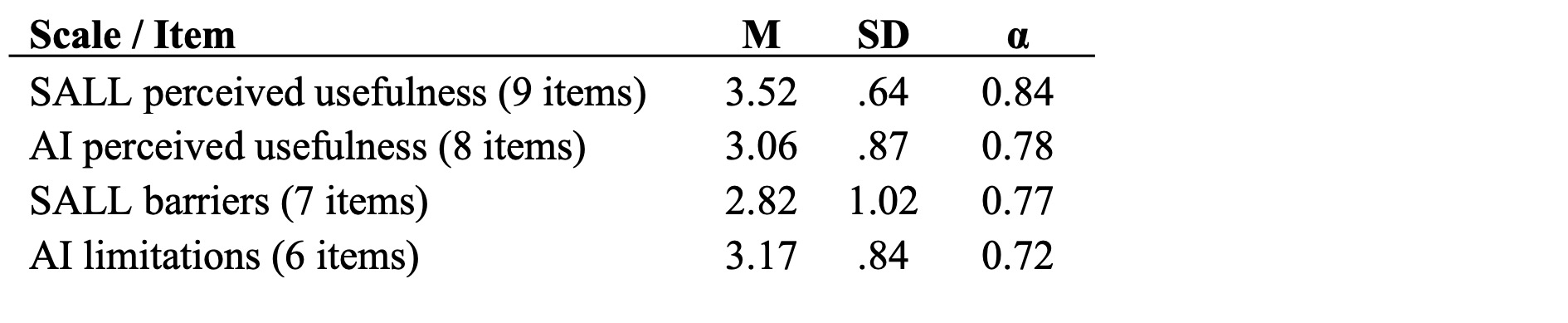
Table 3 summarizes the composite scale scores and reliability estimates, while Appendix A provides all individual items for the entire survey. The composite mean for SALL service usefulness was 3.52 (SD = .64), indicating a high level of perceived value. Comparatively, the perceived usefulness of AI chatbots was moderate (M = 3.06, SD = .87).
Table 3
Composite Descriptive Statistics and Scale Reliability
Participants also reported moderate barriers to using SALL services (M = 2.82, SD = 1.02). The highest-rated barriers were not knowing what SALL services are available (M = 3.56, SD= .65) and not knowing how to access the services (M = 3.47, SD = .71). Participants also moderately agreed that they don’t have time to use the services (M = 2.95, SD = .83), and using SALL services would be troublesome (M = 2.94, SD = .87). However, students disagreed that they don’t need the services (M = 1.97, SD= .91).
Perceived limitations of AI chatbots were also moderate (M = 3.17, SD = 0.84). The most strongly endorsed limitations included chatbots not always being accurate (M = 3.59, SD = .65), AI chatbots may weaken independent thinking (M = 3.50, SD = .66), and fewer opportunities to interact with people in English (M = 3.34, SD = .79).
The mirrored perceived usefulness items for SALL services and AI chatbots are shown in Table 4. Mean ratings were higher for SALL services than for AI chatbots across all five items. The largest difference was observed for speaking skills, with SALL services receiving substantially higher ratings (M = 3.71, SD = .54) than AI chatbots (M = 2.52, SD = .88). SALL services were also rated more highly for increasing motivation (M = 3.51, SD = .67) than AI chatbots (M = 2.38, SD = .91), and participants reported stronger agreement that SALL services could provide personalized advice and feedback (M = 3.52, SD = .64) compared to AI chatbots (M = 2.97, SD = .85).
Table 4
Mirrored Statements for Perceived Usefulness
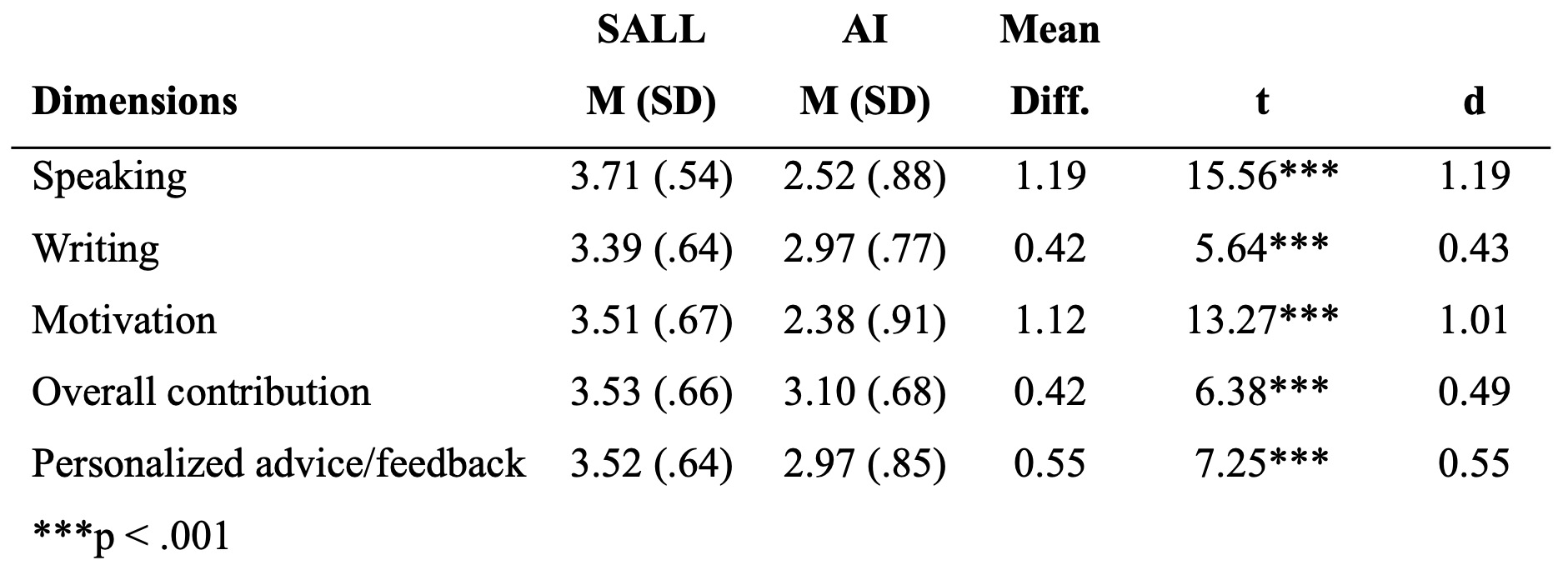
To directly compare perceptions of SALL services and AI chatbots, paired-samples t-tests were conducted on the five parallel items. Participants rated SALL services significantly higher than AI chatbots for improving speaking skills (t(171) = 15.56, p < .001, d = 1.19), increasing motivation (t(171) = 13.27, p < .001, d = 1.01), providing personalized advice and feedback (t(171) = 7.25, p < .001, d = 0.55), contributing to English learning overall (t(171) = 6.38, p < .001, d = 0.49), and improving writing skills (t(171) = 5.64, p < .001, d = 0.43). Effect sizes ranged from moderate to large, with the strongest effects observed for speaking skills and motivation.
RQ2: Learners’ Perceptions of the Future of SALL in the Age of AI Chatbots
The summary descriptive results of the Likert-scale analysis are presented in Table 5. Participants generally held positive views regarding the future role of SALL services. They agreed that SALL services would continue to play an important role in English learning (M = 3.29, SD = .65) and were less likely to agree that their necessity would decrease as AI chatbots develop (M = 2.55, SD = .76). Participants also agreed that SALL services should be used in combination with AI chatbots (M = 3.39, SD = .70) and that SALL services would need to adapt in response to developments in AI technology (M = 3.06, SD = .79).
Table 5
Future Role of SALL Services and AI Chatbots
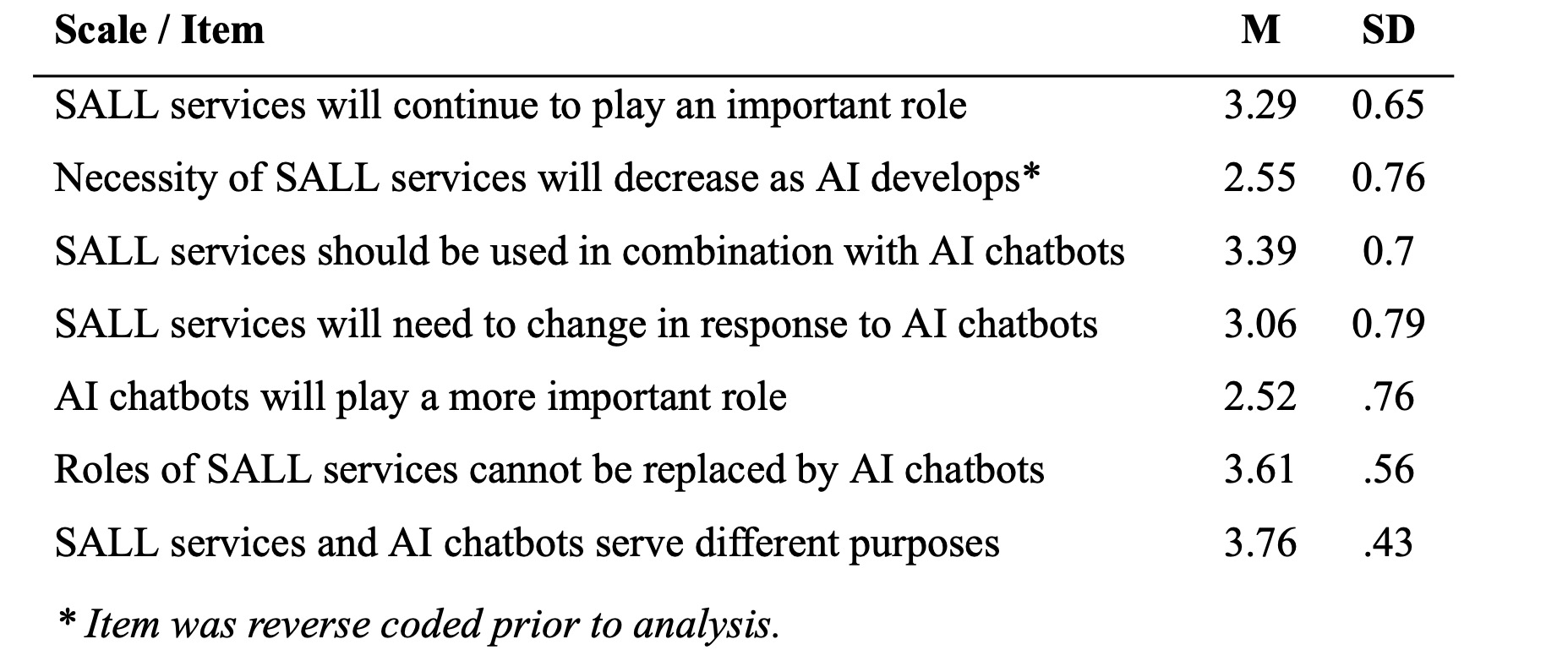
Participants showed modest agreement that AI chatbots will play a more important role than SALL services in future English learning (M = 2.52, SD = .76). At the same time, they strongly agreed that SALL services still fulfill essential roles that cannot be replaced by AI chatbots (M = 3.61, SD = .56). Participants also strongly agreed that SALL services and AI chatbots perform distinct purposes in English learning (M = 3.76, SD = .43).
Open-Ended Questions
A total of 140 participants responded to the question, “Which do you consider more important for English language learning: SALL services or AI chatbots?” The question asked participants to compare the two forms of support directly. Overall, 87 participants (62%) indicated that they considered SALL services to play a more important role than AI chatbots. Many of the reasons were related to the development of general English proficiency (4 coded instances). In particular, participants emphasized communication skills (7), with most referring to SALL services’ ability to improve speaking ability (12). Others valued the opportunity to engage in natural English communication (5), especially through interaction with other people (4). Several participants also favored SALL services because of perceived limitations of AI chatbots, including concerns about inaccurate or unreliable information (14), reduced opportunities for independent thinking (5), and other limitations (3).
In contrast, 40 participants (29%) felt that AI chatbots play a more important role than SALL services. Most comments highlighted the accessibility and convenience of AI chatbots. Participants noted that chatbots can be accessed anytime and anywhere (18 coded instances). As one participant commented, “AI chatbots… can be used anytime and anywhere on a smartphone.” Participants also described AI chatbots as convenient to use (7), providing immediate answers (4), being easy to use (3), and reducing foreign language anxiety (3).
The remaining 13 participants (9%) felt that both SALL services and AI chatbots were equally important. One participant explained, “Rather than one being more important, both are equally important, as each can compensate for what the other cannot do.” Several participants also commented that each serves a distinct and valuable role in English learning (5 coded instances). The most common reasons cited were the accessibility of AI chatbots (3) and the ability of SALL services to support speaking and communication development (3).
A total of 142 participants responded to the question, “In light of the continued development of AI chatbots, what role do you think SALL services should play in future English learning?” As this question explicitly framed SALL services in relation to AI chatbots, the responses should be interpreted within this context. Participants primarily viewed SALL services as providing opportunities for authentic English communication (17 coded instances) that complement areas where AI is perceived to be less effective (6). In particular, they emphasized opportunities for speaking practice (41), face-to-face interaction (13), human interaction (9), spoken communication (8), and practical conversation (5), all of which were seen as contributing to the development of speaking proficiency (5). As one participant explained, “Speaking with a real person feels fundamentally different from interacting with an AI chatbot, so I think SALL services should place greater emphasis on supporting speaking practice rather than explaining grammar.” Another similarly noted, “Human-to-human conversation is difficult to replicate, particularly the other person’s reactions and vocal intonation. In this respect, I think SALL services are better suited to developing learners’ ability to communicate.”Beyond opportunities for authentic communication, participants also viewed SALL services as having an important supportive function. They believed these services can help maintain learner motivation (15), provide personalized advice and guidance (7), offer feedback (5), and help reduce anxiety while building confidence in English use (4).
Discussion
The overall findings suggest that learners generally perceive SALL services and AI chatbots as complementary rather than competing resources for English learning. Although participants expressed modest agreement that AI chatbots may become increasingly important in future English learning, they also strongly agreed that SALL services would remain relevant, fulfill functions that cannot be replaced by AI, and offer complementary forms of support alongside AI chatbots. Participants further agreed that both resources should be used in combination. These findings align with recent discussions suggesting that AI is most effective when integrated alongside existing self-access support structures rather than replacing them (Behforouz & Al Ghaithi, 2024; Terantino, 2024). Rather than viewing AI as a substitute for SALL services, learners appear to envision a future in which both resources coexist and contribute unique benefits to English learning.
The comparison of mirrored perceived usefulness items provides further insight into the different but complementary roles learners assign to SALL services and AI chatbots. Significant differences were found across all mirrored items, with the largest differences observed for speaking development and learner motivation. Participants also rated SALL services significantly higher for personalized advice and feedback, writing development, and overall contribution to English learning. These findings suggest that learners perceive SALL services as offering benefits that are difficult to replicate through AI chatbots alone, particularly in areas that rely on human interaction, encouragement, and communicative practice. This interpretation is also reflected in the open-ended responses, in which participants frequently described SALL services as valuable opportunities for speaking practice and authentic communication. Participants also emphasized the supportive role of SALL services in increasing motivation and providing personalized advice and feedback. Together, these findings are consistent with previous self-access research emphasizing the importance of interpersonal support and meaningful social interaction in language learning (Mynard & Shelton-Strong, 2022). In contrast, participants primarily valued AI chatbots for their convenience, accessibility, and ability to provide immediate assistance, consistent with previous research on AI-assisted language learning (Cai et al., 2024; Liu & Ma, 2024). These findings suggest that learners perceive AI chatbots as support tools rather than replacements for human-supported learning.
Participants agreed that SALL services should adapt in response to advances in AI technology. However, the findings suggest that adaptation should focus less on replacing human interaction and more on addressing practical barriers to participation. The most commonly reported barriers involved awareness, accessibility, and convenience, echoing longstanding challenges identified in self-access research (Thompson, 2014). AI technologies may help address these barriers by providing support outside normal operating hours or for learners unable to attend services in person. At the same time, some participants expressed concerns that AI chatbots may weaken independent thinking and reduce opportunities for human interaction, reflecting concerns raised elsewhere in the AI-in-education literature (Susnjak, 2022; Warschauer et al., 2023). Taken together, the findings suggest that learners perceive the unique contribution of SALL services to lie in providing authentic communication opportunities, interpersonal support, and learner development experiences that learners perceive as difficult to replicate through AI alone.
Conclusion
This study examined learners’ perceptions of SALL services and AI chatbots for English learning and explored the future role of SALL services in the context of AI. The findings suggest that learners view SALL services and AI chatbots as complementary rather than competing resources. While AI chatbots were valued for their convenience and accessibility, SALL services were perceived as particularly beneficial for speaking development, motivation, personalized guidance, and authentic communication practice. Participants also indicated that SALL services would continue to play an important role in English learning despite advances in AI technology.
Several limitations should be acknowledged. First, the study was conducted with a single sample, which may limit the generalizability of the findings. Furthermore, most participants had not previously used SALL services, and their responses therefore reflected perceptions based on the descriptions provided during the study rather than direct experience. Consequently, the findings should be interpreted as learners’ anticipated perceptions of SALL services rather than evaluations based on actual use. In addition, although the open-ended questions were developed based on the study objectives and relevant literature, they were not formally piloted. One question also asked participants to compare the importance of SALL services and AI chatbots directly, while another framed the future of SALL services in relation to AI chatbots. These questions may have encouraged participants to consider the two forms of support comparatively, and alternative wording may have elicited different perspectives. Future research should examine these issues across larger and more diverse populations, include learners with direct experience of SALL services, and explore whether alternative question wording elicits different perspectives.
Notes on the Contributor
Shawn Andersson is a Specially Appointed Associate Professor at the University of Osaka’s Division of Foreign Studies. His research interests include computer-assisted language learning (CALL), digital game-based language learning, and virtual environments.
References
Aithal, P. S., & Aithal, S. (2023). The changing role of higher education in the era of AI-based GPTs. International Journal of Case Studies in Business, IT, and Education, 7(2), 183–197. http://dx.doi.org/10.2139/ssrn.4609337
Aljohani, R. A. (2021). Teachers and students’ perceptions on the impact of artificial intelligence on English language learning in Saudi Arabia. Journal of Applied Linguistics and Language Research, 8(1), 36–47. https://jallr.com/index.php/JALLR/article/view/1156
Alrajhi, A. S. (2025). Intelligent personal assistants in self-access L2 vocabulary learning. Education and Information Technologies, 30(1), 801–831. https://link.springer.com/article/10.1007/s10639-024-12967-7
Andersson, S., & Nakahashi, M. (2023). The future role of online consultations within self-access learning. Studies in Self-Access Learning Journal, 14(1). https://doi.org/10.37237/140102
Behforouz, B., & Al Ghaithi, A. (2024). The impact of using interactive chatbots on self-directed learning. Studies in Self-Access Learning Journal, 15(3). https://doi.org/10.37237/150302
Boonmoh, A., Jumpakate, T., & Karpklon, S. (2021). Teachers’ perceptions and experience in using technology for the classroom. Call-EJ, 22(1), 1–24. https://callej.org/index.php/journal/article/view/320
Cai, Q., Lin, Y., & Yu, Z. (2024). Factors influencing learner attitudes towards ChatGPT-assisted language learning in higher education. International Journal of Human–Computer Interaction, 40(22), 7112–7126. https://doi.org/10.2139/ssrn.5315763
Çakmak, F. (2022). Chatbot-human interaction and its effects on EFL students’ L2 speaking performance and anxiety. Novitas-ROYAL, 16(2), 113–131.
Campbell-Howes, K. (2019, March 18). Why is AI a good thing for language teachers and learners? Oxford TEFL. https://oxfordtefl.com/blog/why-is-ai-a-good-thing-for-language-teachers-and-learners/
Chen, H. H.-J., Yang, C. T.-Y., & Lai, K. K.-W. (2020). Investigating college EFL learners’ perceptions toward the use of Google Assistant for foreign language learning. Interactive Learning Environments, 31(3), 1335–1350. https://doi.org/10.1080/10494820.2020.1833043
Ciaunica, A., McEllin, L., Kiverstein, J., Gallese, V., Hohwy, J., & Woźniak, M. (2022). Zoomed out: Digital media use and depersonalization experiences during the COVID-19 lockdown. Scientific Reports, 12(1), Article 3888. https://doi.org/10.1038/s41598-022-07545-0
Daley, S., & Pennington, J. (2020, June). Alexa the teacher’s pet? A review of research on virtual assistants in education. In T. Bastiaens (Ed.), EdMedia + Innovate Learning 2020 (pp. 138–146). Association for the Advancement of Computing in Education (AACE). https://www.learntechlib.org/p/217296/
Dizon, G., & Tang, D. (2020). Intelligent personal assistants for autonomous second language learning: An investigation of Alexa. The JALT CALL Journal, 16(2), 107–120. https://www.castledown.com/journals/jaltcall/article/view/jaltcall.v16n2.273
Firat, M. (2023, January 12). How can ChatGPT transform autodidactic experiences and open education? Department of Distance Education, Open Education Faculty, Anadolu University. https://doi.org/10.31219/osf.io/9ge8m
Gardner, D., & Miller, L. (1999). Establishing self-access: From theory to practice. Cambridge University Press.
Gardner, D., & Miller, L. (2011). Managing self-access language learning: Principles and practice. System, 39(1), 78–89. https://doi.org/10.1016/j.system.2011.01.010
Har, F., & Ma, B. W. L. (2023). The future of education utilizing an artificial intelligence robot in the Centre for Independent Language Learning: Teacher perceptions of the robot as a service. In C. Hong & W. W. K. Ma (Eds.), Applied degree education and the shape of things to come (pp. 49–64). Springer Nature Singapore. http://dx.doi.org/10.1007/978-981-19-9315-2_3
Haristiani, N., & Rifai, M. M. (2021). Chatbot-based application development and implementation as an autonomous language learning medium. Indonesian Journal of Science & Technology, 6(3), 561–576. https://doi.org/10.17509/ijost.v6i3.39150
Huang, X., Zou, D., Cheng, G., Chen, X., & Xie, H. (2023). Trends, research issues and applications of artificial intelligence in language education. Educational Technology & Society, 26(1), 112–131. https://www.jstor.org/stable/48707971
Hwang, W. Y., Nurtantyana, R., Purba, S. W. D., Hariyanti, U., Indrihapsari, Y., & Surjono, H.D. (2023). AI and recognition technologies to facilitate English as foreign language writing for supporting personalization and contextualization in authentic contexts. Journal of Educational Computing Research, 61(5), 1008–1035. https://journals.sagepub.com/doi/10.1177/07356331221137253
Kim, H., & Kwon, Y. (2012). Exploring smartphone applications for effective mobile-assisted language learning. Multimedia-Assisted Language Learning, 15(1), 31–57.
Li, B., Bonk, C. J., Wang, C., & Kou, X. (2024). Reconceptualizing self-directed learning in the era of generative AI: An exploratory analysis of language learning. IEEE Transactions on Learning Technologies, 17, 1489–1503. https://doi.org/10.1109/TLT.2024.3386098
Liu, G., & Ma, C. (2024). Measuring EFL learners’ use of ChatGPT in informal digital learning of English based on the technology acceptance model. Innovation in Language Learning and Teaching, 18(2), 125–138. https://doi.org/10.1080/17501229.2023.2240316
Martinez, D. (2015). Online writing labs. In B. L. Hewett & E. DePew (Eds.), Foundational practices of online writing instruction (pp. 183–210). WAC Clearinghouse.
Moussalli, S., & Cardoso, W. (2020). Intelligent personal assistants: Can they understand and be understood by accented L2 learners? Computer Assisted Language Learning, 33(8), 865–890. https://doi.org/10.1080/09588221.2019.1595664
Mynard, J. (2019). Perspectives on self-access in Japan: Are we simply catching up with the rest of the world? Mélanges CRAPEL, 40(1), 14–27. https://www.atilf.fr/wp- content/uploads/publications/MelangesCrapel/atilf_melanges_40_1_1_mynard.pdf
Mynard, J., & Shelton-Strong, S. J. (2022). Self-determination theory: A proposed framework for self-access language learning. Journal for the Psychology of Language Learning, 4(1), 1–14. https://doi.org/10.52598/jpll/4/1/5
Ohara, T., & Ishimura, F. (2020). Emergency remote support at the self-access learning center: Successes and limitations. Studies in Self-Access Learning Journal, 11(3), 234–249. https://doi.org/10.37237/110310
Pokrivcakova, S. (2019). Preparing teachers for the application of AI-powered technologies in foreign language education. Journal of Language and Cultural Education, 7(3), 135–153. https://doi.org/10.2478/jolace-2019-0025
Reinders, H., & White, C. (2016). 20 years of autonomy and technology: How far have we come and where to next? Language Learning & Technology, 20(2), 143–154. https://scholarspace.manoa.hawaii.edu/bitstream/10125/44466/20_02_reinderswhite.pdf
Rohalevych, V. (2020). Essentials of artificial intelligence for language learning. Intellias. https://www.intellias.com/how-ai-helps-crack-a-new-language/
Roumeliotis, K. I., & Tselikas, N. D. (2023). ChatGPT and open-AI models: A preliminary review. Future Internet, 15(6), 1–24. https://doi.org/10.3390/fi15060192
Susnjak, T. (2022). ChatGPT: The end of online exam integrity? arXiv, 2212.09292, 1–21. https://doi.org/10.48550/arXiv.2212.09292
Suzuki, K., & Hooper, D. (2024). Analyzing self-access anxiety through the eyes of students. JASAL Journal, 5(1), 4–27. https://jasalorg.com/analyzing-self-access-anxiety-through-the-eyes-of-students/
Terantino, J. (2024). Leveraging AI to enhance self-access language learning centers. JASAL Journal, 5(1) 100–108. https://jasalorg.com/leveraging-ai-to-enhance-self-access-language-learning-centers/
Thompson, G. (2014). Moving online: Changing the focus of a writing centre. Studies in Self Access Learning Journal, 5(2), 127–142. https://sisaljournal.org/archives/june14/thompson
Viberg, O., & Kukulska-Hulme, A. (2021). Fostering learners’ self-regulation and collaboration skills and strategies for mobile language learning beyond the classroom. In H. Reinders, C. Lai, & P. Sundqvist (Eds.), Routledge handbook of language teaching and learning beyond the classroom (pp. 1–15). Routledge.
Wang, R., Hempton, B., Dugan, J. P., & Komives, S. R. (2008). Cultural differences: Why do Asians avoid extreme responses? Survey Practice, 1(3), 1–8. https://doi.org/10.29115/SP-2008-0011
Wangdi, T., & Shimray, R. (2022). Investigating the significance of Coxhead’s academic word list for self-access learners. Studies in Self-Access Learning Journal, 13(3), 367–388. https://doi.org/10.37237/130305
Wangdi, T., & Shimray, R. (2025). AI-Powered ReadTheory as a Self-Access Learning Platform to Enhance EFL Learners’ Reading Enjoyment and Comprehension Skills: A Posthumanist Perspective. Studies in Self-Access Learning Journal, 16(2), 437–460. https://sisaljournal.org/archives/volume-16/jun25/wangdi_shimray/
Warschauer, M., Tseng, W., Yim, S., Webster, T., Jacob, S., Du, Q., & Tate, T. (2023). The affordances and contradictions of AI-generated text for writers of English as a second or foreign language. Journal of Second Language Writing, 62, 1–24. https://papers.ssrn.com/sol3/papers.cfm?abstract_id=4404380
Appendices
Appendix A
Survey Items and Descriptive Results
| Perceived Value of SALL Services | M | SD |
| I think SALL services would help improve my English speaking skills | 3.71 | .54 |
| I think SALL services would help improve my English writing skills | 3.39 | .64 |
| I think advice related to English learning provided through SALL services would be beneficial | 3.49 | .61 |
| I think SALL services would provide guidance on learning methods that suit me | 3.32 | .67 |
| I think SALL services would help increase my motivation for learning | 3.51 | .67 |
| I think SALL services would help reduce anxiety about learning English | 3.42 | .64 |
| I think SALL services would provide opportunities to interact with others in English | 3.75 | .52 |
| I think SALL services would play an important role in English learning overall | 3.53 | .66 |
| I think SALL services would help provide personalized advice and feedback tailored to my needs | 3.52 | .64 |
| Reasons for not using or not frequently using SALL services | M | SD |
| I do not have time to use SALL services | 2.95 | .83 |
| I feel that using SALL services is troublesome | 2.94 | .87 |
| I do not know how to use SALL services | 3.47 | .71 |
| I do not really understand what kinds of SALL services are available | 3.56 | .65 |
| I do not feel a need to use SALL services | 1.97 | .91 |
| I feel anxious or nervous about using SALL services | 2.67 | .97 |
| I feel uncomfortable using English in front of other people | 2.17 | .99 |
| The role of SALL services in future English learning | M | SD |
| I think SALL services will continue to play an important role | 3.29 | .65 |
| I think the necessity of SALL services will decrease as AI chatbots develop* | 2.55 | .76 |
| I think SALL services should be used in combination with AI chatbots | 3.39 | .70 |
| I think SALL services will need to change their content in response to the development of AI chatbots | 3.06 | .79 |
| * Item was reverse coded prior to analysis. | ||
Perceived Value of AI Chatbots | M | SD |
| I think AI chatbots would help improve English speaking skills | 2.52 | .88 |
| I think AI chatbots would help improve English writing skills | 2.97 | .77 |
| I think explanations related to English (such as grammar and expressions) provided by AI chatbots are easy to understand | 3.30 | .68 |
| I think AI chatbots would answer my questions quickly | 3.71 | .56 |
| I think AI chatbots would help me learn at my own pace | 3.53 | .68 |
| I think AI chatbots would help increase motivation for learning | 2.38 | .91 |
| I think AI chatbots would play an important role in English learning overall | 3.10 | .68 |
| I think AI chatbots would help provide personalized advice and feedback tailored to my needs | 2.97 | .85 |
| Limitations of AI Chatbots | M | SD |
| I think using AI chatbots may not greatly improve English proficiency itself | 2.72 | .84 |
| I do not think AI chatbots provide opportunities to interact with people in English | 3.34 | .79 |
| I think it may be difficult to maintain motivation for learning when using AI chatbots | 2.86 | .80 |
| I think responses provided by AI chatbots may not always be accurate | 3.59 | .65 |
| I think AI chatbots may weaken the ability to think independently | 3.50 | .66 |
| I do not think AI chatbots are very suitable for practicing using English in real situations | 3.02 | .86 |
| The role of AI chatbots in future English learning | M | SD |
| I think AI chatbots will play a more important role than SALL services in future English learning | 2.52 | .76 |
| I think there are roles of SALL services that cannot be replaced by AI chatbots | 3.61 | .56 |
| The use of AI chatbots and SALL services for different purposes | M | SD |
| I think it is important to use AI chatbots and SALL services for different purposes in English learning | 3.76 | .43 |
Appendix B
Open-Response Questions
1. Which do you consider more important for English language learning: SALL services or AI chatbots?
2. In light of the continued development of AI chatbots, what role do you think SALL services should play in future English learning?