
Praveen Raj, Jubail English Language and Preparatory Year Institute, Royal Commission for Jubail and Yanbu, Saudi Arabia
Abdullah Al-Qarni, Jubail English Language and Preparatory Year Institute, Royal Commission for Jubail and Yanbu, Saudi Arabia
Raj, P., & Al-Qarni, A. (2026). Technology-assisted self-autonomous listening: Improving vocabulary skills. Studies in Self-Access Learning Journal, 17(1), 128–151. https://doi.org/10.37237/170108
Abstract
Developing listening skills is usually demanding for language learners, as it requires sustained and continuous exposure to language input. However, language learners in a traditional classroom have limited control over replaying or reattempting listening, which results in unequal learning opportunities. Therefore, there is a need for further investigation into technology-mediated listening practices to facilitate autonomous learning and improve listening outcomes. This study aims to examine the effectiveness of self-directed listening practices in learners’ vocabulary acquisition. It also explores learners’ perceived benefits and challenges when using self-paced listening to enhance vocabulary learning. This study employed a mixed-methods approach with a one-group pretest-posttest design, involving 17 B1-level Saudi EFL students in self-directed listening using authentic materials on LearnEnglish Teens for eight weeks. Vocabulary posttest scores improved, and survey results showed learners’ positive perceptions of self-autonomous listening. This study highlights the potential of self-directed listening to facilitate vocabulary learning and learner autonomy in EFL contexts.
Keywords: Self-Autonomous listening, listening and vocabulary, technology-mediated listening, vocabulary learning
A complete teacher-led class is highly unlikely to promote an autonomous learning environment, so educators should foster learning experiences that encourage learners to assume greater responsibility for their learning (Masouleh & Jooneghani, 2012). According to Holec (1981), learners being in “charge of their own learning” is learner autonomy. Students who experience autonomy are more likely to spend additional time practicing and developing proficiency (Alnufaie, 2022). Moreover, they try to work independently and take responsibility for their progress, and any challenges encountered will not demotivate self-learners since they will be proactive in finding solutions. This is because they are curious due to their developing interest in learning, which results in better learning plans and schedules. Thus, autonomous learners exhibit greater self-confidence in achieving their learning objectives (Ahmad et al., 2023; Altan, 2021; Borges & Castro, 2022; Davis, 2013). All in all, most autonomous learning models help students become aware of their goals, so the learners are focused on monitoring their progress to identify key areas of continuous improvement (Isabeles Flores, Cass Zubiría, & Sebire, 2022).
Sinar Okutucu (2021) suggests that educators employ online resources for self-learning that articulate clear learning objectives and outcomes. Furthermore, they can cater to the needs of learners of a wide range of abilities, which teachers can try to integrate into their regular classroom activities (Anderson, 2004; Warschauer & Liaw, 2011). Teachers must be ready to play a significant role in developing learners’ interest in autonomous learning, as this enables learners to be in charge of their learning progress, so one of the primary goals for educators is to design autonomous learning modules that can gradually transfer responsibilities to learners (Fabela-Cárdenas, 2012). As a result, autonomous learning continues effortlessly for future learners (Üstün Kaya & Keçik, 2021). Therefore, teachers’ guidance in an autonomous environment leads to better learning outcomes (Bánhegyi & Fajt, 2022). Additionally, the integrated learning resources should enable learners to monitor, assess, and evaluate their progress (Sinar Okutucu, 2021) and also engage (Lin et al., 2008). Therefore, it is important to select online self-accessible learning resources by adhering to certain foundational ideas. According to Tomilson (2010), effective learning resources should include a wide range of practical, useful, and meaningful materials to support all learners. He also stresses that they must be reusable multiple times to reinforce concepts. Moreover, they must be authentic or reliable and presented interactively.
Therefore, educators should seek ways to simplify, support, and facilitate the learning process (Nakai, 2016). Although rapid technological advancements have accelerated the growth of autonomous learning, teachers continue to play a pivotal role in sustaining self-directed learning practices (Zhong, 2018). Especially, teachers who play a significant role in influencing learners’ development as lifelong learners, providing both short-term and long-term successes. Further, this process can be strengthened by including technology-supported language resources in the language curriculum (Mynard et al., 2020). Tomilson (2010) further notes that language resources need to encourage communication to help purposeful language usage. Finally, he emphasizes that these resources should facilitate an optimistic attitude toward learning.
One key advantage of self-access online materials is that they are easy to grade. Gardner & Miller (2010) highlight the benefit of automatically graded online self-practice activities that are interesting and challenging, because they reduce teachers’ reliance on printed worksheets that require manual grading. For example, students can listen to online audio materials, and their answers can be graded using auto-correct features, which motivates students to continue the independent learning process (Šindelářová Skupeňová & Herout, 2024), so listening can be utilised for autonomous learning using online materials efficiently. This research study explores how self-directed listening is useful for students. Murray (2008) describes how EFL learners in Japan improved their language skills just by listening to pop music out of interest. According to Surayatika (2017), although listening is a receptive skill, it can be effectively integrated with technology, with the teacher being a facilitator.
Technology-Assisted Self-Autonomous Listening
Technological usage to learn languages is beneficial (Hajar, 2015). In particular, integrating computer-based tools effectively enhances language acquisition, as new technologies can supervise, train, and assist learners (Wu, 2017). Consequently, teachers are encouraged to integrate various online language platforms to improve learning proficiency (Dreyer, 2014), creative (Benson et al., 2016), and efficient use of technologies promotes independent learning beyond schools and colleges (Ghazali, 2020; Uzun & Guven-Yalcin, 2021).
Technology-supported learning with the help of computers and mobiles has become more prevalent among learners, irrespective of their levels, since they can supplement classroom instruction (Hancı-Azizoglu, 2023), which can be accessible in CALL labs (computer-assisted language learning) (Hobbs & Dofs, 2017; Malcolm & Majed, 2013; Wu, 2017), self-learning centres (Benson, 2017; Tassinari, 2018) and blended learning environments (Sullivan & McAuley, 2023). Therefore, teachers can integrate learning management systems (LMS) and online websites to provide individual training, as they record grades, time, attempts, and other details, which promotes participation and personalization while self-learning (Ana et al., 2020; Reinbold, 2018; Tassinari, 2012) inside and outside classrooms (Uzun & Guven-Yalcin, 2021; Hobbs & Hynson, 2013).
Further, digital resources on websites enhance self-learning by offering authentic learning materials that can be relistened to multiple times (Luu, 2023) on news websites, online platforms, radio, and podcasts, which can be accessed from students’ homes. Educational websites like the BBC offer autonomous listening (Zhdanov & Baklanov, 2020). Websites like Randall’s ESL Cyber Listening Lab and PodcastsInEnglish.com offer diverse materials for technology integration in classrooms (Kuznetsova et al., 2018; Lin et al., 2008). Also, Online resources on websites, Voice of Ameica, YouTube, and BBC Radio, are engaging, and teachers are therefore encouraged to integrate them into listening lessons (Gómez Martínez, 2010) to enhance pronunciation and intonation (Vo, 2013). For example, a website like ELLO is productive and cognitively engaging on smart devices (Soriano De La Cruz, 2023) to improve vocabulary skills (Agustin & Ayu, 2021).
Listening to authentic materials improves language comprehension (Gilakjani & Sabouri, 2016) and speaking skills by providing valuable language input and native-speaker-like proficiency (Altun, 2023). This is possible because a wide range of “extensive” listening promotes vocabulary learning (Renandya & Farrell, 2011), which has real-life scenarios and interaction, and new vocabulary (Otamurodova, 2025). According to Firestone et al. (2025), listening helps to learn vocabulary incidentally, though accompanying reading results in better vocabulary learning. Therefore, this research study examines the efficiency of vocabulary expansion after listening to authentic online resources in a CALL lab independently and autonomously.
Self-Autonomous Listening to Learn Vocabulary
Students use online websites to improve their language proficiency. For example, Hanifa & Yusra (2024) conducted a qualitative survey among 105 Indonesian English learners at a university to examine the online resources they used outside classroom hours to learn independently. They reported using 34 digital platforms, which included Duolingo, TED Talks, BBC Learning English, and YouTube. Despite only interacting with these websites for less than 5 hours a day, about 70-80% students found that these platforms supported vocabulary expansion. In particular, the listening materials helped them to understand vocabulary in context. Furthermore, they were beneficial in inferring meanings by observing authentic real-life scenarios and practical aspects of new vocabulary words and their usage. Interestingly, a significant number of learners accessed these websites based on teachers’ suggestions, highlighting the role of teachers in helping students access effective technology to develop language skills.
Table 1 below shows that many digital resources have been used in previous studies to enhance vocabulary learning and listening skills. Most online platforms have free listening materials available; it is useful to integrate them for autonomous activities (Yang, 2020).
Table 1
Summary of Cited Resources
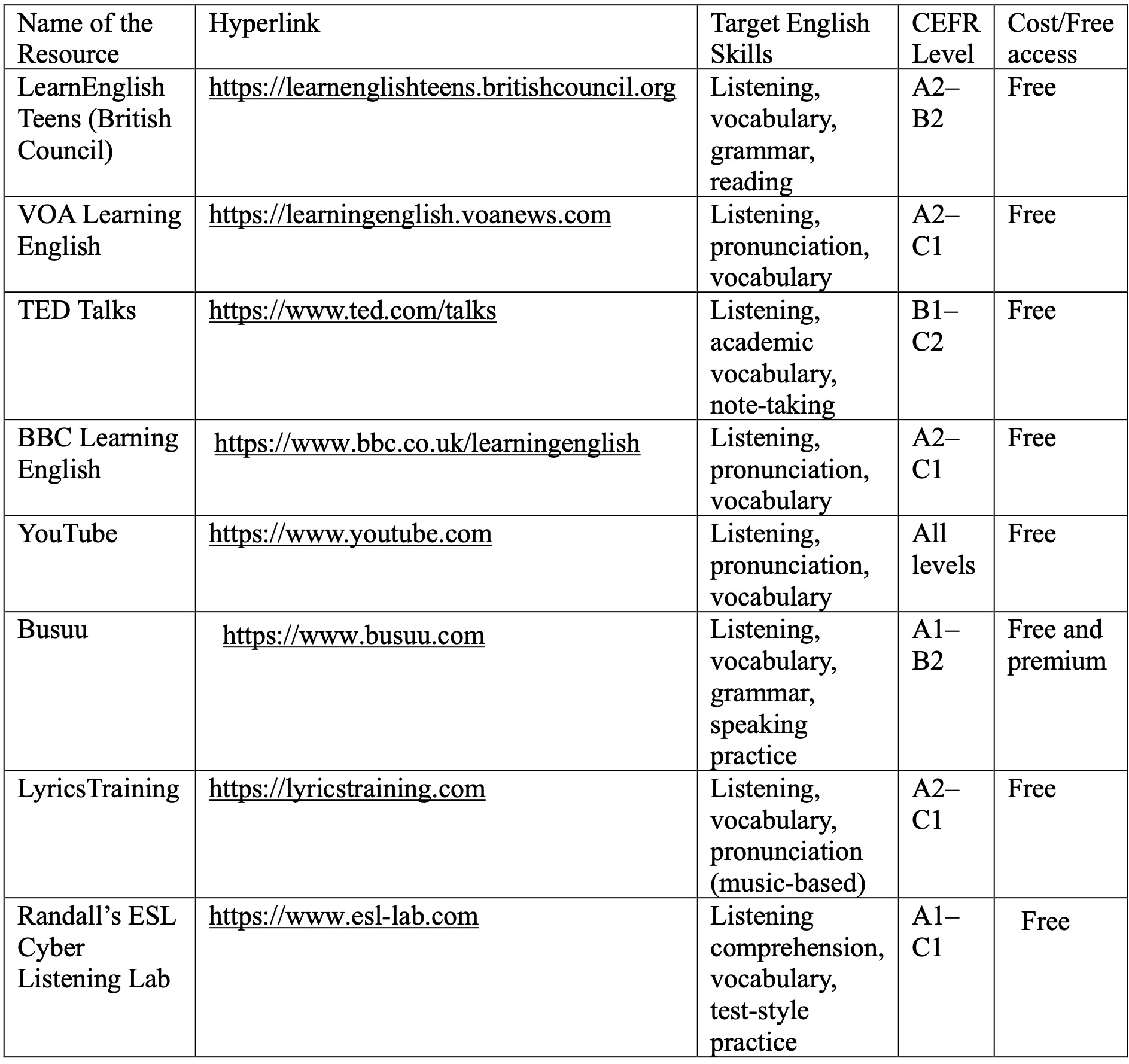
According to Krashen (1981), authentic materials, when listened to intensively and consistently, improve cognitive abilities that contribute to better vocabulary retention (Tran, 2023) without deliberate effort, and absorb new vocabulary (Zhang & Graham, 2020). Even YouTube songs improved vocabulary skills (Ghonivita et al., 2021). Likewise, Tran (2023) reported university students from Vietnam (n=30) listened to English News from BBC News, CNN News, VOA News, Euronews, and Eurosport. They reported vocabulary improvement. 40 high school students in Ecuador used listening exercises on Busuu, lyrics training, and Randall’s ESL Cyber Listening Lab to improve listening as a classroom activity. The learners agreed that listening to these authentic sources improved language skills, including vocabulary (Vilema Macas, 2022).
Feng and Webb (2020) found that reading, listening, and watching equally contributed to vocabulary learning, with no notable differences among the three groups of 76 EFL students after a 13-week intervention in a Chinese University. Feng and Webb also mentioned that increased “encounters” with target vocabulary words improve retention. However, this study did not offer any assessments before, during, or after the intervention. Also, individual repetitions or ‘encounters’ of audio materials were impossible in a classroom. Though this study expected the learners to listen to or read the target resources, it did not integrate activities into the LMS for autonomous practice.
Baigozhina and Mekezhanova (2023) integrated LearnEnglish Teens to improve listening comprehension among 16 students at Pavlodar Pedagogical University in Kazakhstan. The learners were able to listen to the online resources on LearnEnglish Teens in their classrooms, along with other subjects. The post-test mean scores were higher than those of the control group. This study suggested the potential advantages of authentic listening. However, students listened to the audio materials in classrooms without any individual facilities to replay. It depended on the teachers’ support for the audio materials, which is not an appropriate way to implement self-autonomous listening according to Masouleh and Jooneghani (2012). Furthermore, this study did not assess and monitor learners’ progress, which is an essential component of self-autonomous listening according to Isabeles Flores et al. (2022).
Salazar Pabón and Rodríguez Buitrago (2021) made LearnEnglish Teens available to sixth-grade students in Venezuela. The research study aimed to investigate students’ perceptions of the listening tasks in LearnEnglish Teens and concluded that the materials were beneficial for learners from survey responses. Likewise, Astuti et al. (2019) found that Voice of America (VOA) audio materials were productive in improving listening skills among 11th-grade students in Indonesia. The class listened to audio resources as supplementary material in class, which resulted in higher post-test scores; however, it was a whole-class listening rather than autonomous listening. Though the resources were available on the computer, they were not integrated into a learning management platform to track progress, which is necessary for successful autonomous learning (Ahmad et al., 2023; Altan, 2021; Borges & Castro, 2022; Davis, 2013).
Similarly, Aini et al. (2023) inquired into perceptions of BBC Learning English among 11 university students in Indonesia. The students mentioned that the website was useful for comprehension and new words. However, this study did not provide any intervention before the interviews to improve learners’ awareness of the website and relied on students’ knowledge. Similarly, Miranty’s (2017) qualitative survey concluded that the ESL Cyber Listening Lab was beneficial in improving listening skills. 40 students at a university in Indonesia listened to online audio materials in class and provided positive feedback that the tasks were engaging and exciting. Though both websites helped develop language skills, they were not individualised for autonomous learning, which is important according to Ana et al. (2020).
To summarize, online listening websites are useful for autonomous learning (Peterson, 2010). Most available studies have not integrated personalized learning with learner autonomy, and the majority are qualitative surveys. They mention the usefulness of listening for vocabulary, but have not investigated it thoroughly, so integrating online tasks in a learning management system using CALL software will be productive for autonomous learning. Therefore, this study used LearnEnglish Teens for autonomous learning by integrating online tasks on Blackboard LMS and CALL software, Articulate Storyline, and tried to explore the following research questions,
- How effective is self-autonomous listening in improving vocabulary learning among EFL learners?
- What are students’ perceptions and attitudes toward self-autonomous listening as a strategy for vocabulary learning?
Methodology
According to Baigozhina and Mekezhanova (2023), LearnEnglish Teens is suitable for students to improve their listening skills. However, this website does not support personalisation. One major limitation is the absence of facilities to download students’ grades, which is necessary for monitoring students’ progress. Even though multiple attempts are possible by replaying the audio, the website does not save each attempt and restricts teachers’ ability to track learners’ improvements. This means their efficiency cannot be measured. Consequently, teachers will have to depend on students’ reporting to finish the activities on LearnEnglish Teens. However, one of the major principles of self-autonomous learning requires learners to monitor and reflect on their own progress (Okutucu, 2021), highlighting the necessity of an organized tracking process that is possible on Blackboard LMS (Hobbs & Hynson, 2013). Furthermore, websites like Listening Teens and Blackboard LMS could be connected to promote better autonomous learning (Anas et al., 2020). Moreover, to enhance efficiency, the audio files in Learn English Teens were downloaded onto slides in an e-learning authoring tool called Articulate Storyline. The questions were added to the slides, and a SCORM (Shareable Content Object Reference Model) course was created (Donnellan, 2021). This was added to the Blackboard LMS, where students accessed and completed the online resources. The students had an account on the LMS. They opened the course file in the English labs on the campus and had access to the B1 English Level 12 audio files, which they completed in 8 weeks. Therefore, a well-designed listening lesson was created. Teachers acted as facilitators and ensured that students had access to a computer and the SCORM course on Blackboard LMS, and self-learning facilities were provided in the CALL lab while completing the autonomous listening lessons.
Participants
19 Saudi male EFL students participated in the study and completed the online activities, but only 17 students completed the pretest and the posttest. Initially, 30 students joined the study, but they did not complete all the online tasks because they were voluntary and not considered for their overall grades. According to Patton (2015), sample sizes in research studies depend on accessibility and voluntary participation. They cannot be decided by any rules. Patton (2015) further adds that applied research studies experience practical constraints, so they must focus on the process rather than larger samples. Likewise, Teddlie and Tashakkori (2009) state that small samples can be satisfactory for exploratory studies.
The participants were enrolled in a preparatory year program (PYP) at a Saudi public institute. During their enrolment at the university, all students completed the Cambridge Placement Test (CEPT) and were placed according to their proficiency levels, ranging from A1 to B1 plus. The participants selected for this level were classified as B1 based on CEPT scores. They studied 20 hours of Academic English instruction per week at the Institute. It covered subjects like Reading, Writing, Listening, Speaking, Grammar, and Vocabulary. They had to complete English courses before studying their academic major subjects, which were taught in English. The students, aged 19–20, came from different cities and towns across Saudi Arabia, and all participants were Saudi nationals whose mother tongue was Arabic, and had completed their schooling at public schools where Arabic was the medium of instruction.
Instruments
The study included two main instruments. The first instrument was a vocabulary pretest and posttest. The second instrument was a 10-item, 5-point Likert-scale survey. These two instruments measured the effectiveness and students’ perceptions of vocabulary learning after listening to LearnEnglish Teens.
The vocabulary pretest was conducted before and after the intervention. The pretest and posttest, prepared by the researchers, consisted of multiple-choice questions on new vocabulary words from LearnEnglish Teens. These test materials were selected to ensure the vocabulary questions were appropriate to test the effectiveness of vocabulary expansion from autonomous listening. The students answered 25 questions for 25 marks, and their pretest and posttest scores were recorded in percentages. The tests were conducted online on Blackboard LMS in the language lab, proctored by the teacher.
A 10-item survey was developed in Google Forms to assess the students’ perceptions of vocabulary learning after autonomous listening. The survey used a 5-point Likert scale ranging from Strongly Agree (5), Agree (4), Neither Agree nor Disagree (3), Disagree (2), and Strongly Disagree (1). The questions were focused on the perceived usefulness and interaction of the autonomous activities. Firstly, the questionnaire item on self-learning, independent learning, and motivation was influenced by Vandergrift et al. (2006)’s Metacognitive Awareness Listening Questionnaire (MALQ). Next, the perceived task difficulty, usefulness, and self-monitoring were adapted from Benson’s (2011). Furthermore, the survey items on teachers’ support and motivation were adapted from Littlewood’s (1999) autonomy in language learning. Lastly, the survey items on task difficulty and self-regulation were adapted from Goh and Vandergrift’s (2012) self-regulated learning principles. These items were revised and checked by the researchers and two expert teachers at the institute to make sure they were appropriate for the participants. The link was shared on Blackboard LMS, and the students completed it in their free time.
The survey and pretest were not piloted due to scheduling and accessibility. While the survey items were grounded in recognised theories, such as Self‑Determination Theory (Ryan & Deci, 2000), to explore the perceptions of the learners and were clear to students, the researchers and two experienced teachers checked the validity and reliability of the tests for consistent responses, found them satisfactory for a small exploratory study.
Procedure
The study was conducted for 8 weeks in the first semester of 2025, at a university in Saudi Arabia, and all participants studied a preparatory program and had access to Blackboard LMS. The intervention happened in the CALL lab, monitored by the teacher to solve technical issues, and there was minimal instructional interference to encourage autonomous learning.
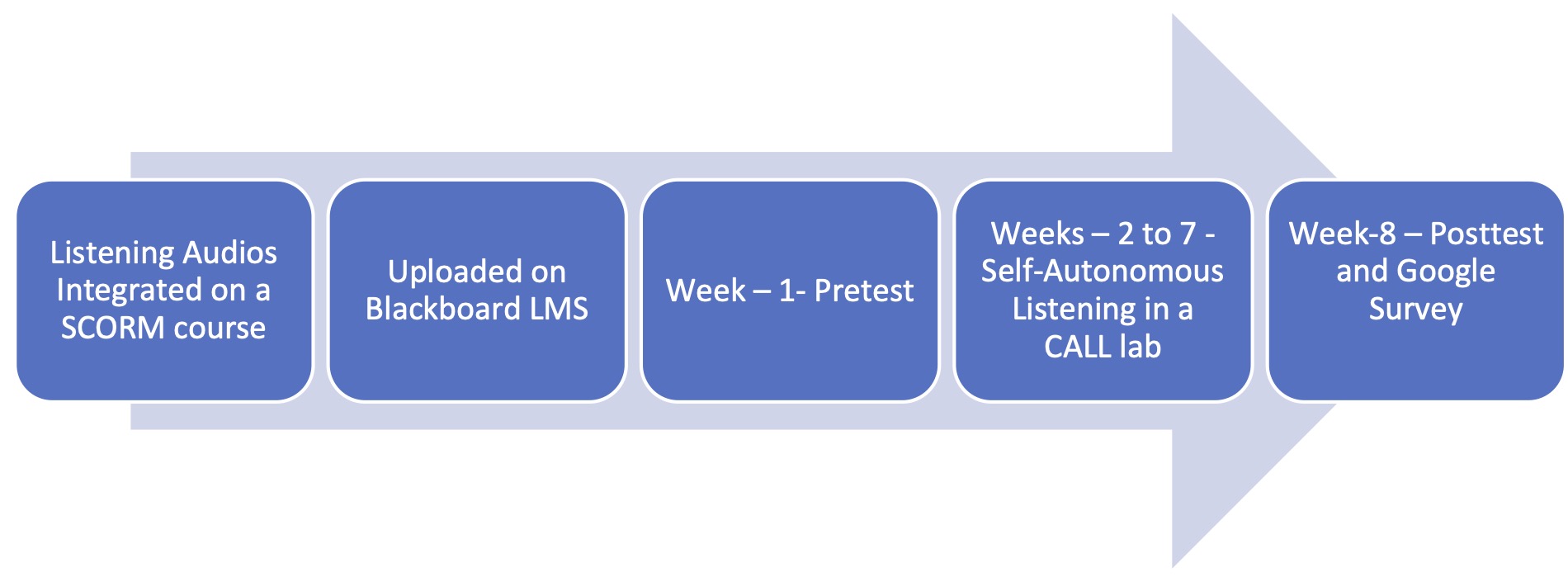
The self-autonomous listening activities consisted of 12 B1-level audio materials from the LearnEnglish Teens website, which were integrated into Articulate Storyline, a CALL software. Each audio was followed by interactive tasks, including multiple-choice questions (MCQ), drag-and-drop activities, and fill-in-the-blank questions. Totally, 12 SCORM courses were prepared by the teacher. These were then uploaded to the listening and speaking course on Blackboard LMS, enabling students to complete all twelve activities over six weeks.
In Week 1, participants completed a vocabulary pretest in the CALL laboratory under the researchers’ supervision. From week 2 to week 7, students completed two SCORM listening courses every week for an hour in the language lab. The instructor did not pedagogically guide the students, but was available to help with any technical issues. The SCROM modules and audio materials could be attempted multiple times, and the Blackboard LMS showed learners’ progress, which supervisors monitored. Although 30 students initially volunteered to complete the pretest, only 19 completed all 12 listening modules, and 17 finished the posttest. In week 8, the vocabulary posttest was conducted in the CALL lab. Subsequently, the survey link on Google Forms was shared on Blackboard LMS, which they completed in their free time.
Figure 1
Procedures (Self-Autonomous Listening)
Results
Data Analysis
Quantitative Analysis
Table 2
Paired Samples t Test Results (before and after the intervention)
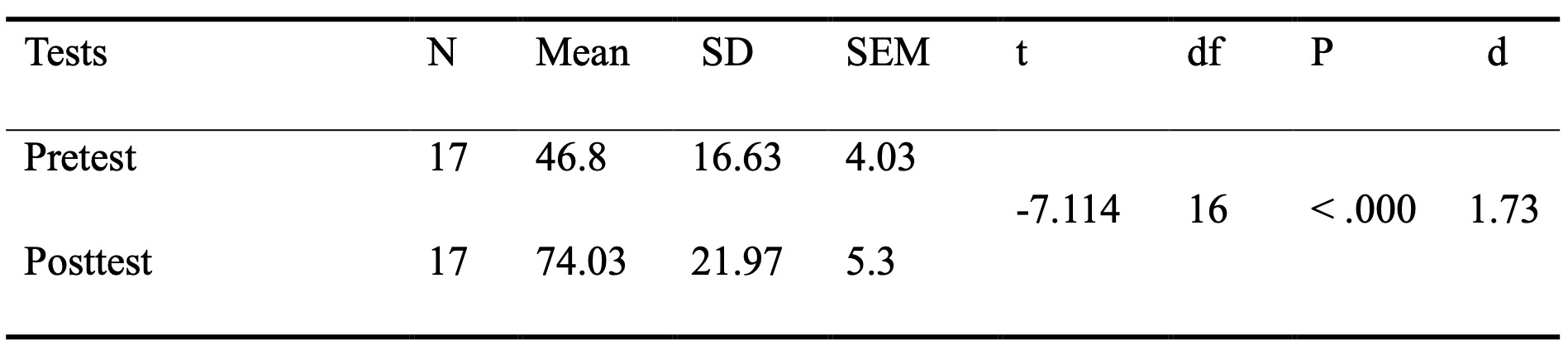
Table 2 shows the paired-samples t-test, which was conducted to estimate the influence of autonomous listening on students’ vocabulary learning. The results showed that posttest scores (M = 74.03, SD = 21.97) were significantly higher than pretest scores (M = 46.80, SD = 16.63), indicating noticeable improvement after the intervention. The difference was significant, t (16) = −7.11, p < .001, with an increase of 27.24. Since the sample size was small, the effect sizes and confidence intervals were considered to interpret the findings. The effect size was very large (Cohen’s d = 1.73), suggesting the positive intervention on learners’ vocabulary development. Additionally, the 95% confidence interval for the mean difference (−35.35 to −19.12) demonstrates the effectiveness of the autonomous listening approach for vocabulary acquisition.
Table 3
Survey Results
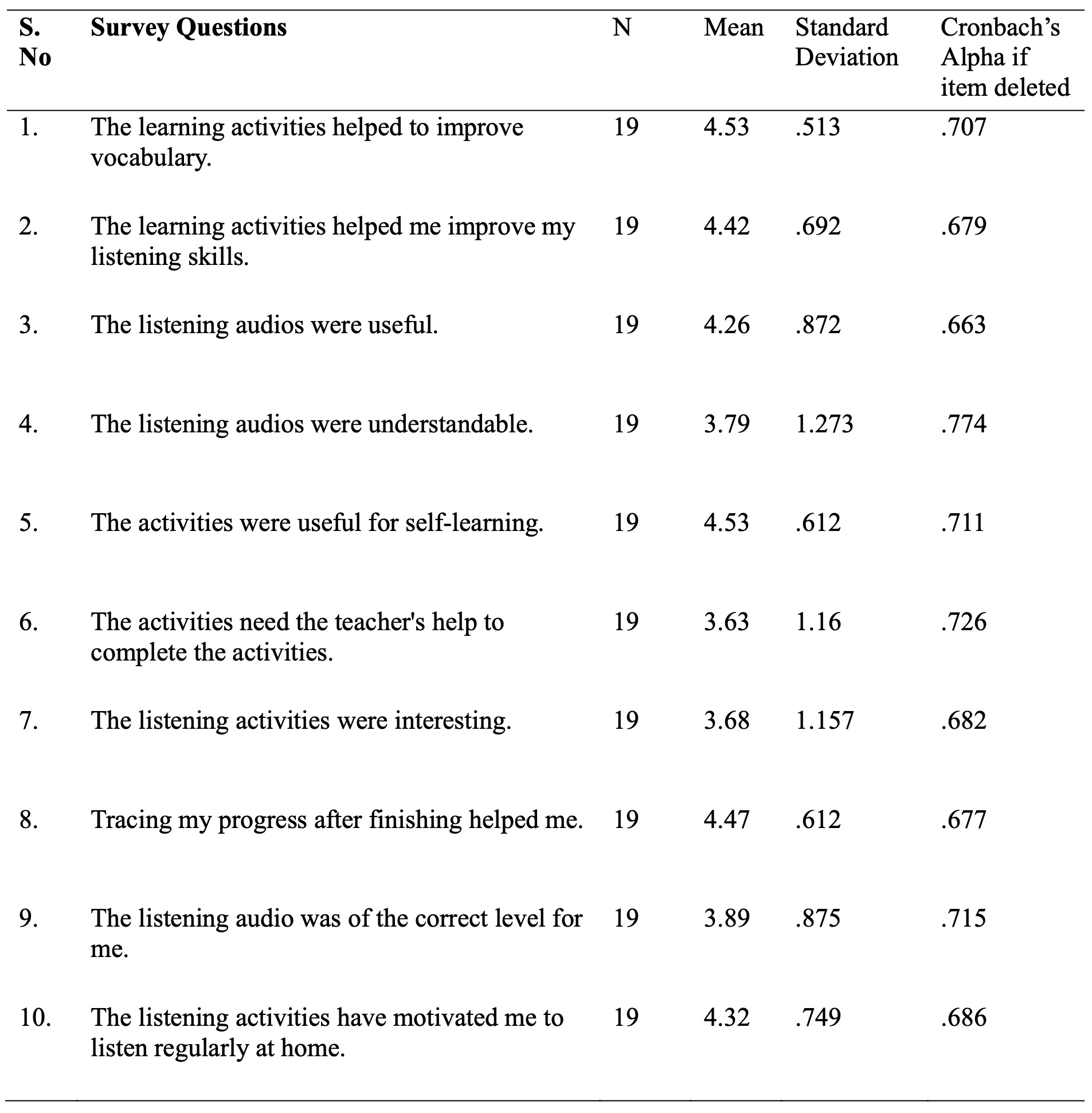
Table 4
Reliability Statistics

Table 3 displays the ten-item Likert‑scale questionnaire that was used to find out students’ perceptions of autonomous listening through SCORM modules. Since the responses were numerical, the survey analysis is quantitative. Table 4 indicates that the internal consistency of the overall scale was acceptable (Cronbach’s α = .725), which exceeds the recommended threshold of .70 for exploratory research, as they fit together coherently.
Descriptive statistics indicated generally positive perceptions of the autonomous listening activities. Firstly, students strongly agreed that the activities improved their vocabulary (M = 4.53, SD = .513) and supported self‑learning (M = 4.53, SD = .612). Furthermore, they also reported that the listening tasks helped improve their listening skills (M = 4.42, SD = .692) and motivated them to continue listening at home (M = 4.32, SD = .749). Items related to the usefulness (M = 4.26, SD = .872) and appropriate difficulty level of the audio materials (M = 3.89, SD = .875) also received positive feedback.
Perceptions were more diverse for items related to the clarity of the audio (M = 3.79, SD = 1.27) and the need for teacher assistance (M = 3.63, SD = 1.16), suggesting that some learners still depended on the teacher’s assistance despite the autonomous setup. Nevertheless, the overall responses indicate SCORM-based listening was useful, engaging, and helpful for self-learning.
Discussion
Research Question 1
How effective was self-autonomous listening in improving vocabulary learning among EFL learners?
The paired‑samples t-test was conducted comparing learners’ vocabulary scores before and after autonomous listening, and the results showed improvement in vocabulary performance. The pretest scores (M = 46.80, SD = 16.63) were substantially lower than posttest scores (M = 74.03, SD = 21.97), displaying noteworthy vocabulary gains following the intervention, and the difference between the two assessments was statistically significant, t (16) = –7.114, p < .001, with a mean difference of 27.24 points. While the pretest and posttest gains in vocabulary were statistically significant and had a large effect size, the results must be understood with caution, since one‑group pretest–posttest design does not allow causal claims, and the results might be influenced by uncontrollable factors (Campbell & Stanley, 1963). Therefore, the results demonstrate the potential effectiveness of autonomous listening rather than definite evidence.
To begin with, Tomlinson (2010) proposed the use of reusable, interactive, and authentic materials for effective language learning, and the principles were used in the current study to create an autonomous learning environment. Secondly, Vilema Macas (2022) highlighted the need for authentic listening materials in vocabulary learning for EFL students. The idea was also supported in the current study through the significant vocabulary improvement observed in the posttest, thus supporting the argument for the use of authentic learning materials in vocabulary learning within the autonomous learning environment.
Also, Baigozhina and Mekezhanova (2023) used audio materials from LearnEnglish Teens and a classroom environment facilitated by a teacher; the results showed that these materials were useful for improving learners’ listening skills. Likewise, the study of Salazar Pabón and Rodríguez Buitrago (2021) highlighted the importance of using audio materials from LearnEnglish Teens without any integration of personalized learning. In contrast, the present study offers autonomous learning through automated exercises facilitated by SCORM. In addition to facilitating listening, the intervention also enhanced vocabulary expansion.
Furthermore, Astuti and Musfirah (2019) found that Voice of America (VOA) audio materials were effective in developing learners’ listening skills as a teacher-directed classroom activity. This present study, on the other hand, utilized automated SCORM-based activities that allowed learners to manage their own learning pace, effectively develop listening skills and vocabulary through self-directed learning.
Collectively, these studies demonstrate the potential of digital listening tools in an English as a Foreign Language (EFL) context. This study, however, adds a unique dimension to the discussion by showing that the potential of integrating digital listening tools into an autonomous learning environment extends beyond listening skills and vocabulary development. This, in essence, reveals the potential of autonomous digital environments to enhance quality learning outcomes when compared to teacher-centred approaches.
Research Question 2
What are students’ perceptions and attitudes toward self-autonomous listening as a strategy for vocabulary learning?
To answer the second research question, this study investigated learners’ perceptions and attitudes toward self-directed learning (SDL), focusing on its relation to vocabulary development. For this, a ten-item Likert-scale questionnaire was used to elicit learners’ evaluations of the usefulness, understandability, and motivational aspects of the SCORM-based SDL activities. Overall, descriptive results indicate that learners generally have positive perceptions of SDL in its connection to vocabulary learning. Moreover, when viewed in relation to test-based results, these provide further understanding of learners’ experiences of self-directedness and its facilitation of vocabulary development. These positive attitudinal responses further validate the pedagogical benefits of autonomous listening as a valuable and learner-supported means of vocabulary learning. This aligns with findings from Hanifa and Yusra (2024), who examined the role of authentic online platforms in vocabulary acquisition outside the traditional learning context and found that students benefited from accessing them. However, there is one major difference: while Hanifa and Yusra mainly focused on students’ perceptions, the current study not only examined perceptions but also explored them in an authentic learning context, where students accessed authentic listening resources via SCORM-based interactive activities.
Similarly, Tran (2023) emphasizes the importance of platforms such as LearnEnglish Teens to interact with language input from native speakers. However, Tran also points out the complexity of the pronunciation, which creates a challenge, especially for those who are not good at listening. This observation is similar to the findings of the present study, in which students showed positive perceptions of autonomous listening activities, but did not strongly agree that the listening materials were entirely comprehensible, as shown by the lower mean score for listening clarity. Contrary to the majority of studies, the current study shows that learners’ perceptions of authentic listening materials are not entirely positive. On the one hand, the use of authentic listening materials is important for vocabulary learning; on the other hand, it is a challenge to learners’ comprehension. Therefore, the findings of the current study emphasize the need for a careful balance between the use of authentic listening materials and potential learners’ challenges.
The present study offers initial pedagogical implications regarding the facilitative role that autonomous listening may play in vocabulary development. However, a critical factor in learners’ engagement in autonomous learning is the materials. If they are dull and too difficult for learners, they may discourage learners from engaging seriously. However, in the present study, most participants concurred that the autonomous listening activities used were engaging and challenging. These results align with previous studies that highlighted the motivational power of engaging autonomous learning materials (Ghazali, 2020; Gardner & Miller, 2010; Kuznetsova et al., 2018). Additionally, challenging autonomous learning materials may help learners to be more productive by allowing them to work at their own pace and outside class hours (Soriano De La Cruz, 2023; Hancı-Azizoglu, 2023. The participants also agreed that the listening activities motivated them to improve their self-learning. For autonomous learners, productive challenge may inspire learners to plan, persevere, and eventually attain self-confidence—two essential goals of autonomous learning (Ahmad et al., 2023; Altan, 2021). Moreover, most participants also agreed that the listening activities stimulated them to continue improving their language skills. Although not definitive, these results suggest that autonomous listening activities, especially authentic and reusable materials (Tomlinson, 2010), may play a vital role in vocabulary development (Vilema Macas, 2022).
Conclusion
This present study’s investigation has provided preliminary pedagogical guidelines on the role of autonomous listening in facilitating vocabulary development. It has been noted that the extent to which the study materials are engaging and challenging is an important aspect in motivating learners to engage in autonomous study. When the materials are too monotonous or too challenging, learners may not be motivated to continue independent learning. In the present study, the learners generally supported the idea that the listening activities were both engaging and challenging. The present investigation has demonstrated the potential of autonomous listening to facilitate vocabulary development in a virtual environment and the substantial improvement in the learners’ vocabulary test results suggests the potential value of including authentic audio materials in SCORM-based activities; however, the results of the test cannot be considered conclusive evidence of the value of autonomous listening in facilitating vocabulary development due to the absence of a control group and the sample size of the study.
In parallel, learners’ self-reported perceptions provide a further, although different, line of evidence. The learners tend to find the autonomous listening activities interesting, appropriately challenging, and motivating—key factors in maintaining engagement with self-instructional learning. These attitudinal responses highlight the educational value of designing autonomous listening activities that offer a balance between authenticity and challenge. However, perceptions are learners’ personal experiences and should not be mixed with objective measures of vocabulary development.
Overall, the results have tentative pedagogical implications, which are pertinent to similar teaching contexts. The research suggests that autonomous listening exercises, especially if these include authentic and reusable audio materials, may encourage learners to engage more actively in vocabulary acquisition outside the classroom. Such findings, however, need cautious interpretation, and these pedagogical implications should be regarded as context-dependent rather than universally generalizable. Given the nature of the present study, further research incorporating more rigorous experimental methodologies and broader samples will be essential to clarify the degree to which autonomous listening can support vocabulary learning.
Limitations
The present study is considered exploratory with some limitations that should be noted when interpreting the results. Firstly, while only one group pre- and post-tests were used to measure vocabulary development, other language skills, such as speaking, reading, and writing, were not considered. Secondly, only 19 Saudi learners from a single class section were used for the study. The results cannot be generalized to a larger population; future studies must consider including a control group and an experimental group. Thirdly, while six to eight weeks were allowed for the intervention, only twelve audio files from LearnEnglish Teens were used. The autonomous listening intervention might have been limited. Fourthly, while a survey was used to collect data, only closed-ended questions were used on a Likert scale, and Google Forms were used for data collection rather than interviews. Fifthly, a control group was not used for comparison, which might have been definitive evidence. Sixthly, other factors, such as learners’ digital skills, motivation, and familiarity with autonomous learning, were not considered, which could have influenced their performance and perceptions.
Acknowledgments
The authors would like to thank Mr. Ibrahim Al Subaie, Instructor, Jubail English Language and Preparatory Year Institute, Royal Commission for Jubail and Yanbu, Jubail Industrial City, Saudi Arabia, for his assistance with various aspects of the research study.
Notes on the Contributors
Mr. Praveen Raj has worked as an English language instructor at the Jubail English Language & Preparatory Year Institute, Royal Commission for Jubail and Yanbu, Jubail Industrial City, Saudi Arabia, since 2011. Also, he has been actively involved in the institute’s E-learning team. He holds an MA in English Literature, a Postgraduate Diploma in Instructional Design, and is pursuing a part-time PhD in Online Learning and English Language Teaching. His research interests include instructional design, E-learning, gamification, blended learning, online learning, and flipped learning. He is also proficient in online tools, such as Articulate Storyline, ActivePresenter, Doodly, Videoscribe, and Vyond.
Abdullah S. Al-Qarni works at Royal Commission for Jubail & Yanbu, Jubail English Language and Preparatory Year Institute (JELPYI), Saudi Arabia. Dr. Abdullah S. Al-Qarni is the Deputy for Planning and Development at the Jubail English Language and Preparatory Year Institute (JELPYI), Royal Commission in Jubail, Kingdom of Saudi Arabia. He holds a PhD in Applied Linguistics, where his doctoral research employed corpus linguistics methods to analyze learner corpora and to evaluate the effectiveness of Corpus Pattern Analysis (CPA) developed by Prof. Patrick Hanks. His current research interests include corpus linguistics, learner corpora, and the integration of artificial intelligence with corpus linguistics methodologies to advance language research and pedagogy. His work contributes to the development of innovative, data-driven, and technology-enhanced approaches to English language teaching and learning.
Declaration
The authors used AI assistance to correct grammar and summarize previously written content.
References
Agustin, R. W., & Ayu, M. (2021). The impact of using Instagram on increasing vocabulary and listening skills. Journal of English Language Teaching and Learning, 2(1), 1–7. https://doi.org/10.33365/jeltl.v2i1.76
Ahmad, B. E., Saad, Z. A., Aminuddin, A. S., & Abdullah, M. A. (2023). Self-directed learning of Malay undergraduate students. Studies in Self-Access Learning Journal, 14(3), 244–266. https://doi.org/10.37237/140302
Aini, N., Abdillah, E. C., & Nevita, N. (2023). BBC learning English channel in listening skill of EFL classroom. In Proceeding International Conference on Education, (28 August 2023, Kedri, Indonesia, pp. 469–478).
Alnufaie, M. R. (2022). Mobile-assisted language learning applications: Features and characteristics from users’ perspectives. Studies in Self-Access Learning Journal, 13(3), 312–331. https://doi.org/10.37237/130302
Altun, M. (2023). A review of listening skills in language learning. International Journal of Social Sciences & Educational Studies, 10(1), 56–61. https://doi.org/10.23918/ijsses.v10i1p56
Anas, I., Amansyah, F., Musdariah, A., & Irmawati (2020). Technological and pedagogical considerations in supporting electronic self-access language learning (e-SALL): In-person learning practice in the time of crisis. Studies in Self-Access Learning Journal, 11(3), 128–134. https://doi.org/10.37237/110303
Anderson, T. (2004). Toward a theory of online learning. In T. Anderson & F. Elloumi (Eds.), Theory and practice of online learning. (pp. 33–60). Athabasca University Press.
Astuti, D., Dj, M. Z., & Musfirah, M. (2019). Developing students’ listening skill through VOA (Voice of America) Learning English video. Didaktika: Jurnal Kependidikan, 13(2), 146–158.
Altan, N. A. (2021). A review of the plenary talks on advising and self-directed learning: Two important systems for learner autonomy. Studies in Self-Access Learning Journal, 12(3), 295–300 https://doi.org/10.37237/120308
Bánhegyi, M., & Fajt, B. (2022). University students’ autonomous learning behaviours in three different modes of ICT-based instruction in the COVID-19 era: A case study of lockdown learning. Studies in Self-Access Learning Journal, 13(1), 5–30. https://doi.org/10.37237/130102
Benson, P. (2011). Teaching and researching autonomy (2nd ed.). Routledge.
Benson, P. (2017). Language learning beyond the classroom: Access all areas. Studies in Self-Access Learning Journal, 8(2), 135–146. https://doi.org/10.37237/080206
Benson, P., Chávez Sánchez, M., McLoughlin, D., Mynard, J., & Peña Clavel, M. (2016). New scenarios in autonomy for foreign language learning: Conference summary and reflections. Studies in Self-Access Learning Journal, 7(3), 287–296. https://doi.org/10.37237/070304
Borges, L., & Castro, E. (2022). Autonomy, empathy and transformation in language teacher education: A qualitative study. Studies in Self-Access Learning Journal, 13(2), 286–304. https://doi.org/10.37237/130207
Campbell, D. T., & Stanley, J. C. (1963). Experimental and quasi‑experimental designs for research. Houghton Mifflin.
Davis, M. (2013). Beyond the classroom: The role of self-guided learning in second language listening and speaking practice. Studies in Self-Access Learning Journal, 4(2), 85–95. https://doi.org/10.37237/040203
Donnellan, J. (2021). Articulate Storyline 360. Computer-Assisted Language Learning Electronic Journal, 22(3), 251–260. https://callej.org/index.php/journal/article/view/364
Dreyer, J. (2014). The effect of computer-based self-access learning on weekly vocabulary test scores. Studies in Self-Access Learning Journal, 5(3), 217–234. https://doi.org/10.37237/050303
Fabela-Cárdenas, M. A. (2012). The impact of teacher training for autonomous learning. Studies in Self-Access Learning Journal, 3(3), 215–236. https://doi.org/10.37237/030302
Feng, Y., & Webb, S. (2020). Learning vocabulary through reading, listening, and viewing: Which mode of input is most effective? Studies in Second Language Acquisition, 42(3), 499–523.
Firestone, E. M., McLean, S. J., & Dabrowski, A. (2025). Towards accurate measurement of incidental vocabulary acquisition: input-matched assessments of reading, listening, and reading-while-listening. Language Testing in Asia, 15(1), 34. https://doi.org/10.1186/s40468-025-00367-8
Gardner, D., & Miller, L. (2010). Beliefs about self-access learning: Reflections on 15 years of change. Studies in Self-Access Learning Journal, 1(3), 161–172. https://doi.org/10.37237/010302
Ghazali, F. A. (2020). Challenges and opportunities of fostering learner autonomy and self-access learning during the COVID-19 pandemic. Studies in Self-Access Learning Journal, 11(3). 114–127. https://doi.org/10.37237/110302
Ghonivita, Y., Pahamzah, J., Wijayanti, M. A., & Sultan, U. (2021). Improving Students’ Listening Skills and Vocabulary Mastery through Contextual Teaching and Learning. Journal of English Language and Cultural Studies, 4(1), 1-12. https://doi.org/10.48181/jelts.v4i1.10557
Gilakjani, A. P., & Sabouri, N. B. (2016). Learners’ Listening Comprehension Difficulties in English Language Learning: A Literature Review. English Language Teaching, 9(6), 123-133. https://doi.org/10.5539/elt.v9n6p123
Goh, C. C. M., & Vandergrift, L. (2012). Teaching and learning second language listening: Metacognition in action. Routledge.
Gomez Martinez, S. (2010). Using Web Resources to Support Teachers and Students with the Teaching and Practice of Listening Comprehension. Online Submission, 19, 20-31. https://files.eric.ed.gov/fulltext/ED525731.pdf
Hajar, A. (2015). ‘Significant others’ in influencing Arab EFL learners’ learning strategy use and development: A qualitative study. Studies in Self-Access Learning Journal, 6(3), 257-270. https://doi.org/10.37237/060302
Hancı-Azizoglu, E. B., & Vural, E. (2023). Computer-assisted autonomous linguistic learning: A novel approach to second language expertise. Studies in Self-Access Learning Journal, 14(3), 337–362. https://doi.org/10.37237/140306
Hanifa, R., & Yusra, S. R. (2024). ‘Why do I listen to this? ‘Voices from university students using websites to practice listening comprehension. Studies in English Language and Education, 11(2), 728–747. https://doi.org/10.24815/siele.v11i2.34755
Hobbs, M., & Dofs, K. (2017). Self-access centre and autonomous learning management: Where are we now and where are we going? Studies in Self-Access Learning Journal, 8(2), 88–101. https://doi.org/10.37237/080203
Hobbs, M., & Hynson, Y. (2013). Development and use of Moodle for online student support. Studies in Self-Access Learning Journal, 4(3), 196–207. https://doi.org/10.37237/040304
Holec, H. (1979). Autonomy and foreign language learning. Council of Europe.
Isabeles Flores, S., Cass Zubiría, M. M., & Sebire, R. H. E. (2022). Processes employed to introduce autonomous learning. Studies in Self-Access Learning Journal, 13(4), 426–441. https://doi.org/10.37237/130404
Krashen, S. (1981). Second language acquisition and second language learning. Pergamon Press.
Kuznetsova, A. A., Ilyasova, L. G., Bezuglova, O. A., & Cruz, J. (2018). Electronic educational resources for developing listening skills in elementary learners. Revista Publicando, 5, 16 (1), 316–323. https://revistapublicando.org/revista/index.php/crv/article/view/1502
Lin, S., Winaitham, W., & Saitakham, K. (2008). The use of websites for practicing listening skills of undergraduate students. A case study at Suranaree University of Technology, Thailand. (ERIC Document No. ED500929). ERIC. https://files.eric.ed.gov/fulltext/ED500929.pdf
Littlewood, W. (1999). Defining and developing autonomy in East Asian contexts. Applied Linguistics, 20(1), 71–94. https://doi.org/10.1093/applin/20.1.71
Luu, T. M. V. (2023). Autonomy-based listening: Vietnamese university students’ perceptions of self-access web-based listening practices. Studies in Self-Access Learning Journal, 14(3), 267–286. https://doi.org/10.37237/140303
Malcolm, D., & Majed, M. (2013). Foundation-level Gulf Arab student response to self-access learning. Studies in Self-Access Learning Journal, 4(4), 323–338. https://doi.org/10.37237/040408
Masouleh, N. S., & Jooneghani, R. B. (2012). Autonomous learning: A teacher-less learning! Procedia-Social and Behavioural Sciences, 55, 835–842. https://doi.org/10.1016/j.sbspro.2012.09.570
Baigozhina, Zh., & Mekezhanova, A. (2023). Developing listening skills via learn English teens resources. National Center for Higher Education Development, 27–34. https://doi.org/10.59787/2413-5488-2023-42-2-27-34
Miranty, D. (2017). Students’ perception of using Randall’s ESL cyber listening lab in the interpretive listening class. Journal of English Language Studies, 2(2). https://doi.org/10.30870/jels.v2i2.2247
Murray, G. (2008). Pop culture and language learning: Learners’ stories informing EFL. Innovation in Language Learning and Teaching, 2(1), 2–17. https://doi.org/10.1080/17501220802158792
Mynard, J., Ohashi, L., Peeters, W., Shelton-Strong, S. J., Tweed, A. D., Watkins, S., & Wongsarnpigoon, I. (2020). Understanding learner autonomy through research: A summary of a forum at JALT 2019. Studies in Self-Access Learning Journal, 11(1), 53–63. https://doi.org/10.37237/110106
Nakai, Y. (2016). How do learners make use of a space for self-directed learning? Translating the past, understanding the present, and strategising for the future. Studies in Self-Access Learning Journal, 7(2), 168–181. https://doi.org/10.37237/070205
Otamurodova, M. J. K. (2025). The importance of listening in improving speaking skills. International Journal of Artificial Intelligence, 5(6), 1211–1213. https://revistapublicando.org/revista/index.php/crv/article/view/1502
Patton, M. Q. (2015). Qualitative research & evaluation methods: Integrating theory and practice (4th ed.). Sage.
Peterson, E. (2010). Internet-based resources for developing listening. Studies in Self-Access Learning Journal, 1(2), 139–154. https://doi.org/10.37237/010208
Reinbold, L. (2018). Self-access centres and autonomous learning: Report on the Japan Association for Self-Access Learning (JASAL) conference 2017. Studies in Self-Access Learning Journal, 9(2), 90–99. https://doi.org/10.37237/090202
Renandya, W. A., & Farrell, T. S. (2011). ‘Teacher, the tape is too fast!’Extensive listening in ELT. ELT journal, 65(1), 52–59. https://doi.org/10.1093/elt/ccq015
Ryan, R. M., & Deci, E. L. (2000). Self‑determination theory and the facilitation of intrinsic motivation, social development, and well‑being. American Psychologist, 55(1), 68–78. https://doi.org/10.1037//0003-066x.55.1.68
Salazar Pabón, N. A., & Rodríguez Buitrago, L. S. (2021). EFL listening for gist with “Learn-English Teens” platform (Unpublished bachelor’s thesis). Universidad Distrital Francisco José de Caldas, Bogotá, Colombia.
Sinar Okutucu, E. (2021). Mirror, mirror on the wall, who is the most autonomous of them all? Studies in Self-Access Learning Journal, 12(3), 281–294. https://doi.org/10.37237/120307
Šindelářová Skupeňová, M., & Herout, R. (2024). Fostering students’ self-directed language learning: Approaches to advising. Studies in Self-Access Learning Journal, 15(2), 213–228. https://doi.org/10.37237/150206
Soriano De La Cruz, A. K. (2023). The use of the interactive website Elllo to improve listening skills in students from the 9th basic grade (Unpublished master’s thesis). Universidad Estatal Península de Santa Elena, La Libertad, Ecuador.
Sullivan, M., & McAuley, M. (2023). The new normal: Student preferences for online advising before, during and after the pandemic. Studies in Self-Access Learning Journal, 14(1), 67– 80. https://doi.org/10.37237/140105
Surayatika, D. (2017). Using a website as a tool for practising English listening skills. Global Expert: Jurnal Bahasa Dan Sastra, 6(1). https://doi.org/10.36982/jge.v6i1.262
Tassinari, M. G. (2012). Evaluating learner autonomy: A dynamic model with descriptors. Studies in Self-Access Learning Journal, 3(1), 24–40. https://doi.org/10.37237/030103
Tassinari, M. G. (2018). Autonomy and reflection on practice in a self-access language centre: Comparing the manager and the student assistant perspectives. Studies in Self-Access Learning Journal, 9(3), 387–412. https://doi.org/10.37237/090309
Teddlie, C., & Tashakkori, A. (2009). Foundations of mixed methods research: Integrating quantitative and qualitative approaches in the social and behavioral sciences. SAGE.
Tomlinson, B. (2010). Principles and procedures for self-access materials. Studies in Self-Access Learning Journal, 1(2), 72–86. https://doi.org/10.37237/010202
Tran, Y. (2023). Improving English vocabulary for students through listening to English news. International Journal of Language and Literary Studies, 5(1), 1–13. https://doi.org/10.36892/ijlls.v5i1.1152
Üstün Kaya, S., & Keçik, İ. (2021). Practical ideas on developing learner autonomy for young learners. Studies in Self-Access Learning Journal, 12(3), 266–280. https://doi.org/10.37237/120306
Uzun, T., & Guven-Yalcin, G. (2021). The digitalisation of self-access and advising services in times of a global pandemic. Studies in Self-Access Learning Journal, 12(3), 248–265. https://doi.org/10.37237/120305
Vandergrift, L., Goh, C. C. M., Mareschal, C., & Tafaghodtari, M. H. (2006). The metacognitive awareness listening questionnaire (MALQ): Development and validation. Language Learning, 56(3), 431–462. https://doi.org/10.1111/j.1467-9922.2006.00373.x
Vilema Macas, J. R. (2022). Technological resources in the development of listening skills (Bachelor’s thesis, Universidad Nacional de Chimborazo). http://dspace.unach.edu.ec/handle/51000/9705
Vo, Y. (2013). Developing extensive listening for EFL learners using Internet resources. Hawaii Pacific University TESOL Working Paper Series, 11, 29-51. https://www.hpu.edu/research-publications/tesol-working-papers/2013/new-with-metadata/02-yenvo2013.pdf
Warschauer, M., & Liaw, M. (2011). Emerging technologies for autonomous language learning. Studies in Self-Access Learning Journal, 2(3), 107–118. https://doi.org/10.37237/020302
Wu, J. (2017). Strategy use in CALL-based self-directed foreign language vocabulary learning. Studies in Self-Access Learning Journal, 8(1), 60–78. https://doi.org/10.37237/080106
Yang, F-Y. (2020). EFL learners’ autonomous listening practice outside of the class. Studies in Self-Access Learning Journal, 11(4), 328–346. https://doi.org/10.37237/110403
Zhang, P., & Graham, S. (2020). Learning vocabulary through listening: The role of vocabulary knowledge and listening proficiency. Language Learning, 70(4), 1017–1053. https://doi.org/10.1111/lang.12411
Zhdanov, D. O., & Baklanov, P. A. (2020). Training in English listening using e-learning resources. Arpha Proceedings: VI International Forum on Teacher Education, 3, 2895–2908. https://doi.org/10.3897/ap.2.e2895
Zhong, Q. M. (2018). The evolution of learner autonomy in online environments: A case study in a New Zealand context. Studies in Self-Access Learning Journal, 9(1), 71–85. https://doi.org/10.37237/090106
 SiSAL Journal