
Emily A. Marzin, Kanda University of International Studies, Chiba, Japan. https://orcid.org/0000-0003-2737-4945
Marzin E. A. (2026). Book Review: Apprentissage, évaluation(s) et autonomisation, l’enseignement des langues à l’université. Studies in Self-Access Learning Journal, 17(1), 152–156. https://doi.org/10.37237/170109
Abstract
This article is a review of the edited volume Apprentissage, Évaluation(s) et Autonomisation, l’Enseignement des Langues à l’Université by Peggy Candas, Pia Acker, and Denyze Toffoli (Presses Universitaires du Septentrion, 2025). The volume is divided into three parts and builds on the 26th RANACLES (Réseau des Centres de Langues de l’Enseignement Supérieur, in French or Network of Higher Education Language Centers, in English), Congress, held in 2018 in Strasbourg, which focused on evaluation practices in language resource centers and the way formative, autonomy-supportive approaches can be identified, aligned with institutional missions, and theoretically grounded. Through 12 chapters that combine theory and case studies, the book explores the relationship among language learning in higher education, assessment, and automatization, while highlighting strategies that promote learner responsibility, reflection, and empowerment.
Keywords: learner autonomy, formative assessment, reflective practice, higher education
Apprentissage, Évaluation(s) et Autonomisation, l’Enseignement des Langues à l’Université is a French-language edited volume that offers an insightful, timely, and valuable contribution to discussions on how evaluation and autonomy intersect in language education at a university level, drawing primarily on case studies from France, with additional contributions from Germany and South Africa. The volume grew out of the 2018 RANACLES Congress (Réseau des Centres de Langues de l’Enseignement Supérieur, in French or Network of Higher Education Language Centers, in English), a French network bringing together researchers and practitioners working in higher education language centers. The contributors – specialists in language education, linguists, educational researchers, and practitioners – collectively challenge the traditional view of assessment as incompatible with learner autonomy, suggesting that both can coexist within an ongoing process of reflective practice.
The first section provides theoretical and ethical foundations, framing evaluation as an interpretive, formative, and humanizing practice. However, some sections are more theoretically oriented and thus likely to appeal more to researchers than to practitioners. A summary of chapters 1 to 4 is provided below.
Yves Bardière (Chapter 1) conceptualizes the paradoxical relationship between evaluation (Évaluation in French) and learner autonomy or automatization (autonomization in French) as a connection of “tension” rather than opposition, distinguishing formative, autonomy-supportive practices from summative, autonomy-constraining ones. Emmanuelle Huver (Chapter 2) expands this theoretical stance by adopting an ethical and interpretive angle, arguing that educators must free themselves from an overreliance on measurement and instead question the paradigms guiding evaluation, particularly in relation to learner diversity and plurilingual identities. David Little (Chapter 3) offers a more pedagogically-grounded framework, presenting constructive alignment as a practical bridge between assessment and autonomy through reflective, CEFR-based course design. He argues that genuine autonomy develops through structured reflection and presents a five-step model for embedding self-evaluation into course design, making learners active participants in their learning process. Finally, Emma García Sanz (Chapter 4) frames self-assessment as a powerful tool for developing learner autonomy and self-regulation. The author provides guidance for implementing self-assessment in language classrooms, emphasizing the teacher’s role as a facilitator who plans the process, selects precise criteria, and guides learners (e.g., in co-creating rubrics) and the importance of social, psychological, and pedagogical considerations in the successful adoption of self-assessment practices.
The second section of the volume illustrates autonomy-supportive practices in different educational contexts, including through program design, choice-based evaluation and reflective self-assessment. Although they are primarily situated in European contexts, the studies’ findings suggest opportunities for comparative studies in other educational settings. The studies indicate that self-assessment enhances self-regulation, motivation, and responsibility, particularly when supported by teachers, peers, or advisors who act as guides rather than evaluators. Chapters 5 to 9 are summarized below.
Christina Merten, Robin Breit, and Wiebke Iversen (Chapter 5) describe the Begleitetes Autonomes Fremdsprachenlernen (guided autonomous foreign language learning in English) program at the University of Bonn, highlighting the conflict between formative, autonomy-supportive tools, including learning journals, peer-feedback workshops, and advising sessions, and the institutional requirement of a summative final exam. Their comparative analysis of students who did and did not take the exam indicates that measurable differences between the two groups were minimal, with no clear evidence that the presence of an exam significantly altered their learning habits or diminished their engagement with autonomous practices. Drawing on a French Master’s program case study, Justine Paris (Chapter 6) expands on autonomy-supportive evaluation by presenting a framework of “structured freedom” in which students choose from a menu of assessment options. This personalization appears to encourage reflection on learning goals, enhance metacognitive skills and accountability, and foster greater self-directed awareness. Similarly, Shamila Naidoo and Roshni Gokool (Chapter 7) provide quantitative evidence from a South African Zulu course, showing that voluntary engagement with online formative assessments translated into higher performance on final exams, suggesting that such learning tools might work as an effective mechanism for facilitating the development of self-regulation, a key component of learner autonomy. Then, Mónica Fierro (Chapter 8) presents a study of an online English course at a French university that integrates audiovisual fiction to connect students’ informal media consumption with structured language learning. The author emphasizes the role of the teacher-tutor as a mediator who facilitates reflective learning, social interaction, and formative feedback. The course’s formative evaluation appears to reframe assessment as an ongoing, supportive process, fostering self-directed awareness and encouraging students to take greater ownership of their learning. Finally, Sophie Bailly (Chapter 9) reports how first-year Master’s students, in France, self-evaluate their scientific English writing. Learners’ reflections gathered before the writing task highlight a focus on perceived lexical gaps (e.g., lack of scientific vocabulary), methodological difficulties (e.g., organization), and affective factors (e.g., self-esteem). The author concludes that this initial self-evaluation helps students, to some extent, clarify their representations of the writing task and suggests a need for personalized support within a self-directed learning framework.
The third part of the book includes chapters 10 to 12 and focuses on the design, implementation, and impact of self-assessment tools to support learner autonomy in higher education language learning contexts.
Carmenne Kalyaniwala, Nicolas Molle, and Carine Martin (Chapter 10) present a comprehensive self-assessment 20-indicator grid for oral practice in a self-directed learning context at the University of Lorraine, France, integrating metacognitive, social, and psychological dimensions of autonomy. Their framework structures learners’ reflection before, during, and after practice. The chapter also analyses conversation facilitators’ feedback, who confirm the tool’s relevance and potential to support reflective processes. Then, Kathleen O’Connor (Chapter 11) investigates a self-assessment checklist used in a university tandem program in France. Her findings reveal that the tool often served to confirm existing objectives, suggesting a disconnection between the tool’s generic focus and students’ actual priorities based on personal experiences and perceived weaknesses. Although data indicate the checklist was underused and that learners still seek external validation, O’Connor concludes by emphasizing the importance of developing self-evaluation skills, as it underpins students’ ability to set goals, select strategies, and monitor their own learning. Finally, Marco Cappellini (Chapter 12) extends this line of research – tandem conversation in France – by presenting a multi-dimensional self-assessment scale that addresses goal-setting, planning, material selection, strategy creation, emotional regulation, and self-evaluation to support university students. The tool is designed to foster learners’ confidence in their abilities, reframing evaluation from a primarily performance-oriented measure into a more humanizing and supportive experience.
A key insight emerging from the volume is that autonomy is not achieved separately but through structured and guided reflection. Co-creation of assessment criteria, personalized feedback, and formative evaluation processes can all contribute to developing learners’ metacognitive and emotional awareness. Ultimately, the book reframes evaluation as a process of accompagnement, a shared, ongoing dialogue on how to make assessment a more ethical, humanizing, and empowering dimension of language learning.
As a learning advisor working in a Japanese self-access learning center, although my advisees’ profiles differ from those described in this volume, many of the perspectives presented here resonate with my practice. In particular, the perspectives on (self-)assessment resonated with me, as assessment is framed not as a gateway to control but as a vehicle for autonomy, reflection, and the co-construction of learning trajectories. These perspectives closely echo the day-to-day work of self-access learning center practitioners.
An aspect that could have further strengthened this volume is a more global representation of higher education contexts, where institutional and cultural approaches to evaluation and autonomy may differ. In addition, further concrete examples could enhance the book’s accessibility for practitioners working beyond traditional classroom settings.
More generally, I believe Apprentissage, Évaluation(s) et Autonomisation, l’Enseignement des Langues à l’Université would be of benefit to language educators, learning advisors, and researchers seeking to understand, develop, and integrate autonomy-supportive assessment practices into higher education language learning and language resource centers contexts.
Publication Information
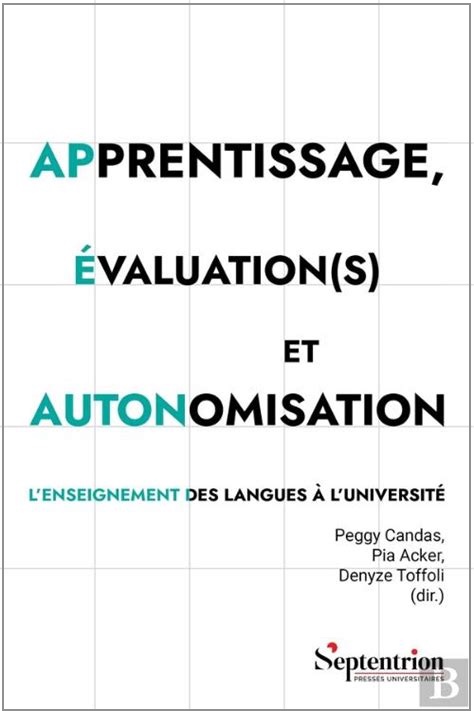
- Title: Apprentissage, Évaluation(s) et Autonomisation, l’Enseignement des Langues à l’Université
- Authors: Peggy Candas, Pia Acker, and Denyze Toffoli (dir.)
- Language: French
- Publisher: Presses Universitaires du Septentrion
- ISBN: 978–2–7574–4370–5
- Date of publication: 1 April 2025
- Price: € 23
- Format: Softcover
Notes on the Contributor
Emily A. Marzin is a Learning Advisor at the Self-Access Learning Center at Kanda University of International Studies. She has completed the Learning Advisor Education Program at the Research Institute for Learner Autonomy Education. She holds a Master’s in didactics from Jean Monnet University, France and an EdD from the Open University, UK.
 SiSAL Journal