
Steven M Lim, Center for Foreign Language Education and Research, Rikkyo University, and Department of English Language and Literature, Waseda University, Tokyo, Japan. https://orcid.org/0000-0003-2955-1933
Lim, S. M. (2026). Can increasing mandatory usage of a university SALC foster autonomous learning? Studies in Self-Access Learning Journal, 17(1), 26–42. https://doi.org/10.37237/170103
Abstract
Self-access learning centers (SALCs) provide the opportunity to take control of the language learning process; however many students are reluctant to use SALCs due to social and cultural factors. To address this hesitancy, many universities integrate SALCs into the curriculum through required visits. This quantitative study investigated how an increase in mandatory self-access center visits changed the usage habits of first- and second-year university students using notions of controlled and autonomous motivation from organismic integration theory as a framework. Data were collected from students (n = 379) through attendance cards, which participants used to self-report how they utilized the SALC. While there was no significant difference in the SALC usage of first-year students, there was a significant increase in both the visits of second-year students and their engagement in autonomous activities. The results suggest this difference is due to emerging and established learner identities; the first-year students’ usage was connected to an autonomous motivation to explore the benefits and affordances of the SALC, whereas second-year students had already formed opinions on the SALC. Understanding how learners respond to an increase in required visits can be valuable for incorporating SALCs into the curriculum. Furthermore, knowing the activities students engage in reveal whether learners see the purpose of SALCs as supporting classroom learning, or to pursue intrinsic interests.
Keywords: Self-directed learning, self-access learning, learner autonomy, motivation, English as a foreign language, curriculum design
The exposure to English provided by in-class learning may be insufficient to achieve high levels of proficiency, and thus opportunities to engage in out-of-class learning are vital. Self-access learning centers (SALCs) are especially important in EFL (English as a foreign language) environments where learners must seek out situations to use the language outside the classroom to have sufficient practice to attain a degree of fluency. SALCs provide an environment which can support autonomy, defined by Benson (2013) as “the capacity to take control over one’s own learning” (p. 2). Despite the value of SALCs, students can be resistant to using them, with many potential social and cultural reasons that might make learners hesitant to explore the affordances of a SALC (Gillies, 2010). Thus, curriculum designers are forced to deal with the paradoxical notion of mandatory visits to a facility dedicated to autonomous learning. Even when attempting to encourage students to take control of their own learning, institutions often prescribe mandatory attendance with deadlines. Although this may stifle the sense of learner autonomy, without such structures students may not use autonomy-supporting facilities at all (Pemberton & Cooker, 2012). Once students become familiar with the environment, the hope is that students will continue to use the SALC because they recognize the intrinsic value of the facility as opposed to the extrinsic need of fulfilling course requirements.
How do required SALC visits impact students’ SALC usage? Does increasing the amount of required visits lead to student-directed autonomy? For curriculum designers who wish to incorporate autonomy-supporting facilities into their programs it is vital to gain empirical answers to such questions. By doing so, we can better understand the delicate balance required to incorporate a SALC into the curriculum, and how to scaffold learners into developing their own autonomous practices.
Integrating SALCs in the Curriculum
The increase in the establishment of SALCs around the world as well as journals and conferences related to them indicate a growing acceptance of the importance of self-access language learning (Morrison, 2008). Students who regularly visit SALCs increase their English proficiency to a greater extent than those who do not (Hughes et al., 2011), and frequent SALC users have a greater sense of self-efficacy than those who rarely or never make use of them (Liu, 2013). In addition, the SALC offers EFL students the rare opportunity to use English for authentic communicative purposes (Kimura, 2014). The out-of-class learning that can be facilitated by the SALC is important for learners who wish to achieve high levels of proficiency (Benson, 2017).
However, the presence of an autonomy-supporting facility such as a SALC does not necessarily mean that students will take advantage of it. Chan et al. (2010) found that although they held positive attitudes towards autonomy, students were unprepared to take responsibility for their language learning, preferring their teachers to make decisions.When educational affordances are entirely optional, they face a risk of neglect due to insufficient interest on the part of the students (Victori, 2006). Despite a high number of signups, Mynard and Stevenson (2017) found that the majority of students did not complete a SALC module after curriculum changes meant the 10 credit points they could get for completing it were removed.
One way to ensure students make use of a SALC is to integrate it into the curriculum. Although coercing learners into autonomous practices could be perceived as contradictory, it can be necessary to foster students’ potential capacity for autonomous learning (Thompson & Atkinson, 2010). Students may avoid using a SALC because they lack confidence in their speaking abilities and thus feel nervous about interacting in their L2 in an unstructured environment (Gillies, 2010). Requiring learners to attend the SALC on a regular basis can reduce the anxiety students feel about using it (Rose & Elliott, 2010). Prescribing too many visits as part of an English course risks a backlash from students who assert that they lack the time to make use of the SALC (Gillies, 2010; Victori, 2006). As such, students should be made aware of how the SALC can be related to their immediate language learning needs in order for it to have greater relevance to them. In a study by Chung (2013) it was found that, in addition to fulfilling course requirements, students’ main reason for using the SALC was to prepare for tests. For learners unsure of how to utilize a SALC, such practical goals are necessary; otherwise once course requirements have been fulfilled, they are unlikely to go again (Gillies, 2010).
Scaffolding the SALC Experience
Students may be dissuaded from visiting a SALC because they do not know how to use it (Gillies, 2010) and do not understand the benefits of using it (Victori, 2006). First-year students need to have their initial SALC experiences scaffolded because they may not have experience with making choices concerning their language learning. Thus, it can be beneficial to link the contents of classroom instruction with the affordances of the SALC (Croker & Ashurova, 2012). For learners who are unsure of the purpose of the SALC, it is important to provide reasons for using it, such as activities and projects related to their courses (Thompson & Atkinson, 2010). One example from Croker and Ashurova (2012) was a SALC project which helped students to prepare for their mid-term speaking test. By providing them with similar materials to those that would be used in the test, learners were made aware of the potential to practice for oral examinations outside of the classroom. The benefits of the SALC as a venue for out-of-classroom preparation for in-classroom activities should be made clear to learners. In a study by Koyalan (2009), students self-reported that the SALC enhanced classroom learning because the materials in the SALC were related to the contents of the course, and that practicing in the SALC improved their performance in classroom activities. Teacher-directed activities related to the course can give learners a clear purpose and structure for using the SALC.
Once established as a valuable tool for improving in-class performance, the SALC can serve as a catalyst for the development of independent language learning; the SALC acts as a stepping stone on the path to autonomy (Morrison, 2008). Teachers must be aware that when SALC visits are required or encouraged as part of the curriculum, the use of SALCs should not be assumed to be indicative of learner autonomy (Chung, 2013). However, SALC attendance being a part of the curriculum of a course does not inherently mean that all students will perceive visits to the SALC as nonautonomous. Deci and Ryan (1985) suggested that people would view the same situation differently depending on whether they were control or autonomy orientated. Those with control orientation have a tendency to view their environment as one in which they must fulfill the expectations of others. They are influenced into acting by pressure and deadlines, with the promise of extrinsic rewards being a strong motivation for their actions. Such people are likely to participate in teacher-directed activities in the SALC which have the potential to improve their grades due to their relatedness to the course. Those with autonomy orientation perceive situations to be autonomy-promoting and take actions that reflect their own goals and interests rather than those they feel have been prescribed. People with autonomy orientation are more likely to engage in autonomous activities, making decisions about what to do based on personal interest, such as discussing a topic they are invested in or playing a game in which English is a means of communication rather than the goal itself. Having control over conversation topics gives the students a sense of autonomy and a degree of control over the learning process (Liu, 2013).
Even with the ability to control their studies, students might make the autonomous decision to follow a teacher-directed language learning process (Pemberton & Cooker, 2012). With teacher-directed activities providing scaffolding, students can gain confidence through the sense of self-efficacy provided and gradually increase their autonomous activities in the SALC. This scaffolding can foster a positive attitude towards autonomy, which is essential to developing autonomous learners (Chan, 2003). Whilst initially they may not be motivated to use the SALC due to their unfamiliarity with the concept of self-directed learning, Bandura (1982) suggested that, given appropriate learning experiences, people can become strongly invested in activities which originally held little intrinsic interest for them.
Autonomous and Controlled Motivation
Ryan and Deci’s (2000) self-determination theory (SDT) proposes that humans are inclined towards activity but are vulnerable to passivity. Rather than examine the causes of motivation, the theory focuses on the social and environmental circumstances which can encourage or discourage motivation. Within SDT are a number of mini-theories, such as cognitive evaluation theory and basic psychological needs theory, which have been applied to a diverse range of fields. In second language learning, organismic integration theory (OIT) is the most widely applied of these theories (Al-Hoorie et al., 2022).
In OIT, Ryan and Deci (2000) portray a cline of motivation from amotivation, to extrinsic motivation, and finally to intrinsic motivation. Within extrinsic motivation, there are four styles of regulation: external, introjected, identified, and integrated. External regulation is when a person is motivated by rewards or punishment. In the case of a SALC user, this could be a learner who visits for the purpose of fulfilling a course requirement. Introjected regulation relates to motivation spurred by feelings of guilt or pride, such as visiting a SALC due to pressure from a teacher. Identified regulation is when someone consciously chooses to value the goal, for example a learner who recognizes the value of the SALC for improving their language learning. When this goal becomes a part of how that person perceives themselves, it is known as integrated regulation. Students whose usage of the SALC is a core component of their language learner identity are examples of integrated regulation. Vansteenkiste et al. (2009) combined external and introjected regulation to form the controlled motivation composite, and combined identified and integrated regulation as the autonomous motivation composite. Although the locus of causality is external, when learners choose to identify with a learning environment such as a SALC and integrate that environment into their learner identity, it can be said that their motivation is autonomous. Conversely, controlled motivation would refer to a state in which learners feel forced to attend the SALC to fulfill the requirements of the course or at the behest of their teacher. Since autonomous motivation is more beneficial than controlled motivation, establishing environments which support the development of learners’ autonomous practices is of great importance (Vansteenkiste et al., 2009).
Making the use of the SALC a compulsory aspect of the course will lead many students to initially perceive visiting it as an act of controlled motivation. The aim of requiring students to attend the SALC regularly is to encourage the learners to identify its value, and eventually integrate the usage of the SALC into their learner identity. By doing so, the act of visiting the SALC becomes one not determined by a need to fulfill course requirements, but an autonomously motivated action. This internalization can lead to greater performance, engagement, and persistence, and as such, Ryan and Deci (2000) saw the matter of how to promote autonomous regulation for extrinsically motivated actions as a critical issue. Whilst mandatory SALC visits may not necessarily lead to intrinsic motivation, visiting a SALC more times than is required by the curriculum would indicate that the learner is being driven by autonomous motivation in their language learning process. Though confounding variables make it difficult to calculate the SALCs effect on language learning gains (Morrison, 2005; Reinders & Lázaro, 2007), by examining the effect of mandatory SALC visits we can better understand how self-access learning can influence learners’ motivational orientation.
Research Questions
This study aims to address a gap in the literature regarding the role of SALCs in the curriculum. Previous research has made reference to the influence of SALC usage policies (e.g., Chung, 2013; Croker & Ashurova, 2012; Mynard & Stevenson, 2017; Victori, 2006), but no studies have quantitatively assessed how changes in the number of mandatory visits influence SALC attendance and autonomous vs. directed activities, which this study addresses. Gaining an understanding of how learners respond to an increased demand for autonomous action can be valuable for curriculum designers who wish to incorporate SALCs into an existing program. Knowing the activities students choose to do in the SALC can help to explore whether learners see the purpose of SALCs as supporting classroom learning, or to pursue intrinsic interests. This study is guided by the following research questions:
- How does an increase in required visits affect the number of student visits to the SALC?
- How does an increase in required visits affect whether students engage in autonomous or directed activities in the SALC?
- How does an increase in required visits affect the number of student visits to the SALC by university year?
- How does an increase in required visits affect whether students engage in autonomous or directed activities in the SALC by university year?
Method
The participants in this study were 379 first- and second-year English-major university students at a university in the Kanto region of Japan. The English language SALC was a room in the university located in the same area as the Japanese and Chinese language SALCs. There were 20 chairs and desks with wheels, which could be moved around freely. In addition to graded readers, magazines, and board games, there were materials created by the teachers related to those used in lessons to help students to prepare for assessed tasks. Students were able to reserve a 25-minute slot in the SALC up to a week in advance, and capacity was limited to 20 students at any one time. The students were required to spend at least 25 minutes in the SALC for the on-duty teacher to sign the attendance card. Students were free to utilize the SALC however they wished, and the type of activity they engaged in did not affect their grade, but they were requested to primarily use English. If students wanted one-to-one counselling sessions with a teacher, such as when they needed help with homework or preparing for examinations, the service was available through a separate system to the SALC.
SALC visits factored into the grading of the first- and second-year Integrated English courses; task-based mandatory communicative English classes focused on the use of the four skills: listening, speaking, reading, and writing. In the 2022 academic year, first-year students were required to visit the SALC three times per semester as part of Integrated English, with each visit accounting for 3% of their grade and an additional 1% being awarded for completion of the three visits. The deadline for the visits was the day of each of the three Integrated English assessed tasks. The second-year students were required to visit four times, with each visit accounting for 2.5% of their grade. The deadline for the visits was the day of each of the three Integrated English assessed tasks and one visit at any other time in the semester. In the 2023 academic year, both the first- and second-year students were required to visit five times, with each visit accounting for 2% of their grade. The deadline for the visits was the day of each of the three Integrated English assessed tasks and two visits at any other time in the semester.
Data were collected through attendance cards, which students used to self-report visits to the SALC. The data was anonymized. The attendance cards for the second semesters of the 2022 and 2023 academic years were used as data for the study, since by that point all students would be familiar with the SALC, and as such, it would be a more accurate reflection of common usage.
Analysis
Students were required to write the date and how they made use of the SALC on their visit in English on attendance cards before the on-duty teacher would sign it. At the end of the semester, once they had been used as part of the grading process, the attendance cards were collected. The SALC usage statements on the cards were examined and categorized into autonomous and directed activities, and were tallied up. Autonomous activities were defined as those which were unrelated to the contents of the Integrated English course, such as general conversation (e.g., I talked with my friends), reading English books (e.g., I read a book about zombies), and playing games (e.g., I played Apples to Apples). Directed activities were those created specifically to support classroom learning for the Integrated English course, such as task practice materials (e.g., I practiced for Task 2) and vocabulary challenges related to the upcoming task (e.g., I did the Food Words Challenge). When students reported that they had taken part in both autonomous and directed activities on a visit (e.g., I practiced for Task 1. After that I talked with some new friends), both were included in the tally. Therefore, the combined number of autonomous and directed activities could surpass the total number of visits. However, if a participant mentioned doing more than one autonomous or directed activity (e.g., I talked with my friends and then we played Boggle) it was only counted once, as the aim was to determine the nature of the activities rather than to count the number of activities within a visit. When it was unclear as to whether the activity was autonomous or directed (e.g., I was with my friends) or was illegible, it was not counted for either.
In addition to descriptive statistics, two-tailed t-tests were run to examine how the increase in required visits affected student visits to the SALC. Welch’s t-test was used due to unequal sample sizes. Outliers were excluded based on two standard deviations from the mean and examination of the box plots. In total, eight outliers were excluded from the data set: four 2022 first-year students (19, 26, 57, and 80 visits), three 2023 first-year students (19, 27, and 31 visits), and one 2023 second-year student (57 visits). All statistical analyses were conducted using the program JASP (JASP Team, 2020).
Results
In response to Research Questions 1 and 2, descriptive statistics for the number of students’ visits to the SALC and whether students engage in autonomous or directed activities in the SALC are presented in Table 1.
Table 1
Students’ Use of SALC by Academic Year

Note. 2022 N = 210 and 2023 N = 161. Excludes outliers 2 standard deviations from the mean (2022 N = 4 and 2023 N = 4).
How Does an Increase in Required Visits Affect the Number of Student Visits to the SALC?
Students visited the SALC more in 2023 than in 2022, indicating that an increase in required visits was associated with an increase in visits to the SALC. However, the means of the visits of the 2022 group (M = 3.60, SD = 2.79) and 2023 group (M = 4.12, SD = 2.60) did not differ significantly, t(355) = -1.88, p = 0.06.
How Does an Increase in Required Visits Affect Whether Students Engage in Autonomous or Directed Activities in the SALC?
The number of autonomous activities the students engaged in increased between 2022 and 2023, and the autonomous activities did differ significantly between 2022 (M = 1.91, SD = 2.42) and 2023 (M = 2.44, SD = 2.38), t(347) = -2.10, p = 0.04. The effect size was small (d = 0.22). The number of directed activities the students engaged in decreased between 2022 and 2023; however, the directed activities did not differ significantly between 2022 (M = 2.04, SD = 1.44) and 2023 (M = 1.76, SD = 1.79), t(302) = 1.59, p = 0.11.
In response to Research Questions 3 and 4, descriptive statistics for the number of students’ visits to the SALC and whether students engaged in autonomous or directed activities by university year are presented in Table 2.
Table 2
Students’ Use of SALC by University Year
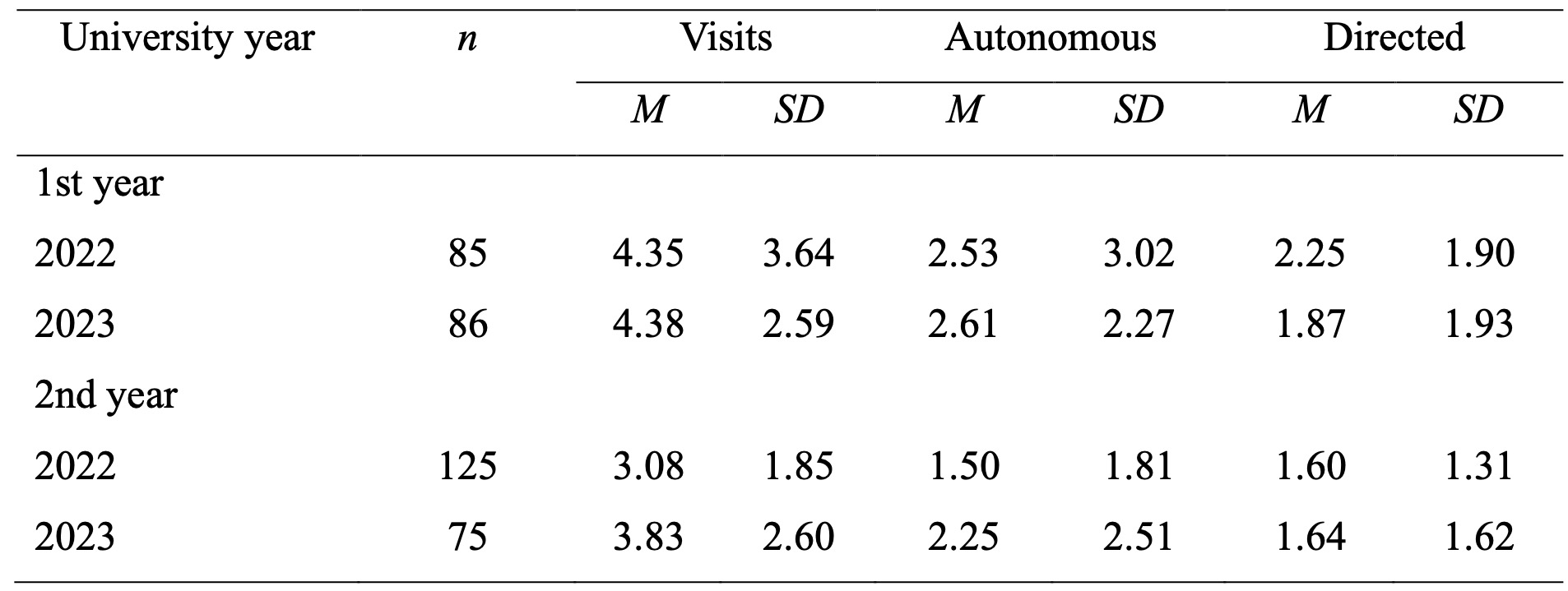
Note. Excludes outliers 2 standard deviations from the mean (1st year 2022 N = 4 and 2023 N = 3, 2nd year 2023 N = 1).
How Does an Increase in Required Visits Affect the Number of Student Visits to the SALC by University Year?
The first-year students visited the SALC more in 2023 than in 2022, however, the 2022 group (M = 4.35, SD = 3.64) and the 2023 group (M = 4.38, SD = 2.59) did not differ significantly, t(151) = -0.06, p = 0.95. The second-year students also visited the SALC more in 2023 than in 2022. The second-year students’ visits of the 2022 group (M = 3.08, SD = 1.85) and 2023 group (M = 3.83, SD = 2.60) differed significantly, t(119) = -2.18, p = 0.03. The effect size was small (d = 0.33).
How Does an Increase in Required Visits Affect Whether Students Engage in Autonomous or Directed Activities in the SALC by University Year?
The first-year students engaged in more autonomous activities in 2023 than in 2022, but fewer directed activities. The first-year students’ autonomous activities did not differ significantly between 2022 (M = 2.53, SD = 3.02) and 2023 (M = 2.61, SD = 2.27), t(156) = -0.18, p = 0.85. The directed activities also did not differ significantly between 2022 (M = 2.25, SD = 1.90) and 2023 (M = 1.87, SD = 1.93), t(164) = 1.39, p = 0.17.
The second-year students engaged in more autonomous activities and directed activities in 2023 than in 2022. The second-year students’ autonomous activities differed significantly between 2022 (M = 1.50, SD = 1.81) and 2023 (M = 2.25, SD = 2.51), t(120) = -2.28, p = 0.02, with a small effect size (d = 0.35). The directed activities did not differ significantly between 2022 (M = 1.60, SD = 1.31) and 2023 (M = 1.64, SD = 1.62), t(132) = 1.16, p = 0.25.
Discussion
Overall, the increase in required visits was associated with an increase in students’ visits to the SALC, an increase in engagement in autonomous activities, and a decrease in directed activities. However, these results should be taken with caution since only the change in autonomous activities was significant and had a small effect size. Rather than having a uniform effect on the student population, examination of the data revealed that the increase in required visits may have affected first- and second-year students differently. These results suggest that developing and established learner identities play an important role in SALC attendance.
For first-year students, there was no significant difference in how often they visited the SALC or how they utilized it. The lack of influence exerted by an increase in required visits may suggest that first-year students’ usage of the SALC is connected to an intrinsic desire to explore the potential benefits of the SALC rather than the need to fulfill a requirement of the course. Ryan (2009) suggested that after the exam-orientation of secondary school education in Japan, learners could reevaluate their attitudes towards English and their identity as language learners in tertiary education. Gillies (2010) noted that first year of university students formed identities based on the frequency of their usage of the SALC. For first-year students still establishing their learner identities, engaging in autonomous activities is a positive sign that they are capable of being autonomy-motivated language learners. Conversely, the fact that in 2022 the average number of visits was above the required visits, whereas in 2023 it was below it suggests some first-year students have already been dissuaded from using the SALC, regardless of the detrimental impact this may have on their grades. Gillies (2010) listed a number of reasons why learners may choose not to attend a SALC, including: lack of knowledge of how to use the SALC, unfamiliarity with teachers working in the SALC, and a cultural disinclination to use the SALC. Since many of these issues can be theoretically overcome by regular use of the SALC, there should be greater scrutiny as to how to better scaffold first-year students’ initial experiences with the SALC.
The increase in required visits to the SALC was associated with a significant increase in both the visits of second-year students and their engagement in autonomous activities in the SALC, with small effect sizes. The increase in visits suggests that the second-year students are motivated by the need to fulfill the requirements of the course and are more control motivated than the first-year students. But although their rational for visiting the SALC may be based on controlled motivation, within the SALC, this increase in visits manifests as a significant increase in autonomous activities. The required visits provided the impetus for the attendance, but the learners used that additional time in the SALC to pursue activities that were of interest to them, rather than ones directed by their teachers. This points to a complex relationship between controlled motivation and autonomous motivation. On one hand, these results may indicate that second-year students are likely to have already formed opinions on the value of the SALC, and thus require extrinsic rewards to motivate them to make use of it. On the other hand, it suggests that when forced to engage in self-directed learning, they have an orientation towards autonomous learning. Despite the increase in visits, the average attendance was lower than the number required to fulfill the course requirements. For those who did not self-identify as frequent visitors in the first year of university, their aversion to the SALC is only likely to increase with time, since visits to the SALC are inverse to the number of years students spend at the university (Gillies, 2010).
Whilst the increase in required visits was associated with an increase of visits to the SALC, it is important to note that this change meant that the average of both the first- and second-year students was less than the five stipulated in the course requirements. Even if learners attended more often in 2023 than in 2022, their failure to fulfil the course requirement could make them resentful of SALC itself. This could result in negative feelings being associated with the SALC, rather than perceiving the facility as an opportunity to take a proactive role in their learning process. Further tweaks to the number of required visits may result in a greater number of students fulfilling the course requirements and using the SALC for more autonomous activities. As Thompson and Atkinson (2010) observed, integrating a SALC into the curriculum will inevitably involve a measure of trial and error.
This study focused on how an increase in required visits to a SALC influences students’ usage of it, reflecting what Vansteenkiste et al. (2009) identified as controlled motivation. However, the outliers in this study are representative of what Vansteenkiste et al. called autonomous motivation. In 2022, one student spent 80, 25-minute sessions in the SALC over the course of a single, 15-week semester, with the other three outliers attending 57, 26 and 19 times. The student who attended 80 times enjoyed communicating in English and found the discussions in the SALC to be more engaging than the structured approach of lessons. The student who attended 57 times had a clear idea of what job he wanted to do in the future and believed that English was necessary to achieve his goals. The student who attended 26 times was preparing for a homestay in an L1 English-speaking country, and upon her return to Japan, expressed a desire to study abroad. The student who visited 19 times was an international student who was more proficient in English than in Japanese and saw the SALC as an opportunity to make friends. On the self-determination continuum (Ryan & Deci, 2000), most of these outliers exemplify integrated regulation; not only do they consciously value the affordances of the SALC, but usage of the SALC has also become a part of their learner identity. However, due to their goal-orientated approach, they would still be considered to be extrinsically motivated. In the case of the student who attended 80 times, however, his purpose for visiting the SALC was his enjoyment of speaking English, indicating his intrinsic motivation. Although it is outside of the scope of this study to investigate these outliers in depth, their cases suggest that, even without being intrinsically motivated, having a clear goal could develop learners’ autonomous motivation for using the SALC.
Pedagogical Implications
As this study has revealed, emphasizing the importance of the SALC to learners through its integration in the curriculum can result in an increase in student usage. However, the aim of a SALC is to develop regular users who visit regardless of requirements and deadlines, and the small effect sizes shown in the results do not indicate that such a drastic change is likely through increasing mandatory visits alone. Instead, when examining the attendance cards, a pattern emerges of groups of friends from the same classes attending the SALC together. Whilst this may help students to overcome many of the social and language anxiety-related issues which dissuade learners from attending in the first place, the SALC becomes simply another venue for an established community to spend a preordained period of time.
For students to become regular SALC users, they need to be members of a community that is specific to the SALC. Hughes et al. (2012) found that students who initially visited the SALC to improve their English continued to use it to socialize with other regular SALC users. If learners identify as part of a community that is unique to the location, the community provides the motivation to return. Long-term motivation to use the SALC comes primarily from the bonds between the people who use it (Croker & Ashurova, 2012; Gillies, 2010; Hughes et al., 2011, 2012; Kimura, 2014). These SALC groups should be a diverse community featuring learners from different classes and grades to be most effective (Croker & Ashurova, 2012; Kimura, 2014; Ohara & Mizukura, 2020). Diversity in proficiency can also be beneficial; confident speakers can act as effective near-peer role models and provide evidence that other students can achieve similar levels of English communication (Liu, 2013). Although it may be intimidating for learners who lack self-confidence, motivation is a greater predictor of SALC use than proficiency (Gillies, 2010), and low and intermediate students can potentially benefit the most from the SALC environment (Liu, 2013).
For curriculum design to strongly influence SALC usage, efforts must be made to integrate required visits with forming SALC-specific communities. Teachers should be responsible for establishing the groups and arranging for them to meet on a regular basis. A community of practice could emerge, with the experiences of learning together leading to the establishment of a community identity (Murphey et al., 2012). Whilst autonomy may be connected with the choice of an individual, it is the interdependence of the community of the SALC users which eventually leads to learner autonomy (Kimura, 2014).
Conclusion
The present study examined how an increase in required visits affected learners’ usage of the SALC. Whereas the habits of first-year students did not change significantly, second-year students went more often and engaged in more autonomous activities. However, it is clear that a change in required visits is not sufficient to be a true catalyst for converting occasional SALC users into regulars. Though excluded from the results due to the extent to which they would skew the data, the outliers in the student body are exemplars of autonomous motivation. The number of visits of the four outliers in 2022 (19, 26, 57, 80) and the four outliers in 2023 (19, 27, 31, 57) are indicative of learners who have chosen to make the SALC a core aspect of their learner identity. The lack of an increase in outliers between 2022 and 2023 suggests that other methods of encouraging students to make the SALC a part of their learner identity through the curriculum must be considered.
This study contained a number of limitations. First, the data were self-reported by the participants, meaning the activities they engaged in may not have been accurately recorded. Potential issues include students misrepresenting, selectively reporting, or underreporting activities in the SALC. Second, since non-English majors and third- and fourth-year English majors were not required to use the SALC, they did not fill in attendance cards, and as such, their visits were not included in the study. It would be beneficial to understand more about the motivation of the learners who visit the SALC despite not being required to do so, as they might play a vital role in establishing SALC communities. Third, the reasons as to why students chose to attend or not to attend the SALC were beyond the scope of this study. Questioning the students directly through interviews or questionnaires would shed light on whether the number of required visits consciously affected their decision to use the SALC.
Future studies should explore other ways of integrating SALC visits into the curriculum, such as whether having SALC-specific groups of diverse learners as part of the required visits can foster unique communities of regular SALC users. By scaffolding not only the language and activities used in the SALC but also the social structure, required visits could be used to progress communities of learners from controlled to autonomously motivated SALC users.
Notes on the Contributor
Steven Lim is an adjunct lecturer at the Center for Foreign Language Education and Research at Rikkyo University and is currently doing his PhD at Waseda University. He has published articles on speech modification, teacher beliefs and practices, and CALL. His interests include motivation, CLIL, the SDGs, and learner autonomy.
Disclosure Statement
No potential competing interest was reported by the author.
References
Al-Hoorie, A. H., Oga-Baldwin, W. L. Q., Hiver, P., & Vitta, J. P. (2022). Self-determination mini-theories in second language learning: A systematic review of three decades of research. Language Teaching Research. Advance online publication. https://doi.org/10.1177/13621688221102686
Bandura, A. (1982). Self-efficacy mechanism in human agency. American Psychologist, 37(2), 122–147. https://doi.org/10.1037/0003-066X.37.2.122
Benson, P. (2013). Teaching and researching: Autonomy in language learning (2nd ed.). Routledge.
Benson, P. (2017). Language learning beyond the classroom: Access all areas. Studies in Self-Access Learning Journal, 8(2), 135–146. https://doi.org/10.37237/080206
Chan, V. (2003). Autonomous language learning: The teachers’ perspectives. Teaching in Higher Education, 8(1), 33–54. https://doi.org/10.1080/1356251032000052311
Chan, V., Spratt, M., & Humphreys, G. (2010). Autonomous language learning: Hong Kong tertiary students’ attitudes and behaviours. Evaluation & Research in Education, 16(1), 1–18. https://doi.org/10.1080/09500790208667003
Chung, I. F. (2013). Are learners becoming more autonomous? The role of self-access center in EFL college students’ English learning in Taiwan. The Asia-Pacific Education Researcher, 22, 701–708. https://doi.org/10.1007/s40299-013-0076-y
Croker, R., & Ashurova, U. (2012). Scaffolding students’ initial self-access language centre experiences. Studies in Self-Access Learning Journal, 3(3), 237–253. https://doi.org/10.37237/030303
Deci, E. L., & Ryan, R. M. (1985). The general causality orientations scale: Self-determination in personality. Journal of Research in Personality, 19(2), 109–134. https://doi.org/10.1016/0092-6566(85)90023-6
Gillies, H. (2010). Listening to the learner: A qualitative investigation of motivation for embracing or avoiding the use of self-access centres. Studies in Self-Access Learning Journal, 1(3), 189–211. https://doi.org/10.37237/010304
Hughes, L. S., Krug, N. P., & Vye, S. (2011). The growth of an out-of-class learning community through autonomous socialization at a self-access center. Studies in Self-Access Learning Journal, 2(4), 281–291. https://doi.org/10.37237/020405
Hughes, L. S., Krug, N. P., & Vye, S. L. (2012). Advising practices: A survey of self-access learner motivations and preferences. Studies in Self-Access Learning Journal, 3(2), 163–181. https://doi.org/10.37237/030204
JASP Team (2020). JASP (Version 0.18.2) [Computer software].
Kimura, H. (2014). Establishing group autonomy through self-access center experiences. Studies in Self-Access Learning Journal, 5(2), 82–97. https://doi.org/10.37237/050202
Koyalan, A. (2009). The evaluation of a self-access centre: A useful addition to class-based teaching? System, 37(4), 731–740. https://doi.org/10.1016/j.system.2009.09.016
Liu, M. (2013). English bar as a venue to boost students’ speaking self-efficacy at the tertiary level. English Language Teaching, 6(12), 27–37. http://dx.doi.org/10.5539/elt.v6n12p27
Morrison, B. (2005). Evaluating learning gain in a self-access language learning centre. Language Teaching Research, 9(3), 267–293. https://doi.org/10.1191/1362168805lr167oa
Morrison, B. (2008). The role of the self-access centre in the tertiary language learning process. System, 36(2), 123–140. https://doi.org/10.1016/j.system.2007.10.004
Murphey, T., Falout, J., Fukada, Y., & Fukuda, T. (2012). Group dynamics: Collaborative agency in present communities of imagination. In S. Mercer, S. Ryan, & M. Williams (Eds.), Psychology for language learning: Insights from research, theory and practice (pp. 220–238). Palgrave Macmillan.
Mynard, J., & Stevenson, R. (2017). Promoting learner autonomy and self-directed learning: The evolution of a SALC curriculum. Studies in Self-Access Learning Journal, 8(2) 169–182. https://doi.org/10.37237/080209
Ohara, T., & Mizukura, R. (2020). The role of a self-access learning center in Japan: Accommodation of translingual practice amidst international educational reform. JASAL Journal, 1(1), 5–36. https://jasalorg.com/journal-june20-ohara-mizukura/
Pemberton, R., & Cooker, L. (2012). Self-directed learning: Concepts, practice, and a novel research methodology. In S. Mercer, S. Ryan, & M. Williams (Eds.), Psychology for language learning: Insights from research, theory and practice (pp. 203–219). Palgrave Macmillan.
Reinders, H., & Lázaro, N. (2007). Current approaches to assessment in self-access language learning. TESL-EJ, 11(3), 1–13. https://files.eric.ed.gov/fulltext/EJ1064992.pdf
Rose, H., & Elliott, R. (2010). An investigation of student use of a self-access English-only speaking area. Studies in Self-Access Learning Journal, 1(1), 32–46. https://doi.org/10.37237/010105
Ryan, R. M., & Deci, E. L. (2000). Self-determination theory and the facilitation of intrinsic motivation, social development, and well-being. American Psychologist, 55(1), 68–78. https://psycnet.apa.org/doi/10.1037/0003-066X.55.1.68
Ryan, S. (2009). Ambivalence and commitment, liberation and challenge: Investigating the attitudes of young Japanese people towards the learning of English. Journal of Multilingual and Multicultural Development, 30(5), 405–420. https://doi.org/10.1080/01434630902928447
Thompson, G., & Atkinson, L. (2010). Integrating self-access into the curriculum: Our experience. Studies in Self-Access Learning Journal, 1(1), 47–58. https://doi.org/10.37237/010106
Vansteenkiste, M., Sierens, E., Soenens, B., Luyckx, K., & Lens, W. (2009). Motivational profiles from a self-determination perspective: The quality of motivation matters. Journal of Educational Psychology, 101(3), 671–688. https://psycnet.apa.org/doi/10.1037/a0015083
Victori, M. (2007). The development of learners’ support mechanisms in a self-access center and their implementation in a credit-based self-directed learning program. System, 35(1), 10–31. https://doi.org/10.1016/j.system.2006.10.005

 SiSAL Journal