
Jo Mynard, Kanda University of International Studies, Chiba, Japan. https://orcid.org/0000-0003-0363-6461
Dominique Vola Ambinintsoa, Kanda University of International Studies, Chiba, Japan. https://orcid.org/0000-0001-5987-3242
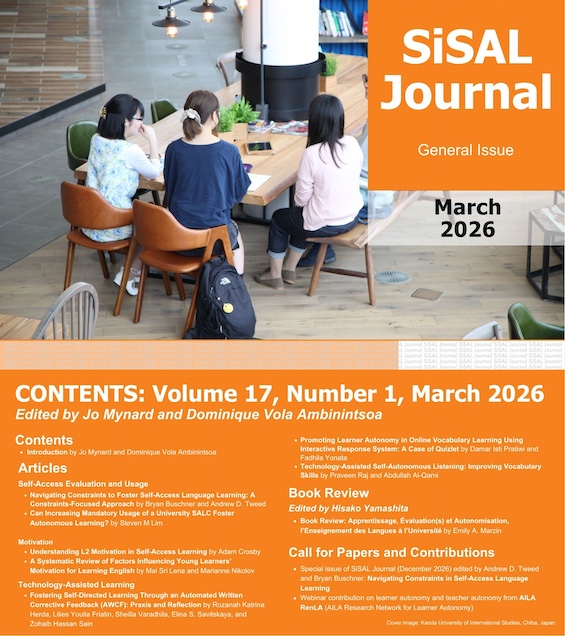
Welcome to the first issue of SiSAL Journal for 2026, featuring seven papers, a book review, and calls for papers and webinar contributions. The authors are based in Japan, Hungary, Indonesia, Pakistan, Russia, and Saudi Arabia. The papers explore key themes: self-access evaluation and use, motivation, and technology-assisted learning.
Contents
Articles
Self-Access Evaluation and Usage
Two papers examine issues central to the effective running of self-access centers. The first paper by Bryan Buschner and Andrew D. Tweed from Soka University in Tokyo outlines an approach to examining constraints in self-access contexts. After reviewing different interpretations of self-access, the authors draw on the current literature to describe a variety of challenges that restrict the fostering of language learning beyond the classroom within an ecological model. They then introduce a practical method for designing and refining self-access initiatives to navigate constraints, giving a brief example from their own institution.
The second paper in this section is by Steven M Lim from Rikkyo University and Waseda University, Tokyo, Japan. The author reports on a study that draws on organismic integration theory as a theoretical framework to investigate how an increase in mandatory visits to a self-access learning center (SALC) influences the usage patterns of first- and second-year university students. Given that students are often reluctant to engage with the SALC, integrating those required visits into the curriculum was a proposed solution to address this hesitancy. The findings reveal that first- and second-year students responded differently to the increased mandatory visits mainly due to their differences in learner identity formation at each stage of study.
Motivation
Two papers provide systematic reviews of motivation and examine its role in self-access learning. The first paper, by Adam Crosby from Kobe City College of Nursing, Kobe, Japan, is a literature-based review that examines second language motivation as a dynamic, socially situated construct by synthesizing three influential theoretical frameworks. Rather than treating motivation as a fixed psychological trait, the paper argues that learner engagement emerges at the intersection of identity, imagined futures, and institutional conditions, particularly in self-access and autonomous learning contexts. The synthesis reveals that future-oriented self-guides, imagined global affiliations, and socially mediated access to participation collectively shape learners’ capacity to translate motivation into meaningful action.
The second paper on motivation is by Mai Sri Lena (University of Szeged, Hungary /Universitas Negeri Padang, Indonesia) and Marianne Nikolov (University of Pecs, Hungary). The authors provide a systematic review of empirical studies on young learners’ English learning motivation from 2020 to 2024 in nine different countries. After answering their four research questions, the authors comment on how the findings inform support needed for learning in both classroom and self-access contexts.
Technology-Assisted Learning
Three papers examine self-access skills support. The first paper in this section is by Rozanah Katrina Herda, Universitas Negeri Yogyakarta, Indonesia; Lilies Youlia Friatin, Universitas Galuh, Indonesia; Sheilla Varadhila Peristianto, Universitas Mercu Buana Yogyakarta, Indonesia; Elina S. Savitskaya, Moscow City, Samara, Russia; and Zohaib Hassan Sain, Superior University, Lahore, Pakistan. This mixed-methods study involved 40 participants from a single university in Indonesia and investigated self-directed learning through automated written corrective feedback (ACWF). The findings indicated effective integration in classrooms, which shows promising benefits for learners’ self-directed writing outside the classroom as well.
The second paper in this section is by Damar Isti Pratiwi from Politeknik Perkeretaapian Indonesia Madiun and Fadhila Yonata from STAIN Sultan Abdurrahman Kepulauan Riau, Bintan, Indonesia. The authors investigate the use of Quizlet as a tool for online vocabulary learning and its potential role as a self-access learning resource. The study shows that while digital tools have the potential to provide accessible opportunities for self-access language learning, they do not automatically foster learner autonomy. Such tools often require intentional pedagogical design, learner involvement, and appropriate scaffolding by teachers.
The final paper related to technology-assisted learning, written by Praveen Raj and Abdullah Al-Qarni from Royal Commission for Jubail and Yanbu, Saudi Arabia, discusses a study investigating the effectiveness of self-directed, technology-mediated listening practices as a means of facilitating vocabulary acquisition and promoting learner autonomy. Utilizing a mixed-methods design, the study engaged Saudi EFL learners in self-paced listening activities using authentic materials over a period of eight weeks. The study also reports on students’ perceptions of such practices. The findings contribute to a growing body of literature on technology-mediated language learning and underscore how self-directed listening can be used as an approach for supporting vocabulary learning and fostering autonomy in EFL contexts.
Book Review (Edited by Hisako Yamashita)
A review of Apprentissage, Évaluation(s) et Autonomisation, l’Enseignement des Langues à l’Université edited by Peggy Candas, Pia Acker, and Denyze Toffoli is provided by Emily A. Marzin, Kanda University of International Studies, Japan. The book is a French-language volume published by Presses Universitaires du Septentrion in 2025.
Calls for Papers and Webinar Contributions
There will be a special issue of SiSAL Journal in December 2026, edited by Andrew D. Tweed and Bryan Buschner. The editors seek contributions that focus on navigating constraints in self-access language learning (SALL) to better understand the complex nature of the field and to illustrate how SALL practitioners respond to challenges in their own contexts. The special issue invites work that examines both the constraints faced by self-access educators and the strategies they employ to navigate them. The authors have published a paper in this issue that might serve as inspiration for potential authors. More details: https://sisaljournal.org/cfpconstraints/
The AILA RenLA [Association Internationale de Linguistique Appliquée or International Association of Applied Linguistics] committee is launching a Learner Autonomy Webinar Series. Diverse contributions, including the latest research or work on learner autonomy, perspectives, and reflections on autonomy-related practices, are welcome. If you are interested in contributing, please fill in this form.
Acknowledgements
Heartfelt thanks go to members of our review and editorial teams, without whom we would not be able to publish this issue. Many thanks, also, to all the authors who shared their work with us.
Notes on the Editors
Jo Mynard is a professor in the Faculty of Global Liberal Arts, Director of the Self-Access Learning Center, and Director of the Research Institute for Learner Autonomy Education at Kanda University of International Studies in Chiba, Japan. She has an M.Phil. in Applied Linguistics (Trinity College, University of Dublin, Ireland) and an Ed.D. in TEFL (University of Exeter, UK). Her research interests include advising in language learning, the psychology of language learning, and learning beyond the classroom.
Dominique Vola Ambinintsoa is a senior learning advisor and lecturer at Kanda University of International Studies in Japan. She holds a PhD in Applied Linguistics focusing on learner autonomy (Victoria University of Wellington, New Zealand) and an Ed.M in TESOL (State University of New York at Buffalo, US). Her research interests include learner autonomy, self-regulated learning, the psychology of language learning, and advising in language learning.
 SiSAL Journal