
Adam Crosby, Kobe City College of Nursing, Kobe, Japan. https://orcid.org/0000-0003-3124-545X
Crosby, A. (2026). Understanding L2 motivation in self-access learning. Studies in Self-Access Learning Journal, 17(1), 43–54. https://doi.org/10.37237/170104
Abstract
Learner engagement in second and foreign language learning cannot be fully explained by motivation alone, particularly in self-access and autonomous learning contexts where learners must actively negotiate their participation. This literature-based review examines L2 motivation as a dynamic, socially situated process by integrating three influential theoretical frameworks: Norton’s theory of Investment, Yashima’s concept of International Posture, and Dörnyei’s L2 Motivational Self System (L2MSS). While each framework has been widely discussed independently, this paper brings them into dialogue to capture both the cognitive and social dimensions of learner engagement in English as a Foreign Language (EFL) contexts. The review highlights how future-oriented self-guides (L2MSS), imagined global affiliations (International Posture), and socially mediated access to participation (Investment) interact to shape learners’ ability to translate motivation into meaningful action. By synthesizing these perspectives, the paper reconceptualizes motivation not as an individual psychological trait but as a context-dependent process unfolding at the intersection of identity, imagined futures, and institutional conditions. The review further discusses implications for self-access language learning, emphasizing the need for learning environments that support identity development, legitimize diverse forms of participation, and align learners’ aspirations with accessible opportunities for investment. The paper concludes by identifying directions for future research on motivation and engagement in self-access and autonomous learning settings.
Keywords: self-access language learning; learner autonomy; L2 motivation; identity
Understanding learner engagement in second and foreign language learning remains a central concern in language learning, particularly in contexts where learners are expected to take increasing responsibility for their own learning (Dörnyei & Kormos, 2000; Hiver et al., 2024). This concern is especially salient in English as a Foreign Language (EFL) contexts, where learners often have limited access to authentic interaction but are nonetheless encouraged to envision English as a resource for future academic, professional, and intercultural engagement.
Research on second language (L2) motivation has evolved considerably over the past several decades. Early models tended to conceptualize motivation as a relatively stable, individual trait, focusing on learners’ attitudes, intensity of effort, or persistence. While these approaches have provided valuable insights, they have been increasingly criticized for underrepresenting the social, cultural, and future-oriented dimensions of language learning. In response, more recent theoretical frameworks have reconceptualized motivation as a dynamic, socially situated process that is closely tied to learners’ identities, imagined futures, and access to meaningful participation (Dörnyei & Ryan, 2015; Norton, 2013).
Within this broader shift, three influential frameworks have contributed complementary perspectives on L2 motivation: Norton’s (1995, 2013) theory of Investment, Yashima’s (2002) concept of International Posture, and Dörnyei’s (2005) L2 Motivational Self System (L2MSS). Each framework highlights a distinct dimension of learner engagement. Investment foregrounds the social, institutional, and power-related conditions that mediate learners’ ability to act on that motivation; International Posture situates learners’ aspirations within imagined global and intercultural communities, a perspective particularly relevant to EFL settings; and the L2MSS explains how learners’ future self-guides shape and sustain motivation at a psychological level. Together, these frameworks highlight that learner motivation cannot be understood solely as an internal psychological process but must also be examined in relation to learners’ identities, imagined futures, and opportunities for learning within specific contexts.
Although these frameworks have been widely examined independently, relatively little work has attempted to integrate them to capture both the psychological and sociocultural dimensions of L2 motivation within a single conceptual framework. Research has shown that learners’ motivational orientations strongly influence how effectively they engage in self-access learning contexts (Gardner & Yung, 2017). These perspectives suggest that learner engagement in language learning cannot be fully explained through psychological motivation alone. Moreover, it may be better understood as the result of an interaction between learners’ future self-guides, their imagined participation in global communities, and the social conditions that shape opportunities for participation and language use. Such integration is especially relevant for self-access language learning contexts, where learners’ motivation must be enacted through autonomous choices, negotiated identities, and uneven access to opportunities. This paper addresses this gap by offering a literature-based review that synthesizes these three perspectives to provide a more holistic account of why learners invest in English and how their motivation is enabled or constrained in practice. By bringing these frameworks into dialogue, the paper aims to clarify their conceptual connections and highlight their relevance for understanding learner engagement in self-access and autonomous learning environments.
Norton’s Theory of Investment and Imagined Communities
Norton’s theory of Investment extends the analysis by foregrounding the social and political dimensions of language learning. Norton (1995) challenged the binary classification of learners as motivated or unmotivated, arguing that even highly motivated learners may disengage if they are excluded from meaningful participation in learning contexts. From this perspective, language learning occurs not only in classrooms but also through learners’ engagement with both real and imagined communities. In this way, learners’ investment in language learning is shaped by the broader social contexts and the communities they wish to belong to, even if those communities are not yet tangible.
Imagined communities refer to social groups that learners aspire to join in the future, even if these communities are not immediately accessible (Anderson, 1983; Kanno & Norton, 2003). These communities offer learners imagined identities and future possibilities that can shape their investment in language learning. Rather than representing abstract aspirations, imagined communities constitute socially structured visions of the future that shape learners’ identities and actions (Simon, 1992). By envisioning themselves as legitimate members of these communities, learners may increase their investment in language learning practices.
Building on poststructuralist views of identity, Norton conceptualized Investment as the socially situated commitment learners make when they engage with a language in hopes of gaining access to symbolic and material resources, such as social recognition, education, or economic opportunity (Norton, 1995, 2013). Investment thus accounts for how power relations, access, and legitimacy shape learners’ opportunities to speak and participate. Even when learners possess strong motivation or clear future goals, unequal classroom practices or institutional norms may limit their ability to invest in the target language.
This perspective helps explain phenomena such as learner silence, which cannot be fully understood through motivational intensity alone. Learner silence and participation are often regulated by implicit power structures that privilege certain voices while marginalizing others (Ducker, 2022). Investment, therefore, complements psycholinguistic models by revealing how learners’ motivation is mediated by social conditions and by highlighting the role of identity and power in shaping engagement. This motivation is further shaped by the materials and resources learners can access. For example, according to Yamaguchi et al. (2019), students in self-access learning contexts were found to engage more effectively when materials are relevant, visually stimulating, and aligned with their learning goals.
International Posture
Building on the idea that motivation is shaped by learners’ imagined futures and social positioning, Yashima’s (2002) concept of International Posture highlights a global, future-oriented dimension of L2 motivation. In an increasingly interconnected world, English functions not only as a tool for communication within native-speaking communities but as a shared global resource that learners can use to participate in international networks. This perspective shifts the focus away from achieving native-like proficiency toward the more attainable and meaningful goal of effective intercultural communication. When learners perceive English as a vehicle for engagement with global communities, their motivation is influenced less by a desire to assimilate into a particular culture and more by the possibilities for social, professional, and intercultural interaction that the language affords (Lamb, 2004; Wei, 2020).
Drawing on Norton’s (1995) concept of imagined communities, Yashima conceptualized International Posture as a future-oriented orientation toward participation in an international community through English use. International Posture integrates both intrinsic and extrinsic motives by encompassing learners’ social, professional, and intercultural interests. It is defined as an interest in international affairs, a willingness to interact with people from different cultural backgrounds, openness toward other cultures, and readiness to use English in global contexts (Yashima, 2002). Importantly, International Posture replaces the often unrealistic goal of native-like proficiency with the more attainable aim of effective international communication.
Research suggests that International Posture is particularly relevant in EFL contexts where learners have limited direct contact with native English speakers. Imagining participation in an international community can strengthen learners’ motivation and lead to positive language learning outcomes (Kormos & Csizér, 2008; Yashima, 2002). This may also foster greater learner autonomy. Given that autonomy is associated with learners’ capacity to take control of their learning beyond the classroom (Benson, 2011), students with a strong International Posture may be more likely to engage in self-access learning to achieve their goals.
However, empirical findings also indicate that International Posture is influenced by a range of individual and contextual variables, including age, gender, socioeconomic status, prior learning experiences, attitudes toward English, and personality traits (Ghonsooly et al., 2012; Islam, 2013; Kormos & Kiddle, 2013; Kong et al., 2018; Peng, 2014; Yashima & Zenuk-Nishide, 2008). These variations suggest that while International Posture offers a valuable framework for understanding EFL motivation, it cannot be applied uniformly across learners or contexts. Instead, it highlights the need to examine how motivational orientations interact with broader social conditions.
The L2 Motivational Self System
Dörnyei’s (2005) L2 Motivational Self System (L2MSS) offers a psycholinguistic framework that emphasizes the role of future self-guides in sustaining motivation. The model consists of three interrelated components: the Ideal L2 Self, the Ought-to L2 Self, and the L2 Learning Experience. Together, these components explain how learners’ visions of the future interact with immediate learning contexts to influence motivation and behavior.
The Ideal L2 Self represents learners’ visions of themselves as competent and confident users of the target language. This future-oriented self-image is closely linked to intrinsic motivation and identity development and has been shown to predict persistence and self-regulated learning behaviors (Lamb, 2012; Taguchi et al., 2009). In contrast, the Ought-to L2 Self reflects externally imposed expectations and obligations, such as family pressure or institutional requirements. While it can generate short-term motivation, it is generally less effective in sustaining long-term engagement unless internalized by the learner (Dörnyei, 2009). The L2 Learning Experience refers to learners’ immediate classroom environment, including teaching practices, peer relationships, and emotional responses to learning. Positive learning experiences can strengthen the Ideal L2 Self by providing opportunities for meaningful language use, whereas negative experiences may undermine motivation and lead to disengagement (MacIntyre et al., 2002; Ushioda, 2009). If the learning experience is positive, students are more likely to continue engaging in autonomous learning both inside and outside the classroom (Carter‑Yamashita, 2025). This may serve as a bridge between learners’ future visions and their present opportunities to invest in learning.
The L2MSS offers a nuanced understanding of how L2 motivation arises from the dynamic interplay between learners’ imagined futures and their immediate learning experiences. The L2MSS emphasizes the role of future self-guides, particularly the Ideal L2 Self and Ought-to L2 Self, in shaping learners’ desires and intentions to engage with the target language. Through this lens, motivation is not merely a product of internal traits or isolated effort; rather, it emerges from how learners envision themselves in relation to their personal, social, and professional aspirations. For instance, learners with a vivid Ideal L2 Self, who imagine themselves confidently using English in global or professional contexts, are more likely to translate these envisioned futures into concrete learning behaviors. They may actively plan, monitor, and sustain their engagement with learning tasks, seeking opportunities to practice outside the classroom and setting goals that align with their aspirations (Ueno & Park, 2025).
Integrating Motivation, Identity, and Social Context in L2 Learning
Taken together, these three concepts highlight complementary dimensions of L2 learning that cannot be fully captured in isolation. Rather than representing competing explanations of motivation, these frameworks can be understood as addressing different layers of the language learning process. While psychological models explain how motivational orientations are formed and sustained, sociocultural perspectives illuminate how these motivations are mediated by identity, power relations, and opportunities for participation within specific learning contexts. While each framework offers valuable insights into learners’ motivation, identity, and orientation toward the target language community, their explanatory power becomes more compelling when considered in relation to one another. The following, therefore, integrates these perspectives to examine how individual motivation is shaped, mediated, and enacted within specific social contexts.
Norton’s concept of Investment accounts for the social, cultural, and institutional conditions that enable or constrain learners’ capacity to act on their motivational drives. While the L2MSS explains the “why” behind learners’ engagement, Investment addresses the “how” and “whether,” revealing how power relations, classroom dynamics, access to opportunities, and perceived legitimacy influence the extent to which learners can translate their motivation into meaningful action. In combination with International Posture, which situates learners’ motivations within broader imagined global communities and intercultural aspirations, the L2MSS and Investment together provide a comprehensive framework that captures both the cognitive and social dimensions of L2 motivation. This integrated perspective underscores that motivation is not merely an individual psychological phenomenon. Moreover, it is a socially situated, context-dependent process that unfolds at the intersection of personal aspirations, imagined futures, and real-world opportunities to participate and invest in language use.
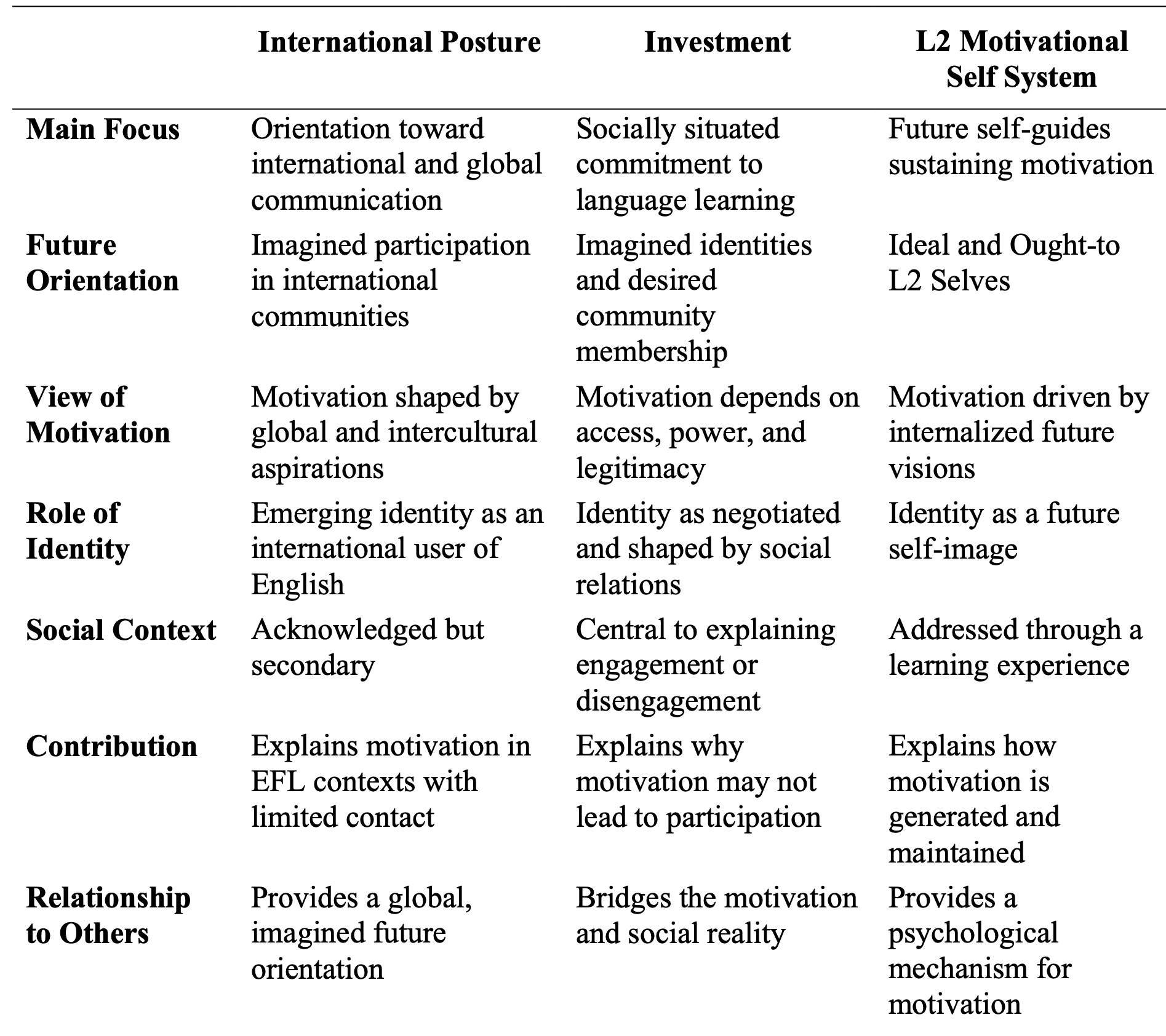
To clarify how the three theoretical perspectives relate to and complement one another, Table 1 provides a comparative overview of their key assumptions and emphases. It highlights how each theory addresses different but interconnected dimensions of L2 motivation, including future orientations, identity construction, social context, and opportunities for participation. By juxtaposing their core concepts, the table illustrates how an integrated perspective can offer a more comprehensive understanding of language learning as both a psychological and socially situated process.
Table 1
Key Conceptual Links Between International Posture, Investment, and L2 Motivation
Implications for Self-Access Language Learning
The integrated perspective presented in this review has several important implications for self-access language learning and the design of environments that aim to foster learner autonomy.
First, the synthesis of International Posture, Investment, and the L2MSS suggests that motivation alone is insufficient to ensure meaningful engagement in self-access contexts. Even learners with strong future-oriented goals or vivid Ideal L2 Selves may struggle to sustain engagement if they perceive limited legitimacy, unequal access to resources, or weak alignment between their imagined futures and available learning opportunities. Self-access systems, therefore, need to attend not only to motivational enhancement but also to the social and institutional conditions that shape learners’ capacity to invest in learning. Research supports this view, indicating that while learners’ motivational orientations influence their engagement in self-access learning, sustained participation depends on more than motivation alone (Gardner & Yung, 2017). According to Mynard and Shelton-Strong (2022), learner engagement is enhanced when learning environments support basic psychological needs such as autonomy, competence, and relatedness.
Second, the findings underscore the importance of supporting learners’ imagined futures in ways that are both personally meaningful and socially grounded. From an L2MSS perspective, self-access environments can play a crucial role in helping learners articulate, visualize, and refine their Ideal L2 Selves through goal-setting tools, reflective activities, and advising sessions. At the same time, International Posture highlights the value of framing English not merely as an academic subject but as a resource for international communication and intercultural participation. Providing opportunities for learners in both formal and informal settings to engage with global content, international peers, or multilingual communities, whether face-to-face or online, can help make these imagined futures more concrete and attainable.
Third, Norton’s concept of Investment draws attention to issues of power, access, and identity that are often overlooked in discussions of learner autonomy. Self-access environments are sometimes assumed to be inherently empowering (Smith et al., 2024). However, without careful design, they may reproduce existing inequalities by privileging learners who already possess cultural capital, confidence, or familiarity with autonomous learning practices. Advising, peer support, and inclusive learning design are therefore critical for ensuring that all learners are positioned as legitimate participants who can meaningfully invest in language use. Attention to learners’ narratives, identities, and prior experiences can help advisors and educators recognize why some learners may appear disengaged despite strong motivation.
Finally, this integrated framework encourages a reconceptualization of autonomy itself, not as an individual trait or skill, but as a socially situated capacity that develops through interaction, recognition, and access to opportunities. Self-access learning is most effective when it functions as a mediated space where learners can align their future aspirations with present practices, and gradually expand their learning opportunities. This highlights the importance of learner-directed engagement, reflective practice, and structured support in sustaining autonomy and motivation (Carter‑Yamashita, 2025). By foregrounding the interplay between motivation, identity, and social context, this review suggests that self-access learning environments are uniquely positioned to support sustained, equitable, and meaningful engagement with language learning.
Conclusion
Motivation in second language learning is a dynamic, socially situated, and future-oriented process. This review has integrated Norton’s Investment, Yashima’s International Posture, and Dörnyei’s L2MSS to show how learners’ identities, imagined futures, and access to meaningful participation interact to shape engagement. Motivation is not merely an individual trait but unfolds at the intersection of personal aspirations, social context, and institutional opportunity. Each framework highlights a distinct yet interconnected dimension: the L2MSS explains how future self-guides generate and sustain motivation; International Posture situates these visions within global and intercultural communities; and Investment shows how social relations, power structures, and institutional conditions mediate learners’ ability to act on their motivation. Together, they may help shed light on why learners may appear motivated yet remain silent, or how those with limited initial confidence can become actively engaged when afforded legitimate opportunities.
In self-access language learning, these insights underscore the need for environments that do more than promote abstract autonomy. Effective systems support identity development, legitimize diverse forms of participation, and connect learners’ future aspirations with present opportunities for investment. Autonomy emerges as a socially mediated capacity developed over time through interaction, reflection, and access. By framing self-access learning in this way, educators can create spaces that encourage learner-directed engagement while ensuring that all learners, regardless of initial confidence or cultural background, can participate meaningfully and sustainably.
This review also highlights the need for further empirical research on the interaction of these constructs in specific self-access contexts. Longitudinal and qualitative studies could illuminate how learners’ imagined futures, motivational selves, and investments evolve, providing deeper insights into learner engagement. Such research would inform the design of self-access environments that foster sustained, equitable, and meaningful language learning. This integrated framework offers both theoretical and practical guidance for promoting motivated, autonomous, and socially empowered learners.
Notes on the Contributor
Adam Crosby is an English teacher at Kobe City College of Nursing. He was awarded a doctoral degree in education from the University of New England in 2024 for his research on the silence of Japanese university students in English language classrooms. His research interests include autonomous learning, silence in the classroom, and the effects of cultural norms in the classroom.
References
Anderson, B. (1983). Imagined communities: Reflections on the origin and spread of nationalism. Verso.
Benson, P. (2011). Teaching and researching autonomy in language learning (2nd ed.). Routledge.
Carter‑Yamashita, J. (2025). Autonomous learning support outside the classroom: Focusing on the planning and reflection phases of self-regulated learning theory. Studies in Self‑Access Learning Journal, 16(4), 635–652. https://doi.org/10.37237/160403
Dörnyei, Z. (2005). The psychology of the language learner: Individual differences in second language acquisition. Lawrence Erlbaum.
Dörnyei, Z. (2009). The L2 motivational self system. In Z. Dörnyei & E. Ushioda (Eds.), Motivation, language identity and the L2 self (pp. 9–42). Multilingual Matters.
Dörnyei, Z., & Kormos, J. (2000). The role of individual and social variables in task performance. Language Teaching Research, 4(3), 275–300. https://doi.org/10.1177/136216880000400305
Dörnyei, Z., & Ryan, S. (2015). The psychology of the language learner revisited. Routledge.
Dörnyei, Z., & E. Ushioda (Eds.), Motivation, language identity and the L2 self. Multilingual Matters.
Ducker, C. (2022). Silence, power, and participation in second language classrooms. Journal of Language, Identity & Education, 21(3), 173–187.
Gardner, D., & Yung, K. W. H. (2017). Learner motivation in self-access language learning. Innovation in Language Learning and Teaching, 11(2), 159–176. https://doi.org/10.1080/17501229.2015.1088545
Ghonsooly, B., Khajavy, G. H., & Asadpour, S. F. (2012). Willingness to communicate in English among Iranian non-English major university students. Journal of Language Teaching and Research, 3(2), 197–206. https://doi.org/10.1177/0261927X12438538
Hiver, P., Al-Hoorie, A. H., Vitta, J. P., & Wu, J. (2024). Engagement in language learning: A systematic review of 20 years of research methods and definitions. Language Teaching Research, 28(1), 201–230. https://doi.org/10.1177/13621688211001289
Islam, M. (2013). L2 motivational self system and international posture: A study of Pakistani learners. Journal of Language and Linguistic Studies, 9(2), 98–114.
Kanno, Y., & Norton, B. (2003). Imagined communities and educational possibilities. Journal of Language, Identity & Education, 2(4), 241–249. https://doi.org/10.1207/S15327701JLIE0204_1
Kong, J., Han, J., Kim, S., Park, H., & Shin, Y. (2018). L2 motivational self system, international posture, and willingness to communicate. System, 72, 139–150. https://doi.org/10.1016/j.system.2017.11.005
Kormos, J., & Csizér, K. (2008). Age-related differences in the motivation for learning English as a foreign language. Attitudes and Motivation in Language Learning, 58(2), 327-355327–356. https://doi.org/10.1111/j.1467-9922.2008.00443.x
Kormos, J., & Kiddle, T. (2013). The role of socio-economic status in motivation to learn English as a foreign language. System, 41(2), 399–412. https://doi.org/10.1016/j.system.2013.03.006
Lamb, M. (2004). Integrative motivation in a globalizing world. System, 32(1), 3–19. https://doi.org/10.1016/j.system.2003.04.002
Lamb, M. (2012). A self system perspective on young adolescents’ motivation to learn English. Language Learning, 62(4), 997–1023. https://doi.org/10.1111/j.1467-9922.2012.00719.x
MacIntyre, P. D., Baker, S. C., Clément, R., & Donovan, L. A. (2002). Willingness to communicate, social support, and language-learning orientations. Language Learning, 52(3), 537–564. https://doi.org/10.1017/S0272263101003035
Mynard, J., & Shelton-Strong, S. (2022). Self-determination theory: A proposed framework for self- access language learning. Journal for the Psychology of Language Learning, 4(1), 1–14. https://doi.org/10.52598/jpll/4/1/5
Norton, B. (1995). Social identity, investment, and language learning. TESOL Quarterly, 29(1), 9–31. https://doi.org/10.2307/3587803
Norton, B. (2013). Identity and language learning: Extending the conversation (2nd ed.). Multilingual Matters.
Peng, J. E. (2014). Willingness to communicate in the Chinese EFL classroom. System, 42, 259–269. https://doi.org/10.21832/9781783091560
Simon, H. A. (1992). What is an explanation of behavior? Psychological Science, 3(3), 150–161. https://doi.org/10.1111/j.1467-9280.1992.tb00017.x
Smith, M., Niboshi, R., Samuell, C., & Timms, S. (2024). The potential of self-access language centres in fostering lifelong global citizenship: towards a community of practice approach. Quality Education for All, 1(2), 21–40. https://doi.org/10.1108/QEA-12-2023-0026
Taguchi, T., Magid, M., & Papi, M. (2009). The L2 motivational self system among Japanese, Chinese, and Iranian learners. In Z. Dörnyei & E. Ushioda (Eds.), Motivation, language identity and the L2 self (pp. 66–97). Multilingual Matters.
Ueno, S., & Park, S. (2025). Exploring the relationship between self-regulation, grit, motivation, and English proficiency among university students in Japan. Studies in Self-Access Learning Journal, 16(2), 418–436. https://doi.org/10.37237/160208
Ushioda, E. (2009). A person-in-context relational view of emergent motivation, self and identity. In Z. Dörnyei & E. Ushioda (Eds.), Motivation, language identity and the L2 self (pp. 215–228). Multilingual Matters. https://doi.org/10.21832/9781847691293-012
Wei, L. (2020). Multilingual English users’ linguistic identities. Applied Linguistics, 41(2), 197–218. https://doi.org/10.1111/weng.12457
Yamaguchi, A., Okamoto, E., Curry, N., & Konno, K. (2019). Adapting a checklist of materials evaluation for a self-access center in Japan. Studies in Self-Access Learning Journal, 10(4), 339–355. https://doi.org/10.37237/100403
Yashima, T. (2002). Willingness to communicate in a second language. The Modern Language Journal, 86(1), 54–66. https://doi.org/10.1111/1540-4781.00136
Yashima, T., & Zenuk-Nishide, L. (2008). The impact of learning contexts on proficiency and motivation. Language Learning, 58(3), 566–601. https://doi.org/10.1016/j.system.2008.03.006

 SiSAL Journal