
Bryan Buschner, World Language Center, Soka University, Tokyo, Japan. https://orcid.org/0009-0007-6266-184X
Andrew D. Tweed, World Language Center, Soka University, Tokyo, Japan. https://orcid.org/0000-0001-9026-3231
Buschner, B., & Tweed, A. D. (2026). Navigating constraints to foster self-access language learning: A constraints-focused approach. Studies in Self-Access Learning Journal, 17(1), 6–25. https://doi.org/10.37237/170102
Abstract
Self-access educators face a variety of challenges that restrict the fostering of language learning beyond the classroom. Despite this reality, no general framework has been articulated to address constraints in self-access learning. This paper begins by reviewing different interpretations of SALL and its evaluation and then presents an ecology of constraints before discussing relevant literature on the various types. Together with this classification system, the paper introduces a method for designing and refining self-access initiatives to navigate constraints. An example from the authors’ own experience is shared to demonstrate the applicability of the model. The paper concludes with a discussion of how the proposed model complements empirical studies in self-access.
Keywords: constraints; navigating; self-access language learning; human-centered design
Charting a course for self-access language learning (SALL) is a rewarding but complex endeavor. Successful self-access centers are seen as an asset to institutions, offering unique services to students for autonomous language learning. They offer a range of affordances and opportunities for learning beyond the classroom as well as dynamic orientations which provide support to individual learners. However, like any department or program, there are barriers to success. Beyond commonplace challenges, self-access programs provide support, resources, and spaces at institutions that may not fully understand or appreciate the value of such services. As a result, self-access programs can be fettered by problems from different fields concurrently (lack of use by students, lack of support from colleagues, and lack of investment by the wider institution), with limited resources to investigate causes or make effective changes. Over the years, many working in SALL have written articles to illustrate the problems they faced and solutions they devised. However, little has been suggested for a comprehensive categorization of common constraints.
The term constraint was chosen to reflect the binding nature of various issues found in and across self-access literature, some of which naturally collocate with constraints (e.g., institutional, resource, and time). This paper begins by reviewing and framing different interpretations of SALL, then presents an ecological classification of constraint labels before discussing relevant literature, which presents various types of constraints in self-access. Addressing the lack of a current systematic framework, this ecological classification is able to categorize and organize issues throughout the field. This leads to an argument for a new constraint-based perspective. This lens offers self-access professionals an understanding of constraints common to many SALL programs to help them effectively identify constraints in their programs.
To make effective use of the constraint categories presented here, the paper suggests a model for quick identification of local constraints along with steps to begin navigating them. The model is based on Human-Centered Design (HCD) and offers SALL practitioners a guide for designing and refining self-access initiatives. Human-Centered Design is a design process that prioritizes an understanding of the needs of people first, and then development and iteration from that foundation of awareness. The authors propose this system to be used in combination with empirical investigation, where possible. Where time and resources are not immediately available for deep program investigation, this model offers a starting point to clearly identify local constraints and to take action.
Review of Literature
Framing Self-Access Language Learning
SALL has been conceptualized in different ways. Benson (2011) explains that early self-access language centers (SACs) were based on the notion that the provision of materials would facilitate self-directed learning. While sometimes associated with the learning that happens inside SACs (see, e.g., Cotterall & Reinders, 2000), recently SALL has been interpreted more broadly to include learning outside of the formal classroom (Mynard & Shelton-Strong, 2022). In addition to location, another key consideration is whether students choose to engage in SALL of their own volition or if they are coerced. While some argue that students should not be required to visit SACs (see, e.g., Cooker, 2010; Mynard & Shelton-Strong, 2022), others report the practices of reward systems (Mehran et al., 2016), required attendance (Warrington, 2018), or homework assignments (Croker & Ashurova, 2012) to boost student participation. With these diverse practices in mind, we adopt Mynard and Shelton-Strong’s (2022) definition of SALL, “language learning that takes place outside a formal language classroom with some kind of support,” but with the understanding that some practitioners are struggling to provide this type of learning due to various constraints (p. 2). Teachers may need to promote self-access in the classroom, for example, or they may be limited in the amount of support they can offer. Accordingly, we adopt an inclusive interpretation whereby those programs that are struggling to offer more idealized learning experiences may also be considered as self-access.
Self-Access Center Evaluation
Over the last two decades, SALL scholars have pursued research on the evaluation of self-access centers in terms of effectiveness, staff practices, and how centers fit into broader educational organizations such as universities. Reinders and Lázaro (2008) investigated self-access assessment across 46 centers in locations ranging from New Zealand to Hong Kong and Germany, identifying the challenges involved in evaluating programs that cater to highly individualized learning. They concluded that systematic evaluation is naturally difficult in such contexts and argued that more structured assessment requires stronger institutional support, including time and training for teachers as well as a clear rationale for learners to use SAC services. Similarly, Thornton and Noguchi (2016) proposed a system for self-access center assessment and management that generates data both for the improvement of services and for demonstrating value to host institutions. Mynard (2016) outlined an extensive three-step evaluation system for the large and flourishing SALC at Kanda University of International Studies (KUIS), integrating strategic planning, research, student feedback, and staff input to address constraints from several complementary angles. More recently, Mynard (2024) observed four European sites offering self-access language learning support and concluded with guiding questions for SAC leaders focused on themes such as assessment and self-evaluation, generative AI, inclusion, institutional structure and collaboration, multilingualism, and teacher education.
Taken together, these studies demonstrate the value of extensive planning and empirical research in assessing the effectiveness of self-access centers. However, approaches such as those described by Reinders and Lázaro (2008), Thornton and Noguchi (2016), and Mynard (2016) often require considerable institutional and staff support. While such systems can produce valuable insights and data, they may be difficult for some programs to implement. By contrast, the open questions proposed by Mynard (2024) illustrate how even small teams may begin reflecting on and improving their programs. The model proposed in the present study follows a similar logic by offering a “lightweight” process that can precede deeper investigation. Ideally, approaches such as ours—or reflective frameworks like Mynard’s—can help generate early insights that later support more extensive evaluative research.
Constraints on Fostering SALL
Related to research on self-access evaluation, some SALL studies include a discussion of how constraints interfere with fostering self-access. In many cases, however, the focus of these papers is not on the constraints themselves, but rather on trying to implement an initiative or achieve certain objectives (e.g., Andersson & Nakahashi, 2019; Baker, 2022; Croker & Ashurova, 2012; Mehran et al., 2016; Parsons & Warrington, 2020; Reinders, 2007) or on assessing or evaluating SALL (e.g., Baker, 2022; Birdsell, 2024; Cotterall & Reinders, 2000; Morrison, 2008). Even when constraints occupy a central focus (e.g., Papadima-Sophocleous, 2013; Reinders & Lázaro, 2008; Taube-Shibata et al., 2023; Warrington, 2018; Wichayathian & Reinders, 2015), due to their inherent complexity and the different language used to label them, it is difficult to account for them. Furthermore, while scholars have conceptualized constraints in autonomous and self-access language learning at different levels (from individual beliefs to institutional policies), they do not label them in a consistent way (see, e.g., Benson, 2011; Murray, 2014; Reinders & Hubbard, 2012). To address this diversity, we adopt an ecological perspective, which enables us to observe that some constraints fall rather neatly under the nested levels (Bronfenbrenner, 1979; van Lier, 2004) of macro (e.g., institutions), meso (e.g., operations) and micro constraints (e.g., teacher tendencies), while others (e.g., spaces and resources) scale at multiple levels.1 Moreover, it is instructive to perceive these constraints through an ecological lens because, as the literature demonstrates, they rarely manifest in isolation but rather emerge in combination with others. Seeing constraints through a consistent lens enables better understanding for SALL professionals, which can lead to resolving constraints and making way for significant positive change. Figure 1 presents our ecological understanding of constraints in fostering SALL.
Figure 1
Ecology of constraints in fostering SALL
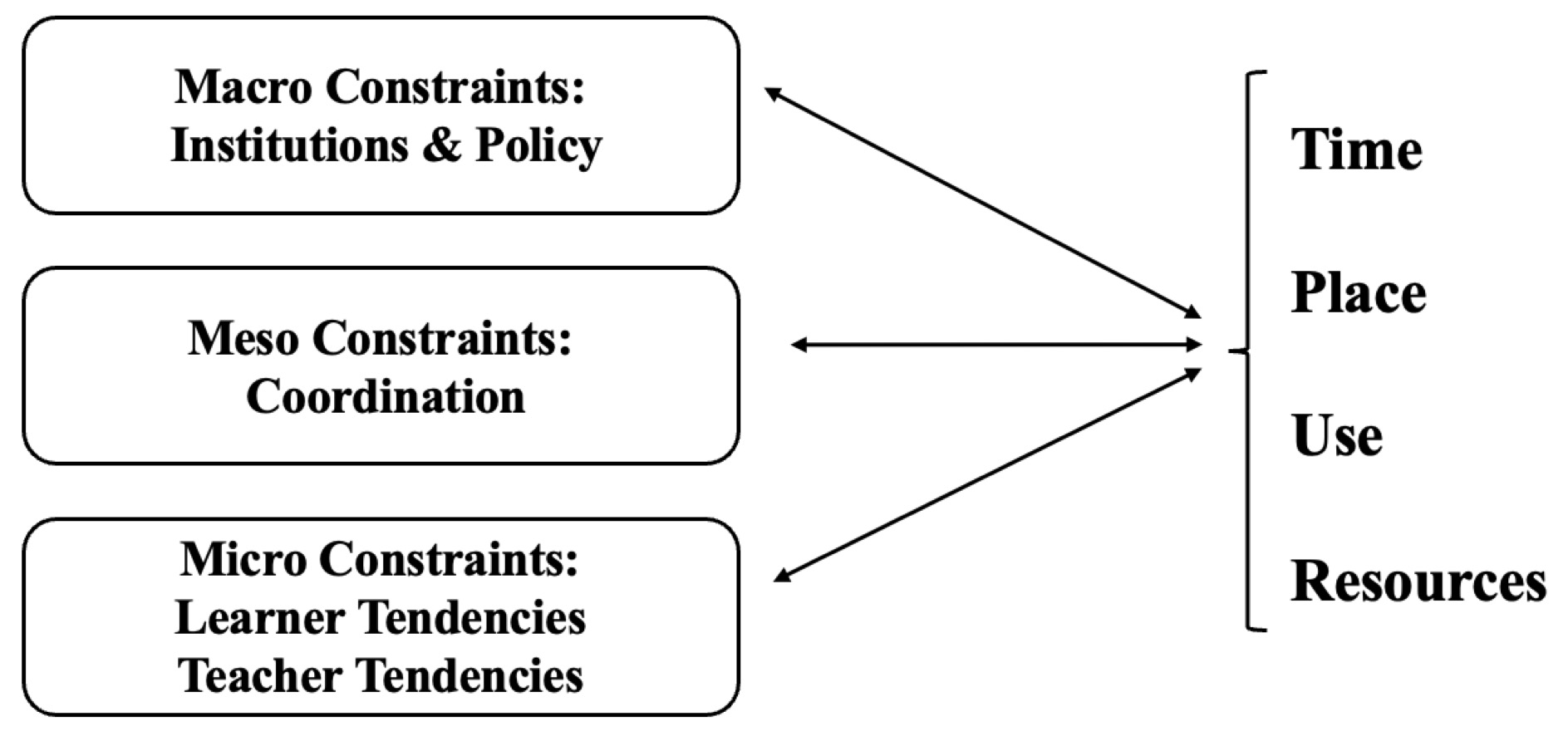
Note. Constraints on the left are more level-specific, while those on the right cut across levels.
In this paper, constraints are defined as factors generally external to self-access educators that inhibit the fostering of SALL. Table 1 presents a categorization of constraints, including definitions and related terms for each one. To address the vast and varied nature of literature on overcoming problems in self-access, we will discuss prominent examples of constraints and make connections that allow for a systematic categorization.
Table 1
Key Constraints on Fostering SALL
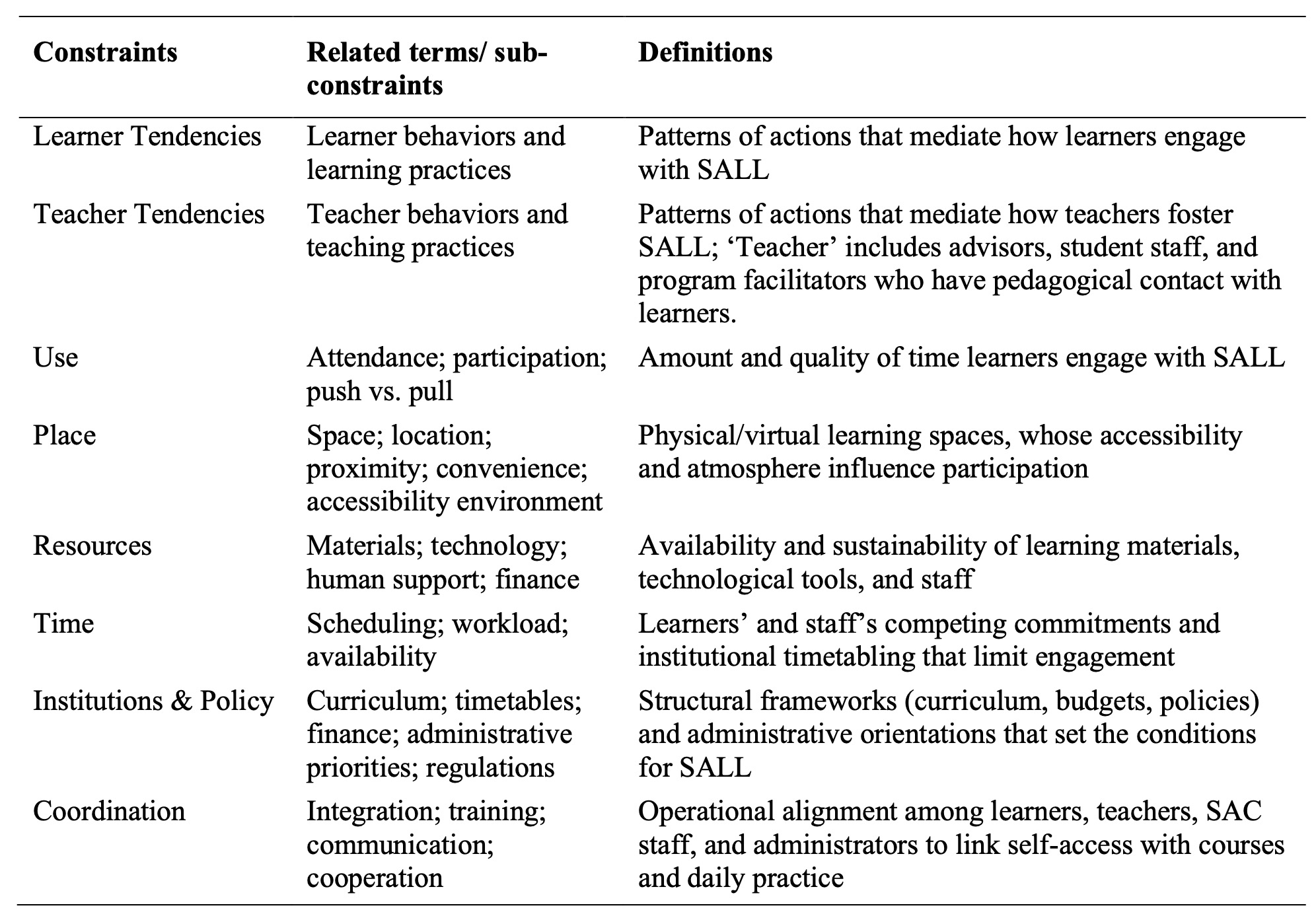
First, we address the connection between learner tendencies and use. As Table 1 shows, learner tendencies refer to learner behaviors and learning practices, representing a pattern of past and present actions that mediate how learners engage with SALL. For instance, Croker and Ashurova (2012) explain that first-year university students in Japan may feel confused and unsettled in their initial experiences with self-access as this style of out-of-class learning is at odds with their previous experiences in a controlled classroom environment under the supervision of a teacher. Similarly, Parsons and Warrington (2020) and Birdsell (2015, 2024) note that students may not use the learning spaces due to a lack of personal experience and understanding. Such learner tendencies may lead to a lack of use (see e.g., Birdsell, 2015; Croker & Ashurova, 2012; Gillies, 2007; Parsons and Warrington, 2018; Warrington, 2018). As Birdsell (2015) explains, “one major issue that many SALCs face . . . is attracting and retaining students because they do not receive any credit from attending any of the seminars or utilizing the space in any way” (p. 272).
Use, which can also be understood as attendance, can be measured for an entire SAC or for particular programs. It is a common concern for SACs, as some believe “the success of these centers comes down to the number of students who utilize the space” (Birdsell, 2015, p. 272). However, it is not merely use which determines success but also support, as well as the effectiveness and quality of the time spent engaging with SALL. Nevertheless, use is a commonly mentioned indicator of a SAC’s success, although when compared with traditional classroom learning, it is difficult to assess any linguistic gains that result from self-access (Reinders & Lázaro, 2008). Not only are students typically engaged in different kinds of learning activities, according to their own goals and preferences, but they are also frequently engaged in SALL concurrently with classroom learning. This challenge makes the number of self-access visitors an attractive measurement for administrators and institutions.
Of course, use is not merely related to learner tendencies but also to institutions and policies. Some administrators’ focus on attendance numbers can lead to coerced visits, where students are required to attend SACs and engage in SAC programs to fulfill homework assignments, a tendency that is at odds with the principle of supporting learners’ autonomy (Cooker, 2010; Warrington, 2018). While it should ideally be the students’ choice to engage in self-access, administrators who lack formal qualifications and training in education may be more concerned with achieving sufficient attendance numbers in order to justify the financial inputs of programs (Warrington, 2018).
Institutions and policies are also closely involved with decisions about place, time, and resources. Although place could be considered a resource, we have treated it separately since it is often central to SALL. Place can refer to the amount and quality of space, the location on a campus, as well as related issues like proximity, convenience, accessibility, and environment. One common issue is location in terms of a space’s proximity or accessibility for students. Regarding proximity, Parsons and Warrington (2020) reported on some students not wanting to visit a SAC because it was located far away. Similarly, Andersson and Nakahashi (2019) shared that their school’s counseling service was only easily accessible to those on one of three campuses. As these examples illustrate, self-access spaces that are difficult to access are a real or perceived drain on student time and can create a notable constraint.
Others have written about the problem of not having suitable spaces to conduct SALL activities. Baker (2022) lamented the lack of sufficient space for his SAC program in Taiwan, underscoring the importance of having spaces appropriate for supporting certain kinds of learning. Taube-Shibata and Lorentzen (2023) explained that not having a set place for providing maker spaces (community spaces with tools and resources for creating and building projects) resulted in a number of problems. For one, students were required to go to different locations, such as classrooms, when they wanted to join the activity. Additionally, the teachers did not have a single place to store materials. This resulted in inconvenience and created time burdens on both groups. Self-access spaces must meet the needs of those who wish to make use of them.
Not only the location but also the environment is important. Warrington (2018) bemoaned the fact that the SAC at his university was located on the first floor of the library, and citing Gromik (2015), he argued that “this can lead to competition between a SAC and a library as a place of learning” (p. 148). The association with a library may also send the wrong message to students about what is expected of them in the SAC. Tweed (2016) mentioned the issue of a library-like SAC in Cambodia, where there was little social interaction or support for learners. Similarly, Cooker (2010) advocates for spaces that do not feel like libraries or classrooms, as she explains the rationale behind her SAC design:
… the careful choice of colour schemes, furniture, physical layout, displays, and décor, we succeeded in creating a space which felt “different”. … Through this relaxed ambience we aimed to provide a place where students would choose to hang out and speak English, and be enticed to use the facilities and materials (p. 8).
Thus, place encompasses a number of qualities that have the potential to attract or discourage students from engaging in SALL. Like place, resources are also fundamental to fostering self-access. These refer to physical and digital materials as well as human resources, including teachers, advisors, and self-access staff, including students. For some self-access programs, however, it is difficult to provide these necessary resources to learners, as they cost money. For example, Papadima-Sophocleous (2013) wrote about the challenge of starting a new SAC in Cyprus during the time of a national financial crisis. Two constraints he addressed were the provision of material and digital resources as well as human resources who could act in both administrative and pedagogical capacities. Similarly, Baker (2022) wrote about the challenges of dealing with limited material and digital resources (for extensive reading, CALL, and multimedia use) as well as teachers and teaching assistants needed to support a range of programs. Although there are many online resources freely available, they may not always match the learners’ needs. While sometimes costly, human resources in the form of advisors, student staff and others remain critical for supporting successful SALL (Mynard & Shelton-Strong, 2022).
Finally, the critical relationship between coordination and teacher tendencies is examined. Regarding the former, self-access often exists in the form of centralized programs or spaces and entails working and communicating with different stakeholders, including high-level administrators, faculty and department leaders, instructors, students and others. Successful coordination is therefore a complex and vital aspect of fostering SALL. Teacher tendencies are closely linked to coordination, just as learner tendencies are connected to use. These tendencies (i.e., teacher behaviors and teaching practices) represent a pattern of actions that mediate how teachers foster and engage with self-access. They can thus have a significant impact on the successful coordination of initiatives.
Achieving a high degree of coordination is not easy in the maelstrom of many educational institutions. One challenge is making effective connections between the classroom and SALL. This is seen as desirable so SACs and related programs can offer the necessary support for classroom learning (Cotterall & Reinders, 2000). For example, students who are in need of language support for their classes may be able to acquire the needed assistance from a program such as advising desks, writing centers, or conversation programs. Moreover, if teachers better understand the practices and principles of self-access, then they may be better equipped to aid them. Sadly, however, this is not always the case (Birdsell, 2024). Due to their tendencies, which may stem from a lack of knowledge or unsympathetic attitudes, some teachers may treat self-access as little more than homework and thus fail to empathize with students’ struggles to engage with out-of-class learning (Wichayathian & Reinders, 2015).
Above, we have seen how the eight constraints across three nested levels were presented in the literature. Their interconnectedness was demonstrated as some constraints were shown to emerge with others, such as learner tendencies and use, as well as coordination and teacher tendencies. It is useful to reiterate the point that the intentions of the authors varied. While their studies were primarily selected to illustrate the different constraint types, some were more concerned with initiatives and objectives (e.g., Andersson & Nakahashi, 2019; Baker, 2022; Croker & Ashurova, 2012; Mehran et al., 2016; Parsons & Warrington, 2020; Reinders, 2007), and others focused more on assessing or evaluating self-access (e.g., Baker, 2022; Birdsell, 2024; Cotterall & Reinders, 2000). Nevertheless, all the authors were motivated to advance SALL on some level. In a similar vein, next we introduce a new model of navigating constraints, with the intention of providing another useful means of propelling self-access forward.
Human-Centered Design
Our constraint model for SALL draws from several approaches but is based primarily on a Human-Centered Design (HCD) framework. HCD is a multi-step design approach that focuses on users of a product or service, prioritizing understanding, in-depth development, and iteration. There have been numerous realizations of HCD in terms of how many steps and what the steps focus on. San Francisco-based IDEO design firm suggests a concise three-step process of Inspiration, Ideation, and Implementation that helps designers to connect with stakeholders, make plans and begin to act on them (IDEO.org, 2015). Conversely, Stanford University’s prestigious d.school design program utilizes a five-step process of Empathize, Define, Ideate, Prototype, and Test (Hasso Plattner Institute of Design at Stanford University, 2010).
HCD evolved from new ideas in industrial processes, business administration and design philosophy. While systems built on industrial design became standards for efficiency, by the 1980s some innovators began to question if human needs had become a casualty of the industrial world. One system that attempted to return focus to workers and their environments was Human-Centered Design (HCD). Developed from ideas in Norman’s (1988) book Design of Everyday Things, Human-Centered Design argued for item design that was more compatible with human bodies, lives and workstyles. Ideas that followed from this basic principle sought to move beyond design of everyday objects to concepts like business practice and management. In education, HCD was adopted in some public schools such as the Nueva School in California (The Nueva School, 2025) and the iZone’s school initiative in New York City (Hodas, 2016; Digital Promise, 2025).
As HCD models focus on the human experience as the basis for action and champion ideas of empathy, collaboration and iteration they serve as a solid foundation for a system of navigating constraints in a self-access environment.
Our Framework for Navigating Constraints on SALL
To aid educators in identifying and taking action on their local constraints, we present a framework that incorporates a constraint focus into HCD. This model is designed to help educators focus on constraints unique to their environment and promote cooperation while emphasizing prototyping, testing and innovating. To be sure, individuals involved in carrying HCD need not be limited to SAC professionals but could include learners, student staff, teachers, and other stakeholders.
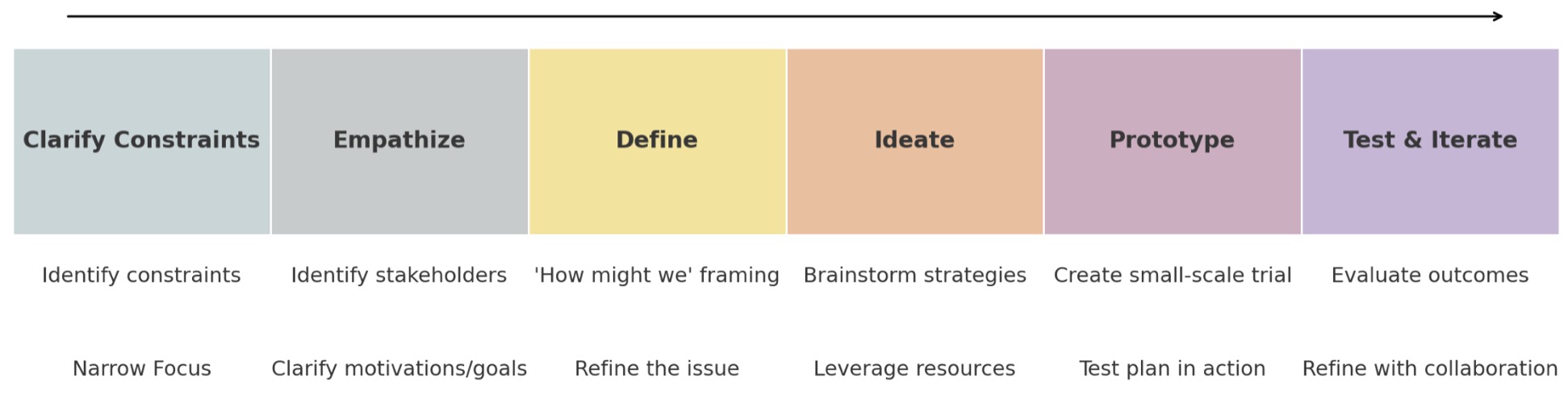
Our framework is a step-by-step process designed to offer educators a clear path from identifying constraints to action. Following the common process for many HCD models, our system is broken into six steps. The first step is to Clarify Constraints, and unlike many other HCD models, this one begins with careful consideration of a constraint that a SALL educator wishes to navigate through an ecological view of their environment (see Figure 1). Leveraging our eight categories (see Table 1), educators can work to identify a focus. Ideally, these constraints would be considered with reference to a SAC’s mission, vision or principles. After defining a focus, the next step is to Empathize. Empathy and understanding of stakeholders’ conflicting motivations and goals are vital to identifying a successful path forward. By empathize, we mean adopting the viewpoint of others. This can be especially helpful when addressing constraints where others’ approval is required for change to take place. The third step is Define, in which the issue is further defined with consideration of cooperation with stakeholders. “How might we” statements help with this clarification. With constraints and people more clearly defined, our system moves to brainstorming with Ideate. This step determines what creative strategies or resources can be leveraged (e.g., technology, spaces, online resources, collaboration, etc.) to address the constraint under focus. From there, we suggest Prototyping, creating a simple, short-term or small-scale version of the plan and putting it into action. Finally, Test and Iterate urges the educator to examine the results and data from the previous phase and, over time and with collaboration from stakeholders, develop towards a lasting strategy.
Figure 2
HCD Process for Navigating Constraints
As mentioned above, one of the benefits of the HCD model is that it is more time-efficient compared to other change-oriented approaches, such as action research and evaluative initiatives. Action research has many positive characteristics, some of which are similar to our HCD model. For instance, both are practitioner-led, and both involve cyclical frameworks in which testing or reflection informs subsequent action (Burns, 2010). However, because action research typically entails a relatively rigorous research process—including study design and the systematic collection and analysis of data—it may not be feasible for many educators (Allwright, 2005). Similarly, while evaluation plays an important role in assessing the overall quality and effectiveness of SACs and their individual programs, its comparatively wide scope, together with the demands of systematic evidence gathering and interpretation, can make it time-consuming (see, e.g., Mynard, 2016; Mynard, 2024; Reinders & Lázaro, 2008; Thornton & Noguchi, 2016). As with teachers, many SAC professionals occupy multiple roles and may not have the capacity to undertake complex and time-intensive research projects. In contrast, an HCD approach focuses more narrowly on identifying and addressing a particular constraint within a learning environment. This allows SALL professionals to prototype and implement practical changes more readily and with greater expediency, albeit on a limited scale.
Applying the Model
Below is an example from our own experience of applying HCD to navigating a constraint in self-access.
Clarify Constraints
The self-access team reflected on the fact that our center was largely program driven. As a result, virtually all the SAC space was occupied by pre-determined programs, primarily ones dedicated to practicing and developing communication skills in English and other languages. Our center lacked a dedicated place where students were encouraged to use and learn languages freely, without regard to adhering to set times or guidelines imposed by programs. In 2023, we established a space at one end of our SAC, which was designated as the Open Lounge. However, after launching it in 2023, one key constraint held it back. As the Open Lounge occupied a rather narrow space, the amount and type of use it could offer were limited.
Analyze Stakeholder perspectives
We were initially concerned about the institution granting a larger area of space and furniture, especially since the Open Lounge was different from our other spaces, which were program driven. From our inquiries, we learned that there was little or no available budget to spend on additional furniture and that there was no unused space adjacent to the one we were currently using.
Define
Since we could not secure new spaces to use, we opted to work within this constraint. We considered the following question: How might we change the way we use our existing SAC spaces so that we can provide a larger and more diversified Open Lounge?
Brainstorm Creative Solutions (Ideate)
We brainstormed different ways we could use the existing space to make room for the enlarged Open Lounge. After considering different options, we decided to use space previously occupied by our established programs. This involved moving some programs to different areas of the SAC. We were thus able to carve out an area within our existing SAC space that we could use as an extension of the Open Lounge. The administrators overseeing the learning commons and our SAC agreed with this plan.
Prototype
The SAC team met together during the winter break in early 2024 and discussed different furniture configurations so that we could create enough space for the new area. We then experimented with the arrangements until we could all agree. We reallocated unneeded furniture from other SAC programs. Finally, we were able to utilize an eclectic array of furniture that created various spaces for social and individual learning.
Test and Iterate
The newly designed Open Lounge was made available during the spring semester in 2024. We have since made ongoing changes to it and have appointed student staff and a full-time manager. Training support sessions are offered to our team of student staff twice a semester to deal with challenging issues that arise and to continue to develop the space. We see this new space as a work in progress and are pleased that we get a mix of international and Japanese students utilizing it regularly for a wide variety of learning purposes.
Commentary
The above example illustrates how HCD design was applied to one constraint, place, in our self-access center. It is important to note that while our experience with using this model was positive, we do not have empirical evidence to support the efficacy of HCD for resolving constraints. The largely practical operation did not include any data collection and analysis, for example. However, the streamlined process enabled us to launch the expanded Open Lounge during one semester in 2024. Our team continues to meet and discuss the operations of the Open Lounge to enhance its capacities and relevance for our learners. Resolving the space constraint for this free learning space has resulted in a SAC that is closer to our vision of one that supports students’ autonomy.
Discussion
It is the mission of self-access programs to offer support and guidance to students in their unique journeys toward becoming capable autonomous learners. This investigation aimed to organize and categorize common problems in SALL implementation to make those constraints more visible to the community and more manageable for individual programs. Each constraint removed liberates time and resources to support learners.
Constraints in self-access language learning programs can vary greatly, and recent literature addresses specific problems, pressures, and obstacles. For example, Birdsell (2015) discusses the difficulties of attracting and retaining students, and similar concerns have been investigated by other SALL professionals in different contexts (e.g., Croker & Ashurova, 2012; Parsons & Warrington, 2020). Taken together, these studies suggest that some constraints arise from past and present patterns of action that mediate how learners engage with SALL. Other constraints emerge from the physical and organizational environments in which self-access programs operate. For instance, Baker (2022) describes his SAC program’s lack of sufficient space—an issue faced by many self-access programs. Related concerns such as location, proximity, and accessibility likewise stem from where and how students interact with SALL professionals (e.g., Andersson & Nakahashi, 2019; Taube-Shibata et al., 2023). Although these challenges are featured in self-access learning literature, they are often discussed individually, and the field currently lacks a shared framework for describing and categorizing them.
To provide a straightforward path from categorization to action, this paper also introduced a method of problematizing and brainstorming based on Human-Centered Design (HCD). We were concerned that the ecology of constraints alone might not offer educators a clear route forward and could function merely as a classification system. HCD offers a relatively quick brainstorming and testing process rooted in a widely used methodology. The HCD model provides a researched and tested framework that has been applied successfully in educational contexts. While there have been no empirical studies confirming the value of applying HCD for resolving constraints in SALL, from our experience, it has been both an effective and time-efficient endeavor. At its core, the approach emphasizes human-centered perspectives while promoting efficiency through attention to interactional relationships and incremental change.
Ideally, the categorizations and problematizing methods proposed here would be used alongside rigorous diagnostic studies examining how individual SACs function and where their constraints lie. In such cases, the ecology of constraints could serve as a tool for identifying and organizing data gathered through internal research. The HCD method, in turn, could help structure the investigative process and guide the development of possible solutions. However, in schools and centers where empirical research is difficult due to size, budget, or time limitations, the method presented here offers an expedient way to identify constraints and begin planning actions to address them.
Conclusion
Returning to the core idea of fostering self-access language learning, this project was envisioned as a way to help educators solve problems, to allow for more time and energy to focus on helping students. The impetus for this study arose from repeated discussions with SALL professionals working in different contexts who expressed frustration with institutional barriers that obstructed them from serving learners as effectively as possible. In the investigation that followed those discussions, the authors uncovered patterns in problems as well as the lack of a common forum for labeling and discussing these issues. While there remains a world of unique problems and clever solutions, we hope the current work can build bridges between these islands.
We should note that this study could not provide an exhaustive overview of papers written on problems in SALL. Instead, we addressed key papers that resonated with broader issues discussed across the literature. In line with the growing need for professional support for SALL educators, the authors hope that this investigation can aid in developing research linked to constraints, offering a guiding star to programs looking to overcome difficulties and spend more energy on helping students. We believe that the field would benefit from further analysis of common constraints and the promotion of new and inventive approaches to aid schools, self-access centers and educators.
Notes on the Contributors
Bryan Buschner is a lecturer in the World Languages Center at Soka University Japan, and co-coordinator of the Self-Access Center. Within self-access he is particularly interested in language advising and currently serves as the language advising trainer for the SAC. His research interests include language advising, academic writing, sociocultural theory, conceptual metaphor theory, and discourse analysis. He holds a PhD in Applied Linguistics from Pennsylvania State University.
Andrew D. Tweed is an associate professor in the World Language Center and co-coordinator of the WLC Self-Access Center at Soka University in Tokyo, Japan. He has worked as a teacher trainer in Cambodia, Malaysia, Thailand, and Vietnam. His research interests include teacher education, learning beyond the classroom, and psychology in language learning. He holds an MATESOL from the University of Washington and an EdD in TESOL from Anaheim University.
Acknowledgements
The authors would like to thank Dr. Jo Mynard for her support in the publication of this article. We also thank the reviewers for their helpful suggestions. Finally, we are grateful to Dr. Stuart Warrington for his insightful comments on our model of constraints.
Notes
1. We have adapted Bronfenbrenner’s (1979) model to make it more practical for the purpose of navigating constraints in fostering SALL within institutions. We use the term macro in a different way from the original. Bronfenbrenner used macro to encompass all of his systems and to refer to factors such as culture, society and politics that shape them. While we agree that these certainly impact self-access and other types of learning, most SALL educators are not in positions to navigate these in practical ways to achieve immediate goals. We adopt macro to refer to institutions and policy because the word is widely used to refer to a top, hierarchical structure. Furthermore, while Bronfenbrenner examined learning within the context of nested systems that radiate beyond the institution, our use of the model for examining constraints remains focused within schools.
References
Andersson, S., & Nakahashi, M. (2019). Establishing online synchronous support for self-access language learning. Studies in Self-Access Learning Journal, 10(4), 323–338. https://doi.org/10.37237/100402
Allwright, D. (2005). Developing principles for practitioner research: The case of exploratory practice. The Modern Language Journal, 89(3), 353–366. https://doi.org/10.1111/j.1540-4781.2005.00310.x
Benson, P. (2011). Teaching and researching autonomy in language learning (2nd ed.). Routledge. https://doi.org/10.4324/9781315833767
Baker, J. R. (2022). Going beyond brick and mortar self-access centers: Establishing a satellite activity self-access program. Studies in Self-Access Learning Journal, 13(1), 129–141. https://doi.org/10.37237/130107
Birdsell, B. (2015). Self-access learning centers and the importance of being curious. Studies in Self-Access Learning Journal, 6(3), 271–285. https://doi.org/10.37237/060303
Birdsell, B. J. (2024). Crossing language boundaries on campus: Using a SALC as a learning space for interactive homework. Studies in Self-Access Learning Journal, 15(4), 420–441. https://doi.org/10.37237/150404
Bronfenbrenner, U. (1979). The ecology of human development: Experiments by nature and design. Harvard University Press.
Burns, A. (2010). Doing action research in English language teaching: A guide for practitioners. Routledge. https://doi.org/10.4324/9780203863466
Cooker, L. (2010). Some self-access principles. Studies in Self-Access Learning Journal, 1(1), 5–9. https://doi.org/10.37237/010102
Cotterall, S., & Reinders, H. (2000). Learners’ perceptions and practice in self-access language learning. The TESOLANZ Journal, 8, 23–38. https://hdl.handle.net/10652/2418
Croker, R., & Ashurova, U. (2012). Scaffolding students’ initial self-access language centre experiences. Studies in Self-Access Learning Journal, 3(3), 237–253. https://doi.org/10.37237/030303
Digital Promise. (2025, May 13). New York City Department of Education. Digital Promise. Retrieved Sept 20, 2025 from https://digitalpromise.org/district/new-york-city-department-of-education/
Gillies, H. (2007). SAL for everyone? Motivation and demotivation in self-access learning. Studies in Linguistics and Language Teaching, 18, 117–137.
Gromik, N. (2015). Self-access English learning facility: A report of student use. JALT CALL Journal, 11(1), 93-102. Retrieved from https://files.eric.ed.gov/fulltext/EJ1107995.pdf
Hasso Plattner Institute of Design at Stanford University. (2010). An introduction to design thinking: Process guide. Stanford University. https://web.stanford.edu/~mshanks/MichaelShanks/files/509554.pdf
Honda, S. (2016, January) Changing methods and mindsets: Lessons from Innovate NYC (Center on Reinventing Public Education). https://crpe.org/wp-content/uploads/innovationtoolkit_1.2016_final.pdf
IDEO.org. (2015). The field guide to human-centered design. IDEO.org. https://d1r3w4d5z5a88i.cloudfront.net/assets/guide/Field%20Guide%20to%20Human-Centered%20Design_IDEOorg_English-0f60d33bce6b870e7d80f9cc1642c8e7.pdf
Mehran, P., Alizadeh, M., Koguchi, I., & Takemura, H. (2016). The need for establishing an English self-access center at Osaka University: Practical suggestions and guidelines. Studies in Self-Access Learning Journal, 7(4), 365–378. https://doi.org/10.37237/070404
Morrison, B. (2008). The role of the self-access centre in the tertiary language learning process. System, 36(2), 123–140. https://doi.org/10.1016/j.system.2007.10.004
Murray, G. (Ed.). (2014). Social dimensions of autonomy in language learning. Palgrave Macmillan. https://doi.org/10.1057/9781137290243
Mynard, J. (2016). Looking backwards and forwards: Evaluating a 15-year-old SALC for continued growth. Studies in Self-Access Learning Journal, 7(4), 427-436. https://doi.org/10.37237/070410
Mynard, J. (2024). Self-access language learning support in Europe: Observations and current practices. Studies in Self-Access Learning Journal, 15(2), 258–278. https://doi.org/10.37237/150209
Mynard, J., & Shelton-Strong, S. (2022). Self-determination theory: A proposed framework for self-access language learning. Journal for the Psychology of Language Learning, 4(1), 1–14. https://doi.org/10.52598/jpll/4/1/5
Norman, D. A. (1988). The design of everyday things. Doubleday.
Papadima-Sophocleous, S. (2013). Davids still exist among Goliaths: A story of modest self-access centre establishment and survival in times of economic decline. Studies in Self-Access Learning Journal, 4(4), 281–294. https://doi.org/10.37237/040405
Parsons, A., & Warrington, S. (2020). Have a look around: The effect of a ‘push’ activity on future SAS use. Studies in Self-Access Learning Journal, 11(1), 4–22. https://doi.org/10.37237/110102
Reinders, H. (2007). Big brother is helping you: Supporting self-access language learning with a student monitoring system. System, 35(1), 93–111. https://doi.org/10.1016/j.system.2006.10.009
Reinders, H., & Lázaro, N. (2008). The assessment of self-access language learning: Practical challenges 1. Language Learning Journal, 36(1), 55–64. https://doi.org/10.1080/09571730801988439
Reinders, H., & Hubbard, P. (2012). CALL and learner autonomy: Affordances and constraints. In M. Thomas, H. Reinders, & M. Warschauer (Eds.), Contemporary computer-assisted language learning (pp. 359–375). Continuum. https://innovationinteaching.org/docs/chapter-2012-Reinders-and-Hubbard.pdf?utm_source=chatgpt.com
Taube-Shibata, J., & Lorentzen, A. (2023). Maker conversation: Successes and challenges in a university SALC. Studies in Self-Access Learning Journal, 14(2), 232–239. https://doi.org/10.37237/140207
Thornton, K., & Noguchi, N. (2016). Building a picture of usage patterns in a language learning space: Gathering useful quantitative and qualitative data. Studies in Self-Access Learning Journal, 7(4), 412-425. https://doi.org/10.37237/070409
The Nueva School. (2025, Sept 1). Design thinking. The Nueva School. Retrieved Sept 20, 2025 from https://www.nuevaschool.org/why-nueva/design-thinking
Tweed. (2016). Implementing a language learning advising service at a self-access center in Cambodia. Studies in Self-Access Learning Journal, 7(1), 96–109. https://doi.org/10.37237/070111
van Lier, L. (2004). The ecology and semiotics of language learning: A sociocultural perspective. Kluwer Academic. https://doi.org/10.1007/1-4020-7912-5
Warrington, S. (2018). Push, don’t pull: One self-access centre’s struggle for an identity. Studies in Self-Access Learning Journal, 9(2), 147–155. https://doi.org/10.37237/090207
Wichayathian, N., & Reinders, H. (2015). A teacher’s perspective on autonomy and self-access: From theory to perception to practice. Innovation in Language Learning and Teaching, 12(2), 89–104. https://doi.org/10.1080/17501229.2015.1103245
 SiSAL Journal