Jo Mynard, Kanda University of International Studies, Chiba, Japan. https://orcid.org/0000-0003-0363-6461
Dominique Vola Ambinintsoa, Kanda University of International Studies, Chiba, Japan. https://orcid.org/0000-0001-5987-3242
Mynard, J., & Ambinintsoa, D. V. (2026). Introduction. Studies in Self-Access Learning Journal, 17(2), 157–160. https://doi.org/10.37237/170201
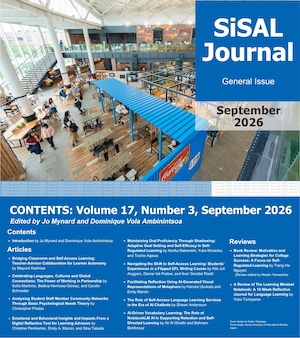
Welcome to the second issue of SiSAL Journal for 2026, featuring four papers and two reviews. The authors are based in Indonesia, Japan, Thailand, Saudi Arabia, and Vietnam, and the papers explore the following themes: conceptualizing self-access from a unique perspective; understanding learners’ SL writing experiences and the implications for outside-class writing support; exploring the experiences of self-access student staff; applying self-determination theory to self-access learning; and experiences using AI-supported tools to support learning.
Contents
Articles
The first paper by Mohammad Alnufaie from Jubail Institute of English Language and Preparatory Year and the Royal Commission for Jubail and Yanbu (Saudi Arabia) proposes a theoretical model called the Semantic Reception and Innate Generation (SRIG) model as a complementary explanatory lens for understanding self-access language learning. The model emphasizes the interaction of three interconnected dimensions (semantic reception, innate generation, and “habitus” (Bourdieu, 1990) and the author examines self-access learning process through this lens.
The second paper is by St. Asriati Am, Nurdevi bte Abdul, Nunung Anugrawati, Herlina Daddi, and St. Asmayanti Am from Universitas Muhammadiyah Makassar, Makassar, Indonesia, and Dwi Santoso from Universitas Ahmad Dahlan, Yogyakarta, Indonesia. The researchers report on a small-scale study that has indirect applications for self-access writing support. The study correlated data from a questionnaire investigating four learner factors and an English writing test. Findings suggest that students with stronger overall learner-factor profiles tend to achieve higher writing scores. Self-access writing supports could help students strengthen both engagement and writing performance.
The third paper by Anh Nguyen Thi Lan, Cuc Pham Thi Thu, and Lien Nguyen Thi Phuong from Hanoi University, Vietnam, present an exploratory qualitative research study investigates how students and teachers of Japanese perceive AI-assisted self-access writing in a Vietnamese university context. Results suggest that AI is reshaping how learners make sense of feedback, highlighting concerns about trust and uncertainty and becoming overreliant.
The final paper in this issue is by Daniel Hooper, Sam Reid, Yuki Namiki, and Yusuke Kon from Tokyo Kasei University, Japan. The authors report on a qualitative case study that explores how self-access student staff view their participation in a community of practice at a self-access center at a private university in Japan.
Reviews
Twice a year, the Research Institute for Learner Autonomy Education (RILAE) in Japan hosts online webinars known as LAb Sessions (Learner Autonomy Sessions). In June 2026, RILAE collaborated with the Self-Determination Theory Special Interest Group of the International Association for the Psychology of Language Learning to host a LAb session with the theme ‘Getting Started With Self-Determination Theory in Language Education.’ The authors of this review, Dominique Vola Ambinintsoa and Jo Mynard (Kanda University of International Studies, Japan), reflected on the event and present a summary of the event with some takeaways for self-access practitioners.
The final article is by Kiki Juli Anggoro from the School of Education, Walailak University, Thailand. The author describes one teacher’s reflective experience using interactive slides on the platform Wayground (formerly Quizizz) to support self-regulated learning in a flipped classroom. The author shares practical affordances, limitations, and future possibilities that could be relevant to teachers blending self-access support and classroom learning.
Special Issue: Call for Papers
This is the final call for submissions for the special issue of SiSAL Journal to be published in December 2026, edited by Andrew D. Tweed and Bryan Buschner. The editors seek contributions that focus on navigating constraints in self-access language learning (SALL) to better understand the complex nature of SALL with regard to how practitioners respond to challenges in various contexts. The special issue invites work that examines the constraints faced by self-access educators and the strategies they employ to navigate them. The authors have published a paper in the March 2026 issue that might serve as inspiration for potential authors. More details: https://sisaljournal.org/cfpconstraints/
Acknowledgements
Many thanks to members of our review and editorial teams for their insightful comments and helpful feedback. We would not be able to publish this issue without you. Appreciation also goes to all the authors who shared their work with us.
Notes on the Editors
Jo Mynard is a professor in the Faculty of Global Liberal Arts, Director of the Self-Access Learning Center, and Director of the Research Institute for Learner Autonomy Education at Kanda University of International Studies in Chiba, Japan. She has an M.Phil. in Applied Linguistics (Trinity College, University of Dublin, Ireland) and an Ed.D. in TEFL (University of Exeter, UK). Her research interests include advising in language learning, the psychology of language learning, and learning beyond the classroom.
Dominique Vola Ambinintsoa is a senior learning advisor and lecturer at Kanda University of International Studies in Japan. She holds a PhD in Applied Linguistics focusing on learner autonomy (Victoria University of Wellington, New Zealand) and an Ed.M in TESOL (State University of New York at Buffalo, US). Her research interests include learner autonomy, self-regulated learning, the psychology of language learning, and advising in language learning.
Reference
Bourdieu, P. (1990). The logic of practice (R. Nice, Trans.). Stanford University Press. (Original work published 1980)