St. Asriati Am, Universitas Muhammadiyah Makassar, Makassar, Indonesia. https://orcid.org/0000-0002-5348-7946
Nurdevi bte Abdul, Universitas Muhammadiyah Makassar, Makassar, Indonesia. https://orcid.org/0000-0003-1922-1594
Nunung Anugrawati, Universitas Muhammadiyah Makassar, Makassar, Indonesia. https://orcid.org/0000-0003-2551-9178
Herlina Daddi, Universitas Muhammadiyah Makassar, Makassar, Indonesia
Dwi Santoso, Universitas Ahmad Dahlan, Yogyakarta, Indonesia. https://orcid.org/0009-0000-9320-6486
St. Asmayanti Am, Universitas Muhammadiyah Makassar, Makassar, Indonesia. https://orcid.org/0000-0002-9354-3252
Am., A., Abdul, N., Anugrawati, H., Daddi, H., Santoso, D., & Am, A. (2026). Character, motivation, interest, and attitudes as predictors of EFL writing proficiency in eighth-grade students. Studies in Self-Access Learning Journal, 17(2), 184–202. https://doi.org/10.37237/170203
Abstract
The small-scale study described in this paper highlights the importance of integrating affective and motivational support into EFL writing instruction and has implications for self-access and outside-class writing support. The study correlated data from a questionnaire (adapted from Garry & Thompson, 2010) investigating four factors: character, motivation, interest, and attitudes, and an English writing test which assessed ideas/content, organization, vocabulary, and sentence structure. Descriptive findings showed that students generally possessed positive interest and attitudes toward English learning, whereas their motivation remained moderate. Writing results indicated that students still required support in organizing ideas, utilizing appropriate vocabulary, and constructing accurate sentences. Notably, interest emerged as the dominant predictor dimension affecting writing performance, followed by attitudes and character. This suggests that students with stronger overall learner-factor profiles tend to achieve higher writing scores. Self-access writing supports, such as guided writing checklists, vocabulary logs, sentence-building practice, and reflective learning tasks, may help students strengthen both engagement and writing performance.
Keywords: learner factors, individual differences, EFL writing proficiency, motivation, interest
English writing is a core component of second-language learning because it requires learners to transform ideas into organized texts while managing vocabulary, grammar, and rhetorical choices. In English as a Foreign Language (EFL) classrooms, students often show different levels of writing performance even when they receive the same instruction. These differences are not only related to linguistic knowledge but also to learner factors that shape how students engage with writing tasks, respond to feedback, and persist when they face difficulty (Hz, 2023; Qanwal & Ghani, 2019).
In this study, learner factors refer to students’ character, motivation, interest, and attitudes toward English learning and writing. These dimensions represent engagement-related tendencies that may influence students’ willingness to participate in writing activities, sustain effort, and use available support. Although personality traits such as introversion, extroversion, openness, and conscientiousness have often been discussed in language learning research, the present study does not measure personality traits directly. Instead, it focuses on the learner-factor profile measured through the four dimensions of character, motivation, interest, and attitudes. This clarification is important because these dimensions are conceptually related to individual differences, but they should not be treated as equivalent to formal personality constructs.
Motivation, interest, and attitudes are particularly relevant to EFL writing because writing requires sustained attention, planning, revision, and willingness to express ideas in a language that students are still developing. Students with stronger motivation may be more likely to complete writing tasks, revise their work, and seek improvement. Students with higher interest may engage more actively with writing topics and classroom activities. Positive attitudes toward English may also support persistence, especially when students encounter difficulties with vocabulary, grammar, and organization. Character-related learning dispositions, such as responsibility and perseverance, may further help students manage the effort required in writing tasks (Sutrisno et al., 2019; Zaswita & Ihsan, 2020).
Previous studies suggest that learner differences can influence how students approach academic tasks and respond to learning demands (Hz, 2023; Qanwal & Ghani, 2019). In writing, these differences are important because students must coordinate several processes at once: generating ideas, organizing content, selecting vocabulary, constructing sentences, and revising text. Some learners may benefit from collaborative writing and peer feedback because these activities provide social support and opportunities to exchange ideas (Astrid & Manalullaili, 2021; Ersoy & Çetin, 2023). Other learners may benefit from more structured individual writing time that allows planning, reflection, and self-paced revision. These patterns suggest that writing instruction may be more effective when it is responsive to students’ learner-factor profiles rather than assuming that one instructional approach fits all learners.
Self-regulated learning (SRL) also helps explain why learner factors may be related to writing performance. Students who set goals, monitor their progress, and reflect on their writing tend to show stronger engagement and more sustained improvement (Yabukoshi, 2020; Zhang et al., 2022). Motivation, interest, attitudes, and character-related dispositions may support these self-regulatory behaviors by encouraging students to plan, revise, and seek feedback. However, the present study does not test SRL as a mediating variable. Instead, SRL is used as a theoretical explanation for why learner factors may be associated with writing proficiency and why students may differ in their ability to manage writing tasks. These differences are primarily driven by individual variations in their internal profiles, such as their character, motivation levels, situational interest, and attitudes toward English learning.
Learner factors also interact with linguistic competence. Vocabulary knowledge and grammatical control are consistently associated with higher-quality written output, regardless of students’ affective or motivational profiles (Alavinia & Hassanlou, 2014; Trapman et al., 2018). This means that writing proficiency depends on both engagement-related factors and linguistic resources. A student may have strong interest and positive attitudes, but still need explicit support in core linguistic skills such as vocabulary and sentence structure, as well as rhetorical skills like text organization. Conversely, students with adequate language knowledge may underperform if they lack motivation, confidence, or persistence. For this reason, studies of EFL writing should consider both the psychological conditions that support engagement, alongside the distinct linguistic and rhetorical skills that enable effective written expression
The classroom environment may further shape the relationship between learner factors and writing proficiency. Collaborative writing tasks can provide immediate feedback and opportunities to negotiate meaning, while individual writing tasks can give students time to plan and revise at their own pace (Kaweera et al., 2019; Schoonen et al., 2011). Teacher–student interaction and classroom climate may also influence students’ willingness to write, take risks, and continue working when they experience difficulty (Limbong et al., 2023; Hoşgören Alıcı et al., 2023). These contextual influences show that learner factors should be understood not as fixed causes of performance, but as tendencies that operate within specific learning environments.
This issue is also relevant to self-access and outside-class writing support. In EFL contexts where exposure to English outside the classroom may be limited, students often need opportunities to continue developing writing skills beyond regular lessons. Self-access writing resources, guided writing checklists, vocabulary logs, sentence-building activities, reflection sheets, and optional feedback opportunities can help students practise independently while receiving appropriate support. Understanding students’ learner-factor profiles can therefore help teachers and learning-support providers design writing activities that sustain interest, strengthen motivation, and encourage autonomous practice. However, because this study does not directly measure students’ use of self-access resources, the implications for self-access learning should be interpreted as pedagogical applications rather than direct empirical findings.
Despite growing interest in individual differences and language learning, the relationship between engagement-related learner factors and EFL writing proficiency remains insufficiently clarified, especially among secondary-school learners. Much previous work has discussed broad personality orientations or general academic outcomes, while fewer studies have examined how measurable learner factors such as character, motivation, interest, and attitudes relate to writing performance in a specific EFL classroom context (Li, 2023; Limbong et al., 2023). This gap is important because writing is a demanding skill that requires both linguistic control and sustained engagement.
Given this background, the present study investigates the relationship between individual learner factors and English writing proficiency among Grade 8 EFL students in Sinjai, Indonesia. The learner-factor construct is operationalized through four dimensions: character, motivation, interest, and attitudes. The study is guided by the following hypothesis: Character, Motivation, Interest, and Attitude significantly and collectively predict EFL writing proficiency among eighth-grade students
The novelty of this study lies in its focused examination of EFL writing proficiency alongside multiple engagement-related learner dimensions in a secondary-school context. By connecting learner-factor profiles with writing performance, the study aims to provide preliminary evidence that can inform more responsive writing instruction and outside-class writing support. The findings are expected to help teachers identify the need to sustain students’ interest, strengthen positive attitudes toward writing, and provide motivational support while continuing to develop core linguistic skills such as organization, vocabulary, and sentence structure.
Methodology
This study employs a predictive correlational design. This design is appropriate because it goes beyond identifying simple relationships by utilizing linear regression analysis to examine the extent to which independent variables (the questionnaire dimensions) can statistically predict the dependent variable (students’ English writing proficiency).
Participants
The participants were 25 students from Class 8A at a junior high school in Sinjai, Indonesia. They were selected using purposive sampling because they belonged to the same grade level and shared a comparable instructional context. The students were within the typical age range for Grade 8, approximately 12–13 years old, strict ethical protocols were maintained. Prior to data collection, formal institutional approval was obtained from the school administration acting in loco parentis to safeguard the students’ involvement. The students were fully informed of the research intentions and provided with opportunities to ask questions before data collection. Informed verbal assent was then secured from each participant. Involvement was entirely voluntary, with guaranteed anonymity, and students could withdraw at any stage without any academic repercussions.
Data Collection Procedure
Data collection was conducted in two stages. First, students completed the learner-factors questionnaire (see Appendix). The researcher explained the purpose of the questionnaire, clarified how to respond to the items, and informed students that their responses would be used for research purposes. Students were encouraged to answer honestly based on their own learning experiences.
Second, students completed the English writing test under classroom conditions. After the questionnaire and writing test were collected, the responses and writing scores were coded and entered into statistical software for analysis. The EFL writing test was administered solely for the purpose of this research, rather than serving as a graded examination. To maintain a natural setting, it was conducted during regular class hours, and the same rigorous ethical protocols—including voluntary participation and complete anonymity—applied equally to both the questionnaire distribution and the writing test administration.
Instrument
Data were collected using two instruments: a learner-factors questionnaire and an English writing test.
Learner-Factors Questionnaire
The research instrument used in this study was adapted and modified from the standardized framework established by Garry and Thompson (2010). It comprises a total of 54 items distributed across four distinct dimensions: Character, Motivation, Interest, and Attitude. Due to historical data fragmentation from the initial processing phase, separate empirical Cronbach’s alpha coefficients for each dimension could not be mathematically generated. However, to ensure maximum psychometric transparency and validity, the comprehensive item-level descriptive response distribution for all 54 items across 25 respondents is fully detailed in the Appendix at the end of this paper.
The questionnaire included both positively and negatively worded items. Students responded to each item using a Likert-type response scale ranging from 1 = strongly disagree, 2 = disagree, 3 = neutral, 4 = agree, 5 = strongly agree. Negatively worded items were reverse-scored before the data were analyzed (1 = strongly agree, 2 = agree, 3 = neutral, 4 = disagree, 5 = strongly disagree).
English Writing Test
An English writing test was administered to measure students’ writing proficiency. Students were asked to write a short text on familiar personal topics, such as self-description, family, favorite activities, or future aspirations. These topics were selected because they were appropriate for Grade 8 students and allowed them to express ideas using vocabulary and structures commonly taught at their level.
The writing test was conducted under classroom testing conditions. Students were given 90 minutes to complete the task. They completed the task individually. The use of dictionaries, notes, translation tools, or other external assistance was not permitted. The teacher supervised the test to ensure that all students completed the task under similar conditions.
Data Analysis
Descriptive statistics were used to summarize students’ learner-factor profiles and writing proficiency. The descriptive analysis included frequency distributions, percentages, means, and standard deviations where appropriate. The learner-factor results were reported for the four dimensions of character, motivation, interest, and attitudes. The writing results were reported according to the analytic rubric components. To ensure the validity of the writing test data, students’ essays were evaluated using an analytic scoring rubric adapted from Ellis and Barkhuizen (2005). The assessment explicitly measured five distinct components: Idea and Content, Organization (physical structure), Vocabulary, Sentence, and Convention. Each component was scored on a standardized scale ranging from 1 to 5, where a score of 5 represents the highest proficiency level and 1 represents the lowest. This structural breakdown provided a transparent, objective, and multi-dimensional framework for assessing the participants’ EFL writing performance.
A simple linear regression analysis was then conducted to examine whether the overall learner-factor score predicted students’ English writing proficiency. The dependent variable was the total writing proficiency score, and the independent variable was the overall learner-factor score derived from the questionnaire. This analysis was described as simple linear regression because only one composite predictor was included in the model.
Statistical significance was evaluated at the .05 alpha level. The regression results were interpreted using the unstandardized coefficient (B), standard error, standardized coefficient (β), t-value, and p-value. The p-value was reported as p < .001 when the statistical output showed .000. Model fit should also be reported using R, R², adjusted R², F, and degrees of freedom. Before interpreting the regression model, relevant assumptions should be checked, including linearity, normality of residuals, homoscedasticity, and the absence of extreme influential cases.
Findings
Students’ Learner-Factor Profiles
The questionnaire results showed variation in students’ learner-factor profiles across four dimensions: character, motivation, interest, and attitudes. These dimensions were treated as learner-related and engagement-related factors rather than as formal personality traits. The descriptive results are presented in Table 1.
Table 1
Dominant Percentage and Sample Statements of Questionnaire Dimensions
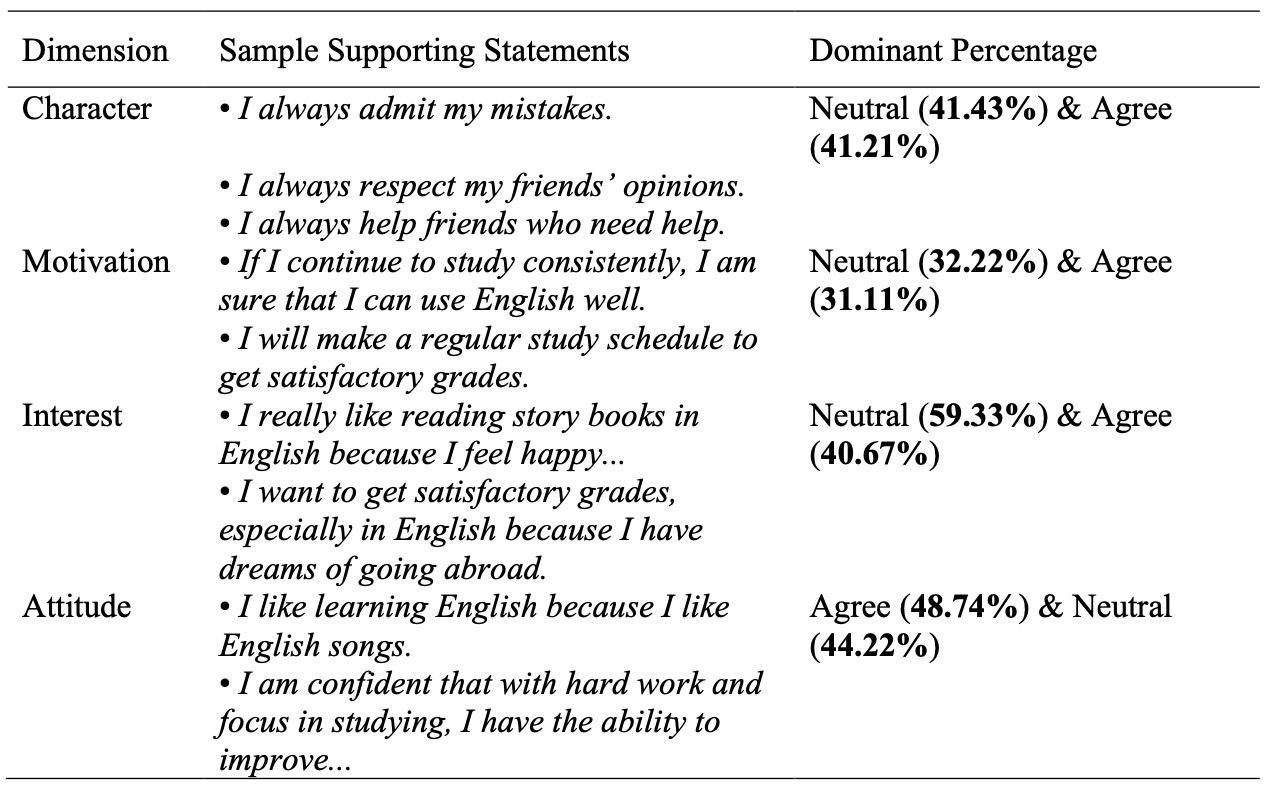
As shown in Table 1, respondents demonstrated a generally positive character, high motivation, and favorable attitudes toward EFL writing. However, a notable pattern across the data is the high concentration of “Neutral” responses, particularly prominent in the Interest dimension (59.33%), Character (41.43%), and Motivation (32.22%). This substantial neutrality indicates that while students tend toward positive perceptions, a significant portion remains uncertain or inconsistent in fully demonstrating these traits.
Conclusively, the Attitude dimension exhibits the strongest positive tendency among the participants, with “Agree” responses reaching 48.74%. Conversely, the Interest dimension is heavily dominated by “Neutral” choices (59.33%), signaling that students’ intrinsic engagement and interest in English writing still require strategic academic improvement.
Students’ English Writing Proficiency
Students’ English writing proficiency was comprehensively assessed using the analytical rubric adapted from Ellis and Barkhuizen (2005), which evaluates five core components: ideas/content, organization, vocabulary, sentence structure, and writing conventions. To provide a clearer and more transparent statistical overview, the distribution of raw student frequencies along with their respective percentages is simplified and summarized in Table 2.
Table 2
Students’ Writing Skills
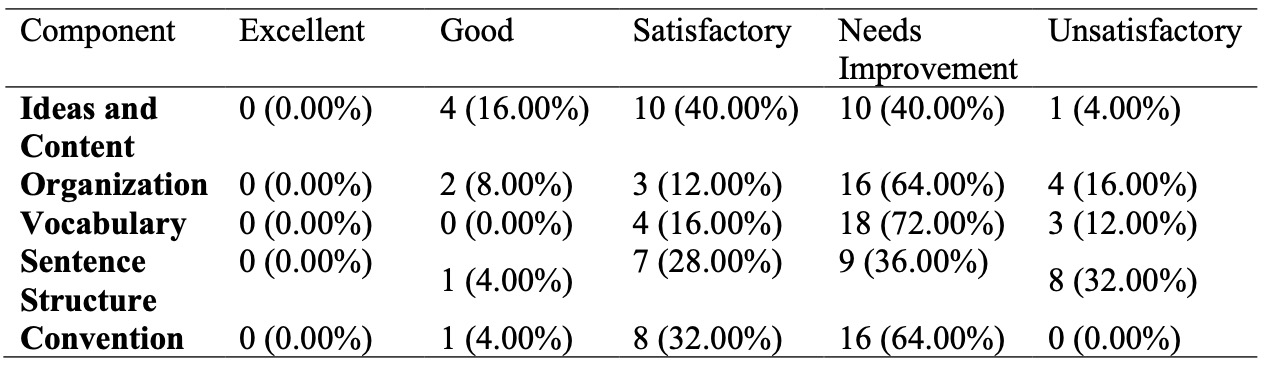
As illustrated in Table 2, the descriptive analysis reveals a comprehensive breakdown of students’ EFL writing performance across the five evaluated components. Overall, the data demonstrates that a majority of the students still struggle significantly with structural and linguistic mechanics, as reflected by the high concentration of scores shifting toward the lower proficiency categories.
A closer inspection of the specific components indicates that Ideas and Content represents the students’ relative strength, with 40.00% of participants achieving a “Satisfactory” level and 16.00% reaching a “Good” level. Conversely, severe proficiency deficits are evident in Vocabulary and Organization. In terms of vocabulary usage, a striking 72.00% of students fall into the “Needs Improvement” category, combined with 12.00% marked as “Unsatisfactory.” Similarly, text organization poses a major hurdle, with 64.00% of the sample needing improvement and 16.00% exhibiting unsatisfactory performance. These findings clearly signal that while students possess a baseline capability to generate ideas, their linguistic resourcefulness and ability to logically structure a text remain primary instructional barriers that require targeted intervention.
The assessment of writing skills shows that many students need support in fundamental areas such as organization, vocabulary, and sentence structure. These weaknesses could potentially be related to their individual personality traits, which may influence how they approach learning and practicing these writing components.
To further examine the connection between students’ questionnaire responses and their writing performance, a linear regression analysis was conducted. Rather than utilizing a single aggregated score, the analysis focused on the dominant dimension patterns. The results indicated a statistically significant positive effect on students’ writing proficiency (t = 7.652, β= 0.847, p < .001). This demonstrates that higher levels of positive affective and personality factors, as measured through the dimensions, strongly predict better English writing skills.
These findings underscore the importance of considering personality factors when designing educational interventions aimed at improving writing skills. Individual characteristics such as openness, conscientiousness, or introversion/extroversion clearly influence how students engage with writing tasks and affect their overall performance. Therefore, tailoring teaching methods to align with students’ personality traits could lead to more effective learning experiences and, ultimately, to improved writing proficiency.
Discussion
This study examined the relationship between learner factors and English writing proficiency among Grade 8 EFL students. Overall, the descriptive results indicated generally positive interest and attitudes, while motivation responses were more mixed and clustered around neutral. The writing assessment showed that many students needed improvement in organization, vocabulary, and sentence structure. The regression analysis further indicated a significant positive association between the overall learner-factor score and writing proficiency.
Learner Factors and Engagement in Writing
The descriptive pattern of high interest and largely positive attitudes is consistent with research suggesting that students who are interested in a subject tend to engage more actively and achieve better learning outcomes (Fonseca-Mora et al., 2021). Similarly, prior studies have emphasized that personality- and disposition-related factors shape how students participate in academic activities and persist during challenging tasks (Velasco et al., 2023). In the present study, these engagement-related dimensions may help explain why students with higher learner-factor scores also tended to achieve higher writing proficiency.
Motivation, however, appeared less robust than interest and attitudes. The relatively high proportion of neutral responses suggests that many students may not experience strong intrinsic drive or sustained extrinsic incentives to invest effort in writing. This pattern aligns with findings that motivation varies widely across learners and can fluctuate depending on task demands and classroom context (Capinding, 2022; Li, 2023). Moderate motivation is important because writing requires prolonged effort, planning, and revision; without sufficient motivation, students may not practice consistently enough to develop complex writing skills (Vianty et al., 2020).
Attitudes also matter because they influence students’ willingness to participate, accept feedback, and persevere when writing is difficult. The presence of neutral (and a small number of negative) attitude responses in this sample supports earlier findings that positive attitudes are associated with stronger engagement and academic performance (Tuerah et al., 2019). Together, these findings indicate that instructional efforts aimed at strengthening motivation and maintaining positive attitudes may be especially useful when students’ writing outcomes are limited.
Writing Weaknesses and Instructional Implications
The writing profile in Table 1 highlights three areas of consistent difficulty: organization, vocabulary, and sentence structure. These weaknesses are common in EFL writing contexts, where learners often have limited exposure to English outside the classroom and may have insufficient opportunities to practice drafting and revising. The results suggest that interventions should not focus only on affective factors (interest, attitudes, motivation), but also strengthen linguistic foundations and writing routines.
Instructionally, the generally positive interest observed in this sample can be leveraged to design writing tasks that connect to students’ experiences and preferences, which may increase persistence and time on task. This approach is consistent with recommendations that linking instruction to student interest and emphasizing character-related habits (e.g., responsibility, persistence) can support better learning outcomes (Noviadi et al., 2023). At the same time, the moderate motivation pattern indicates a need for targeted supports that make goals and progress visible. For example, teachers can use clear success criteria, short-term writing targets, and structured feedback cycles to help students experience improvement over time, which may strengthen motivation and self-efficacy.
Avoiding Overinterpretation: What the Current Data Can and Cannot Claim
Although the regression analysis showed a strong association between the overall learner-factor score and writing proficiency, the present data do not allow conclusions about which specific dimension (character, motivation, interest, or attitudes) is the strongest predictor. In addition, the current analysis does not test differences between introverted and extroverted students, nor does it measure trait dimensions such as openness or conscientiousness. Therefore, interpretations about introversion/extroversion or other trait profiles should be treated as theoretical context rather than direct conclusions from the results.
To avoid overinterpretation of the findings, this study acknowledges that the questionnaire was not analyzed as a single aggregated score. Instead, by evaluating the specific data patterns of the four dimensions independently, the study provides a more nuanced look at how affective factors relate to writing. Given the sample size, care has been taken not to over-generalize the regression pathways, ensuring that the interpretations remain strictly representative of the distinct dimension tendencies observed in the current data.
Similarly, prior literature suggests that self-regulated learning strategies may contribute to writing development (Teng, 2022; Yabukoshi, 2020; Zhang et al., 2022), and it is plausible that learners with stronger engagement profiles use more effective planning and self-monitoring during writing. However, SRL was not directly tested as a mediator in the reported analysis. As a result, SRL should be framed as an explanatory pathway supported by prior studies, and future work should examine it with appropriate measures and mediation analyses.
Implications and Directions for Future Research
The findings support the practical value of responsive writing instruction that addresses both affective and linguistic needs. Teachers may consider combining structured language development (vocabulary learning routines, sentence-combining practice, and guided grammar feedback) with engagement-oriented strategies (topic choice, meaningful audiences, and supportive feedback) to sustain interest and strengthen attitudes. Where motivation is moderate, incremental goal setting and progress monitoring may help students persist through demanding writing tasks.
Future studies should (1) test the unique contribution of character, motivation, interest, and attitudes using a multiple-predictor model; (2) include controls for key confounds such as prior language proficiency and classroom-level factors; and (3) examine mechanisms such as SRL and writing self-efficacy to clarify how learner factors translate into writing improvement.
Regarding the pedagogical implications for self-access learning, the findings of this study offer valuable insights into how affective factors influence students’ self-directed study outside of the classroom. Given that dimensions like attitude and motivation strongly correlate with writing performance, self-access centers should design personalized, low-anxiety writing environments. For instance, since students struggle significantly with vocabulary and text organization, self-directed learning modules should provide autonomous scaffolding tools—such as digital writing portfolios, vocabulary logs, and self-assessment checklists. By leveraging students’ positive attitudes, educators can encourage independent writing practices, enabling learners to proactively manage their EFL writing development beyond formal classroom settings.
Conclusion
This study examined the association between individual learner factors—character, motivation, interest, and attitudes—and English writing proficiency among Grade 8 EFL students. The results indicate that higher overall learner-factor scores were significantly associated with higher writing proficiency in this sample. Descriptive findings also showed generally positive interest and attitudes, while motivation tended to be moderate.
In terms of writing performance, many students were rated as needing improvement in organization, vocabulary, and sentence structure. These patterns suggest that writing instruction should address both affective and linguistic needs: sustaining students’ interest and positive attitudes may support engagement, while structured practice and feedback are needed to strengthen core language resources that underpin writing quality.
This study provides preliminary evidence that learner-factor profiles are relevant for understanding variation in students’ writing outcomes in an EFL classroom. However, the findings are limited by the small purposive sample drawn from a single class and by the absence of controls for key confounding factors such as prior language proficiency. Future research should employ larger and more diverse samples, test the unique contribution of each learner-factor dimension using a multiple-predictor model, and examine mechanisms such as self-regulated learning and writing self-efficacy that may explain how learner factors relate to writing development.
Notes on the Contributors
St Asriati Am is a lecturer and researcher at the Magister English Education Department, Pascasarjana Universitas Muhammadiyah Makassar, Indonesia. Her research focuses on English education, reading comprehension, linguistics, the foundation of education and instruction, and language assessment. Her contribution to this study includes writing the introduction, methodology, discussion, original draft preparation, and serving as the corresponding author.
Nurdevi bte Abdul is a lecturer at the Faculty of Teacher Training and Education, Universitas Muhammadiyah Makassar, Indonesia. Her interests include phonetics and phonology, writing and speaking, discourse analysis, and research. She was involved in data collection, data analysis, and final article drafting.
Nunung Anugrawati is a lecturer at the Faculty of Teacher Training and Education, Universitas Muhammadiyah Makassar, Indonesia. She specializes in sociolinguistics, language teaching, psycholinguistics, and advanced grammar. Her contribution to this paper includes conceptualization and article writing.
Herlina Daddi is a lecturer at the Faculty of Teacher Training and Education, Universitas Muhammadiyah Makassar, Indonesia. Her research areas include pronunciation, discourse analysis, public speaking, and language education. She contributed to this paper by writing the abstract and conclusion, and formatting the article.
Dwi Santoso is a senior lecturer at Universitas Ahmad Dahlan, Yogyakarta, Indonesia. His research focuses on pragmatics, politeness strategies, and forensic linguistics. He contributed to this paper by proofreading using Grammarly, collecting data, and formatting.
St. Asmayanti Am is a lecturer at the Faculty of Teacher Training and Education, Universitas Muhammadiyah Makassar, Indonesia. Her interests include writing skills, linguistics, pronunciation, language teaching, sociolinguistics, and TEFL. She contributed to this paper by writing the abstract, conclusion, and data, and formatting.
References
Alavinia, P., & Hassanlou, A. (2014). On the viable linkages between extroversion/introversion and academic Iranian EFL learners’ writing proficiency. English Language Teaching, 7(3), 167–175. https://doi.org/10.5539/elt.v7n3p167
Astrid, A., & Manalullaili. (2021). Implementing teacher written feedback and oral writing conference. Proceedings of the 5th Asian Education Symposium 2020 (AES 2020), 566 (AES 2020), 344–347. https://doi.org/10.2991/assehr.k.210715.072
Capinding, A. T. (2022). Impact of modular distance learning on high school students’ mathematics motivation, interest/attitude, anxiety and achievement during the COVID-19 pandemic. European Journal of Educational Research, 11(2), 917–934. https://doi.org/10.12973/eu-jer.11.2.917
Ellis, R., & Barkhuizen, G. (2005). Analysing learner language. Oxford University Press.
Ersoy, E., & Çetin, D. (2023). Investigation of the relationship between the writing autonomy and writing skill of students learning Turkish as a foreign language. Shanlax International Journal of Education, 11(S1-July), 114–131. https://doi.org/10.34293/education.v11iS1-July.6117
Fonseca-Mora, M. C., Machancoses, F. H., Gryb, O., & Reiterer, S. (2021). Musical aptitude, working memory, general intelligence and plurilingualism: When adults learn to read fluently in a foreign language. Cogent Education, 8(1), 1936371. https://doi.org/10.1080/2331186X.2021.1936371
Garry, W., & Thompson, S. (2010). Personality and learning: A study on individual differences. Sage Publications.
Hoşgören Alıcı, Y., Hasanli, J., & Ceran, S. (2023). Affective neuroscience personality differences between medical school students and engineering school students. Acta Medica, 54(3), 172–177. https://doi.org/10.32552/2023.ActaMedica.882
Hz, B. I. R. (2023). Writing anxiety in EFL students: Personality traits perspective. ELT Echo: The Journal of English Language Teaching in Foreign Language Context, 8(2), 160–174. https://doi.org/10.24235/eltecho.v8i2.15245
Kaweera, C., Yawiloeng, R., & Tachom, K. (2019). Individual, pair and group writing activity: A case study of undergraduate EFL Student Writing. English Language Teaching, 12(10), 1–12. https://doi.org/10.5539/elt.v12n10p1
Li, S. (2023). Motivation reasons and suggestions for junior high school students in English teaching. Journal of Education, Humanities and Social Sciences, 23, 110–115. https://doi.org/10.54097/ehss.v23i.12753
Limbong, S., Alberto, & Tandibura, F. (2023). Lecturer’s personal and social competence toward students’ writing proficiency in EFL classroom. Journal of English Education and Teaching, 7(4), 914–927. https://doi.org/10.33369/jeet.7.4.914-927
Noviadi, A., Sumiyadi, S., & Permadi, T. (2023). The role of creative literature teaching based on character in character development. Diglosia: Jurnal Kajian Bahasa, Sastra, Dan Pengajarannya, 6(3), 645–654. https://doi.org/10.30872/diglosia.v6i3.693
Qanwal, S., & Ghani, M. (2019). Relationship between introversion/extroversion personality trait and proficiency in ESL writing skills. International Journal of English Linguistics, 9(4), 107–116. https://doi.org/10.5539/ijel.v9n4p107
Schoonen, R., van Gelderen, A., Stoel, R. D., Hulstijn, J., & de Glopper, K. (2011). Modeling the development of L1 and EFL writing proficiency of secondary school students. Language Learning, 61(1), 31–79. https://doi.org/10.1111/j.1467-9922.2010.00590.x
Sutrisno, B., Rasyid, Y., & Rahmat, A. (2019). Beyond the use of think-pair-share towards the personality type of students in essay writing. Proceedings of the 2nd International Conference on Applied Linguistics (Conaplin 2018), 254, 120–126. https://doi.org/10.2991/conaplin-18.2019.25
Teng, M. (2022). Predictive effects of writing strategies for self-regulated learning on secondary school learners’ EFL writing proficiency. [Preprint]. https://doi.org/10.31234/osf.io/hdaje
Trapman, M., van Gelderen, A., van Schooten, E., & Hulstijn, J. (2018). Writing proficiency level and writing development of low-achieving adolescents: the roles of linguistic knowledge, fluency, and metacognitive knowledge. Reading and Writing, 31(4), 893–926. https://doi.org/10.1007/s11145-017-9808-8
Tuerah, P. R., Santie, Y. D. A., Lonto, A. L., & Pangalila, T. (2019). Character education on students in social science faculty at Manado State University. Proceedings of the 3rd International Conference on Social Sciences (ICSS 2019), 335, 512–517. https://doi.org/10.2991/icesshum-19.2019.82
Velasco, J. J. B., Guillermo, M. M., Cabigon, P. A., Corpuz, A. G., Damo, S. J., Dela Cruz, C. F., & Felipe, J. J. (2023). Leadership skills and personal characteristics of student leaders of Northwestern University. International Journal of Research Studies in Education, 12(3), 129–140. https://doi.org/10.5861/ijrse.2023.1010
Vianty, M., Amrullah, A., & Fiftinova, F. (2020). English reading motivation, strategies, attitude, and interest of state junior high school students. The Journal of English Literacy Education, 6(2), 129–140. https://doi.org/10.36706/jele.v6i2.10825
Yabukoshi, T. (2020). Self-regulated learning processes outside the classroom: Insights from a case study of Japanese EFL students. Journal of Asia TEFL, 17(3), 758–777. https://doi.org/10.18823/asiatefl.2020.17.3.1.758
Zaswita, H., & Ihsan, R. (2020). The impact of personality types on students’ writing ability. JPI (Jurnal Pendidikan Indonesia), 9(1), 75–84. https://doi.org/10.23887/jpi-undiksha.v9i1.21101
Zhang, Y., Li, M., Chieh, Y. T., & Han, S. (2022). On a path to becoming more self-regulated: Reflective journals’ impact on Chinese English as a foreign language students’ self-regulated writing strategy use. Frontiers in Psychology, 13. https://doi.org/10.3389/fpsyg.2022.1042031
Appendix: See PDF version