
Mátyás Bánhegyi, Budapest University of Economics and Business, Budapest, Hungary https://orcid.org/0000-0003-1011-0345
Balázs Fajt, Budapest University of Economics and Business, Budapest, Hungary https://orcid.org/0000-0003-4983-3962
Bánhegyi, M., & Fajt, B. (2025). Integrating portfolio-based learning into ESP teacher education: Fostering learner autonomy and enhancing professional language skills. Studies in Self-Access Learning Journal, 16(3), 591–611. https://doi.org/10.37237/160306
Abstract
In the context of English for Specific Purposes (ESP) education, fostering learner autonomy is essential for not only equipping students with the specialised language skills required for their professional fields but also for developing such skills beyond classroom instruction. Unlike general English courses, ESP requires engagement with domain-specific vocabulary, professional communication strategies, and industry-related discourse, which necessitate the recognition of self-directed and self-access learning as a key component of language development in this field. Fixed curricula and teacher-centred instruction, however, often limit opportunities for independent learning. This reflection-on-practice paper explores a portfolio method that encourages students to take ownership of their progress through learner autonomy, self-access learning, student engagement, and reflective skills. This paper presents the structure and implementation of a piloted ESP portfolio in detail and argues for its integration into teacher training programmes, thereby promoting the fostering of sustainable self-directed learning practices. The incorporation of portfolio-based learning into teacher education will likely help future ESP teachers implement portfolio approaches in their own ESP classrooms.
Keywords: learner autonomy, portfolio-based learning, self-access learning, ESP teacher education, reflective learning
In an increasingly globalised and digitalised world, the ability to learn independently beyond the classroom has become an essential skill for students (Blidi, 2017). In English for Specific Purposes (ESP) education, where students often require very specialised language skills for their professional fields, the limited time available within the scope of formal instruction poses a significant challenge to equipping learners with all the linguistic and critical thinking skills necessary for their future careers (Wu & Fernando, 2023). Therefore, fostering learner autonomy—the ability to take charge of one’s own learning, as defined by Holec (1981)—is crucial in ensuring that students develop the competencies needed for engaging in effective communication in professional contexts. However, traditional ESP teaching methods, which often emphasise syllabus-driven content delivery, may not fully support this development. Many ESP courses follow fixed curricula, leaving little room for individualised learning experiences or self-directed exploration of language use in professional settings (Dou et al., 2023), and students may not possess all the necessary skills to substantially contribute to their own language development. While teachers provide essential guidance, students require structured yet flexible learning opportunities that extend beyond classroom instruction.
One way to bridge the gap between teacher guidance and the provision of flexible learning opportunities extending beyond classroom instruction is using a portfolio method, which encourages students to practice language outside the classroom, engage with content at their own pace, reflect on their progress, and take charge of their learning process (Fernsten & Fernsten, 2005). In addition, one of the key contributions of the portfolio approach is its role in developing reflective learning practices. Reflection is a fundamental aspect of learner autonomy: it allows students to assess their progress, identify areas for improvement, and adapt their learning strategies accordingly (Ekbatani, 2000; Hirvela & Pierson, 2000; Little, 1991, 2009; Lo, 2010; Pierce & Durán, 2014).
In addition, in ESP education, where students must acquire specialised language skills relevant to their professional fields, learner autonomy is more extensively emphasised (Girón-García, 2025; Borges, 2023), given the specific nature of language knowledge. In an ESP education context, the portfolio method offers an effective means of bridging the gap between classroom instruction and real-world language use. Through self-access learning strategies, students can actively engage with terminology and communicative practices specific to their fields (Knight, 2010).
On the other hand, research in teacher education emphasises that teachers who experience the operation of learner autonomy first-hand are more likely to incorporate it into their own instructional practices (Jiménez Raya et al., 2007; Little, 1995; Reeve et al., 2004). This aligns with growing emphasis on preparing educators to foster self-access learning, as highlighted in discussions on teacher education and learner autonomy (Basri, 2020; Fabela-Cárdenas, 2012; Little, 1995, 2020). If future ESP teachers actively engage with portfolio-based learning during their training or are provided with portfolio-related methodological instruction or examples, they are more likely to incorporate such good practice into their teaching, thereby ultimately benefiting their future students (Little, 1995; Magno e Silva, 2018; Oates, 2019).
In light of this scenario, the rationale for this paper lies in the belief that portfolio-based learning not only supports learners in developing their learner autonomy and field-specific competence required for professional success but also equips future ESP teachers with some tools and experience to foster such skills and competences in their students. Accordingly, the aim of this paper is twofold: first, to present a portfolio approach piloted in an ESP context and capable of supporting learner autonomy, self-access learning, and students’ reflective practice; and second, to argue for the integration of this method into teacher education programmes to prepare future ESP instructors to implement learner-centred practices capable of supporting autonomy and self-access.
In the scope of ESP teacher education, this paper presents a conceptual and practice-oriented discussion on the benefits of portfolio-based learning supporting learning autonomy and self-access learning with a special focus on languages for specific purposes. The paper introduces a reflection on current university practice and explores how an ESP portfolio method may serve as a tool of supporting students in experiencing and later using self-directed learning beyond the classroom. The paper argues that through the incorporation of the portfolio method into teacher education, future ESP teachers will become effective facilitators of outside-class learning, which may lead to a sustainable shift toward student-centred and autonomous teaching practices in the field of teaching languages for specific purposes.
Learner Autonomy and Self-Access Learning
In language education, fostering learner autonomy has long been recognised as a key factor in enabling students to take ownership of their learning (Benson, 2011; Larsen-Freeman, 2017; Ryan & Deci, 2000, 2020). Holec (1981) defines learner autonomy as learners’ ability to take responsibility for their own learning process, making decisions about what, when, and how they learn. In ESP education, the need for autonomy is even more emphatic (Gardner, 2007; Girón-García, 2025; Blažević & Ruža Blažević, 2023; Borges, 2023) as students must acquire language skills specifically tailored to their narrower professional fields. Unlike general English courses, ESP learners require individualised approaches (Rear, 2005; Dou, 2024) that allow them to engage with domain-specific vocabulary, as well as communication styles and professional discourse characterising the field in question. Since these aspects cannot always be fully and exhaustively covered within classroom constraints, students must develop the ability to extend their learning beyond formal instruction.
One effective way to encourage autonomy in ESP learners is through self-access learning (Carver, 1983; Knight, 2010; Sanz, 2014; Yang, 2015), which is a process in which students engage in independent learning using both structured and unstructured resources. Self-access learning enables students to do the following: select materials that align with their professional needs, practice skills relevant to their future careers, and refine their language competencies in an individualised manner (Shibata, 2016). The importance of self-access and the opportunities afforded by it in relation to portfolio approaches (Jabr, 2011), and the role portfolios can play in promoting self-directed learning (Yang, 2003) have also been discussed, which further strengthens the relevance of portfolios in tailoring and supporting person-specific EFL studies. By engaging in self-directed study, reflection, and targeted practice, students can develop the skills necessary to communicate effectively in their specific fields (Barhoumi, 2023).
However, despite some widely acknowledged benefits of self-access learning, traditional ESP education often fails to fully support the development of learner autonomy. Many ESP courses follow fixed curricula and focus on a predefined set of learning objectives that may not align (fully) with the diverse needs of students (Dou et al., 2023). Moreover, teacher-centred approaches often dominate ESP instruction, leaving little room for students to engage in self-directed exploration of language use. Additionally, time constraints in ESP courses further challenge the implementation of engagement with content, as lessons are often full of task-driven instruction, leaving little time and opportunity for personalised learning. Such rigid structures limit opportunities for students to take control of their learning process, thereby reducing their ability to develop critical self-regulation strategies.
Given these challenges, it is crucial to explore alternative teaching methodologies that not only address the limitations of traditional ESP instruction but also actively promote learner autonomy and self-access learning, thereby extending students’ learning opportunities. One such method is the portfolio approach, which provides structured yet flexible learning opportunities that empower students to take charge of their own learning and progress. By integrating portfolios into ESP instruction, learners can actively engage with content, track their own development, and develop skills necessary for professional communication.
Portfolio-Based Learning as a Tool for Learner Autonomy
As the demand for more autonomous learning approaches grew, portfolio-based learning has emerged as an effective tool for fostering self-regulation, reflection, and active engagement in language education (Ekbatani, 2000; Hirvela & Pierson, 2000; Little, 1991, 2009; Lo, 2010; Pierce & Durán 2014). Unlike traditional assessment methods that rely on standardised tests or one-time evaluations, portfolios offer a dynamic and student-centred approach (Dalziel & Davies, 2009; Forster Vosicki, 2012; Hirvela & Pierson, 2000; Nunes, 2004), allowing learners to take ownership of their progress. Portfolios are described in various ways in the literature, with definitions often shaped by the specific educational context in which the given portfolios are used. Davis and Ponnamperuma (2005, p. 279) provide a comprehensive definition stating that a “portfolio is a collection of various forms of evidence of achievement of learning outcomes” and emphasise the demonstration of students’ effort and development in compiling portfolios.
In ESP education, where students must acquire highly specific language skills tailored to their professional fields (Lafford, 2012), the portfolio method is particularly beneficial (Polyakova, 2023) as this method is also capable of supporting personalised language learning outside the classroom. Traditional ESP instruction often focuses on task-based learning that aligns with general industry-specific needs but generally fails to observe person-specific needs (Nhung, 2024; Dou, 2024). Furthermore, such activities are frequently confined to the classroom. Portfolios, on the other hand, provide a structured framework for extending learning beyond formal instruction outside the classroom (Wang & He, 2020). They encourage students to engage in authentic learning experiences, such as conducting case studies, writing professional documents, and completing reflective tasks that simulate real-world communication (Wang & He, 2020). Through self-assessment and reflection, students learn to analyse their own language use, identify gaps, and develop strategies for improvement (Yin, 2013).
In the context of this study, a portfolio comprises a selection of student-created assignments that have been revised and refined by the students themselves. Accordingly, in this paper, we use the following portfolio definition developed by the authors: a collection of texts of diverse genres evidencing students’ best knowledge, compiled by the students after revisiting and correcting their assignments produced over a period of one academic semester.
Role of Teacher Education in Fostering Learner Autonomy
The role of teacher education is critical in fostering learner autonomy, as teachers with experience in learner autonomy are the primary facilitators of self-access learning in the classroom. Therefore, if future ESP teachers engage in portfolio-based learning during their own training, they are more likely to internalise this approach and later implement it in their own teaching.
Incorporating portfolios into teacher education serves as a model for good practice (Feder & Cramer, 2023): this demonstrates the ways learner autonomy and self-access methodology can be incorporated in ESP instruction and also shows some ways reflective and student-centred learning can be structured in the scope of a portfolio approach. The portfolio introduced in the scope of this paper might serve as a case study and an example to be used in ESP teacher education and ESP teacher practice. Through being exposed to portfolio approaches, teacher trainees learn to design tasks that support self-access learning and will be able to ensure that their future students are provided with opportunities of self-assessment, planning, and adaptation as far as their ESP studies are concerned. The portfolio assignment presented in this paper, the skills development goals behind the applied portfolio tasks and the language development aims of the portfolio tasks provide various insights into the design of portfolios that facilitate learner autonomy and self-access learning.
Portfolio Structure and Task Design
When the portfolio assignment introduced in the present paper was used, Budapest Business University (the former name of Budapest University of Economics and Business) offered a maximum of three semesters of studies of foreign languages for specific purposes at its bachelor-level programmes. In their content, these language courses were tailored to students’ training programmes and ranged in level from B1 to C1 CEFR. The courses aimed to provide students with an introductory-level knowledge of languages for specific purposes in their respective fields of study. The courses aimed to help students to further improve their field-specific language skills along their actual and future professional needs.
The Department of Languages for Finance and Management at Budapest Business University’s Faculty of Finance and Accountancy has been using an English for Specific Purposes portfolio at some of its ESP language classes since the autumn semester of 2019/2020. Based on practical experiences, including professors’ and students’ feedback with actually used portfolios, the applied portfolio methods and tasks used throughout the academic terms have changed. Over the years, there has been a shift to more student-centred tasks, giving students the opportunity to customise ESP studies to their fields of study and speciality, as well as their own linguistic needs. At the same time, it was also noticed that due to a lack of constraints in time and the amount of invested effort, students would welcome portfolio tasks that integrated several language skills and soft skills, such as interpersonal skills, co-operational skills, leadership skills, collaborative learning, problem-solving, and critical thinking under one task.
With all the above in mind and to facilitate that the portfolio method used in the scope of this study effectively supports learner autonomy, self-access learning, and field-specific professional preparedness in ESP, we developed a structured design that is capable of integrating language development, soft skills improvement, and the resolution of workplace-oriented tasks. Given these goals, we developed a portfolio that consists of three tasks (see Appendix and Table 1 for an overview) aimed at developing learner autonomy and self-access learning:
- Vocabulary development: Students compile a bilingual (English-Hungarian) or monolingual (English-English) field-of-study-specific glossary of at least 50 key terms encountered during the semester. The term list is made complete with some illustration of the use of the English terms in context, e.g., by citing sentences containing the terms from dictionaries. This task encourages vocabulary consolidation and reflection on mono- or bilingual terminological issues in the students’ field of study.
- Communication about one’s professional self: A personal professional introduction in writing (200–300 words), prepared for a potential job interview, in which students outline their professional background, qualifications, and career aspirations. This task requires reflection on career paths and critical thinking in assessing one’s past career and future career opportunities.
- Case study analysis: The development and analysis of a case study in writing (500-600 words), summarizing the problem, proposed solutions, expected outcomes, and key takeaways as a follow-up to an in-class discussion of the same case. This task fosters teamwork, collaborative learning, problem solving, and critical thinking, while also developing students’ ability to articulate and analyse real-world business scenarios.
Table 1
Description of Portfolio Tasks
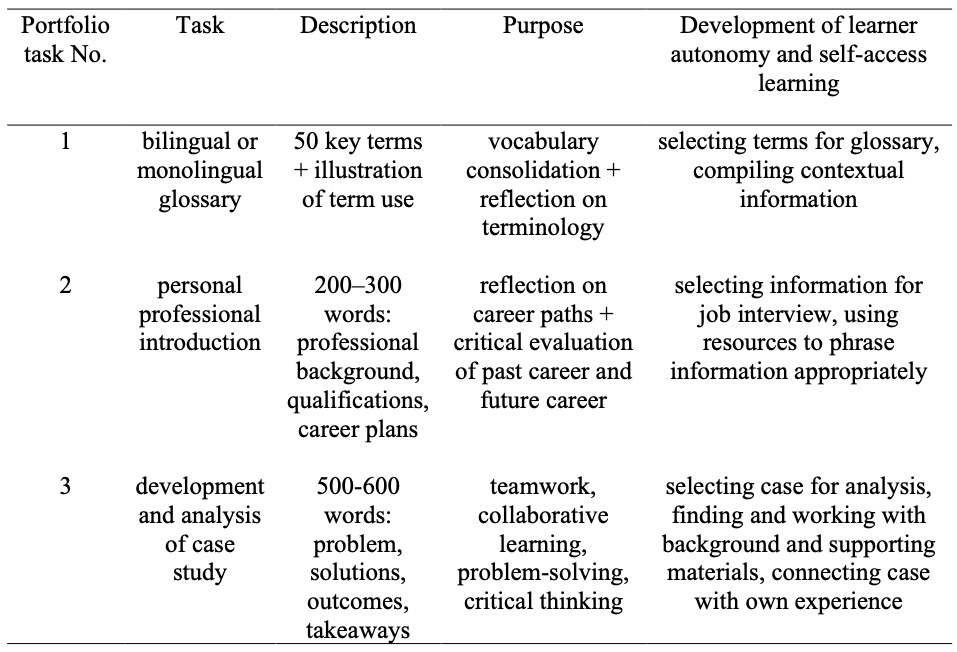
All of the above tasks develop learner autonomy and self-access learning through facilitating students’ self-direction in terms of task definition, delineation, and completion as the individual portfolio tasks enable students to:
- select terms for the glossary and compile the contextual information;
- select information for a potential job interview and use resources to phrase such information in a linguistically and professionally sound manner;
- select a case for analysis, research and work with background and supporting materials, and connect the case with students’ own professional experience.
With a view to the gradual development of portfolios, students have the option to submit their portfolio earlier than the final deadline and request several rounds of feedback from their teachers and peers. This allows students to refine their work based on instructor and/or peer feedback, thereby further enhancing learner autonomy and self-access learning as well as improving the quality of final submissions.
Reflections on and Experiences with Applied Portfolio Method
As stated above, the teaching context where the above portfolio assignment was used is a Hungarian university offering business programmes, where students were required to complete three semesters of studies of foreign languages for specific purposes. Typically, the majority of the students are motivated to pursue studies of foreign languages for specific purposes, but very often they lack the adequate amount of time, the necessary autonomous learning skills, the ability to cater for their specific individual learning needs, and the reflectivity to do so efficiently. The portfolio method introduced in this paper mainly tries to support students in the above areas.
Time
As the majority of the students are working besides completing their studies, finding time outside the classroom to engage in real-time language studies in the company of other students might pose a challenge. Through the incorporation of portfolio tasks requiring students’ individual and joint work, time spent learning specific languages is enhanced in flexible ways suited to students’ academic and job-related engagements. This flexibility reflects findings in the literature that describe that flexible learning approaches can accommodate diverse learner schedules and promote autonomy (cf. Lockee & Clark-Stallkamp, 2022; Smith & Hill, 2019).
Autonomous Learning Skills
When introducing the portfolio method to students, the biggest challenge, on the instructor’s part, was to make students understand that they are more responsible for their own progress than in other traditional instructor-led arrangements (Adams et al. 2020; Han & Xu, 2019; Larsen-Freeman, 2017; Winstone et al. 2017; Yu & Liu 2021; Zhang & Hyland 2018, 2022). This included highlighting to students, especially the advantages of formative assessment as well as the necessity and responsibility that they are supposed to arrange for and manage the completion of their tasks through learner autonomy and self-access learning. When students were explained how the completion of these tasks may contribute to the development of their language and job-related skills, participants seemed convinced and were ready to accept the novel method (cf. Bánhegyi & Fajt, 2020; Bánhegyi et al., 2020). When already engaged with the tasks, students became accustomed to the freedom that they were given, and could also see, explore, and exploit language and soft skills development potentialities – both in and out of class – afforded by self-tailoring the tasks for themselves (cf. Bánhegyi et al., 2020; Blažević & Ruža Blažević, 2023; Borges, 2023; Girón-García, 2025; Lam, 2018).
Specific Individual Learning Needs
Another significant aspect of portfolio-based learning is its role in promoting professional preparedness tailored to individual learning needs. This is emphasised by our University’s practice-oriented approach in its training programmes. As Dalziel and Davies (2009) and Nunes (2004) highlight, portfolios have the potential to be fully learner-centred and may also serve as a bridge between academic learning and the application of professional knowledge in field-specific contexts by enabling students to engage with workplace-oriented tasks. The structured portfolio tasks introduced in this paper – including vocabulary development, professional self-introduction, and the case study analysis – encourage students to apply their linguistic skills in contexts directly relevant to their person-specific future careers. This aligns with the objectives of ESP education, which emphasise the importance of context-specific language acquisition (Dou, 2024).
Reflective Practices Fostering Autonomy and Self-access
One of the key contributions of this portfolio approach is its potential to develop reflective learning practices. Participating students described their brief but revelational development in becoming more aware and more in control of their own learning, and also highlighted the usefulness of reflections concerning the portfolio tasks (cf. Bánhegyi et al., 2020). This reflection, through the evaluation of progress and the pinpointing of areas for improvement, could enable students to alter their learning strategies and could ultimately enhance learner autonomy.
In addition, in ESP education, where students must acquire specialised language skills relevant to their professional fields, learner autonomy and self-access learning are more extensively emphasised (Borges, 2023; Girón-García, 2025). In our context, the portfolio method offers an effective means of bridging the gap between classroom instruction and real-world language use through individualised development opportunities. Through self-access learning strategies, students could actively engage with terminology, discourse structures, and communicative practices specific to their future careers. Also, such engagement typically extends beyond traditional course content, thereby enabling learners to explore authentic professional contexts in a manner that promotes deeper and tailor-made linguistic and conceptual understanding.
Institutional Challenges
Despite these advantages, portfolio-based learning requires careful implementation to ensure its effectiveness (Davis & Ponnamperuma, 2005; Kemp & Toperoff, 1998). Consequently, institutional support plays a crucial role in successful adoption. Based on our experience with the portfolio projects at our University, ESP programmes that aim to incorporate this approach should 1) allocate sufficient time for portfolio activities within the curriculum, 2) acknowledge the extra time and effort educators invest in this approach, and 3) should likewise provide professional development opportunities for future educators. In the areas above, our University contributed to successful portfolio method projects in the following way: 1) designed course curricula in a way that core materials allow ample opportunities to introduce instructor-specific approaches including the use of ESP portfolios; 2) enabled staff to do research on the use of portfolios but unfortunately did not have the means to support participating instructors in terms of acknowledging related extra work load or otherwise; and 3) offered several in-house department-level training opportunities for non-participating staff members to get professional and practical information about the ESP portfolio methods used at the University. The integration of portfolio assessment into course design can further reinforce the value of self-directed learning and can ensure that students perceive self-directed learning as a meaningful component of their academic and professional development (Bánhegyi, 2019).
Effectiveness of the Applied Portfolio Method
In addition to the above advantages, empirical research in the Hungarian context supports the effectiveness of the above portfolio approach. Previous studies (Bánhegyi & Fajt, 2020; Bánhegyi et al., 2020) reported that participating students viewed the portfolio method positively, recognizing its benefits for independent learning and ESP development. In addition, a quasi-experimental study (Bánhegyi & Fajt, 2023) also found that the method significantly improved students’ ESP writing skills, confirming the value of the above portfolio method as a tool for language learning.
Conclusion
The portfolio method introduced in this paper provides a structured yet flexible framework that encourages learner autonomy, reflective learning, personalised goal-setting, self-access learning, and the application of both language and soft skills in authentic professional contexts. The three portfolio tasks we presented exemplify how targeted portfolio activities can bridge the gap between classroom instruction and real-world language use. Through these tasks, students not only develop their ESP proficiency but also strengthen critical thinking, self-assessment, and problem-solving skills—essential competencies for lifelong learning and career success. Based on our experience, the integration of portfolio methods into teacher training programmes—as applicable practice and methodology—can be advocated for a number of reasons. Portfolios create a flexible framework to support students’ autonomous learning by providing opportunities for learners to practise self-direction through task definition, delineation, and completion. The integration of the portfolio method into ESP instruction not only enhances students’ autonomy and self-access learning but also contributes to their professional preparedness. Given the increasing demand for self-directed learning in today’s globalised and digitalised world, it is essential that ESP education moves beyond traditional syllabus-driven approaches and incorporates methodologies that actively support students in assuming responsibility for their own specific learning needs.
In addition, the integration of portfolio-based learning into ESP teacher education has broader implications for pedagogical practices. When future ESP teachers experience learner autonomy and self-access learning first-hand through portfolio assignments, they are more likely to incorporate such approaches into their own classroom practices, as happened in the case of practising teachers and the teaching of science during an in-service programme (Smith, 2017). Such experiences are likely to contribute to a shift towards student-centred teaching methodologies, this way reinforcing the role of educators as facilitators of autonomous learning.
While the portfolio approach presented here offers promising pedagogical insights, certain limitations should be acknowledged. This paper draws primarily on the authors’ professional experience and reflections, supported mainly by informal student and colleague feedback, rather than systematically collected empirical data specific to this applied portfolio method. As such, the findings may not be generalisable beyond the specific context of a Hungarian business university. The absence of longitudinal or comparative data also limits the ability to assess the sustained impact of the approach on learner autonomy, self-access learning and professional language skills.
Future research should, therefore, include and extend to more systematically designed empirical studies in varied ESP contexts to measure learning outcomes, compare portfolio-based and traditional approaches, and explore the long-term effects on both learners and teachers. Investigating how institutional factors influence the adoption and sustainability of portfolio-based learning would also help refine the implementation of portfolios across diverse educational settings.
Notes on the Contributors
Mátyás Bánhegyi (PhD) is a full-time associate professor at Budapest University of Economics and Business. He currently offers ESP and skills development classes. His research areas include various issues in language pedagogy, methodology of ESP, translation studies, and cultural studies.
Balázs Fajt (PhD) is a senior lecturer at Budapest University of Economics and Business. His research focuses on individual learner differences, particularly L2 learning motivation and anxiety in language learning, with additional interests in learner autonomy, and extramural English in secondary and higher education, as well as teacher training contexts.
References
Adams, A. M., Wilson, H., Money, J., Palmer-Conn, S., & Fearn, J. (2020). Student engagement with feedback and attainment: The role of academic self-efficacy. Assessment & Evaluation in Higher Education, 45(2), 317–329. https://doi.org/10.1080/02602938.2019.1640184
Bánhegyi, M. (2019). Alternatív értékelés a felsőoktatásban és a szaknyelvoktatásban: a portfóiómódszer [Alternative assessment in higher education and in teaching languages for specific purposes: A portfolio method]. Porta Lingua, 2019(1), 255–274.
Bánhegyi, M., & Fajt, B. (2020). Portfólió a gazdasági szaknyelvoktatásban: Hallgatói attitűdök [University students’ perception of the portfolio method in ESP instruction: An attitudinal study at Budapest Business School]. Modern Nyelvoktatás, 26(3), 38–50.
Bánhegyi, M., & Fajt, B. (2023). Improving university students’ ESP writing skills through a process-based portfolio approach. Acta Universitatis Sapientiae, Philologica, 15(2), 56–74. https://doi.org/10.2478/ausp-2023-0016
Bánhegyi, M., Fajt, B., & Dósa, I. (2020). Szaknyelvi portfólió újratöltve: Egy hallgatói attitűdfelmérés tapasztalatai [Portfolio reloaded: Results of a student attitude survey]. In Zs. Bocz, & R. Besznyák (Eds.), Porta Lingua 2020. Szaknyelvoktatás és -kutatás nemzetközi kontextusban: Cikkek, tanulmányok a hazai szaknyelvoktatásról (pp. 215–230). SZOKOE. https://doi.org/10.48040/PL.2020.18
Barhoumi, E. M. (2023). The effects of controlled self-learning on the improvement of soft and cognitive skills of engineering students: A focused analysis. Learning and Motivation, 83, 101915. https://doi.org/10.1016/j.lmot.2023.101915
Basri, F. (2020). Factors influencing learner autonomy and autonomy support in a faculty of education. Teaching in Higher Education, 28(2), 270–285. https://doi.org/10.1080/13562517.2020.1798921
Benson, P. (2011). Teaching and researching: Autonomy in language learning (2nd ed). Routledge.
Blažević, A. P., & Ruža Blažević, M. (2023). A focus on objectives, outcomes, and learner needs in ESP courses. Strani jezici, 52, 101–125.
Blidi, S. (2017). Collaborative learner autonomy. Springer Nature. https://doi.org/10.1007/978-981-10-2048-3
Borges, L. (2023). The “Complex dynamic model of autonomy development” in action: A longitudinal multiple case study on language learners’ trajectories. Studies in Self-Access Learning Journal, 15(1), 5–28. https://doi.org/10.37237/150104
Carver, D. (1983). Some propositions about ESP. English for Specific Purposes World Journal, 2(2), 131–137. https://doi.org/10.1016/0272-2380(93)90003-p
Dalziel, F., & Davies, G. (2009). The ELP as a resource for university language learning and teaching. In G. Mansfield & C. Taylor (Eds.), L’AICLU e la politica linguistica nelle università italiane (pp. 169–181). Supergrafica.
Davis, M. H., & Ponnamperuma, G. G. (2005). Portfolio assessment. Journal of Veterinary Medical Education, 32(3), 279–284. https://doi.org/10.3138/jvme.32.3.279
Dou, A. (2024). Language needs and learning strategies of ESP learners. Frontiers in Educational Research, 7(5), 243–247. https://doi.org/10.25236/FER.2024.070537
Dou, A. Q., Chan, S. H., & Win, M. T. (2023). Changing visions in ESP development and teaching: Past, present, and future vistas. Frontiers in Psychology, 14, 1140659. https://doi.org/10.3389/fpsyg.2023.1140659
Ekbatani, G. (2000). Moving toward learner-directed assessment. In G. Ekbatani & H. Pierson (Eds.), Learner-directed assessment in ESL (pp. 1–11). Erlbaum.
Fabela-Cárdenas, M. A. (2012). The impact of teacher training for autonomous learning. Studies in Self-Access Learning Journal, 3(3), 215–236. https://doi.org/10.37237/030302
Feder, L., & Cramer, C. (2023). Research on portfolios in teacher education: A systematic review. European Journal of Teacher Education, 1–18. https://doi.org/10.1080/02619768.2023.2212870
Fernsten, L., & Fernsten, J. (2005). Portfolio assessment and reflection: Enhancing learning through effective practice. Reflective Practice, 6(2), 303–309. https://doi.org/10.1080/14623940500106542
Forster Vosicki, B. (2012). Overcoming the challenges of implementing the European Language Portfolio (ELP) in higher education: The experience of the University of Lausanne Language Centre. In B. Kühn & M. L. P. Cavana (Eds.), Perspectives from the European Language Portfolio: Learner autonomy and self-assessment (pp. 100-121). Routledge.
Gardner, D. (2007). Integrating self-access learning into an ESP course. In D. Gardner (Ed.), Learner autonomy 10: Integration and support (pp. 8–32). Authentik.
Girón-García, C. (2025). The potential of ‘Lesson’ to facilitate autonomous language learning with the use of online dictionaries in a higher education ESP classroom. Alicante Journal of English Studies / Revista Alicantina de Estudios Ingleses, 42, 25–51. https://doi.org/10.14198/raei.25252
Han, Y., & Xu, Y. (2019). Student feedback literacy and engagement with feedback: A case study of Chinese undergraduate students. Teaching in Higher Education, 26(2), 181–196. https://doi.org/10.1080/13562517.2019.1648410
Hirvela, A., & Pierson, H. (2000). Portfolios: Vehicles for authentic self-assessment. In G. Ekbatani & H. Pierson (Eds.), Learner-directed assessment in ESL (pp. 105–126). Lawrence Erlbaum Associates.
Holec, H. (1981). Autonomy and foreign language learning. Pergamon Press.
Jabr, R. K. (2011). Introducing the skills of self-assessment and peer feedback. Studies in Self-Access Learning Journal, 2(1), 26–31. https://doi.org/10.37237/020104
Jiménez Raya, M., Lamb, T., & Vieira, F. (2007). Pedagogy for autonomy in language education in Europe: Towards a framework for learner and teacher development. Authentik.
Kemp, J., & Toperoff, D. (1998). Guidelines for portfolio assessment in teaching English. Ministry of Education.
Knight, K. (2010). English for specific purposes (ESP) modules in the self-access learning center (SALC) for success in the global workplace. Studies in Self-Access Learning Journal, 1(2), 119–128. https://doi.org/10.37237/010206
Lafford, B. A. (2012). Languages for specific purposes in the United States: Commentary on Grosse and Voght (1991) revisited. The Modern Language Journal, 96, 1–27. https://doi.org/10.1111/j.1540-4781.2012.01294.x
Lam, R. (2018). Teacher learning of portfolio assessment practices: Testimonies of two writing teachers. In H. Jiang & M. F. Hill (Eds.), Teacher learning from classroom assessment: Perspectives from Asia Pacific (pp. 99–118). Springer. https://doi.org/10.1007/978-981-10-9053-0_6
Larsen-Freeman, D. (2017). Complexity theory: The lessons continue. In L. Ortega & Z. H. Han (Eds.), Complexity theory and language development: In celebration of Diane Larsen-Freeman (pp. 11–50). John Benjamins Publishing.
Little, D. (1991). Learner autonomy 1: Definitions, issues, problems. Authentik.
Little, D. (1995). Learning as dialogue: The dependence of learner autonomy on teacher autonomy. System, 23(2), 175–181. https://doi.org/10.1016/0346-251X(95)00006-6
Little, D. (2009). Language learner autonomy and the European Language Portfolio: Two L2 English examples. Language Teaching, 42(2), 222–233. https://doi.org/10.1017/S0261444808005636
Little, D. (2020): The future of language learner autonomy: Theory, practice, research. In: K. Sedláčková, B. Chovancová, & Š. Bilová (Eds.): The teacher’s role in development of learner autonomy (pp. 12–28). Candlin & Mynard.
Lo, Y. (2010). Implementing reflective portfolios for promoting autonomous learning among EFL college students in Taiwan. Language Teaching Research, 14(1), 77–95. https://doi.org/10.1177/1362168809346509
Lockee, B. B., & Clark-Stallkamp, R. (2022). Pressure on the system: increasing flexible learning through distance education. Distance Education, 43(2), 342–348. https://doi.org/10.1080/01587919.2022.2064829
Magno e Silva, W. (2018). Autonomous learning support base: Enhancing autonomy in a TEFL undergraduate program. In G. Murray, & T. Lamb (Eds.), Space, place and autonomy in language learning (pp. 219–232). Routledge. https://doi.org/10.4324/9781317220909-14
Nhung, D. T. T. (2024). Teaching English for specific purposes (ESP) through task-based learning approach and observing interactions between students. IOSR Journal of Humanities and Social Science, 29(4, Series 2), 12–19.
Nunes, A. (2004). Portfolios in the EFL classroom: Disclosing an informed practice. ELT Journal, 58(4), 327–335. https://doi.org/10.1093/elt/58.4.327
Oates, S. (2019). The importance of autonomous, self-regulated learning in primary initial teacher training. Frontiers in Education, 4, Article 102. https://doi.org/10.3389/feduc.2019.00102
Pierce, J., & Durán, P. (2014). Developing and evaluating self-assessment reading competence descriptors for the European Language Portfolio. Porta Linguarum, 22, 127–143. https://doi.org/10.30827/Digibug.53715
Polyakova, O. (2023). E-portfolio in students’ learning for sustainable development. Information Technologies and Learning Tools, 96(4), 1–14. https://journal.iitta.gov.ua/index.php/itlt/article/view/5238
Rear D. (2005). Individualisation of instruction in the EAP / ESP classroom? The Journal of Kanda University of International Studies, 17, 243–257.
Reeve, J., Jang, H., Carrell, D., Jeon, S., & Barch, J. (2004). Enhancing students’ engagement by increasing teachers’ autonomy support. Motivation and Emotion, 28(2), 147–169. https://doi.org/10.1023/B:MOEM.0000032312.95499.6f
Ryan, R. M., & Deci, E. L. (2000). Intrinsic and extrinsic motivations: Classic definitions and new directions. Contemporary Educational Psychology, 25(1), 54–67. https://doi.org/10.1006/ceps.1999.1020
Ryan, R. M., & Deci, E. L. (2020). Intrinsic and extrinsic motivation from a self-determination theory perspective: Definitions, theory, practices, and future directions. Contemporary Educational Psychology, 61, 1–11. https://doi.org/10.1016/j.cedpsych.2020.101860
Sanz, A. M. G. (2014). Fostering learner autonomy in technology-enhanced ESP courses. In E. Bárcena, T. Read, & J. Arús (Eds.), Languages for specific purposes in the digital era (Vol. 19, pp. 19–43). Springer. https://doi.org/10.1007/978-3-319-02222-2_2
Shibata, S. (2016). Extensive reading as the first step to using the SALC: The acclimation period for developing a community of language learners. Studies in Self-Access Learning Journal, 7(3), 312–321. https://doi.org/10.37237/070307
Smith, K. V. (2017). Teachers as self-directed learners: Active positioning through professional learning. (Self-Study of Teaching and Teacher Education Practices; Vol. 18). Springer. https://doi.org/10.1007/978-981-10-3587-6
Smith, K., & Hill, J. (2019). Defining the nature of blended learning through its depiction in current research. Higher Education Research & Development, 38(2), 383–397. https://doi.org/10.1080/07294360.2018.1517732
Winstone, N. E., Nash, R. A., Parker, M., & Rowntree, J. (2017). Supporting learners’ agentic engagement with feedback: A systematic review and a taxonomy of recipience processes. Educational Psychologist, 52(1), 17–37. https://doi.org/10.1080/00461520.2016.1207538
Wu, Y., & Fernando, Y. (2023). Development of Student’s Innovation Skills through Extracurricular Activities. Journal of E-Business and Management Science, 1(2), 170–180. https://doi.org/10.61098/jems.v1i2.106
Yang, N. (2003). Integrating portfolios into learning strategy-based instruction for EFL college students. International Review of Applied Linguistics in Language Teaching, 41(4), 293–317. https://doi.org/10.1515/iral.2003.014
Yang, Y. F. (2015). Self-directed learning to develop autonomy in an online ESP community. Interactive Learning Environments, 24(7), 1629–1646. https://doi.org/10.1080/10494820.2015.1041402
Yu, S., & Liu, C. (2021). Improving student feedback literacy in academic writing: An evidence-based framework. Assessing Writing, 48, 100525. https://doi.org/10.1016/j.asw.2021.100525
Zhang, Z., & Hyland, K. (2018). Student engagement with teacher and automated feedback on L2 writing. Assessing Writing, 36, 90–102. https://doi.org/10.1016/j.asw.2018.02.004
Zhang, Z., & Hyland, K. (2022). Fostering student engagement with feedback: An integrated approach. Assessing Writing, 51, 100586. https://doi.org/10.1016/j.asw.2021.100586
Wang, L., & He, C. (2020). Review of research on portfolios in ESL/EFL context. English Language Teaching, 13(12), 76–82. https://doi.org/10.5539/elt.v13n12p76
Yin, M. (2013). Portfolio assessment in the classroom. In A. J. Kunnan (Ed.), The companion to language assessment (Vol. 2, Part 6, pp. 659–676). John Wiley & Sons.
Appendix
The Portfolio
Dear Student,
You are invited to compile a portfolio to complete this English for Specific Purposes course. Portfolios are often used in the world of work: portfolios are used for collecting one’s most outstanding works and creations and are submitted when applying for a job, etc. As well as giving a comprehensive picture of the skills of the person who produces it, the portfolio also develops and demonstrates a range of skills. As we all know, in today’s job market, it is not only content knowledge that matters, but also the ability to work collaboratively with peers, independent job execution, responsibility, creativity, flexible and critical thinking, cooperation and, above all, complex problem-solving. This portfolio, therefore, develops all the skills needed in the 21st century labour market. We are therefore encouraging you to produce a high-quality portfolio by the end of this course so that it can be presented with confidence at a job interview, for example.
For the above reasons, you will be asked to prepare a language portfolio as a requirement for course completion. The aim of the portfolio is to complete tasks in the scope of which the student:
- develops a linguistic product, either independently or with peers, which can be presented at a job interview;
- develops their language and communication skills and cooperation skills;
- develops their creativity, critical thinking, analytical skills and autonomous learning;
- engages in tasks that facilitate the synthesis and repetition of what has been learned at previous language course(s).
The portfolio, detailed below, is linked to the material covered at ESP courses and helps students to deepen their knowledge of field-specific language use through improving their language skills. The portfolio also provides a (selective) overview of the knowledge acquired at the ESP courses.
Portfolio submission: the portfolio must be submitted in person to the instructor or sent by e-mail by the deadline the latest.
At the end of the course, it is recommended to keep the corrected and improved portfolio versions in a complete final portfolio: this version can be presented at job interviews and can be used for other job-related purposes in the future.
The structure and content of the portfolio is as follows:
- front page with the portfolio’s and the student’s details (name of the language course for which the portfolio is submitted, semester of submission, name, degree programme, contact details (e-mail), name of the instructor; either in English or Hungarian)
- table of contents (indicating the work submitted; either in English or Hungarian)
- portfolio tasks in English or in Hungarian as detailed in the requirements
- the portfolio should precisely indicate which assignments were completed by the student on his/her own, or in groups (in this case, the names of the students’ partners should be indicated)
TASKS
Type I (compulsory, maximum 20 points)
Personal professional introduction: 200-300 words in running text (not in an autobiographical format) about professional topics introducing the student’s career, structured by topic (minimum: education, employment, (work) experience, strengths and weaknesses, interests, future career plans, etc.). Please, include the exact word count at the end of the text.
Type II (compulsory, maximum 20 points)
Letter detailing the solution of a case study: in 500-600 words, in your capacity as an employee of the organisation concerned or as an external expert, write a letter to the decision-makers of the organisation involved in the case study. The letter should contain the solution proposed by your group to the problem raised in the case study. The letter should consist of: 1. an introduction describing the problem; 2. a brief outline of possible solutions to the problem; 3. a more detailed description and justification of the solution selected to solve the problem; 4. a summary and conclusion. Remember to observe style-related requirements of formal letters! Once the content parts have been finalised by your group, the full letter should be written by each team member. The four letters will then be combed, revised, developed and finalised by the team members in such a way that the one single final letter will ultimately contain the version of the text that the team considers best. The first text-production round is to be done alone, then in a group of four (cooperating students will receive the same score for this work). The finalised text will be submitted to the instructor for review. Please, indicate in the assignment with whom you worked on the assignment, and please include the exact word count of the text at the end of the assignment.
Type III (compulsory, maximum 20 points)
Collection of terms: up to 50 NEW technical terms previously unknown to the student and relevant to the studies, related to up to 2 professional topics. The terms should come from two sources: 40 words from the textbook or course material and the remaining 10 words should reflect the result of independent research. The latter 10 words should be related to one subject area only. For each of the 50 words, please include an English definition and context alongside the English meaning; the words should be arranged by topic (e.g. balance sheet, etc.). This task requires independent work, you may use the Internet and other sources for this assignment without restriction, but please indicate these sources appropriately (use APA style).
Type IV (compulsory, not assessed)
Reflection and self-reflection: concerning the group assignment, please describe the following: contribution of each team member to joint work, how the work was organised, distributed and coordinated. Finally, we also ask you to describe what you have learnt from this joint task about yourself, others, the situation in general and about cooperation with others in teamwork. This part will not be assessed, it is your self-reflection that is important as this will make you more aware of the work you have done in the team. Individual work.
In general, the portfolio should contain numbered pages and reflect academic quality both in appearance and layout. Grading of the portfolio:
- Above 91%: excellent (5)
- Between 81-90%: good (4)
- Between 71-80%: average (3)
- Between 61-70%: fair (2)
- Below 60%: unsatisfactory (1)
Submissions received after the deadline will be downgraded: the maximum number of points that can be awarded for non-compliance with the deadlines is 50% of the relevant score.
Please, do not plagiarise from the Internet or other sources (do not use passages written by others, in whole or in part, without giving the exact bibliographic reference of the relevant source), as portfolios containing such passages will be rejected.
 SiSAL Journal