
Jing Yun, International Education and Lifelong Learning Institute, University of St Andrews, Scotland. https://orcid.org/0000-0002-4573-8522
Sin Wang Chong, International Education and Lifelong Learning Institute, University of St Andrews, Scotland. https://orcid.org/0000-0002-4519-0544
Yun, J., & Chong, S. W. (2025). An advising approach to language teaching for improving learner autonomy. Studies in Self-Access Learning Journal, 16(1), 213–236. https://doi.org/10.37237/160111
Abstract
Learner autonomy is an ability that is highly correlated with learning motivation, language proficiency and performance. The roles played by language teachers in cultivating learner autonomy are under-explored in academic literature. Drawing on the Language Advising framework (Mynard & Carson, 2012), we conducted semi-structured interviews with nine student teachers based in six countries on their language teaching experiences. Specifically, we investigated their perceptions on implementing language advising to develop autonomy of their learners in a classroom setting. Inductive coding unveiled that learner autonomy has been well understood as a context-specific concept, which should be viewed in consideration with language teachers’ personal circumstances, working environments, and culture backgrounds that they are associated with. Despite the consensus on developing language learner autonomy, language advising is not a widely recognised pedagogical approach among participants; they have expressed a sense of curiosity for knowing more about the skills and possibilities of acquiring them in their specific teaching context, in order to promote learner autonomy. Findings suggest that language teachers could benefit from learning advising skill training that is tailored to their teaching contexts. We call for future studies to examine the implementation of advising skills in language classrooms.
Keywords: language advising, learner autonomy, motivation, learner wellbeing, TESOL
As Kelly (1996) observed, language advising is a form of therapeutic dialogue, empowering individuals to respond to challenges in their learning process. It is a pedagogical interaction (Mozzon-McPherson & Tassinari, 2020) supporting the development of learner autonomy, an ability to take charge of one’s own learning (Holec, 1981), in a social learning environment. Autonomous learners are the ones who accept responsibilities in the learning process (Little, 1995). The development of learner autonomy depends on the development of teacher autonomy (Little, 1995), which requires teachers to develop their professional skills, knowledge, and attitudes, often in collaboration with others (Smith & Erdogan, 2008). Internationally recognised language teacher development frameworks have assigned teachers with important tasks including promoting autonomous learning, understanding learners’ levels of learner autonomy, developing learners’ self-assessment skills, conducting technology mediated teaching and learning (The British Council’s Continuing Professional Development Framework, 2015), identifying individual learner’s needs and differences (Cambridge Assessment English Teaching Framework Components, 2019), implying a resonance with the main purpose of language advising. Clearly, teachers play a crucial role in supporting the development of language learner autonomy. However, very few studies have explored the two distinct roles, language advising and teaching in tandem, in cultivating learner autonomy (Esen, 2020). This study explores language teachers’ perspectives about using advising skills in language classrooms to foster learner autonomy. In what follows, the rationales for incorporating advising skills into teaching are explained, followed by a literature review of learner autonomy, language advising, and advisors’ skills. Findings are presented based on an analysis of semi-structured interviews conducted with nine language practitioners from different teaching contexts.
Literature Review
Understanding Learner Autonomy
The notion of learner autonomy has experienced a profound transformation since Holec’s (1981, p.1) seminal definition: “the ability to take charge of one’s own learning”. Later, Benard (1995, p. 1) elaborated that learner autonomy is “an ability to act independently and to exert some control over one’s environment, including task mastery and self-efficacy”. The fundamental determinants of learner autonomy are intrinsic motivation, metacognitive skills, and the learning environment (Abdolrezapour & Fallah, 2015, Kato & Mynard, 2016). In other words, autonomous learning is dependent upon learners’ motivation (Ushioda, 2011); their own learning goals, learning strategies, and learning evaluation (Dickinson, 1993); and an autonomy-supportive learning environment (Mercer, 2019). Building on these characteristics, studies proceed to frame learner autonomy based on several psychological constructs including motivation, self-efficacy, metacognition, learner beliefs, anxiety, and awareness (Chong & Reinders, 2022). A scoping review by Chong and Reinders (2022) reported that there is a positive relationship between the degree of learner autonomy and language proficiency. Similarly, several primary studies concluded that learners’ language proficiency and performance, such as reading skills (Abbasian & Hartoonian, 2014), speaking proficiency, reduced speaking anxiety, and academic learning efficacy (EI-Sakka, 2016), developed because of their becoming more autonomous. Despite the various foci, the above studies consistently argue that teachers play a primary role in fostering learner autonomy.
In this study, we suggest that the role of language teachers needs repositioning, their skills need to be upgraded to support the development of learner autonomy. Teachers need to shift their roles from being a purveyor of knowledge to a facilitator of language learning (Little, 1995, Voller, 1997). In addition to disseminating linguistic knowledge, what is more important is the teachers’ ability, capacity, and disposition to encourage students to take responsibility for their own learning. This rapport between teachers and learners highly influences learners’ capability to be autonomous (Ganza, 2008). The interrelatedness between learner autonomy and teacher autonomy reflects on a joint ability learners and teachers need to obtain to take control of their language learning and teaching process (Ganza, 2008).
However, learner autonomy is often construed as ‘self-regulated learning,’ ‘independent learning,’ and ‘self-control,’ which could lead to a misinterpretation about autonomous learning being isolated from the social elements of learning (Little, 2007). There is a need for teachers to develop a relational and social view on autonomous learning. For instance, teachers can guide students to know where and who to contact for learning resources at different phases of the learning process.
What is Language Advising and How is it Operationalized?
Language advising is a process-oriented approach that assists learners to take charge of their own learning and eventually become autonomous learners (Mynard & Carson, 2012). Underpinned by a social constructivist perspective, language advising can be perceived as pedagogical interactions, aiming to raise individual learners’ awareness of learning and support learners to take actions. It will result in helping them make a fundamental change in their existing learning trajectory reflectively and holistically (Kato & Mynard, 2016; Mozzon-McPherson & Tassinari, 2020). Ways that language advising are implemented are context-dependent and can vary to adapt to different learning objectives in diverse educational settings.
Being learner-focused and non-judgmental are the gist of a well-executed language advising session, which requires a good combination of dialogues, tools, and context (Kato & Mynard, 2016). Reflective dialogue during language advising sessions is crucial (Kelly, 1996). Learners are more relaxed to talk through their language learning problems following questioning, restating, guiding, supporting, reflecting from advisors who listen to them (Kelly, 1996). There are various tools that advisors can draw on to initiate reflective dialogues, such as the goal setting pyramid, confidence-building diary, the wheel of language learning, and motivation graph (Kato & Mynard, 2016; Mynard & Carson, 2012).
One-on-one advising and group advising are the most typical and effective approaches (Kato & Mynard, 2016; Mynard & Carson, 2012). One-on-one advising mostly takes place face-to-face between advisors and learners in a learning space, such as a self-access space or booked rooms at learning institutions. This type of setting provides flexibility for advisors to fully apply their skills to establish rapport with learners (Ciekanski, 2007, Güler, 2021). Group advising supports multiple students with the chance to achieve independent learning on a larger scale (Kato & Mynard, 2016). By mixing learners with different proficiency levels, group advising forms a collaborative learning environment where learners can exchange common learning difficulties and work together on solutions. However, problems can inevitably occur when learners feel reluctant to open up and discuss personal learning issues with peers. Unlike one-on-one advising, group advising limits the opportunities for supporting individual learners (Horai & Wright, 2016). Supplementary to these two types of dialogical advising, written advising is also documented in the literature, which refers to written exchanges between advisors and learners on a regular basis, aiming to generate more in-depth reflections on the language learning journey in a chronological way (Mynard & Thornton, 2012).
What are Language Advising Skills?
Many scholars have outlined, defined, and exemplified language advising skills (Table 1). Kelly (1996) outlined the macro and micro skills that language advisors are supposed to attain. These skills are crucial to minimizing teacher-student power distance and help learners develop their emotional regulation skills and wellbeing in the advising process (Esen, 2020, Gurney & Grossi, 2023). Kato and Mynard (2016) discussed basic strategies vis-à-vis communicative interactions during advising. Skilled advisors would listen to learners while showing empathy to develop a trusting relationship. Advising is not just a matter of mastering these strategies, but it is a much more complex educational activity (Reinders, 2008). Mozzon-McPherson and Tassinari (2020, p. 125) assembled a more comprehensive view of language advisors’ core competences combined with the repertoire of advising skills. Firstly, advisors need to build a sustainable rapport with learners and employ intercultural competence to work with learners from diverse cultural backgrounds. Likewise, advisors need to possess the knowledge of the target language, be able to recommend learning resources and technology to cement advisees’ learning.
Table 1
A Summary of Language Advising Skills

Effective communications come from intentional dialogues during language advising. As dialogic interventions, language advising sessions should generate self-determination, self-direction, and reflection in the learning process (Mynard & Carson, 2012). Since language advisors and teachers take on an overlapping pedagogical position as facilitators of language learning (Ciekanski, 2007), our focus is to investigate teachers’ perspectives about applying advising skills in their classes to enhance learner autonomy.
Methodology
This study is a small-scale qualitative study that involves conducting individual semi-structured interviews with nine teaching practitioners. It aims to explore language teachers’ perceptions about autonomous learning, and how their teaching practice can benefit from knowing about language advising skills. To do so, we attempt to answer the following research questions on language teachers’ perceptions regarding:
- What is learner autonomy?
- What is the pedagogical relatedness between language teaching and advising?
- How can language advising help teachers develop autonomous learners and cope with classroom incidents?
Data Collection
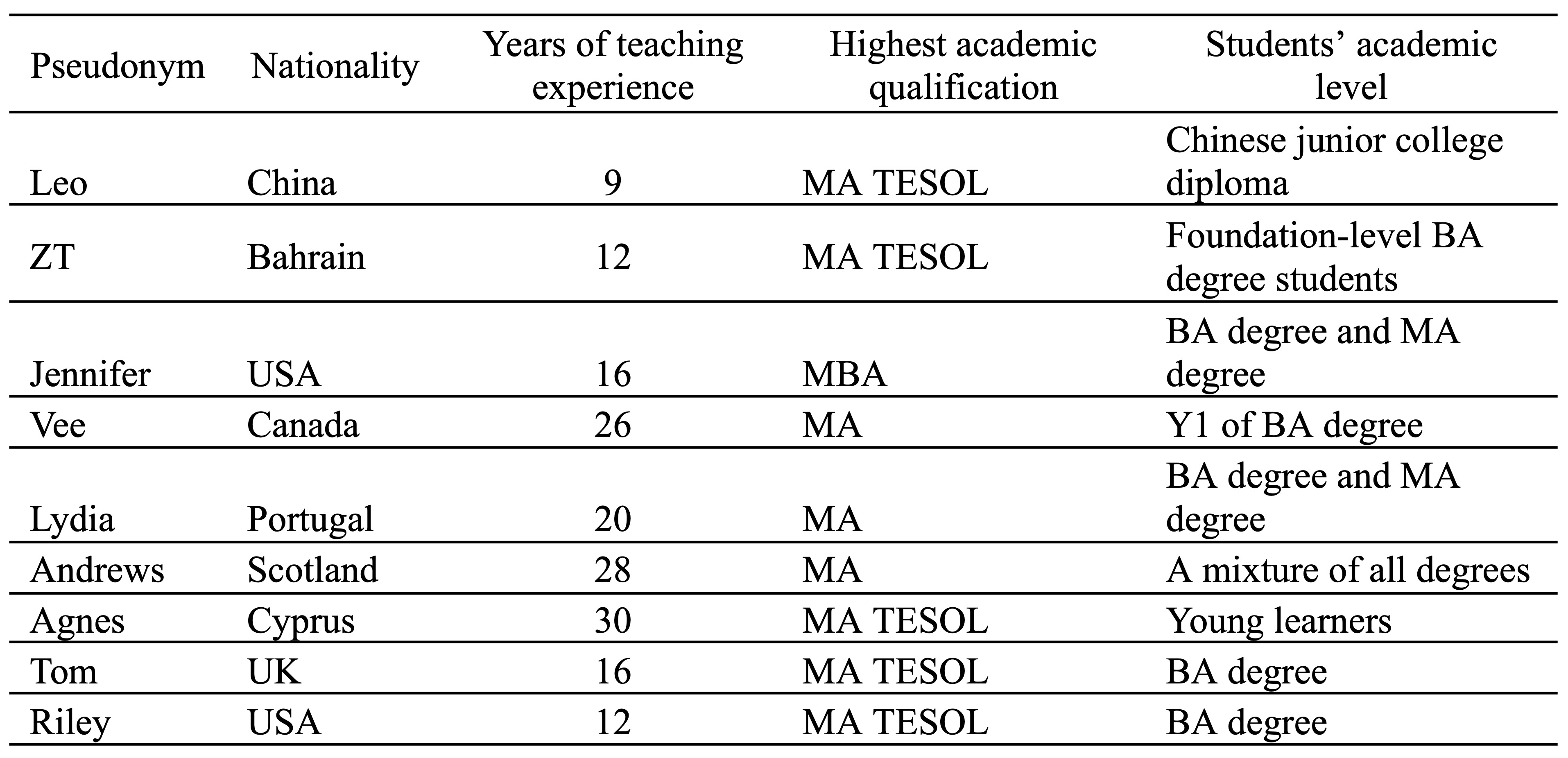
Interview participants were nine student teachers from Europe, North America, Asia, Middle East, and the United Kingdom, teaching respectively in Austria, Cyprus, China, Japan, Bahrain, and the United Kingdom. They are mostly experienced practitioners with an average of 18.8 years of experience teaching in private sectors and state institutions, and represent learners at different stages, ranging from young learners to university students (Table 2). At the time of this study, they were classmates of the first researcher, completing a Professional Doctorate in TESOL (DProf TESOL), a distance-learning program, on a part-time basis. Participants were recruited on a voluntary basis following a convenience sampling technique. The first author posted a call for the study on Microsoft Teams to recruit potential participants whose research interests include learner autonomy, language advising, and teacher development. The first author approached those who have expressed an interest individually through the DProf TESOL Microsoft Teams, introduced the background and purpose of this study. Upon receiving their signed consent forms, the first author shared the interview questions (Appendix 1) with them and scheduled an online interview with each of them. Ethical approval was acquired from University of St Andrews’ School Ethics Committee.
Table 2
Participant Demographics
The data were collected from January to March 2024, via one-on-one semi-structured interviews online using Teams. Each interview lasted for approximately 30 minutes, was video recorded, and automatically transcribed on Teams. The first author listened to the recordings and checked the transcription to ensure its accuracy before organizing and analyzing the pseudonymized data. It was an open, semi-structured, and non-judgmental interview process, allowing participants to express their perceptions about the research topic in detail. During interviews, participants talked freely without being interrupted; only occasionally did the first author ask follow-up questions to stimulate more in-depth responses. Whilst this qualitative study only interviewed participants once, it is hoped that in-depth descriptions of the findings can be produced given their diverse backgrounds and rich teaching experiences.
Data Analysis
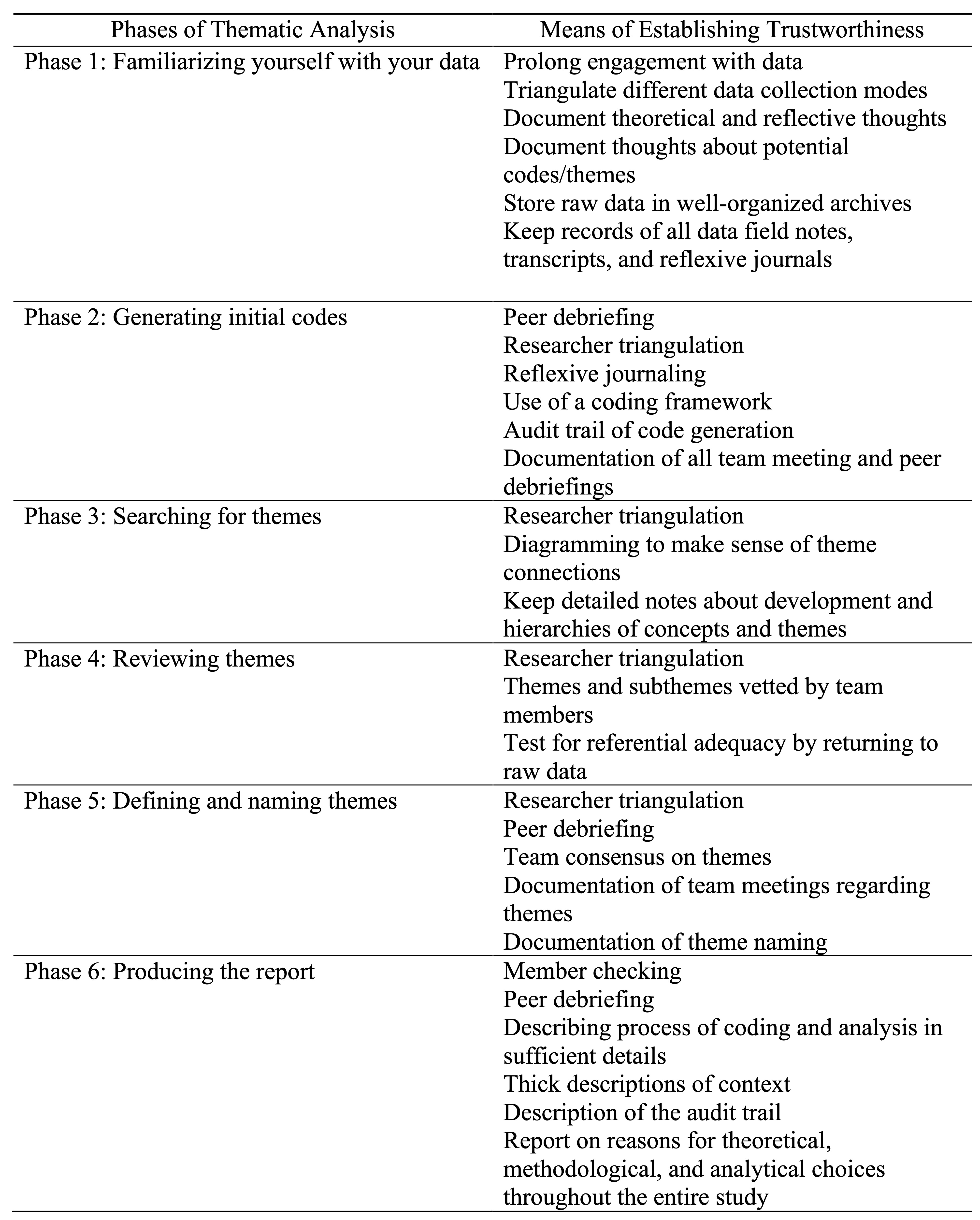
The transcripts were uploaded to the university OneDrive folder with a link created to be shared with the co-author for data accessibility. The transcripts were sent to participants for member checking before coding started. Two participants expressed their concern as to the fact that some words were not correctly transcribed by Teams and minor changes were made accordingly. With the data securely stored, the first author conducted a thematic analysis of the interview data following the framework outlined by Nowell et al. (2017) (Appendix 2). The phases of thematic analysis comprised a thorough reading of the data and interpretation of the data in relation to the research questions, which was followed by the generation of codes in order to identify meaningful units. Themes and subthemes were then developed inductively, with each being carefully named and defined to capture their essence. Throughout the process, constant cross-checking was carried out to ensure consistency and coherence in the identified patterns before presenting findings using the analyzed dataset. To enhance the rigor of the analysis, the second author acted as a critical friend, providing constructive feedback, and a sounding board to discuss any challenges and provide guidance on coding related issues.
Findings and Discussion
The study findings demonstrated that participants agreed on the importance of engaging with a sociocultural stance while understanding learner autonomy. Teaching is a relational construct towards the broader institutional and cultural contexts, cultivating learner autonomy in different teaching contexts requires to consider teacher’s position in relation to the highly complex agentic teaching environment. Language advising is a recognized but not widely used approach among these interviewed practitioners, limited theoretical and practical knowledge about how language advising works to improve learner autonomy has caused concerns regarding its generality and transferability within teaching. Most of them expressed that they lack the capacity and autonomy to implement innovative teaching pedagogies in their classrooms.
Language Teachers’ Perceptions of Language Learner Autonomy
The existing literature has established the similarity between learner autonomy and “learner independence, self-direction, autonomous learning, and independent learning” (Palfreyman, 2003, p. 3). In response to this similarity, data gathered from interviews affirmed that language learner autonomy is the capability of taking control of one’s own learning through setting goals, making plans, solving problems, reviewing, and self-assessment. According to one of the participants, learners should be less dependent on teachers: “I think the term learner autonomy basically means how learners can learn outside the classroom without the teacher there to hold their hand or provide the actual input.” Jennifer emphasized the personal attribute of being decisive: “Take a little bit more ownership and make their own decisions.” Vee also mentioned the importance of being exploratory when seeking solutions to problems: “Sometimes it might be about finding the answers to questions by themselves.”
Although the conceptualization of language learner autonomy is broadly agreed (Chong & Reinders, 2022), there is no universal exemplification of autonomous learning because it is highly context specific, culturally, and economically dependent. For example, Tom clarified: “A Japanese learner expressing their autonomy might be perfectly well and able to do it inside that context; it might just look different from a learner in Chile, or you know, Egypt or England.” Vee shared a similar view: “British person, might be Australian or Japanese or Chinese or whoever, might say this is what autonomy is, and I do think it can be culture specific. It might not match with what a Canadian perceives as being an autonomous learner.”
While most of the literature emphasizes the self in learner autonomy, our participants have not only offered the affirmation that learner autonomy is about the learners planning, executing, and reflecting on their language learning but also reframed it from a sociocultural perspective. They emphasized the essential role of context in shaping and understanding learner autonomy.
Cultivating Language Learner Autonomy in Different Teaching Contexts
Being autonomous is not an innate ability. Some of the participants believe that certain skills need to be possessed in order to become autonomous learners. Critical thinking is one such skill, which resonates with Candy (1991), who claimed that being logical and analytical in thinking is one of the requisite characteristics for being an autonomous language learner. For example, Lydia commented on the importance of nurturing critical thinking for learner autonomy: “So being able to look at the work that has been assigned to them and sort of look at their own profile, what they know and they don’t know and being able to sort of self-direct to fill those gaps. I think and I suppose it has to do with sort of critical thinking as well.” Agnes, who runs a private language school, further stated the value of critical thinking from her professional experience: “My understanding of learner autonomy covers the skills and the attitudes at the same time, critical thinking skills. You know, being a bit more creative, utilizing the four skills, the 21st century communication, collaboration, critical thinking skills and creativity. If they want to find a job afterwards, this is what employers want. This is what the employers are required to do.”
Being an autonomous language learner tends to be independent from teachers, but independent is not to be misunderstood as isolation because language learning, and in fact any learning, never takes place in a social vacuum. Sociocultural theory postulates that learners’ beliefs and learning actions are socially constructed (Bibby et al., 2016; Murray, 2017). In other words, learner autonomy depends on interdependence instead of mere independence (Benson & Cooker, 2013). Community building could be an accelerating practice for facilitating autonomous learning, bringing language learners with common concerns or passion for learning to interact in collaborative activities (Wenger-Trayner & Wenger-Trayner, 2015, p. 1, Mynard et al., 2020). For example, Leo suggested the idea of community of practice: “So it’s very important to build a learning community, a small group, so that they learn together and work together, so the learning community might be helpful with their learner autonomy.”
With the booming resources for language learning and teaching, more flexible, hybrid, and distance learning choices and resources have become available. With diverse materials, resources, and learning modes available, language teachers take a plethora of approaches to developing autonomy of their learners, based on their needs and educational contexts. For example, Jennifer shared the principle of providing students with choices in classroom activities including “choice on the projects,” “choice in how they approach the assessment topic,” “choosing their partner,” and “choosing vocabulary that is interesting to them.” ZT described the importance of fostering learners’ ownership of learning and providing them with the opportunities to work with one another: “So I gave them the room to kind of control that, you know, who do they wanna work with? They can collaborate with each other and reach the desired results.” Andrews emphasized the importance of creating an engaging and motivating learning environment for language learners: “So I think providing a fun, enjoyable environment to generate motivation, so the students are more likely to pick up on some of the things which I might mention in class like some YouTube links or going to a website, doing a bit of extra stuff.” While most language teachers held the stance that teachers play a facilitative role in developing learner autonomy through activities that promote collaboration, self-regulation, and ownership, Lydia was of the opinion that learner autonomy should be taught explicitly: “because often we just practice learner autonomy, or we want students to be autonomous, but we don’t really explain what that means and what they have to do to be autonomous.”
Taking a closer look at the above, several participants shared a similar view that an autonomy-supportive learning environment (Mercer, 2019) needs to be created to cultivate language learner’s basic psychological needs of autonomy, competence, and relatedness to their surroundings (Shelton-Strong, 2020). This is primarily achieved through promoting learners’ motivation and encouraging choices towards novel learning paths (MacIntyre & Gregersen, 2012). What underpins these pedagogical endeavors is self-determination theory (Shelton-Strong, 2020), which describes how self-regulated learning process is cultivated through learners being more mindful about their thinking and affective states (MacIntyre & Gregersen, 2012).
Language Teachers’ Understanding of Language Advising
Language advising usually takes the form of one-on-one language support between advisers and advisees; the primary role of advisors is to cultivate learner autonomy (Mynard & Carson, 2012; Reinders, 2008). Learners are encouraged to direct their own learning journey during which their basic psychological needs of autonomy, competence, and relatedness are fulfilled, enabling them to thrive (Shelton-Strong, 2020). Advising in language education draws upon principles and strategies from overlapping professions, such as coaching, consulting, counselling, and tutoring, but with distinctive advantages worthwhile to learners’ ultimate learning, with a specific focus on catering for learners’ emotional needs (Mynard, 2011).
Five of the participants hold a similar role of language advisors in their teaching contexts as “academic advisors.” Part of their work is to provide academic writing support to enhance students’ academic writing skills through one-on-one tutorials that are appointment-based and optional to students during the whole semester. However, to the best knowledge of these participants, none of them would claim the intellectual capacity of knowing the conceptualization, features, and operationalization of advising in language education, neither were they clear about the skills required for being a language advisor.
Lydia expressed her confusion regarding the “language advising” label and its associated terminologies: “It’s hard to say because there is a lot of diversity in terms of these labels and what we call things.” She provided several synonymous terms that were used in her context: “We call them academic skills or study skills, or EAP or success.” She further explained and elaborated: “I wonder if language advising you were talking about is sort of lectures or doing things like tutorials and workshops where you see students on a one-to-one basis. In the case of tutorials and the students will come to you, for example, that I’ve got an assignment and I’m not quite sure how to start and the lecture will give them some advice that could be language advising, or if you’re talking, I know there’s also things like success coaches.” Andrews, who has more than 20 years of teaching experience, distinguished language advising from teaching: “I got the idea that it’s not really necessarily connected to improving someone’s language like grammar skills or vocabulary skills. It’s more about improving their general skills and learning the language. So finding ways for them to actually access the language, whatever language it is, and ways that work for them. They need to work out a strategy, I suppose, for learning.” ZT also lacks the experience of being a language advisor, but she heard of the concept from previous work experience: “At my institution, what I do is I help students achieve their learning goals or academic goals, and I feel like that’s if we talk about language advising, then I think the purpose of having a language advisor is similar to helping students achieve their language goals. If I understand that correctly, we don’t have that at my institution.”
As a different case, because language advising is widely practiced in Japan, Tom, who is teaching in Japan, has formed a rather comprehensive understanding about language advising: “I know that it’s often something that takes place in self-access centres. I know that it’s often one to one, but not necessarily only. I know that there are various tools that are used in this kind, but they are often based around some kind of guided reflection. It is taking place in the setting of an outside class setting. So it happens in these kinds of semi formal spaces as well like self-access centres. Guided reflective dialogue, I think it’s about helping a learner to find their own path.” Among all of the participants, Jennifer is the most acquainted with language advising: “I have been involved in a project at one of my universities where it looks like we might do something semi related to language advising and I was really careful because they wanted to use the word coach, but we need to stay away from the word coach and we need to go to advising because it just has different implications and it’s more recognised in language learning.”
Though a few assumptions and perceptions have been made, participants were very much motivated to explore what advising in language education is. They took advantage of the interview opportunity to solicit information about this emerging area to fill in gaps in their own knowledge. The impulse for learning new knowledge and experience reflected their desires for professional development, not only contributing to their teaching practice but also their motivation and wellbeing as practitioners in the field (Mercer, 2024).
The Need for Language Teachers’ Professional Development
Learner autonomy, motivation, and wellbeing are intertwined strands in language education (Abdolrezapour & Fallah, 2015, Kato & Mynard, 2016, Shelton-Strong, 2022). Motivation underlines learner engagement in the classroom, which is about learners’ willingness to learn, their attentiveness to what they learn, and their genuine and sustained engagement (Mercer, 2023). Wellbeing, empathy, and confidence are the key ingredients to language learning success, which help learners to cultivate optimism and resilience (Mylntyre et al., 2018). Traditional teachers’ characteristics such as knowledge transmission and exam-oriented teaching do little to support learners’ motivation, engagement, and wellbeing (Mynard, 2020). In order to cultivate autonomous learning, teachers need to develop their skills and capacity to create a safe learning atmosphere to facilitate students’ cognitive change and enhance intrinsic motivation, a skillset that is central to language advising. Like a language advisor, a teacher is primarily a facilitator, helping learners focus on the learning process, provide constructive advice, and be generous about giving encouragement. For example, Riley shared a typical classroom situation in China where language learners behave in a passive way due to a particular cultural norm:
So in my case, I’m based in China, the students are kind of shy, they are kind of reluctant to speak very much in class. This can be for a few reasons, so this can because it comes down to face, so they don’t want to lose face or get embarrassed, maybe they don’t think their English is very good or they don’t want to ask many questions because they think it makes them kind of dumb or stupid, they don’t want to seem like they’re showing off, because they think if people think they show off that it will disturb the harmony in classroom. It’s very Confucius kind of thing.
Teaching is communication, and teachers need to create comfortable environments where students feel safe to speak; this form of active trust is the foundation for positive mutual communication to happen (Mercer, 2023). This can be addressed through applying language advising pedagogies such as intentional reflective dialogues to understand students’ learning problems. Advisors, being facilitators, involve students in setting their goals and developing their sense of self to enhance motivation and wellbeing during their learning trajectory (Mynard, 2020). Advisors usually work in a self-access environment that is autonomy and competence supportive (Mercer, 2019), where students have more chance to thrive in the learning process (Mynard & Shelton-Strong, 2020). Comparatively speaking, language teachers seem to have more challenges creating the same atmosphere in classrooms, but they can refine their pedagogical approach to incorporate principles and activities from language advising to help students to be more agentic by giving them a choice and voice (Mercer, 2011, 2023).
Tom mentioned the need for language teachers to develop their knowledge and receive training about advising skills: “When you try to bring the language advising skills into the classroom in terms of like teaching better, I think it’s harder to do. It might be hard to get the learners to think that it’s a valuable way to spend time, right, and a teacher might struggle, they might just not have the ability to do that. Or they never received any training. So I think in an ideal world it can be a very, very effective way to teach more competently, So I think teachers need training to do that.” Leo appreciated the affordances of language advising but reported that it remains a niche area in his educational context: “I think using language advising skills can definitely improve learners’ learner autonomy ability, also develop my teaching competence, but unfortunately this might be ignored in my daily teaching context.” Despite the harsh reality of limited resources, he made efforts to “pay more attention to this and give more advice to students on language learning to encourage them to think about the most effective language learning strategy for themselves as an individual.”
On the topic of ways for language teachers to engage in professional development to hone their language advising skills, Jennifer described what language teachers can do: “Take a little bit more ownership and make their own decisions. I think in a lot of cases it would help teachers to focus more on the learner’s needs and also differentiating between the learners and recognizing that they have differences, you know, learning approaches and learning strategies and modes of learning and may be helping us sort of, focus on these individual aspects rather than like the classes of cohesive group.” Her insights demonstrated that giving students ownership and leadership in the learning process is the first step to embracing the advising principle of language teaching.
Challenges in Implementing Language Advising Principles
Language teachers are held responsible and accountable by students, parents, and schools (Silva & Mølstad, 2020) while creating an autonomy-supportive environment in and beyond the classroom (Mercer, 2019). In this section, we discuss the problems and challenges of implementing language advising strategies in the classroom, which were discussed by teacher participants. Generally speaking, these inhibiting factors are related to culture, educational context, and learner wellbeing.
Riley reported his problems by highlighting the influence of cultures and educational systems: “So what you see is a lot of countries that are in East Asia like China, the Koreas, Japan, they are influenced by Confucians kind of methodology learning and life in general. But the students are dependent on the teacher to pass on knowledge to them, and the teachers are the source of information. So in the West, we have a very big idea: teach somebody to fish and they can eat fish every day, but it’s kind of difficult for students because they’re so used to be given stuff what we call spoon fed, where it just gives you knowledge, gives you stuff.” His observation echoed the tenet of language advising, that is, teachers should teach students how to learn rather than what to learn.
Jennifer’s concern was mainly on teacher autonomy being constrained by the curriculum: “What’s even more important, of course, is the curriculum constraints. Because I do teach in higher education and I do have some teacher autonomy, depending on the course that I’m teaching. There’s so many different experiments and they’re doing such cool things and I can’t do any of that when I’m stuck in a curriculum, right?” Furthermore, Lydia and ZT expressed the lack of support from their institutions. Lydia said, “So how does that autonomy, we often tell students that you must be autonomous, but when it comes to our own professional development, we wait for our managers to come and give us a workshop.” ZT also talked about a similar situation: “If I understand it correctly, the institution is not telling us to encourage this so much.” Tom described the educational system in Japan as a bureaucracy pyramid, emphasizing the expectation to balance his agency with institutional requirements: “So there is a kind of, you know, hierarchical pyramid with the teacher at the top in terms of like the status and the power and the knowledge the kind of instruction is given and it’s not much of a two-way dialogue. I think it’s not possible outside the kind of context where you, as a teacher, have total autonomy to set up the class in the way that you want.”
Wellbeing, empathy, and confidence are crucial for language learning success (Mercer et al., 2018). Applying language advising principles may sometimes be perceived by some learners as exposing their vulnerability and weaknesses especially in a classroom setting where they do not feel safe to do so. Jennifer stressed the importance of recognizing the emotional influence on learner wellbeing in developing language learner autonomy: “One of the main things that we looked at, it was a workshop actually, was the role of scaffolding in learner wellbeing and how teachers need to sort of recognize what it is that our learners need. It’s just making sure that students feel safe when they answer a question.” Language advising is a novel approach to these interviewed practitioners. Its applicability in classrooms, according to them, should be explored.
Our findings (Table 3) have resonated with earlier studies which suggested the role of language teachers need repositioning, their skills need to be reappraised for adapting the autonomous learning relationship (Little, 1995, Voller, 1997). In this study, all participants embraced the idea that knowing what advising is and how to apply it can surely enhance learner autonomy. Enabling a collaboration with advising skills to teaching can be rewarding not only with respect to attributing to learners’ motivation and wellbeing but also equally to practitioners.
Table 3
A Summary Table of Study Findings

Conclusion
This study aims to explore language teaching practitioners’ perceptions of learner autonomy, and how teaching can benefit from language advising pedagogy to nurture learner autonomy. Our findings revealed that all the participants had a shared understanding of learner autonomy. The recollection of their past experiences indicated the importance of conceptualizing language learner autonomy as a relational and sociocultural construct, highlighting its interconnectedness with educational and cultural contexts. Secondly, findings also reported that intrinsic motivation, basic psychological needs and learner wellbeing are core values for forming autonomous learning. However, it is regrettable to notice an absence of pedagogical resources that teachers can use in classrooms to develop learner autonomy. Furthermore, a discussion about incorporating advising skills into classroom teaching has stimulated curiosity among participants; they embraced the idea of knowing what language advising skills are and how to apply them can enhance learner autonomy. However, they note that it would be invalid to construct any pedagogical initiatives without being reflexive (Donati, 2011) about their unique teaching contexts (Mercer & Pawlak, 2024).
This qualitative study is not without limitations. First, this is a small-scale study with a limited number of teacher participants, most of whom are mid-career practitioners. Although qualitative research does not aim for generalizability, the views presented in this study may not be representative of language teachers at other career stages. Therefore, we suggest future studies consider giving voices to language teachers from diverse backgrounds. Also, researchers can explore learners’ experiences and effectiveness of specific advising/autonomy-informed pedagogical interventions that are implemented in the language classroom.
Notes on the Contributors
Jing Yun is an English teacher and studying for a Doctor of Professional Practice in TESOL at the International Education and Lifelong Learning Institute, University of St Andrews. She obtained an MA in Applied Linguistics with TESOL at the University of Sheffield and a second MA in Cultural Studies at KU Leuven.
Professor Sin-Wang Chong is Director of Research and Director of Impact and Innovation at the International Education and Lifelong Learning Institute at the University of St Andrews. Sin-Wang is Editor of Review of Education and Founding Editor-in-Chief of Research Synthesis in Applied Linguistics.
Acknowledgments
The authors would like to express the gratitude to the University of St. Andrews doctoral students and language teachers who shared their perceptions and experiences in this study, their kindness and generosity are greatly appreciated.
References
Abdolrezapour, P., & Fallah, E. (2015). An investigation into the impact of reflective teaching on EFL learners’ autonomy and intrinsic motivation. Cypriot Journal of Educational Science, 10(4), 305–315. http://dx.doi.org/10.18844/cjes.v10i4.229
Abbasian, G., & Hartoonian, A. (2014). Using self-regulated learning strategies in enhancing language proficiency with a focus on reading comprehension. English Language Teaching, 7(6), 160–167. http://dx.doi.org/10.5539/elt.v7n6p160
Benard, B. (1995). Fostering resilience in children. http://files.eric.ed.gov/fulltext/ED386327.pdf
Benson, P., & Cooker, L. (2013). The social and the individual in applied linguistics research. In P. Benson & L. Cooker (Eds.), The applied linguistic individual: Sociocultural approaches to identity, Agency and autonomy (pp. 1–16). Equinox. https://doi.org/10.1017/S0261444817000234
Bibby, S., Jolley, K., & Shiobara, F. (2016). Increasing attendance in a self-access language lounge. Studies in Self-Access Learning Journal, 7(3), 301–311. https://doi.org/10.37237/070306
Candy, P. C. (1991). Self-direction for lifelong learning. Jossey-Bass.
Cambridge assessment English teaching framework components. (2019). https://www.cambridgeenglish.org/Images/172991-categories-and-components-cambridge-english-teaching-framework.pdf
Chong, S. W., & Reinders, H. (2022). Autonomy of English language learners: A scoping review of research and practice. Language Teaching Research, 29(2), 607–632. https://doi.org/10.1177/13621688221075812 (Original work published 2025)
Ciekanski, M. (2007). Fostering learner autonomy: Power and reciprocity in the relationship between language learner and language learning advisor. Cambridge Journal of Education, 37(1), 111–127. https://doi.org/10.1080/03057640601179442
Dickinson, L. (1993). Talking shop: Aspects of autonomous learning: An interview with Leslie Dickinson. ELT Journal, 47(4), 330–336. https://doi.org/10.1093/elt/47.4.330
Donati, P. (2011). Modernization and relational reflexivity. International Review of Sociology, 21(1), 21–39. https://doi.org/10.1080/03906701.2011.544178
Esen, M. (2020). A case study on the impacts of advising on EFL teacher development. English Language Teaching Educational Journal, 3(2). 75–85.
Ganza, W. L. (2008). Learner autonomy – teacher autonomy. In T. Lambs & H. Reinders (Eds.), Learner and teacher autonomy: Concepts, realities and responses (pp. 63–79). John Benjamins Publishing Company. https://doi.org/10.1075/aals.1.08la
Glaser, B. G., & Strauss, A. L. (1967). The discovery of grounded theory: Strategies for qualitative research. Routledge.
Güler, A. T. (2021). Analyzing advising sessions for rapport-building discursive elements. Studies in Self-Access Learning Journal, 12(3), 195–211. https://doi.org/10.37237/120302
Gurney, L., & Grossi, V. (2023). Supporting student wellbeing as an academic language and learning advisor: Challenges and opportunities. Journal of University Teaching & Learning Practice, 20(6), 1–22. https://doi.org/10.53761/1.20.6.18
Hiver, P., & Whitehead, G. (2018). Sites of struggle: Classroom practice and the complex dynamic entanglement of language teacher agency and identity. System, 79, 70–80. https://doi.org/10.1016/j.system.2018.04.015
Holec, H. (1981). Autonomy in foreign language learning. Pergamon.
Horai, K., & Wright, E. (2016). Raising awareness: Learning advising as an in-class activity. Studies in Self-Access Learning Journal, 7(2), 197–208. https://doi.org/10.37237/070208
Kato, S., & Sugawara, H. (2009). Action-oriented language learning advising: A new approach to promote independent language learning. The Journal of Kanda University of International Studies, 21, 455–475.
Kato, S., & Mynard, J. (2016). Reflective dialogue: Advising in language learning. Routledge.
Kelly, R. (1996). Language counselling for learner autonomy: The skilled helper in self-access language learning. In R. Pemberton, E. S. L. Li, W. W. F. Or & H. D. Pierson (Eds.), Taking control: Autonomy in language learning (pp. 93–113). Hong Kong University Press.
Little, D. (1995). Learning as dialogue: The dependence of learner autonomy on teacher autonomy. System, 23, 175–182. https://doi.org/10.1016/0346-251X(95)00006-6
Little, D. (2007). Language learner autonomy: some fundamental considerations revisited. Innovation in Language Learning and Teaching, 1(1), 14–29. https://doi.org/10.2167/illt040.0
Little, D., Dam, L., & Legenhausen, L. (2017). Language learner autonomy: Theory, practice and research. Multilingual Matters. https://doi.org/doi:10.21832/9781783098606
MacIntyre, P.D., & Gregersen, T. (2012). Affect: The role of language anxiety and other emotions in language learning. In S. Mercer, S. Ryan & M. Williams (Eds.), Language learning psychology: Research, theory and pedagogy (pp. 103–118). Palgrave.
Mercer, S. (2011). Understanding learner agency as a complex dynamic system. System, 39(4), 427–436. https://doi.org/10.1016/j.system.2011.08.001
Mercer, S. (2019). Language learner engagement: Setting the scene. Second handbook of English language teaching, 643–660.
Mercer, S. (2023). Learner engagement in language classrooms. https://www.youtube.com/watch?v=Zj8twRsmM90&list=PLTX82hHDOlisy2IGPytI5vcAELDYaXZ6m&index=6
Mercer, S., & MacIntyre, P., & Gregersen, T., & Talbot, K. (2018). Positive language education: Combining positive education and language education. Theory and Practice of Second Language Acquisition, 4(2). https://www.journals.us.edu.pl/index.php/TAPSLA/article/view/7011
Mercer, S., & Pawlak, M. (2024). Language teacher professional curiosity: Understanding the drive for professional development. Studies in Second Language Learning and Teaching, 14(3), 393–420. https://doi.org/10.14746/ssllt.39293
Mozzon-McPherson, M., & Tassinari, M. G. (2020). From language teachers to language learning advisors: a journey map. Philologia Hispalensis, 34(1), 121–139. https://dx.doi.org/10.12795/PH.2020.v34.i01.07
Murray, G. (2017). Autonomy in the time of complexity: Lessons from beyond the class- room. Studies in Self-Access Learning Journal, 8(2), 116–134. https://doi.org/10.37237/080205
Mynard, J. (2011). The role of the learning advisor in promoting autonomy. Learner Autonomy in Language Learning, 1–6. http://ailarenla.org/lall/january2011/mynard_b_2011/
Mynard, J., Burke, M., Hooper, D., Kushida, B., Lyon, P., Sampson, R., & Taw, P. (2020). Dynamics of a social language learning community: Beliefs, membership and identity (Vol.9). Multilingual Matters.
Mynard, J., & Carson, L. (2012). Advising in language learning: Dialogue, tools and context. Routledge.
Mynard, J., & Shelton-Strong, S. J. (2020). Investigating the autonomy-supportive nature of a self-access environment: A self-determination theory approach. In J. Mynard, M. Tamala & W. Peeters (Eds.), Supporting learners and educators in developing language learner autonomy. Candlin & Mynard ePublishing.
Mynard, J., & Thornton, K. (2012). The degree of directiveness in written advising: A preliminary investigation. Studies in Self-Access Learning Journal, 3(1), 41–58. https://doi.org/10.37237/030104
Nowell, L. S., Norris, J. M., White, D. E., & Moules, N. J. (2017). Thematic analysis: striving to meet the trustworthiness criteria. International Journal of Qualitative Methods, 16(1), 1–13. https://doi.org/10.1177/1609406917733847
Palfreyman, D. (2003). Introduction: Culture and learner autonomy, In D. Palfreyman & R. C. Smith (Eds.), Learner autonomy across cultures: Language education perspectives. (pp. 1–17). Palgrave Macmillan.
Reinders, H. (2008). The what, why, and how of language advising. https://innovationinteaching.org/docs/article-2008-Mextesol-the-what-why-and-how-of-language-advising.pdf
Silva, A., & Mølstad, C. (2020). Teacher autonomy and teacher agency: a comparative study in Brazilian and Norwegian lower secondary education. The Curriculum Journal, 31(1), 115–131. https://doi.org/10.1002/curj.3
Smith, R., & Erdoğan, S. (2008). Teacher-learner autonomy. In T. Lamb & H. Reinders (Eds.), Learner and teacher autonomy: Concepts, realities, and responses (pp. 83–102). John Benjamins Publishing.
Shelton-Strong, S. J. (2020). Advising in language learning and the support of learners’ basic psychological needs: A self-determination theory perspective. Language Teaching Research, 26(5), 963–985. https://doi.org/10.1177/13621688209123
Shelton-Strong, S. J. (2022). Sustaining language learner well-being and flourishing: A mixed-methods study exploring advising in language learning and basic psychological need support. Psychology of Language and Communication, 26(1), 415–449. https://doi.org/10.2478/plc-2022-0020
The British Council’s continuing professional development framework. (2015). https://www.teachingenglish.org.uk/sites/teacheng/files/CPD_framework_for_teachers_WEB.PDF
Ushioda, E. (2011). Motivating learners to speak for themselves. In G. Murray, X. S. Gao & T, Lamb (Eds.), Identity, motivation, and autonomy in language learning (pp. 11–24). Multilingual Matters.
Voller, P. (1997). Does the teacher have a role in autonomous learning?, In P. Benson & P. Voller (Eds.), Autonomy and Independence in Language Learning (pp. 98–113). Longman.
Wenger-Trayner, E., & Wenger-Trayner, B. (2015). Communities of practice: A brief introduction. http://wenger-trayner.com/wp-content/uploads/2015/04/07-Brief-introduction-to-communities-of-practice.pdf
Appendix
Appendix A: Interview Questions
- Reflect on your teaching, what is your understanding about learner autonomy?
- How do you perceive learner autonomy in your class?
- Can you give an example?
- What are the difficulties that you have experienced while developing autonomous learning?
- What do you know about language advising?
- How do you see the emotional and affective aspects of language learning?
- To what extent do you agree that using language advising skills can improve learner autonomy and teaching competence?
- Do you have any other suggestions for this study topic?
Appendix B: Establishing Trustworthiness During Each Phase of Thematic Analysis (Nowell et al., 2017, p. 4)
 SiSAL Journal