
Jo Mynard, Kanda University of International Studies, Chiba, Japan. https://orcid.org/0000-0003-0363-6461
Dominique Vola Ambinintsoa, Kanda University of International Studies, Chiba, Japan. https://orcid.org/0000-0001-5987-3242
Eduardo Castro, Kanda University of International Studies, Chiba, Japan. https://orcid.org/0000-0001-8218-6205
Hisako Yamashita, Kobe Shoin Women’s University, Kobe, Japan
Mynard, J., Ambinintsoa, D. V., Castro, E., & Yamashita, H. (2025). Studies in Self-Access Learning Journal: A retrospective. Studies in Self-Access Learning Journal, 16(1), 5–24. https://doi.org/10.37237/160102
Abstract
To celebrate the 60th issue of Studies in Self-Access Learning (SiSAL) Journal, this retrospective article tracks the journal’s journey from its launch in June 2010 to the current issue published in March 2025. As an open-access, peer-reviewed, quarterly publication, SiSAL has been instrumental in advancing the field of self-access language learning. In this paper, the authors (the current editors) discuss the history of the journal, the editorial policies, the geographical reach, and the details of the content. The section on ‘history’ includes a summary of the shifting directions during the three eras of the journal. The section about editorial policies covers open access, database inclusion, and how the journal supports authors. The content section reviews major themes and the most cited and accessed papers. It also explores the nature of the special issues, the reviews section, and special columns over the years. The authors conclude with some thoughts about what is next for the journal.
Keywords: self-access learning, reflective practice, open-access publishing.
Fifteen years ago, the inaugural issue of Studies in Self-Access Learning (SiSAL) Journal created an ambitious yet clear vision: to create a space where practitioners, learning advisors, and researchers in self-access learning could share insights, challenges, and innovations (Mynard, 2010). What began as a modest institutional project soon evolved into a peer-reviewed publication with an international reach committed to fostering dialogue and advancing the field. Recognizing the need to document and disseminate research on self-access learning, the journal aimed to ensure that its principles and practices remained visible, relevant, and continually evolving. Now, as we celebrate the publication of our 60th issue, we reflect on how SiSAL Journal has met these early aspirations.
The concerns expressed in the very first editorial, including the scarcity of published work on self-access learning and the risk of misconceptions persisting in the absence of ongoing scholarship (Mynard, 2010) still remain relevant today. However, through the collective efforts of contributors from around the world, SiSAL Journal has played a significant role in keeping self-access learning at the forefront of discussions in language education. As an open-access, peer-reviewed, quarterly publication, it has provided a vital platform for practitioners and researchers to share new approaches, explore emerging themes, and critically engage with evolving technologies that shape self-access learning in different parts of the world.
In this retrospective article, we trace the journal’s journey from its inception in June 2010 to the present, March 2025, highlighting key milestones in the history of the journal, recurring themes, editorial policies, geographical reach, and content that have shaped both the publication and the broader field of self-access learning. In doing so, we reaffirm SiSAL Journal’s role in the cultivation of ideas, the dissemination of research, and the continuous reimagining of self-access in response to technological advancements and pedagogical shifts. As we mark this milestone, we also look ahead, considering the future directions of the journal and the field it serves.
History of the Journal
Establishing an International Journal (2010)
When SiSAL Journal was created in 2010, the original aim was to make it an in-house publication to share and document the work of the team of learning advisors, teachers, and administrative staff at Kanda University of International Studies (KUIS) and its associated institutions (Murphey et al., 2012). However, given that journals focusing on self-access learning were scarce and extending the journal to other professionals in the field would result in opportunities for worldwide sharing, it was decided that SiSAL Journal would be an international journal open to submissions from outside our institution. Since then, it has enabled educators and staff around the world to write about their work related to self-access learning by means of articles, reports, reviews, perspectives, and work in progress.
Three Eras of the Journal
Clarifying the Field of Self-Access (2012-2013)
The early years of the journal (2010-2013) were dedicated to establishing the foundations of self-access learning. To establish these foundations, the articles published in SiSAL journal in its early years were mainly related to self-access learning centers (SALCs), including their principles, establishment and management, and materials development. In the early published articles, there was a strong emphasis on developing materials such as worksheets, ESP modules, and language learning resources to encourage independent study. The papers highlighted how SALC services go far beyond what libraries and computer labs offer. The journal also featured papers related to promoting learner autonomy, integrating self-access into language curricula, and exploring learning strategies. Learner autonomy also emerged as a key theme, with studies focusing on self-regulation, strategic learning, and motivation in self-access environments. However, the perspective at this stage was largely centered on individual learners and their ability to navigate self-directed learning spaces.
In addition to serving as a platform to share knowledge about self-access learning, SiSAL Journal aims to help language educators and practitioners understand the importance of self-access in language learning. The first seven issues were intentionally special issues related to the core features of SALCs. As Murphey et al. (2012) explain, the reason for this decision was to collate similar research and practice around a theme to highlight the multifaceted nature of the field coherently. Having special issues also helped to show how the field of self-access had developed since the flurry of activity it experienced in the 1990s, challenging many people’s misconceptions that “a self-access centre is a library for language learning materials” as “those of us working in the field know how that this is only one of the functions” (Murphey et al., 2012, p. 117).
Shaping the Field (2014-2017)
As the journal moved into its middle years (2014-2017), the focus broadened beyond individual autonomy, and research began to highlight the role of learning advisors in guiding students emotionally and strategically, reflecting a deeper understanding of the affective dimensions of self-access learning. The papers at that time especially highlighted the significance of learning with the help of and/or through interactions with other people, such as learning advisors and peers. There were papers about advising, peer collaboration, social learning, and communities of practice. This shift marked an important transition from self-access as an isolated practice to a more socially dynamic process emphasizing the emotional aspects of learning.
At the same time, technology became more integrated into self-access environments and such integration was also one of the main themes during that time. Studies examined the use of Moodle, mobile learning tools, and online self-access systems to enhance engagement and accessibility. SiSAL Journal continued to show the constant development and the dynamic features of SALCs. Since learners’ needs change over time and the world continues to evolve with more innovative resources and advanced technology, SALCs are constantly a “work in progress” (Mynard, 2010, p. 2).
Responding to Global Events (2018-2024)
In recent years, (2018-2024), there has been a growing emphasis on digital learning, which was further boosted by the changes and adjustments that institutions, including SALCs, had to make due to the COVID-19 pandemic. From 2020 onward, self-access learning research focused on innovations such as online consultations, where digital tools became central to supporting learner autonomy. The journal captured these developments, highlighting the emergence of online writing centers, synchronous tutoring, and new digital platforms that extended self-access practices into virtual spaces.
Apart from digital learning, the themes of the journal during that time included emotional and cultural dimensions of learning, teacher and student relationships, and self-regulation. Themes of student leadership and teacher cognition have also gained prominence, reflecting a broader, more nuanced view of autonomy, one that now incorporates collaboration, leadership, and the evolving roles of both students and educators in self-access learning environments.
Editorial Policies
Every journal has stated and implied policies that are largely shaped by the editors’ experiences. From the beginning, SiSAL Journal aimed to be an accessible resource for readers and contributors, and the editors have always taken a supportive stance. This section highlights features that support accessibility and have contributed to the professionalism of the journal.
Open Access
From the beginning, SiSAL Journal has been a ‘diamond’ open-access journal, meaning that there is unrestricted access to its scholarly content available via the Internet, and academic texts are “published/distributed/preserved with no fees to either reader or author” (Wikipedia, n.d.). Over the years, we have been approached by several organizations wishing to purchase the journal, but we continue to decline. Such organizations are concerned with consolidating academic journals in a for-profit distribution model, which is the antithesis of what the journal stands for. We continue to be an independent open-access journal for several reasons. Firstly, an open-access journal article is often more likely to be read and cited in academic papers due to its accessibility than one published in a restricted journal. Also, as Murphey et al. (2012) mention, open access takes an altruistic stance and makes the world more “flat” (Friedman, 2007) and provides access to everyone, not just those with research budgets and disposable income. This open-access nature also impacts diversity among readers and contributors (Murphey et al., 2012; Mynard, 2014), which has always been important to us.
Online Access
The journal has always been 100% online. Although this is now quite commonplace, in 2010, it was unusual for an academic journal not to be published in print format in Japan, and some senior colleagues were initially concerned that the journal would not be taken seriously. However, these concerns were unfounded, and the online format allowed us to publish cheaply, promptly, and with full open access.
Standards of Professionalism and Scholarship
When the journal was formed in 2010, the first step was to register it officially with the appropriate authorities in Japan to obtain an ISBN. We also ensured that there were professional paginated PDF pages (in addition to regular web page access) so that authors could print their articles if they wished, and cite them just as they would a print journal with transparent page numbers. Later, we indexed the content with several international open-access databases, such as EBSCO, Google Scholar, and Ulrich. After an application process, we were accepted for inclusion in the prestigious Directory of Open Access Journals (DOAJ), ensuring that our content would be available in universities and other libraries. The step of adding DOI numbers (Digital Object Identifier – a unique and permanent identifier assigned to digital content) to every paper was also a significant one. This process has provided further academic credibility and easy access to all of the articles. Finally, to ensure smoother submissions, communication flow, and article tracking, we have subscribed to Scholastica since 2020.
One of the milestones in SiSAL Journal’s history was its Scopus acceptance in 2019. After an independent evaluation was conducted, the journal was deemed to consistently offer high-quality and relevant articles for an international academic audience, which means that it meets the Scopus standards.
Evaluation
Mynard (2014) evaluated the journal as a research project to investigate three principles that the journal values: diversity, accessibility, and quality. The results showed that the journal enjoyed good accessibility and favorable perceptions of its quality. However, the results also identified that efforts should be made to increase its international appeal and encourage submissions from authors in more areas of the world.
Mynard (2014) summarized various ways that a journal might be evaluated. A common measure for academic journals is calculating the citation index (CI) or Impact Factor (IF), which is derived by dividing the number of citations over two years by the number of citable articles published the following year. Although these are robust indicators, they might not be as applicable to journals with a somewhat practical application, such as SiSAL Journal. Another measure is the rejection rate, which might be problematic, depending on the journal and its editorial policy (see Egbert, 2007, for a discussion of the issues). Publication regularity, availability, and accessibility are other factors that can be discerned. SiSAL Journal has published four issues per year on time for 15 years, and articles are fully accessible, which are significant achievements. Inclusion in indexes/databases is also a good indicator of quality (see previous section).
Support for Authors
Another intentional policy is that the journal should be nurturing. Where possible, if we see potential in a submission, we provide feedback to authors to help them improve their papers and eventually publish them. We have always accepted a range of papers, allowing contributors at different career stages and in different roles to submit a paper. For example, many PhD and MA students have contributed work-in-progress articles; non-academic staff working in self-access have contributed resource reviews; and students have contributed case studies of their self-access learning in collaboration with their teachers or learning advisors. We have always welcomed a range of voices, and collectively, we have shaped the field.
Speed of Publication
All of our articles are blind peer-reviewed by an international team. Although we have many experienced researchers on the review team, we also include early-career researchers and practitioners in the process. Depending on the article being reviewed, input from colleagues in different kinds of roles with differing experiences is always welcome.
Our publication speed tends to be quicker than other peer-reviewed journals, and most authors can expect to publish their papers in the same year. There are several reasons for this. Firstly, we publish four times a year. Secondly, the editorial team members are full-time staff at KUIS and undertake the editorial duties as part of their academic ‘service’ incorporated into their roles. In addition, the reviewers tend to be in our extensive network and engage in reviewing willingly due to reciprocal arrangements, where we support them with their academic projects. Finally, as we draw on a large number of reviewers, we try not to overburden each person, meaning they are usually happy to complete a review relatively quickly.
Geographical Reach
To observe the journal’s geographical reach, we analyzed the location of the authors and the location of the readers. To calculate the authors, we manually counted their locations and tabulated the results. We counted the location once per article, regardless of the number of authors. Our website provider provided readership data, which we simply downloaded and included here.
International Contributors
SiSAL Journal aims to reach language educators and practitioners involved and interested in the field of self-access learning all over the world and to enable them to share research and practices related to the field in their contexts. During the evaluation of the journal in 2014 (Mynard, 2014), we found that authors in the first 14 issues published were based in 21 different countries, and 48% of the authors (n=59) were based in Japan. In March 2025, we found that the authors were based in 47 different countries across six different continents, so our aim to expand the geographical location of our authors seems to have been achieved. However, as Figure 1 shows, the distribution is far from equal. 62% of the authors are located in Asia (n=322), and 19.5% are in Europe (n=101). Authors located in North America represent 8.3% of the total number (n=43). 6.2% are from Australasia (n=32), including Australia and New Zealand, and 3.3% are from South America (n=17). Authors located in the African continent represent less than 1%. Actually, there were only two papers from authors located in Egypt and South Africa.
Figure 1
Author Locations by Continent

When looking at the countries represented, we found that almost half of the 518 authors were based in Japan (n=250) (Figure 2). Perhaps this is inevitable, given that the editorial team is all based in Japan. In addition, Japan seems to be one of the few countries where institutions are still investing in self-access, and the country has become an unofficial hub of self-access learning (Mynard, 2019a, 2019b).
Figure 2
Author Locations by Country

Reaching Readers Worldwide
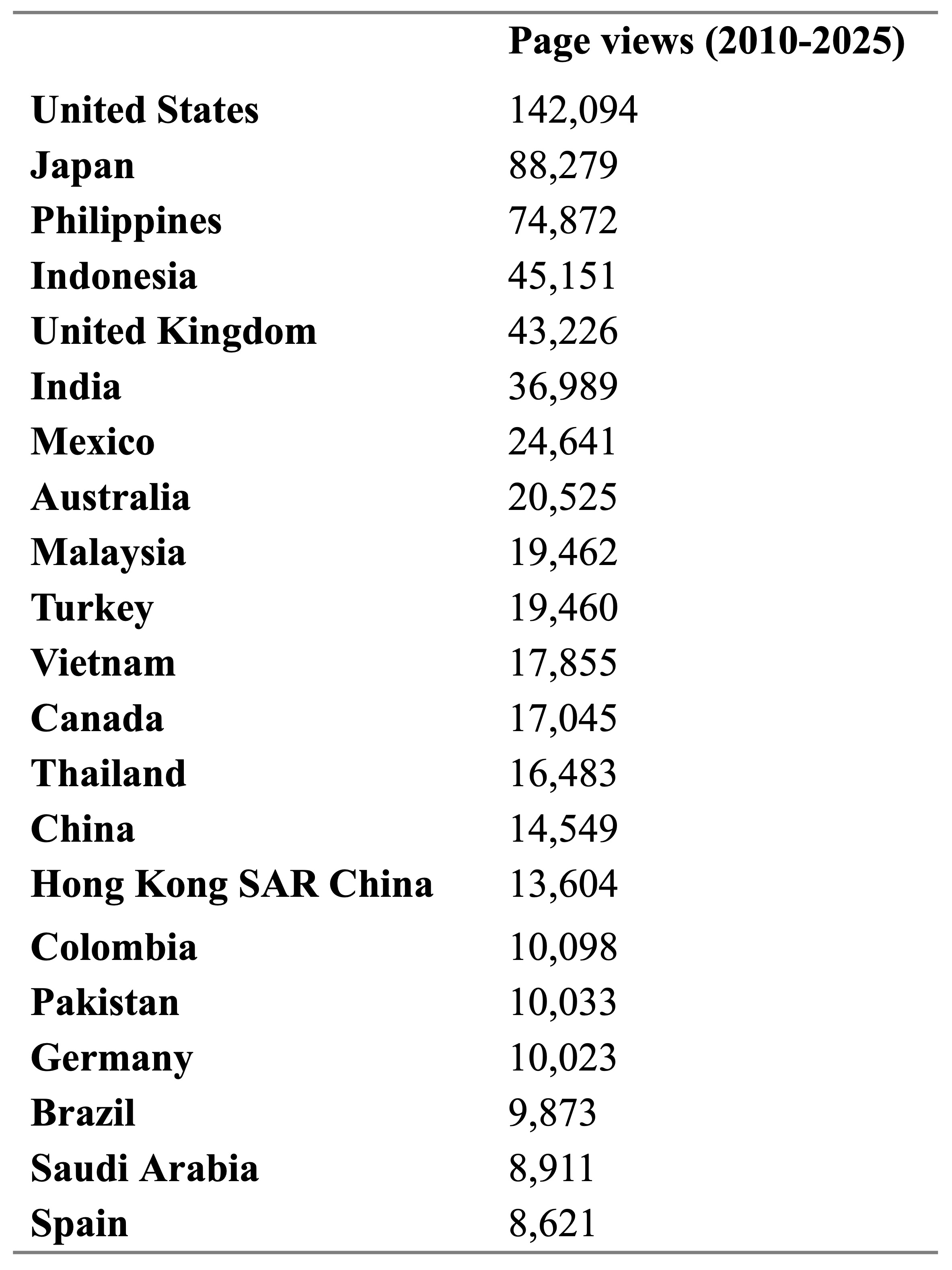
The statistics available from the website provider are limited, but we are able to see that since the beginning of the journal in 2010, there have been almost 900,000 views from 225 countries or territories, including some unexpected locations (Vatican City, North Korea). In the past 12 months, there have been more than 45,000 page views. Table 1 shows the top 20 countries. Overall, 16% of readers (n=142,094) were in the United States of America, and almost 10% were in Japan (n=88,279). The figures do not take into account the use of VPNs to disguise one’s location.
Table 1
Page Views Recorded From the Top 20 Countries 2020-2025
Content
This section provides insight into the content of the journal; popular themes, most accessed and cited articles, and an exploration of some of the sections of the journal, namely the reviews section and the special columns. At the end of this section, we will provide some comments on the design of the cover pages.
To provide details of the content and identify trends and shifts in the focus of SiSAL Journal over the past 15 years, we conducted a thematic analysis of all published articles from Volumes 1 to 15. We began by reviewing the titles and abstracts of each article to identify recurring topics and areas of interest. Articles were then grouped under broad themes, such as learner autonomy, advising, technology in language learning, and collaborative learning. These categories were refined iteratively as patterns emerged, allowing for both consistency over time and recognition of newly developing themes. We recorded the number of articles under each theme for each year to track changes and identify enduring or emerging areas of focus. This qualitative approach provided insight into the evolving concerns of the field and how the journal reflects those changes described in the ‘History of the Journal’ section above. Of course, we included special issues in the analysis. As the editors decided the topics of the special issues based on factors such as current interests or even gaps in the field, we acknowledge that we have influenced the content and the direction of the journal.
Popular Themes
The journal has explored a wide range of themes over its 15 years of publication, and the top 10 are shown in Table 2. Among the most prominent are learner autonomy and self-regulation (48 articles). Papers in this area have explored goal-setting, self-reflection, and the strategies learners use to direct their studies independently. Closely linked to this are articles about technology in language learning and self-directed learning (41 articles), examining digital tools, MOOCs, mobile-assisted learning, and online self-access platforms. While technology became a major focus around 2016, the COVID-19 pandemic accelerated discussions on remote learning, virtual advising, and digital autonomy. Self-access center management is another popular theme in the journal (37 articles), and the journal has become a popular venue for showcasing best practice or exploring interventions related to improving SALC services and designing and maintaining effective spaces for independent learning. Another focus has been advising and the emotional aspects of language learning (35 articles), emphasizing the role of advisors in providing both strategic and emotional support to learners and fostering autonomy while addressing psychological challenges.
A large number of articles have been published on the theme of collaborative learning and peer support (30), which reflects the growing role of learning communities, peer mentoring, and cooperative strategies in fostering autonomy. Over time, there have been more articles related to self-directed learning strategies and practices (27 articles), including metacognitive approaches, task-based learning, and the use of self-access materials. Curriculum design and integration with self-access (21 articles) has also been an ongoing theme, exploring how formal education can incorporate self-directed learning principles. The professional development of learning advisors (19 articles) has also emerged as a key area, highlighting the need for advisors to refine their skills in supporting independent learners effectively. Student motivation and perceptions (18 articles) have remained a relevant theme, exploring what drives learners to engage with self-access environments. More recently, the journal has captured the impact of global events on self-access learning, particularly through pandemic-related research (17 articles). These studies have examined how remote learning reshaped self-access practices, leading to increased use of virtual writing centers, online consultations, and digital self-access tools.
Table 2
Top 10 Themes (June 2010 to March 2025)

Special Issues
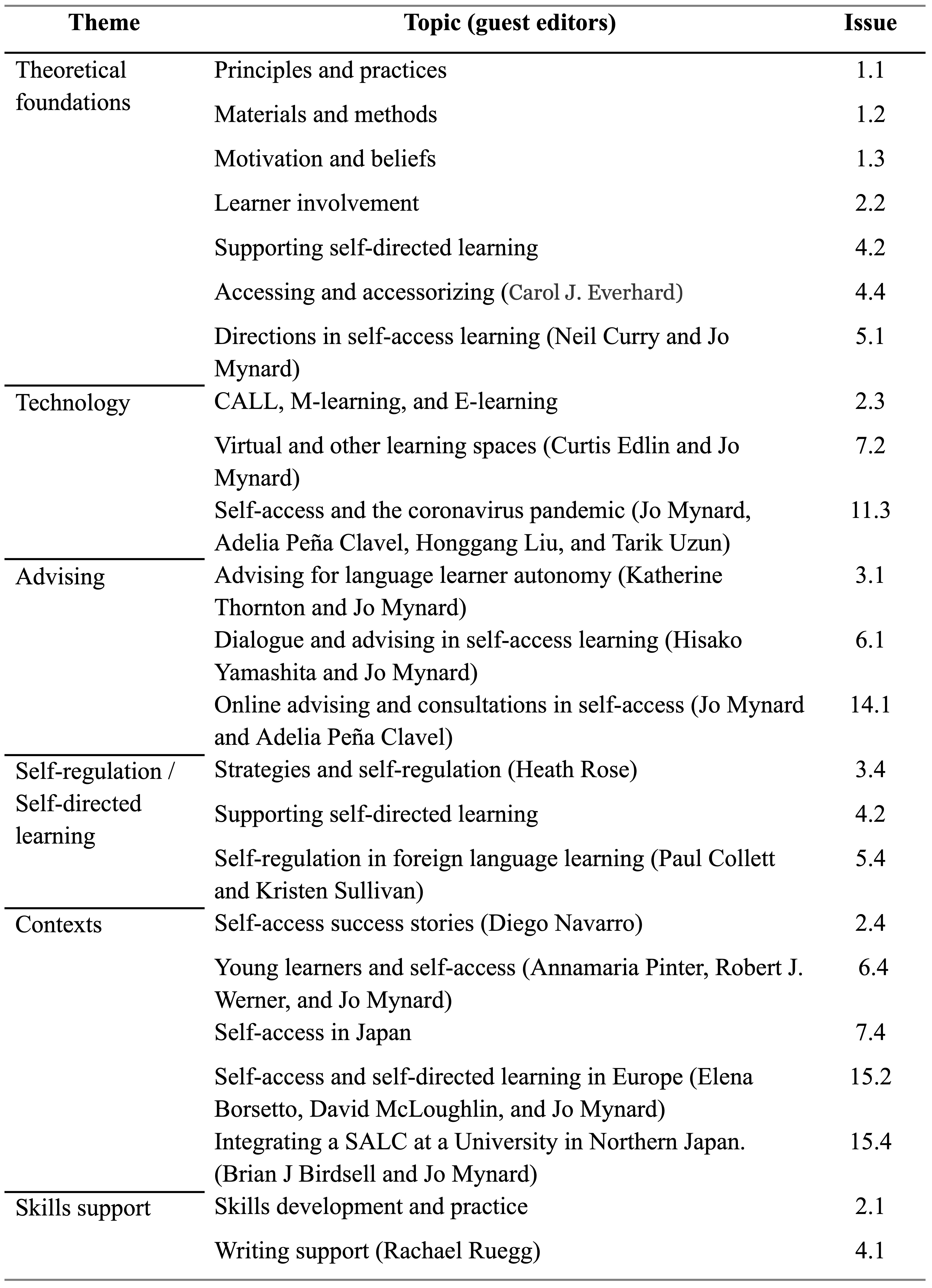
One of the features of SiSAL Journal is the regular special issues, which allows us to explore a related feature of self-access or learner support in depth. Table 3 gives a breakdown of the special issues we have published over 15 years, sorted by theme and topic. Many of these special issues have been guest-edited.
Table 3
Special Issues Through the Years Presented Thematically
Supporting Significant International Events
Special issues also provide opportunities for publishing papers related to a significant event, either in the field of self-access or in a related field, allowing us to make interdisciplinary connections and expand collaboration opportunities with international colleagues. Table 4 shows that there have been seven special issues from events held in six different countries.
Table 4
Special Issues Based on Significant International Events

Most Accessed Articles
Our journal has featured numerous influential articles, with some standing out as the most accessed by readers worldwide (Table 5). Table 5 shows the top ten most accessed articles, all of them exceeding 10,000 views between June 2010 and the end of March 2025. These papers may be popular due to several reasons, such as the nature of the content being useful to practitioners and scholars, authors being well-known in the field, and the accessibility and visibility of the papers thanks to authors who are proactive at sharing their resources widely, for example, on blogs, and at conferences.
Table 5
Most Accessed Articles (2010-2025)

Most Cited Articles
Using Google Scholar, we were able to access the citation details for all of the articles. The 14 papers that received more than 20 citations are presented in Table 6. These papers are likely to have been instrumental in providing supporting evidence for research projects or when introducing innovations or interventions in institutions worldwide.
Table 6
Most Cited Articles (2010-2025)


These highly accessed and cited articles collectively reflect the journal’s global reach and its pivotal role in shaping discussions on independent learning and learner autonomy.
Reviews
The reviews section provides important content for the journal and opportunities for all of us involved in self-access learning to share new materials and learning tools, such as books, textbooks, self-directed learning materials, apps, technology, and details of academic conferences we have attended. SiSAL Journal started publishing review articles in 2015. Reflecting on the 10 years since the reviews section began, the world has been going through constant advancement in mobile technology. The COVID-19 pandemic led us to invent alternative ways for learners to engage in language learning and communication. The topics of review articles have expanded over the past ten years. In addition to the traditional reviews of paper-based books, we have had reviews of MOOCs (2015), mobile apps (2020), and AI platforms (2024). We hope to continue receiving review articles on various tools that will support our learners to engage in language learning autonomously.
While there has been a shift in topics over the past 10 years, we have always received review articles and reports on academic conferences from all over the world, including China, Iceland, Japan, Mexico, and New Zealand. We also welcome review articles from students involved in self-access learning on their experiences attending student conferences and forums held by the Japan Association for Self-Access Learning (JASAL). Since 2017, we have been receiving insightful review articles from undergraduate and graduate students. The voice of students is very powerful and motivating.
The reviews of learning materials, tools, and conferences have provided our readers with a wealth of resources for their respective institutions and programs. As readers of the journal as well as editorial team members, we, too are motivated by the materials and events reviewed. Since learner autonomy and its approach to language teaching/learning can still be new to some of the institutions, many SiSAL Journal readers often engage in their work without much support from colleagues. Therefore, we hope that SiSAL Journal continues to serve as a hub for such readers to exchange information, reflect on their work, and connect to innovative initiatives that promote self-access learning and learner autonomy in language education.
Columns
In 2012, we introduced our first column, which allowed us to explore a theme in more depth over a longer period of time while incorporating diverse contributors. Table 7 shows a summary of the columns to date. The first column, Self-Access Case Studies, edited by Katherine Thornton, featured explorations of SALCs in two institutions consecutively, one in Japan (issue 4.2 in 2013 to issue 5.2 in 2014 ) and one in the UK (issue 5.3 in 2014 to issue 6.1 in 2015).
The Language Learning Spaces column, also edited by Katherine Thornton, ran for seven issues (from issue 6.2 in June 2015 to issue 7.3 in 2016). Each issue unpacked a “different aspect of self-access management, through reflective case studies from professionals who work in language learning spaces” (Thornton, 2015, p. 216).
The Ethnographies of Self-Access column has been running since 2020 (issue 11.2) and has been edited by Jo Mynard, Robert Werner, and Eduardo Castro. The column has so far featured six cases, two of them being multi-part autoethnographies published over several issues.
Table 7
Columns

Covers
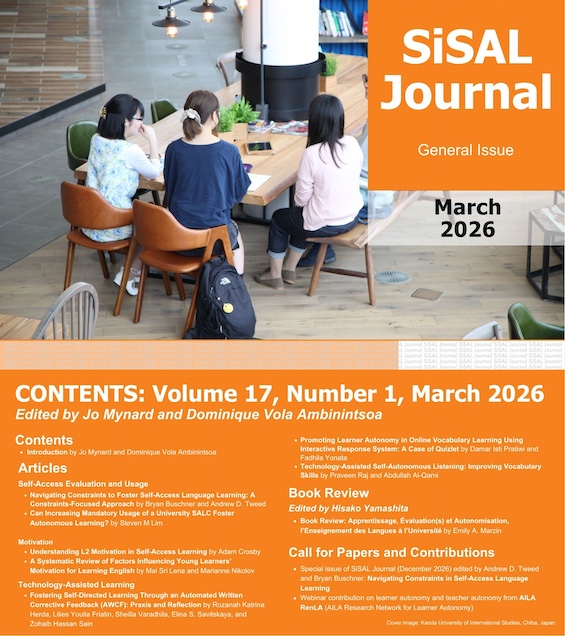
The cover of each issue is distinctive as we are fortunate that professional designers took over producing them from the second issue. Rui Hosono created the original design, and the covers are updated each time by Noriko Takasago based on photos that we collect from various sources. The cover of the 60th issue is a collage based on a selection of covers over the past 15 years. The collection of covers is available here: https://tinyurl.com/sisalcovers
Conclusions and Future Directions
As we celebrate the 60th issue of SiSAL Journal, we are reminded of the enduring relevance of self-access learning and the critical role this journal has played in sustaining dialogue, sharing innovations, and shaping practice in the field. From its modest beginnings as a platform for a single institution to its current status as an international, peer-reviewed journal with contributors and readers from across the globe, SiSAL has evolved alongside the field it represents. Through fifteen years of continuous publication, the journal has captured shifts in educational priorities, technological developments, and global events that have influenced how autonomy and learner support are understood and enacted.
This retrospective has offered us a valuable opportunity to pause and reflect—not only on our journey but also on the broader trajectory of self-access learning. We have seen how the journal has adapted to changing times, supported a diverse range of authors, and served as a hub for the community of practitioners and scholars committed to learner autonomy. We take pride in our open-access model, inclusive editorial approach, and commitment to maintaining high academic standards while remaining accessible and supportive to authors at various stages of their careers.
Looking ahead, we recognize that the field of self-access learning is entering a new era—one shaped by rapid developments in artificial intelligence, growing attention to learner well-being, and increasing demands for inclusive, equitable, and sustainable education. These changes present exciting opportunities for SiSAL Journal to continue evolving as a space for critical inquiry, interdisciplinary dialogue, and practitioner-led research. In particular, we anticipate a growing interest in the ethical and pedagogical implications of emerging technologies, the role of self-access learning in multilingual and multicultural contexts, and the continued redefinition of teacher and learner identities.
As we enter our next chapter, we remain committed to amplifying underrepresented voices, fostering reflective practice, and cultivating a vibrant global community of educators and researchers. We hope that SiSAL Journal will continue to be a catalyst for innovation and a supportive home for ideas that move the field forward.
Notes on the Contributors
Jo Mynard is a professor in the Faculty of Global Liberal Arts, Director of the Self-Access Learning Center, and Director of the Research Institute for Learner Autonomy Education at Kanda University of International Studies in Chiba, Japan. She has an M.Phil. in Applied Linguistics (Trinity College, University of Dublin, Ireland) and an Ed.D. in TEFL (University of Exeter, UK). Her research interests include advising in language learning, the psychology of language learning, and learning beyond the classroom.
Dominique Vola Ambinintsoa is a senior learning advisor and lecturer at Kanda University of International Studies in Japan. She holds a PhD in Applied Linguistics focusing on learner autonomy (Victoria University of Wellington, New Zealand) and an Ed.M in TESOL (State University of New York at Buffalo, US). Her research interests include learner autonomy, self-regulated learning, the psychology of language learning, and advising in language learning.
Eduardo Castro is a Learning Advisor and Lecturer at Kanda University of International Studies in Japan and a PhD candidate at the University of Jyväskylä in Finland. He holds an MSc in Applied Linguistics from the Federal University of Viçosa in Brazil. His research interests focus on the psychology of language learning and teaching, particularly the role of emotions in language education.
Hisako Yamashita is an Associate Professor at Kobe Shoin Women’s University, Japan, and a lecturer at the Graduate School of Language Sciences, Kanda University of International Studies, Japan. She holds an MA in Teaching Foreign Languages (Monterey Institute of International Studies, USA). Her research interests include peer interactions in developing learner autonomy, advising in language learning, and its classroom applications. She is the former president of the Japan Association for Self-Access Learning (JASAL).
Acknowledgments
The authors wish to thank Genesis Widick for his assistance with tabulating and analyzing the statistical data reported in this article.
References
Egbert, J. (2007). Quality analysis of journals in TESOL and applied linguistics. TESOL Quarterly, 41(1), 157–171. https://doi.org/10.1002/j.1545-7249.2007.tb00044.x
Friedman, T. (2007). The world is flat. Picador
Mynard, J. (2010). Editorial. Studies in Self-Access Learning Journal, 1(1), 1–4.
Mynard, J. (2014). Striving for diversity, accessibility and quality: Evaluating SiSAL Journal. Studies in Self-Access Learning Journal, 5(2), 178–199. https://doi.org/10.37237/050209
Mynard, J. (2019a). Advising and self-access learning: Promoting language learner autonomy beyond the classroom. In H. Reinders, S. Ryan, & S. Nakamura (Eds.) Innovations in language learning and teaching: The case of Japan (pp. 185–220). Palgrave Macmillan.
Mynard, J. (2019b). Perspective on self-access in Japan: Are we simply catching up with the rest of the world? Mélanges Crapel: Revue en didactique des langues et sociolinguistique, 40(1), 14–27. http://www.atilf.fr/spip.php?article4465
Murphey, T., Mynard, J., & Shanley, M. (2012). Editorial strategies for stimulating professional collaboration with peer reviewed publications. Studies in Linguistics and Language Teaching, 23, 111–124.
Thornton, K. (2015). Sharing stories of practice in self-access facility design and management. Studies in Self-Access Learning Journal, 6(2), 216–218. https://doi.org/10.37237/060205
Wikipedia (n.d.). Diamond open access. https://en.wikipedia.org/wiki/Diamond_open_access
 SiSAL Journal