
Kiki Juli Anggoro, Department of Language Teaching, School of Education, and Center of Excellence on Women and Social Security (CEWSS), Walailak University, Thailand https://orcid.org/0000-0002-5519-3036
Anggoro, K. J. (2025). Navigating the integration of generative AI in EFL teaching: An autoethnographic journey with the flipped classroom model. Studies in Self-Access Learning Journal, 16(1), 237–250. https://doi.org/10.37237/160112
Abstract
This autoethnographic study chronicles my experiences as an English as a Foreign Language (EFL) instructor integrating Generative AI (GenAI) tools into the Flipped Classroom (FC) model to create a more engaging and effective learning environment. Since adopting the FC approach in 2017, I have encountered challenges, such as students’ lack of self-regulation and motivation, issues that were further exacerbated by the abrupt shift to online teaching during the Covid-19 pandemic. Motivated to find innovative solutions, I turned to GenAI platforms, which have significantly streamlined lesson planning and enhanced the interactivity and personalization of learning experiences. However, this journey has not been without obstacles. I have had to ensure the accuracy of AI-generated content, remain vigilant about ethical concerns like data privacy and academic integrity, and be aware of the risk of becoming overly reliant on these technologies. Balancing AI’s efficiency with the need for authentic human connection in the classroom has been an ongoing process of growth and learning. Despite these challenges, the integration of GenAI has enriched my teaching practices, deepened my dedication to continuous improvement, and reaffirmed my commitment to prioritizing students’ needs and fostering meaningful interactions.
Keywords: English language teaching, flipped classroom, generative AI
Since joining my university in 2017, I have made it my mission to transform my English as a Foreign Language (EFL) class using the Flipped Classroom (FC) model. Back then, my motivation to implement FC stemmed from the pressing challenges I observed in my EFL classes. With large class sizes and students with low average proficiency levels (around CEFR A1), opportunities for meaningful communication were rare. FC seemed to offer a promising solution, shifting passive learning into active and purposeful practice. This first attempt came with its fair share of challenges. At first, my students found it difficult to adapt to self-directed pre-class learning and often struggled with the self-regulation and self-discipline needed to complete assignments independently. So, I introduced Interactive Response Systems (IRS) like Kahoot, aiming to bring a sense of fun and excitement to the learning process.
From 2018 to 2019, as more IRS tools emerged and evolved (e.g., Quizizz, Nearpod, and Mentimeter), offering features like interactive quizzes, slides, and videos, I found myself constantly tweaking and refining my approach. Integrating interactive platforms into pre-class activities when performing FC appeared to enhance students’ productivity, as reflected in their punctuality in completing self-regulation tasks. Additionally, since I typically allowed multiple attempts for pre-class tasks, most students took advantage of this opportunity, which may have contributed to a deeper understanding of the material.
In 2020, the Covid-19 pandemic brought a new set of challenges, forcing a sudden shift to online teaching. This tested the resilience of FC in a digital environment. I started making an adaptation of FC for a fully virtual use. I started experiments using different interactive tools within the adapted model. In addition to IRS, in 2021 began incorporating Task-Based Learning (TBL) steps into the pre-class and in-class sessions. Though the approach’s improvement benefited both my students and myself, it also increased my workload as a teacher, especially for class preparation.
In late 2022, my colleagues began discussing the Generative AI (GenAI) tool, ChatGPT, during our hangouts. Curious, I decided to try it out myself and quickly realized they were right when they mentioned it could be a valuable resource for class preparation, among other uses. This realization ultimately led me to explore the potential of GenAI in my classroom. This autoethnographic study explores my integration of GenAI technologies into my FC practices and aims to provide a reflective, in-depth analysis of this process.
Contextual Framework
Artificial Intelligence (AI) is transforming the way teachers work by taking over routine tasks. From lesson design to assessment and classroom management, AI-powered tools are streamlining various aspects of teaching, making it easier to create meaningful learning experiences (Ahmad et al., 2022). This is particularly valuable in FC, where lesson planning requires careful coordination of both pre-class and in-class activities, often doubling a teacher’s workload. Tools like Quizizz AI have simplified this process by automatically generating quizzes based on teacher input or uploaded files, significantly reducing preparation time (Anggoro & Pratiwi, 2024).
AI also provides personalized feedback and adaptive learning paths. It can tailor content to meet individual student needs, enhancing learning outcomes by designing customized curricula and instructional materials that promote foundational learning and self-reflection (Seo et al., 2024). On the administrative side, AI further lightens the workload by automating grading, particularly for essays, freeing up more time for direct student interaction (Ahmad et al., 2022). It can also assist in tracking student progress and organizing data (Seo et al., 2024).
AI’s potential extends beyond supporting teachers. It can also empower students to take charge of their own learning and improve self-regulation when used strategically (Anggoro & Pratiwi, 2024). Research has shown that AI applications support autonomy in various ways, such as promoting inclusive learning environments and enabling tailored learning experiences (Szabó & Szoke, 2024). Yeh (2024) and Ruiz-Rojas et al. (2023) emphasize the transformative potential of GenAI in language education, highlighting how these tools facilitate the creation of tailored feedback and interactive content.
Despite these advantages, integrating GenAI into the FC model is not without challenges. Liu et al. (2024) warn of issues such as over-reliance on AI, concerns over the quality and reliability of AI-generated content, and ethical dilemmas related to academic integrity. In addition, managing AI biases is crucial to ensure content remains inclusive and appropriate for all learners. Jochim and Lenz-Kesekamp (2024) stress the need for educators to critically evaluate AI-generated materials and establish ethical guidelines to uphold academic standards.
While these insights from the literature shed light on both the promise and the challenges of GenAI, I realized that understanding the true impact of these tools required hands-on experimentation in my classroom. This realization led me to adopt an autoethnographic approach. Autoethnography is especially suited for capturing the dynamic and often unpredictable journey of teaching, as well as the evolving role of technology in language education (Kessler, 2023). By placing myself at the center of this inquiry, I seek to explore how my practices have been shaped by the use of GenAI tools.
At the core of this autoethnography are my self-reflections, gathered over a seven-year period of adapting and refining my teaching methods. These reflections include vivid memories, classroom observations, and the nuanced experiences of weaving FC strategies with GenAI technologies into my lessons. To enrich and validate these reflections, I engaged in a deliberate process of memory retrieval, recalling key moments and experiences that influenced my approach. Recognizing the fluid and sometimes elusive nature of memory, I acknowledge that some details may have faded or been altered with time. To ensure a well-rounded understanding, I triangulated my reflections with multiple sources: detailed observations of how students interacted with GenAI tools, based on class notes and surveys administered at the end of class or after using specific tools as part of informal assessments. I also recorded their participation levels, engagement with the tool, language use, and classroom dynamics. I also engaged in informal conversations with colleagues, gaining valuable feedback and insights from their own teaching experiences, as well as conversing with students to understand their perspectives and reactions. To contextualize my experiences and highlight broader implications, I also incorporated insights from existing research on GenAI and FC practices.
Given the deeply personal and subjective nature of this research, I carefully navigated ethical considerations. Placing myself at the center of this narrative required a mindful approach to relational ethics. I ensured that my stories respected the privacy and dignity of my students and colleagues. While sharing my experiences with vulnerability and openness, I remained committed to ethical storytelling, taking care not to reveal any details that could negatively impact others within my professional community.
Exploring GenAI: Self-Study Journey to Enhance FC Practices
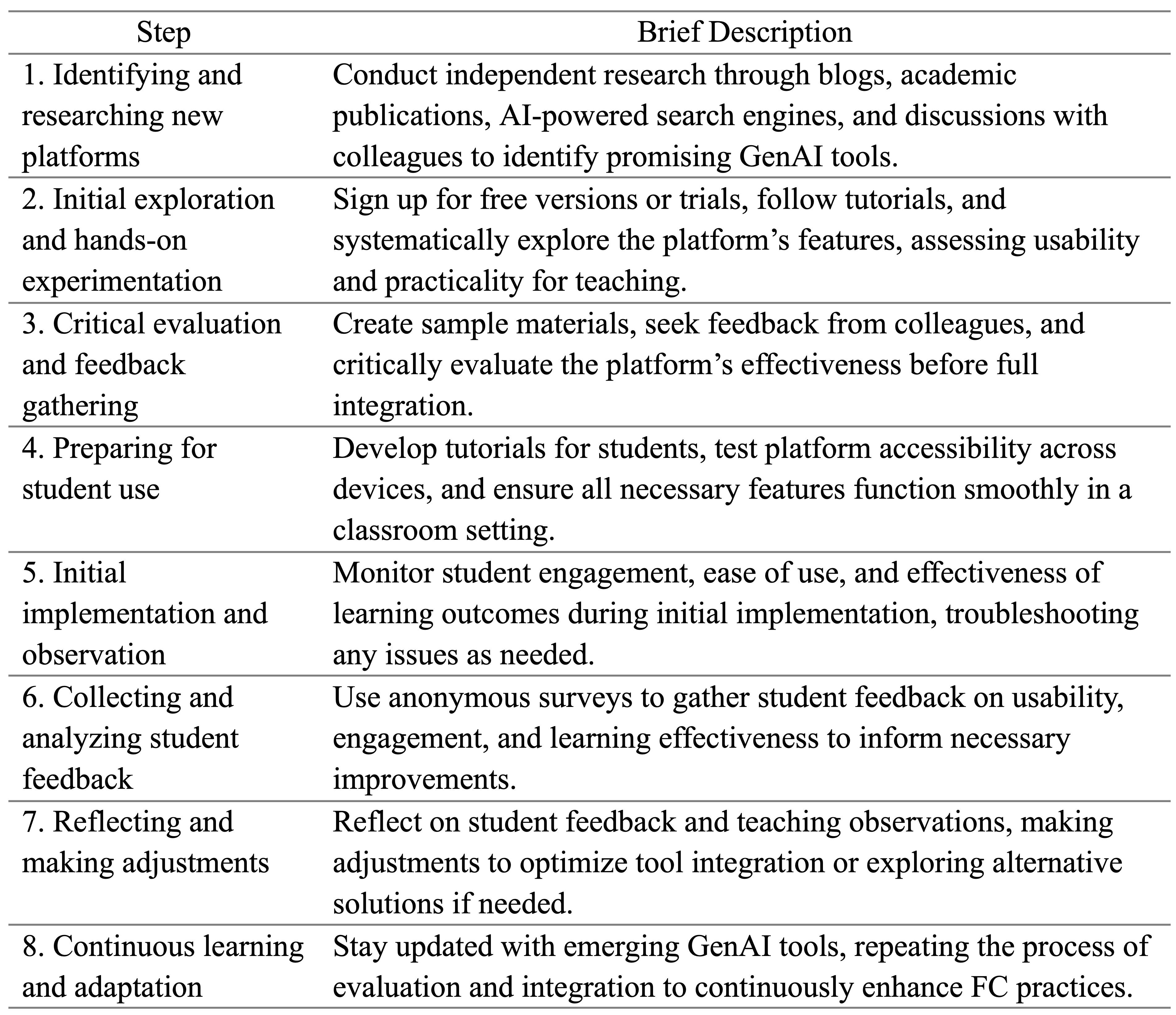
As background knowledge, I teach at a higher education institution in Thailand. In 2023, I joined the teacher education programs, expanding my role beyond general English courses. Since then, I have been teaching English education and educational technology courses. As a foreign professor, I teach entirely in English to a Thai audience. My department is not an international one, and I am currently the only foreign faculty member. My students’ English proficiency varies, ranging from beginners (mostly education majors outside of English education) to advanced learners, primarily English education students. When teaching the same course to these mixed-proficiency groups, such as Educational Technology for Teachers or English Medium Instruction, I design differentiated activities that cater to each group’s cognitive level and learning needs, ensuring that all students can meaningfully engage with the content. This need for tailored instruction is one reason I seek assistance in developing activities, and GenAI serves as a valuable tool in this process, helping me create and adapt materials more efficiently. While this process is mostly self-driven, my university does have strict student evaluation criteria, requiring lecturers to score at least 4.5 out of 5, among other benchmarks, to receive a full score in the annual evaluation. This encourages me to be more innovative in my teaching approach while also being cautious when implementing new technologies. Table 1 summarizes the steps of my self-study process.
Table 1
Self-Study Process
GenAI in FC Environment: An EFL Instructor’s Reflection
Streamlining Lesson Preparation
Before adopting GenAI, lesson planning was a time-consuming process that required meticulous effort to design engaging content. GenAI tools have significantly streamlined and expedited this process. In the past, I had to prepare separate activities for both pre-class and in-class sessions. Pre-class activities included materials and connecting tasks like mini quizzes, while in-class activities focused more on review, further practice, and feedback. Tools like ChatGPT have revolutionized this by generating content for both stages. For instance, when planning a reading lesson, I can use it to draft several sets of reading comprehension passages with follow-up questions. Some sets are used for pre-class activities, while others serve for further practice during class. In another lesson, the platform can generate easy-to-understand summaries of language functions, along with exercises. I can then upload the checked summary and exercises to an interactive slide platform like Pear Deck for students’ pre-class activities. For in-class practice, I can generate additional exercises with slightly higher difficulty levels. In speaking classes, I have found it valuable to provide model conversations or role-play scripts for students to study before class, with missing vocabulary or expressions for them to fill in. ChatGPT helps me create these model texts and exercises for both pre-class and in-class activities. I also ensure that the texts are relevant to my students’ context, such as featuring local attractions or important events of the week. Moreover, I can adjust the difficulty level and vocabulary choice to better suit their needs. This supports the finding of Ahmad et al. (2022) that AI-powered tools are streamlining various aspects of teaching, making it easier to create meaningful learning experiences. It also supports the findings of Hartung and Hicks (2024) that GenAI tools can create customized lesson plans by processing detailed classroom specifics, accommodating diverse student needs.
This shift has not only saved me hours of work but has also provided me with more time to innovate and customize active learning strategies. For example, instead of creating quizzes from scratch, I now use Quizizz AI to generate interactive and gamified quizzes, which I review and modify to ensure alignment with my pedagogical objectives, as recommended by Jochim and Lenz-Kesekamp (2024). The platform also allows me to adjust the difficulty level of my quizzes. The reduction in preparation time has also given me the opportunity to reflect more deeply on my teaching practices and consider new methods for fostering student engagement.
It is important to note that my years of teaching and research experience have shaped me into the new roles. I understand what is likely to work (or not work) for my classes and students’ learning. Therefore, before relying on a GenAI platform for lesson planning, I strongly recommend that teachers and, especially, student teachers, first develop confidence in their lesson design skills and have a deep understanding of their students. This foundational knowledge is crucial for selecting activities that will be truly effective. Without it, the chosen activities may fail to meet students’ needs successfully. By building this expertise first, I have been able to leverage AI more effectively.
Boosting Pre-Class Engagement
Based on the results from informal assessment in my class during the use of platforms like Quizizz, Socrative, and Pear Deck, which have begun incorporating GenAI, I could observe that interactive platforms featuring gamified quizzes and engaging slide presentations have made pre-class learning both more enjoyable and effective for my students. In addition, platforms that incorporate elements like instant feedback and rewards have significantly boosted student motivation and participation. This is in line with Yeh (2024) who highlight how GenAI can facilitate the creation of tailored feedback and interactive content. The competitive, game-like features of Quizizz and Socrative, in particular, motivate students to complete assignments, creating a foundation for more dynamic and meaningful in-class activities. These features likely enhance students’ learning autonomy, aligning with the findings of previous studies (Almohesh, 2024). Moreover, the data analytics provided by these platforms give me valuable insights into student performance. I can quickly identify common areas of difficulty and tailor my in-class instruction to address these gaps, supporting the findings of Seo et al. (2024). This data-driven approach ensures that class time is used efficiently, focusing on active learning exercises that enhance language use and critical thinking.
Furthermore, an important observation in my classes is that students are more likely to complete pre-class activities if they know the teacher is actively monitoring their work. Displaying the results of these activities at the beginning of class can have a significant impact. While most students complete the pre-task before class, there are occasional instances where a few forget. When asked about this, they often cite busy schedules or issues with their network or devices as the cause. Another strategy to increase motivation for completing the pre-task on time is assigning scores for self-regulation. This approach helps create a sense of urgency. Allowing multiple attempts can also enhance comprehension. Although I score self-regulation based on task completion rather than achievement, I have noticed that many students attempt the tasks multiple times to improve their score.
Enhancing Visual and Conceptual Understanding
Visual aids have always played a crucial role in language teaching, particularly when it comes to explaining abstract concepts or cultural nuances. Using DALLE, I can now generate custom images that bring these ideas to life. For instance, when teaching idiomatic expressions, learning theories, or EFL instructional strategies, I create visuals that make the meaning clear and memorable. When teaching idioms like “apple of my eye,” I can create an image that visually represents its symbolic meaning, a favorite person. Similarly, when covering a learning theory like behaviorism, I can use the platform to generate images that illustrate operant conditioning. While there are existing images online, the platform allows me to create more tailored visuals with various objects and styles, better catering to my students’ preferences.
I use AI-generated images for both the pre-class and in-class stages of FC. I find it especially beneficial during the pre-class phase, as students work independently. By providing visual aids tailored to their preferences and explaining complex concepts, I aim to help students better understand the material. Occasionally, I include images in the pre-class quiz, particularly when teaching concepts like learning theories and EFL pedagogies. For example, I might ask questions like, “Which method or theory is represented in this image?” In the in-class stage, I can generate new sets of similar images for additional practice or discussions, further reinforcing the concepts.
From my observation, this approach has enhanced students’ comprehension, making lessons more engaging and enjoyable. The response from students has been positive; they often express curiosity about the visuals, which sparks deeper discussions. The ability to design tailored visual content has also enabled me to better address the diverse learning needs of my students, supporting the claim of Hartung and Hicks (2024) as well as Zhang and Zhang (2024). Visual learners, in particular, might benefit greatly from these customized images, which complement the written material and provide a more holistic understanding of the content.
Creating High-Quality Pre-Class Videos
Another way I use to engage students before class is by using an interactive video. Producing pre-class videos used to be a time-intensive process that I typically avoided. I tried it a few times and quickly realized just how time-consuming it was. I had to design, write scripts, record, and then edit the videos. Often, after the video was rendered, I would spot minor mistakes and have to go back and make corrections, which made the experience stressful. Platforms like InVideo AI have simplified this by automating much of the video creation process, allowing me to generate visually appealing lesson summaries. These videos provide students with a clear and concise overview of the material, which they can review at their own pace. The technology has simplified the process and lightened my workload a s a teacher, supporting the findings of Ahmad et al. (2022).
After generating the videos, I typically upload them to platforms with interactive video features, such as Edpuzzle and Quizizz. These platforms allow me to embed questions, including multiple-choice, short-answer, and true/false, directly into the video. The ability for students to pause, rewind, and rewatch content while answering questions likely improves their comprehension and retention, better preparing them for active participation during class. At the time of writing this manuscript, I had to manually add the questions to the videos. However, if platforms like Quizizz and Edpuzzle could automatically generate the questions, it would shift my role to that of an assessor and editor, significantly reducing my workload.
The use of AI-generated videos along with the interactive video platforms has also made learning more accessible, especially for students who benefit from visual and auditory reinforcement. As a result, pre-class engagement has significantly improved, contributing to more dynamic and productive in-class sessions. This is congruent with the findings of Zhang and Zhang (2024) that these tools can foster learning of students with various learning styles and, thereby improving the overall effectiveness of instruction.
Personalizing Feedback and Adaptive Learning
One of the most significant advancements in my FC practice has been the ability to provide personalized feedback and facilitate adaptive learning through GenAI. This is in line with the reports of Seo et al. (2024). ChatGPT has been instrumental in analyzing student responses to pre-class assignments and offering suggestions for improvement. This allows me to give individualized feedback, helping students understand their strengths and areas for growth. For writing assignments, AI-powered tools like Grammarly provide instant, detailed feedback on grammar, vocabulary, and style, which students can use to self-correct and improve.
Moreover, the adaptive capabilities of AI tools have enabled me to create differentiated learning pathways for my students. By analyzing performance data, I can identify students who need additional support and offer tailored resources. For instance, after completing a task on Quizizz AI, I would observe students’ performance and provide further assistance for students with better achievement. With the platform, I can generate similar sets of quizzes with different difficulty levels, catering to students’ levels. These follow-up tasks are especially beneficial for assisting lower achieving students to reach the lesson objectives. In a class with mixed students’ English proficiency levels, this treatment has potential to further enhance learning of different student groups. This personalized approach has made learning more effective and inclusive, fostering a classroom environment where all students can thrive. Also, it does not exhaust me because of the assistance of GenAI.
In addition to using technology to provide personalized feedback and adaptive learning for my students, I encourage them to independently use the platforms to complete this task on their own. I encourage students to use AI platforms to generate personalized feedback before submitting pre-class assignments that involve writing or typing. I ask them to ensure that the ideas are their own and to use the platform to improve readability and receive feedback. I also require them to submit two versions of each task: one before using GenAI and one after incorporating feedback. Despite this, I occasionally notice that both versions submitted by students still heavily rely on GenAI, indicating an overreliance on the tool. This observation aligns with the findings of Liu et al. (2024). To ensure genuine learning, I incorporate a gamified activity in class that challenges students to describe their work orally or in writing without the help of the internet. One activity I frequently use is Teams-Games-Tournaments (TGT), where students work in random groups and compete to answer questions or complete tasks. My Thai students seem to enjoy this competitive activity each time. This demonstrates how I use my previous teaching strategies to navigate the use of GenAI, ensuring that learning continues despite the easy access to generated content. While new platforms have great potential for learning, as educators, we must also step back and apply strategies we know are effective for students’ benefit. By blending traditional methods with GenAI, we can ensure that learners remain the primary agents of their education (Yan et al., 2024).
Transforming In-Class Active Learning
The FC model is built on the premise of using class time for active, student-centered learning. GenAI has helped me design more engaging and effective in-class activities. For example, ChatGPT generates realistic role-play scenarios that allow students to practice language skills in authentic contexts, such as job interviews or travel situations. These scenarios have not only improved students’ fluency and confidence but also made learning more relevant to their real-world needs.
I have also incorporated AI-generated problem-solving tasks and critical thinking exercises that promote collaboration and active engagement. In one lesson, students worked in groups to solve a series of AI-generated challenges, applying language skills in a problem-based learning format. The result was a lively and interactive class session, where students were fully engaged and motivated to participate. The data-driven insights from GenAI tools have further refined my in-class strategies. For example, if I notice that a significant number of students struggled with a pre-class concept, I can design targeted activities that focus on that area. This level of responsiveness has made my teaching more effective and has contributed to a more adaptive learning environment. This supports the findings of Zhang and Zhang (2024) that the AI tools can create a more supportive classroom environment.
Leveraging Data for Continuous Improvement
One of the most valuable aspects of using GenAI tools in my FC practice has been the access to real-time data on student performance and engagement. Platforms like Quizizz AI and Socrative provide analytics that highlight trends, such as which concepts students find most challenging or which types of questions generate the most errors. This data has informed my lesson planning and allowed me to make evidence-based adjustments to my teaching strategies. This is in line with the argument of Seo et al. (2024) that the technology can track student progress and organize data. For instance, if data indicates that students consistently struggle with a particular grammatical structure, I can allocate more time to that topic and create additional practice opportunities. This data-driven approach has also allowed me to measure the impact of my teaching methods more accurately, contributing to my ongoing professional development and the continuous improvement of my FC practices.
Addressing Challenges and Ethical Considerations
While the integration of GenAI tools has brought many benefits, it has also come with its share of challenges. Ensuring the accuracy and reliability of AI-generated content is critical and I must rigorously review all pre-class and in-class materials before using them. To ensure the quality and authenticity of the materials, I make it a point to thoroughly review and adapt all AI-generated content before implementing it in my classroom. Navigating ethical concerns, such as maintaining academic integrity and safeguarding data privacy, has also been a key focus, echoing the concerns raised by Liu et al. (2024). In addition, both Thorne (2024) and Liu et al. (2024) caution against the risk of becoming overly reliant on AI platforms, a concern I have experienced firsthand. As my own dependence on these tools grows, I continually remind myself that the core ideas and direction for both stages of my FC must come from me. From the above discussion, I observed that my students were becoming increasingly reliant on AI, particularly when completing out-of-class writing activities. As a result, I felt the need to incorporate non-technological activities in class to ensure their learning remains grounded and independent. Thus, balancing the use of AI with traditional teaching methods might be a valuable consideration. While GenAI has undoubtedly increased the efficiency of many teaching tasks, I remain conscious of the importance of preserving meaningful teacher-student interactions. My goal is to leverage AI as a tool that enhances the learning experience rather than allowing it to replace the human connection and personalized guidance that are essential to effective teaching and learning.
Epilogue
The integration of GenAI tools into my FC and active learning practices has been a transformative milestone in my journey of self-professional development as an EFL instructor. These technologies have streamlined lesson planning and enriched the learning experience, making it more engaging, personalized, and adaptive for my students. Although there have been challenges, the benefits of using GenAI thoughtfully and ethically might have outweighed the drawbacks. This experience has strengthened my belief in the power of educational innovation and fueled my passion for continuously finding new ways to enhance my teaching. However, I am mindful of the potential pitfalls, such as over-reliance, ethical concerns, and content accuracy. As an instructor, I must always remember that I am in charge of guiding my students’ learning, not the AI tools. It is my responsibility to thoughtfully manage and oversee their educational experience. I also need to remind students of these drawbacks, ensuring they use the technology in a balanced way that supports their autonomous learning.
As GenAI technology continues to evolve, I remain committed to harnessing its potential to further improve the FC model and cultivate a more dynamic, impactful, and student-centered learning environment. I also plan to continue conducting classroom research and experiments to monitor how these innovations impact my students’ EFL learning. Additionally, it is crucial to study how to navigate technology in a healthy way, avoiding overreliance and other potential pitfalls. As an EFL instructor, I find that this ongoing process of experimentation and reflection is mutually beneficial, as it not only supports my students’ growth but also fosters my own continuous learning and development.
Notes on the Contributor
Kiki Juli Anggoro is an Assistant Professor at the School of Education at Walailak University, Thailand. He holds a B.Ed. in English Language Teaching from Yogyakarta State University, Indonesia. Additionally, he holds an M.Ed. and Ph.D. in Educational Technology and Communications from Naresuan University, Thailand. His research interests include technology-enhanced language learning (TELL) and the use of online technologies in English classrooms.
References
Ahmad, S. F., Alam, M. M., Rahmat, Mohd. K., Mubarik, M. S., & Hyder, S. I. (2022). Academic and administrative role of artificial intelligence in education. Sustainability, 14(3), 1101. https://doi.org/10.3390/su14031101
Almohesh, A. R. I. (2024). AI application (ChatGPT) and Saudi Arabian primary school students’ autonomy in online classes: Exploring students and teachers’ perceptions. The International Review of Research in Open and Distributed Learning, 25(3), 1–18. https://doi.org/10.19173/irrodl.v25i3.7641
Anggoro, K. J., & Pratiwi, D. I. (2023). Fostering self-assessment in English learning with a generative ai platform: a case of Quizizz AI. Studies in Self-Access Learning Journal, 14(4), 489–501. https://doi.org/10.37237/140406
Hartung, F., & Hicks, R. E. (2024). Cultivating transferable skills in AI-enhanced teaching. Agora, 59(2), 21–24. https://search.informit.org/doi/10.3316/informit.T2024070500012990546772816
Jochim, J., & Lenz-Kesekamp, V. K. (2024). Teaching and testing in the era of text-generative AI: Exploring the needs of students and teachers. Information and Learning Sciences, 126(1), 149–169. https://doi.org/10.1108/ILS-10-2023-0165
Kessler, M. J. (2023). Autoethnography for language teacher education programs: Connecting identities, ideologies, and experiences to curricular design practices. TESOL International Journal, 15(2). https://doi.org/10.1002/tesj.772
Liu, Y., Park, J., & McMinn, S. (2024). Using generative artificial intelligence/ChatGPT for academic communication: Students’ perspectives. International Journal of Applied Linguistics, 34(4), 1437–1461. https://doi.org/10.1111/ijal.12574
Ruiz-Rojas, L. I., Acosta-Vargas, P., De-Moreta-Llovet, J., & Gonzalez-Rodriguez, M. (2023). Empowering education with generative artificial intelligence tools: Approach with an instructional design matrix. Sustainability, 15(15), 11524. https://doi.org/10.3390/su151511524
Seo, K., Yoo, M., Dodson, S., & Jin, S. H. (2024). Augmented teachers: K-12 teachers’ needs for artificial intelligence’s complementary role in personalized learning. Journal of Research on Technology in Education, 1–18. https://doi.org/10.1080/15391523.2024.2330525
Szabó, F., & Szoke, J. (2024). How does generative AI promote autonomy and inclusivity in language teaching? ELT Journal, 78(4), 478–488. https://doi.org/10.1093/elt/ccae052
Thorne, S. L. (2024). Generative artificial intelligence, co-evolution, and language education. The Modern Language Journal, 108(2), 567–572. https://doi.org/10.1111/modl.12932
Yan, L., Greiff, S., Teuber, Z., & Gašević, D. (2024). Promises and challenges of generative artificial intelligence for human learning. Human-Computer Interaction. https://doi.org/10.48550/arxiv.2408.12143
Yeh, H. C. (2024). The synergy of generative AI and inquiry-based learning: Transforming the landscape of English teaching and learning. Interactive Learning Environments, 1–15. https://doi.org/10.1080/10494820.2024.2335491
Zhang, J., & Zhang, Z. (2024). AI in teacher education: Unlocking new dimensions in teaching support, inclusive learning, and digital literacy. Journal of Computer Assisted Learning, 40(4), 1871–1885. https://doi.org/10.1111/jcal.12988
 SiSAL Journal