
Benjamin Panmei, Bangkok University International-Language and Culture for Business Department, Thailand. https://orcid.org/0000-0002-2788-5385
Prasit Na-Ek, Department of Medical Science, Walailak University, Thailand. https://orcid.org/0000-0002-4976-3274
Budi Waluyo, Research Center for Language Teaching and Learning, Languages Department, Walailak University, Thailand. https://orcid.org/0000-0003-1919-2068
Ervina CM Simatupang, English Department, Widyatama University, Indonesia. https://orcid.org/0000-0002-4021-3532
Aisah Apridayani, Center of Excellence on Women and Social Security (CEWSS), English Department, Walailak University, Thailand. https://orcid.org/0000-0002-6794-9590
Safnil Arsyad, English Education Postgraduate Program of Education Faculty, Bengkulu University, Indonesia. https://orcid.org/0000-0003-4174-2556
Panmei, B., Na-Ek P., Waluyo, B., Simatupang, E. CM, Apridayani, A., & Arsyad, S. (2025). Exploring WhatsApp Meta AI in self-directed English learning: A critical analysis through activity theory. Studies in Self-Access Learning Journal, 16(2), 461–472. https://doi.org/10.37237/160210
Abstract
Self-directed learning (SDL) serves as a foundation of language acquisition, enabling learners to take ownership of their linguistic development. WhatsApp Meta AI, a versatile digital tool, offers a promising platform for mediating SDL in English education. By examining the interactions among learners, the tool, and the broader learning environment through the framework of Activity Theory, this article explores the potential advantages and limitations of this technology. Although WhatsApp Meta AI supports foundational skill development, including writing assistance, speaking and listening practice, reading comprehension, and test preparation, it also presents challenges, such as overreliance on AI-driven feedback and reduced opportunities for social interaction. Optimizing its impact requires a balanced approach that integrates the tool with complementary learning resources and strategies, fostering a more holistic and effective SDL experience.
Keywords: WhatsApp meta-AI features, self-directed English learning, activity theory, English skills Self-directed learning (SDL) has been given considerable research focus in language learning, responding to wider education trends towards learner autonomy, personalization, and technology-supported instruction (Hawkins, 2018; Lim et al., 2018). SDL is widely recognized as one strategy for empowering learners to be in control of the pace, direction, and content of their language learning, thus promoting lifelong learning and flexibility. With digital technologies becoming more pervasive in daily life, SDL more and more takes place outside the classroom. Mobile apps and AI-based platforms provide informal and personalized learning paths (Li et al., 2024; Yang et al., 2022).
Prior research has confirmed that SDL facilitates adaptive and individualized language ability acquisition—listening, speaking, reading, and writing—by adjusting one’s own pace and attention to the needs and context of the individual (Lim et al., 2018; Yang et al., 2022). Recent research has also put these variables in the spotlight as essential in realizing these effective SDL results: engaging students to be motivated, with their own metacognitive consciousness, and utilizing varied resources—digital and non-digital (Li et al., 2024). Technology-rich environments, namely mobile apps and artificial intelligence (AI) software, have been found to significantly support SDL by offering instant access to content, instant feedback, and the possibility of out-of-class engagement (Kessler, 2018; Yang et al., 2022).
Even with such progress, there exist gaps in the literature. Firstly, most of the research conducted on SDL and digital tools has been centered on either the effectiveness of general technology platforms or the application of individual learning applications, hence neglecting the complex social, cultural, and cognitive tensions that emerge as AI crosses learner autonomy (Yang & Kyun, 2022). There is also a tendency to maximize the affordances of technology—convenience and customized feedback, for example—while reducing potential risks, including diminishing opportunities for social contact, reinforcement of the prevailing language rules, and the risk of cognitive passivity. In particular, relatively little is known about the use of commercial AI tools such as WhatsApp Meta AI in multilateral, non-formal learning environments, or how they overlap with current self-access learning centers (SALCs). Further, the presumption that all learning individuals are to be equally advantaged by AI-based SDL disregards digital inequality, learner autonomy variation, and the subtle dynamics through which AI-provided feedback might reflect or perpetuate language biases (Albusaidi, 2019; Keegan et al., 2024).
Another significant gap is the limited application of robust theoretical frameworks—such as Activity Theory (AT)—in analyzing technology-mediated SDL. While some scholars have used AT to investigate project-based and blended language learning or to identify systemic contradictions in digital learning environments (Gibbes & Carson, 2014; Pullenayegem et al., 2021), there remains a need for more comprehensive analyses that map the components of AT onto the lived realities of learners engaging with AI-driven platforms such as WhatsApp Meta AI. Questions about the mediation of learner goals, the division of labor between humans and AI, and the influence of contextual rules and communities are largely underexplored.
Filling these gaps, this article presents a critical examination of WhatsApp Meta AI as an SDL mediating tool based on AT to explore the possibility and tensions of technology-supported SDL. Through the use of real-world examples of informal learning environments and their mapping onto AT components, the article not only challenges the potential benefits and risks of AI introduction in self-access settings, but also challenges conventional beliefs about learner autonomy, digital accessibility, and the impartiality of AI feedback. In the process, it spurs continued discussion of SDL, digital autonomy, and the place of AI in language learning, with implications for research, practice, and policy makers interested in developing more inclusive, effective, and critically aware self-access learning environments.
Activity Theory and WhatsApp Meta AI: Mediating Self-Directed English Learning
AT is a holistic perspective that can be used to examine how digital tools mediate and structure self-directed English learning (SDL) in terms of the intricate interconnection between the learner (subject), his/her language objectives (object), and resources that he/she interacts with. WhatsApp Meta AI, in this context, is a multi-layered mediating tool, offering tailored assistance and interactive possibilities in areas of language growth, encompassing vocabulary, writing, and speaking. At a critical level, AT underlines not only the affordances of these tools—that is, the flexibility, immediacy, and autonomy they allow—but also the inherent contradictions and constraints that are most likely to arise, including overdependence on computer-mediated feedback, less room for genuine social interaction, and difficulty in striking an optimal balance between supported guidance and independent problem-solving.
To elucidate such dynamics, Table 1 systematically maps the components of Engeström’s (2014) expanded activity system to the context of WhatsApp Meta AI, detailing how the subject (learner) utilizes the tool (WhatsApp Meta AI) to achieve specific objectives (e.g., enhanced writing or speaking proficiency) within a system governed by explicit and implicit rules (norms of technology use and academic integrity), situated in a broader community of peers, educators, and digital support networks, and structured through a division of labor that delineates the roles and responsibilities of both human and artificial agents. This analytical approach not only clarifies the potential of WhatsApp Meta AI to facilitate SDL but also foregrounds the relational tensions and contextual factors that must be critically navigated to maximize meaningful, autonomous learning outcomes in technology-mediated, self-access environments.
Table 1
Mapping Activity Theory Components to WhatsApp Meta AI in Self-Directed English Learning
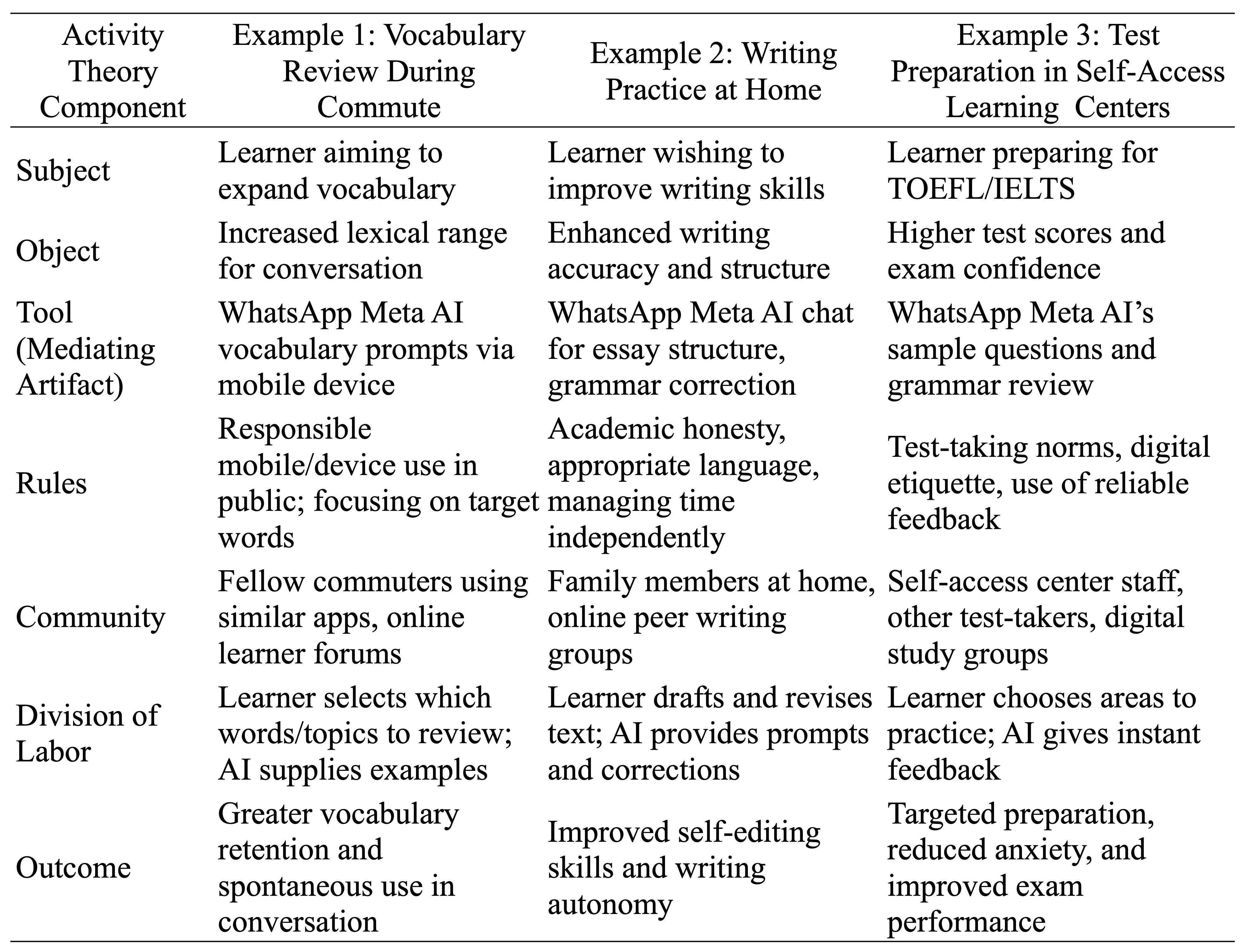
For example, a student commuting to university (Example 1) uses WhatsApp Meta AI on their phone to review new vocabulary through chat prompts, following personal study goals (subject/object) and accepted mobile use norms (rules). In a different scenario, a learner working on an essay at home (Example 2) interacts with the AI for real-time feedback on structure and grammar, balancing independence and automated support (division of labor) within the context of academic honesty. Meanwhile, another student in a self-access learning centers (SALCs) (Example 3) prepares for an English proficiency test by answering sample questions with immediate AI feedback, often sharing insights with peers in the community. These examples demonstrate how AT structures and explains the dynamic interplay between learners, digital tools, and varied learning environments in self-directed English development.
Facilitating Foundational Language Skills Development
WhatsApp Meta AI includes features such as grammar explanations, vocabulary enhancement, pronunciation guidance, and interactive exercises that mediate the development of essential language skills. Grammar explanations simplify complex rules through real-time queries and illustrative examples, enabling learners to address challenging areas independently. Vocabulary-building tools, incorporating contextual usage, synonyms, and antonyms, support lexical development and contribute to accurate language use. Pronunciation guidance, supported by phonetic transcriptions and tips, aids in refining oral fluency, accent accuracy, and clarity. Interactive exercises, including quizzes and simulated conversations, facilitate learner interaction and the applied use of target language structures, aligning closely with the principles of SDL. Nonetheless, AT stresses contradictions that may emerge, such as overreliance on AI-generated feedback for pronunciation, which limits opportunities for social and face-to-face practice. The lack of real-time interaction further restricts contextual language use, necessitating the integration of complementary resources, such as language exchange platforms, to address these gaps and provide a more holistic learning experience (Keegan et al., 2024; Yang & Kyun, 2022). In practical, out-of-class scenarios, learners may use WhatsApp Meta AI for a five-minute grammar check while waiting for public transport, or practice vocabulary during brief study breaks at home. The convenience of accessing the tool via mobile devices allows for “micro-learning” moments throughout the day, exemplifying how WhatsApp Meta AI supports ongoing, self-access skill development in informal settings that parallel the goals of traditional SALCs.
Mediating Writing Support Through WhatsApp Meta AI
The writing assistance tools offered by WhatsApp Meta AI mediate learners’ engagement with written communication by mediating the writing process through features such as essay structuring, writing prompts, and grammar proofreading. Essay guidance tools, for instance, offer strategies for outlining and organizing arguments, promoting independent composition skills and enabling learners to articulate ideas with clarity and coherence. Grammar proofreading tools identify errors and improve sentence structure, alleviating the cognitive load of editing and allowing learners to focus on content generation. Nevertheless, the reliance on AI-driven tools introduces a tension between automation and cognitive skill development (Shen & Teng, 2024). Learners who become overly dependent on automated proofreading may fail to develop critical self-editing and revision skills, creating a contradiction between the tool’s facilitative role and the learner’s need to achieve comprehensive writing proficiency. For instance, learners drafting essays in university self-access center often consult WhatsApp Meta AI for immediate grammar or structure feedback, enabling real-time revisions before assignment submission. Similarly, at home, students can interact with the AI late at night to generate ideas or receive writing prompts, offering additional flexibility and learner control over the writing process. These scenarios illustrate the integration of digital tools into self-access learning spaces, fostering greater learner independence.
Enhancing Speaking and Listening Practice
The integration of conversation practice, role-playing, and podcast recommendations enriches the mediation of speaking and listening tasks in language learning. AI-driven role-plays simulate real-world scenarios, enabling learners to practice conversational English with contextual relevance, while transcription and summarization tools enhance listening comprehension by distilling audio inputs into key insights (Zaim et al., 2024). Podcast recommendations expose learners to diverse linguistic inputs, fostering improved auditory processing and comprehension skills. From the perspective of AT, these tools lower barriers to access and provide flexible opportunities for practice (Kessler, 2018). Yet, contradictions emerge when learners rely solely on AI-mediated exercises, as the lack of social interaction and collaborative dialogue limits opportunities to develop spontaneous language use (Yang & Kyun, 2022). Addressing this gap requires supplementary resources, such as language exchange platforms or live conversation tutors, to provide a more balanced and holistic approach to speaking and listening skill development. In informal environments, learners might engage in simulated conversation practice with WhatsApp Meta AI while walking or commuting, or utilize its summarization tools in a quiet corner of a self-access center to improve listening comprehension. Such uses enable learners to fit targeted language practice into their daily routines, echoing the individualized, self-paced support traditionally found in SALCs.
Supporting Reading Comprehension and Critical Analysis
Reading comprehension tools, such as summarization features and contextual vocabulary enrichment, mediate the learner’s ability to analyze complex texts. Summarization distills intricate ideas into main arguments, aiding learners in identifying key points and enhancing comprehension. Contextual vocabulary tools further deepen linguistic competence by integrating new words into meaningful frameworks, allowing learners to analyze texts with greater precision. Conversely, contradictions arise when learners rely solely on summarization tools without engaging in deeper critical analysis. The overuse of such tools may undermine the development of independent reading strategies, creating a tension between the tool’s facilitative role and the learner’s need for active cognitive engagement in SDL (Keegan et al., 2024). Students may rely on WhatsApp Meta AI to summarize complex reading materials while studying independently at home or in a campus self-access centre, or to clarify unfamiliar vocabulary during self-directed exam preparation. These affordances illustrate how digital tools can replicate and extend the reading support functions of physical self-access facilities.
Bridging SDL and Performance-Based Assessment through Test Preparation
WhatsApp Meta AI can be an effective tool for filling the gap between SDL and performance-based assessment of English language learning by offering individualized assistance to students for common tests such as TOEFL and IELTS. Through engagement with practice questions, practice grammar, and practice vocabulary in an engaging manner, students can individually practice getting themselves to detect and correct individual linguistic flaws, making them prepared for the tests. These activities facilitate not only effective exam preparation but also SDL principles by means of autonomy, self-management, and systematic practice on language learning material outside the classroom. In addition, ancillary features of the platform—e.g., cultural observations and study routine suggestions—extend the educational benefit of the platform, facilitating the construction of increased linguistic and intercultural ability in accordance with integrated SDL goals. Particularly, the extensive use of WhatsApp Meta AI for test preparation outside the classroom in non-formal settings—during traveling time, in the home, or in self-access learning centers (SALCs), for example—is a developing trend toward independent, digitally mediated learning spaces that complement and expand the remit of traditional SALCs.
Nevertheless, the blend of AI-based tools in autonomous learning is not without deep tensions and challenges. Overdependence on automated grading can promote intellectual laziness, deterring students from constructing independent thinking and self-correction skills fundamental to long-term language competency (Waluyo & Kusumastuti, 2024). Also, the language models used by WhatsApp Meta AI are most probably calibrated to standards that do not fully support different varieties of English or the broad range of learners’ sociocultural experiences, potentially restricting chances of effective intercultural communication. Digital disadvantage similarly presents severe challenges because not all learners have equal access to stable internet, modern devices, or digital literacy competencies required to take full advantage of such platforms. Second, SDL is habitually idealized as a naturally autonomous process, but rather too frequently, learners, especially those trained in teacher-directed or collectivist pedagogical environments, need overt direction, social correction, and culturally aware assistance to flourish. Third, the seemingly objective nature of AI-generated feedback deserves close examination because these computers can reproduce hegemonic language ideologies unintentionally or neglect finicky aspects of language use. Together, these challenges highlight the importance of creating a balanced, critically conscious effort to implement AI technology in SDL that intersects technological innovation with student engagement, inclusive pedagogy, and ongoing concern for equity and diversity among students.
Limitations of WhatsApp Meta AI features
Even though innovative, WhatsApp Meta AI features have some limitations that limit their use in English language learning. The application does not have the audio/visual feature since it is not capable of generating audio files, offering examples of pronunciation, or enabling video classes, making it unsuitable for interactive multimedia learning. Its interactive features are also limited, with no speech recognition to evaluate pronunciation and no live conversation function, since interactions are only possible through text-based media. As far as grading and feedback, the application is unable to automatically grade auto tests or quizzes and is only capable of providing limited feedback without the ability for full linguistic analysis.
Also, the AI competence is limited to general English and not specialized fields, e.g., medicine or law domains or geographical dialects. The requirement for an internet connection also limits accessibility, making the platform unavailable for offline use. Moreover, the lack of emotional intelligence and human judgment renders it unable to offer empathy, emotional support, or sophisticated analysis of language use. To curb these limitations, users can complement WhatsApp Meta AI with supporting materials in the form of language exchange websites such as italki, online courses from providers such as Duolingo and Coursera, individual English tutors, or language learning podcasts, stimulating a balanced and interactive learning process.
Conclusion
Application of AT in examining the effects of WhatsApp Meta AI illustrates how the technology mediates and co-constitutes SDL in English learning, particularly through its messaging feature. WhatsApp Meta AI facilitates learners taking more agency and control by providing specific facilitation for language skills acquisition, writing development, and examination readiness, thus reframing the learners’ relationship with learning goals. Nevertheless, the application of such technology also presents dramatic contradictions and challenges, such as accessibility for diverse learner groups, ethical issues regarding data privacy and feedback from AI, and the potential to foster cognitive dependence at the cost of more advanced-level critical thinking and independent problem-solving.
Meeting these challenges may involve a conscious and balanced strategy that combines technological innovation with people-centered pedagogy, holding out the potential that learners can tap the flexibility and individualization of digital tools while maintaining the support and intelligence of educators and learning communities. Because WhatsApp Meta AI is context-independent, on-demand language assistance, it can be said to be an actual digital self-access learning centers (SALCs) in that it empowers learners to control their own language development in a range of informal contexts—be it at home, on the daily commute, or even in institutional support spaces. This shift is a benchmark in the self-access model, closing the divide between virtual and physical space and emphasizing the relevance of lifelong, independent language development fostered by human and technological support structures.
Notes on the Contributors
Benjamin Panmei is a published author and lecturer in Business English at Bangkok University International, with 13 years’ experience and a master’s in Curriculum Development from Spicer Adventist University, India; his research interests include language, education, teaching, and technology.
Prasit Na-Ek is an Assistant Professor at Walailak University’s School of Medicine, holding a BA from Walailak University and a combined Master’s and Ph.D. (International Program) from Mahidol University, supported by an OHEC scholarship from Thailand’s Ministry of Higher Education, Science, Research and Innovation.
Budi Waluyo is an Associate Professor at Walailak University’s School of Languages and General Education and his research centers on English language teaching, educational technology, and international education.
Ervina CM Simatupang is a lecturer with a PhD in Linguistics from Universitas Padjadaran, Indonesia, whose research spans sociolinguistics, pragmatics, semantics, education, and technology; she has received national research grants and serves as PILMAPRES coordinator and adjudicator in West Java.
Aisah Apridayani (Corresponding Author) is a full-time English lecturer at Walailak University, Thailand, with an M.A. from Prince of Songkla University; her research interests include English language teaching, self-regulated learning, self-efficacy, and learning and writing strategies.
Safnil Arsyad is a Professor of English Language Education at Bengkulu University, Indonesia, with research interests in discourse analysis of academic texts; he has published in leading international journals such as the Journal of Multicultural Discourses, Asian ESP Journal, Asia Pacific Education Researcher, Australian Review of Applied Linguistics, and Asian Englishes.
References
Albusaidi, S. (2019). Using Activity Theory to explain how a student learns in an internationalised classroom from a sociocultural perspective. Journal of language teaching and research, 10(6), 1142–1149. http://dx.doi.org/10.17507/jltr.1006.02
Engeström, Y. (2014). Learning by expanding: An activity-theoretical approach to developmental research. Cambridge University Press.
Gibbes, M., & Carson, L. (2014). Project-based language learning: an activity theory analysis. Innovation in language learning and teaching, 8(2), 171–189. https://doi.org/10.1080/17501229.2013.793689
Hawkins, M. W. (2018). Self-directed learning as related to learning strategies, self-regulation, and autonomy in an English language program: A local application with global implications. Studies in Second Language Learning and Teaching, 8(2), 445–469. https://doi.org/10.14746/ssllt.2018.8.2.12
Keegan, B. J., Dennehy, D., & Naudé, P. (2024). Implementing artificial intelligence in traditional B2B marketing practices: an activity theory perspective. Information systems frontiers, 26(3), 1025–1039. https://doi.org/10.1007/s10796-022-10294-1
Kessler, G. (2018). Technology and the future of language teaching. Foreign Language Annals, 51, 205-218. https://doi.org/10.1111/flan.12318
Li, Z., Bonk, C. J., & Zhou, C. (2024). Supporting learners’ self-management for self-directed language learning: A study within Duolingo. Interactive Technology and Smart Education, 21(3), 381-402. https://doi.org/10.1108/ITSE-05-2023-0093
Pullenayegem, J., De Silva, R., & Jayatilleke, G. (2021). Contradictions in learner interactions in a blended-learning writing course: An activity theory analysis. Journal of Learning for Development, 8(2), 327–345. https://doi.org/10.56059/jl4d.v8i2.496
Shen, X., & Teng, M. F. (2024). Three-wave cross-lagged model on the correlations between critical thinking skills, self-directed learning competency and AI-assisted writing. Thinking Skills and Creativity, 52, 101524. https://doi.org/10.1016/j.tsc.2024.101524
Waluyo, B., & Kusumastuti, S. (2024). Generative AI in student English learning in Thai higher education: More engagement, better outcomes?. Social Sciences & Humanities Open, 10, 101146. https://doi.org/10.1016/j.ssaho.2024.101146
Yang, H., & Kyun, S. (2022). The current research trend of artificial intelligence in language learning: A systematic empirical literature review from an activity theory perspective. Australasian Journal of Educational Technology, 38(5), 180–210. https://doi.org/10.14742/ajet.7492
Yang, Y. Y., Majumdar, R., Li, H., Flanagan, B., & Ogata, H. (2022). Design of a learning dashboard to enhance reading outcomes and self-directed learning behaviors in out-of-class extensive reading. Interactive Learning Environments, 32, 892–909. https://doi.org/10.1080/10494820.2022.2101126
Zaim, M., Arsyad, S., Waluyo, B., Ardi, H., Al Hafizh, M., Zakiyah, M., … & Hardiah, M. (2024). AI-powered EFL pedagogy: Integrating generative AI into university teaching preparation through UTAUT and activity theory. Computers and Education: Artificial Intelligence, 7, 100335. https://doi.org/10.1016/j.caeai.2024.100335
 SiSAL Journal