
Jo Mynard, Kanda University of International Studies, Chiba, Japan. https://orcid.org/0000-0003-0363-6461
Dominique Vola Ambinintsoa, Kanda University of International Studies, Chiba, Japan. https://orcid.org/0000-0001-5987-3242
Eduardo Castro, Kanda University of International Studies, Chiba, Japan. https://orcid.org/0000-0001-8218-6205
Mynard, J., Ambinintsoa, D. V., & Castro, E. (2025). Introduction. Studies in Self-Access Learning Journal, 16(32), 260–264. https://doi.org/10.37237/160201
Welcome to this issue of SiSAL Journal, featuring nine research papers and one theoretical exploration. We are delighted to feature papers from authors based in Indonesia, Japan, the Kurdistan Region of Iraq, Thailand, and the Philippines. The papers in this collection explore key themes, such as the role of parental and technological support in language learning, learner autonomy and self-regulation, and the use of tools and applications to enhance self-access and self-directed learning. Topics range from home-based strategies for vocabulary development and informal language learning journeys to the implementation of tools like Flipgrid, QuillBot, WhatsApp Meta, and ReadTheory in language learning contexts. The studies investigate concepts such as learner perceptions, advising practices, and the integration of visual and interactive elements in learning materials. We hope you enjoy the variety of content and that it gives you much to think about.
Contents
The first paper is by Zanyar Nathir Ghafar of Sulaimani Polytechnic University, Sulaymaniyah, Kurdistan Region, Iraq, and Niga Salam Abdalqadir, Gasha Educational Community, Sulaymaniyah, Kurdistan Region, Iraq. The authors draw on semi-structured interview data from 14 parent-child pairs to explore the critical role that parents play in supporting the development of English language skills through both home-based and external strategies. The findings show how parents enhance vocabulary acquisition and also reveal challenges in providing support.
The second paper is by Abd Rahman from Institut Agama Islam Negeri Sorong, Southwest Papua, Indonesia, and Ahmad Mustamir Waris from Institut Agama Islam Negeri Manado, North Sulawesi, Indonesia. The authors highlight the importance of informal language learning settings and draw on three frameworks to analyze a participant’s narrative, illustrating her journey from a passive observer to an active communicator in English.
The third paper is by Roderick Julian Robillos from Khon Kaen University, Thailand. The author uses mixed methods to examine the impact of integrating computer-aided argument mapping (CAAM) and the Flipgrid application to foster self-directed learning and enhance argumentative writing skills among university EFL learners in Thailand. The results showed an increase in student confidence in writing and the development of self-directed learning skills.
The fourth paper, by Misato Saunders of Ritsumeikan Asia Pacific University, Japan, and Osamu Takeuchi of Kansai University, Japan, explores the role of learning advisors working in self-access contexts. The study draws on Thompson’s Coaching Impact Model and semi-structured interviews to examine the perspectives of two learning advisors and four advisees. The findings show how learner perceptions shifted over time. The researchers also highlight the multiple roles and complex nature of the adviser role.
The fifth paper is by Sureerat Talapngoen (Nakhon Phanom University, Thailand) and Wadinlada Thuratham (Rajamangala University of Technology Tawan-ok, Thailand). The authors explore how technology can be utilized to support out-of-class writing and research using QuillBot, an assistive tool designed for students in a university setting in Thailand. This mixed-methods study shows a significant improvement in students’ writing skills and positive attitudes towards using the tool.
The sixth paper is by Haruka Ubukata, Emily Marzin, and Isra Wongsarnpigoon from Kanda University of International Studies in Japan. The study explores university students’ perceptions of in-house materials at a self-access learning center. Through group discussions with nine student staff working at that center, findings highlight the importance of support in the learning process and the strong influence of visual design. Existing evaluation criteria were expanded based on learners’ insights.
The seventh paper is by Shotaro Ueno from Kanda University of International Studies, Japan, and Siwon Park from Juntendo University, Japan. In this study, the authors investigated the relationship between self-regulated learning variables, including grit and motivation factors, and English proficiency among 47 Japanese university students. Using questionnaires and TOEFL scores, the study revealed limited correlations among most variables, which contrasts with previous research findings. The authors contend that contextual differences may explain the inconsistency, highlighting the need for broader, more context-sensitive research on L2 self-regulated learning.
The final research paper is by Thinley Wangdi and Ringphami Shimray (Saint Louis University, the Philippines). The authors describe a study investigating the effectiveness of ReadTheory, an AI-powered platform, on the reading comprehension and enjoyment of EFL learners. Based on their findings, the authors argue that learners who used ReadTheory showed improved reading comprehension skills and tended to enjoy reading more than those who did not. Additionally, they outline other benefits and limitations of the platform from the learners’ perspectives. They conclude by discussing some implications of how ReadTheory can be utilized as a self-access language learning platform.
There is also a theoretical exploration by Benjamin Panmei, Bangkok University, Thailand; Prasit Na-Ek, Walailak University, Thailand; Budi Waluyo, Walailak University, Thailand; Ervina CM Simatupang, Universitas Widyatama, Bandung, Indonesia; Aisah Apridayani, Walailak University, Thailand; and Safnil Arsyad, University of Bengkulu, Indonesia. The authors use Activity Theory as a framework to examine the potential of the digital tool WhatsApp Meta AI as a mediator for self-directed and self-access language learning. The authors explore the tool’s potential for language skill development but note several challenges.
Acknowledgements
As always, we are grateful to the members of our review and editorial teams, without whom we would not be able to publish this issue. Many thanks, also, to all the authors who shared their work with us.
Notes on the Editors
Jo Mynard is a professor in the Faculty of Global Liberal Arts, Director of the Self-Access Learning Center, and Director of the Research Institute for Learner Autonomy Education at Kanda University of International Studies in Chiba, Japan. She has an M.Phil. in Applied Linguistics (Trinity College, University of Dublin, Ireland) and an Ed.D. in TEFL (University of Exeter, UK). Her research interests include advising in language learning, the psychology of language learning, and learning beyond the classroom.
Dominique Vola Ambinintsoa is a senior learning advisor and lecturer at Kanda University of International Studies in Japan. She holds a PhD in Applied Linguistics focusing on learner autonomy (Victoria University of Wellington, New Zealand) and an Ed.M in TESOL (State University of New York at Buffalo, US). Her research interests include learner autonomy, self-regulated learning, the psychology of language learning, and advising in language learning.
Eduardo Castro is a learning advisor and lecturer at the Self-Access Learning Center at Kanda University of International Studies in Japan. He holds an MSc in Applied Linguistics from the Federal University of Viçosa in Brazil. His research interests encompass learner autonomy, advising in language learning, and the psychology of language learning and teaching, with a particular emphasis on the motivational and emotional dimensions of language education.
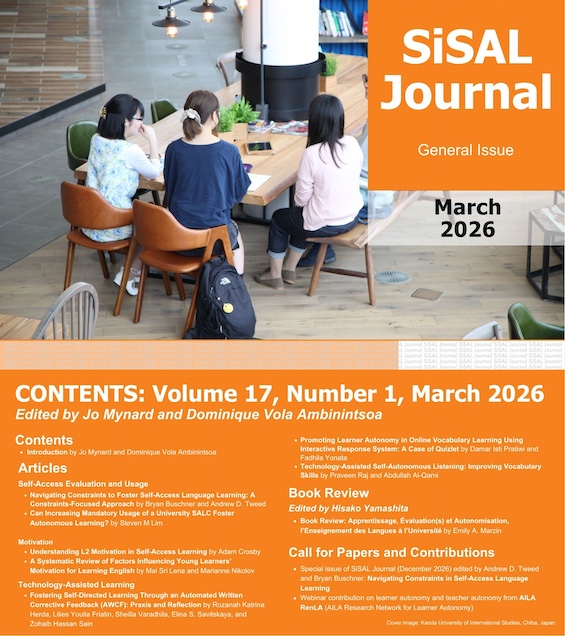
 SiSAL Journal