
Jo Mynard, Kanda University of International Studies, Chiba, Japan. https://orcid.org/0000-0003-0363-6461
Mynard, J. (2023). Language learning in the far north of Europe: Attending EUROCALL 2023 and exploring the University of Iceland. Studies in Self-Access Learning Journal, 14(3), 403–410. https://doi.org/10.37237/140310
It was a privilege to be able to attend this year’s EUROCALL conference at the University of Iceland in Reykjavik from the 15th to the 18th of August, 2023. In this short review, I will comment on some of my takeaways from the conference, especially for the field of self-access language learning. Also, as I had the chance to visit the University of Iceland in person, I was keen to see what support was available to language learners outside the classroom, so my review includes some details of libraries and other on-campus facilities.
EUROCALL 2023: Some Highlights and Takeaways for Self-Access
EUROCALL (https://www.eurocall-languages.org/) is an organisation focusing on the using technologies for language learning that has been hosting annual conferences in different European countries since 1993. The last in-person conference was in 2019 in Belgium, and I had not attended a EUROCALL conference myself since Padova, Italy, in 2015. As the president of EUROCALL, Mirjam Hauck, said in her opening address, it was ‘good to be back.’
The organisers of the conference were from the Vigdís International Centre for Multilingualism and Intercultural Understanding, and the Árni Magnússon Institute for Icelandic Studies, led by Branislav Bédi. The overall theme of the conference was “CALL for all languages,” and the focus was on inclusiveness in language learning with technology, particularly in relation to promoting indigenous, endangered, and less commonly spoken languages. 215 delegates from around the world attended the conference, and the topics of the presentations were wide-ranging.
Keynote Presentations
The opening keynote was given by Róbert Bjarnason (Citizens Foundation Iceland) on the topic of ‘Leveraging AI for Language Education: An Overview of ChatGPT in Language Learning.’ This was an excellent start to the conference as the presenter filled in the technical gaps in our knowledge of ChatGPT and helped us to understand how it worked. He shared some findings from experiments where AI was unable to adequately support the learning of Icelandic due to its current lack of Icelandic content. This might be an issue for other less-commonly spoken or endangered languages for the time being.
The second plenary was by Júlía Guðný Hreinsdóttir (Communication Centre for the Deaf and Hard of Hearing, Iceland), who looked at ‘The history of sign language and the development of sign language teaching in Iceland.’ It was the first time I had ever seen the keynotes throughout the conference being simultaneously translated into sign language.
The third plenary was by Neasa Ní Chiaráin (Trinity College Dublin, Ireland) on the topic of the revitalisation of an endangered language (Irish) in her talk, ‘Endangered Languages from an Irish perspective: Tír gan Teanga, Tír gan Anam.’ The fourth and final plenary talk by Trond Trosterud (Arctic University of Norway) was entitled ‘CALL for all languages? Why languages differ and what consequences that has for CALL.’ All four plenaries were well chosen for the theme of the conference and set the scene well for the parallel sessions and symposia.
Parallel Sessions and Symposia
There were around 250 presentations in all, and as usual, I was disappointed only to be able to attend a handful of these. However, the conference (PDF) booklet contained summaries of all the talks, and the conference app (using Whova) allowed delegates to interact with each other by sending private messages, contributing to discussion prompts, and posting photos and news. Although none of the presentation abstracts specifically mentioned ‘self-access,’ themes important to our field were well represented. 40 presentations mentioned accessibility and/or suitability of CALL resources for language learners; 24 of the papers mentioned the concept of self-directed learning, self-regulation, self-study, or similar; and 12 of the presentations specifically focussed on using CALL for promoting learner autonomy. This demonstrated that supporting language learners in self-access/self-directed contexts is a key focus in current CALL research. Some of the other popular topics were artificial intelligence (AI), using CALL to learn less-commonly spoken languages, online teaching, machine learning, machine translation, L2 writing, augmented reality, chatbots, and digital learning environments.
Artificial Intelligence and Language Learning
In order to find out more about how AI could support self-access language learning, I attended the AI SIG Symposium. Speakers in the three presentations explored artificial intelligence from multiple perspectives. Robert Godwin-Jones (Virginia Commonwealth University, USA) focused on AI-enabled writing tools, Google Translate, Grammarly, and ChatGPT. The presenter made a case that although some tools were not designed for L2 learners (e.g., Grammarly is useful for proofreading rather than L2 development), newer tools embedding AI can support second-language writers both inside and outside classrooms due to its capacity to remember previous interactions and personalise them. As a keen self-directed learner of Italian, these tools have been invaluable for my learning, giving me the kind of feedback and modelling I need, exactly when I need it. However, I agree with Godwin-Jones that its strength is in developing accuracy, and language teachers are still needed, particularly to develop pragmatic competence.
Maryam Mirzaei (RIKEN AIP, Japan) explored how developments in AI and machine learning can influence the design of language learning tools. It was fascinating to learn about the potential for CALL systems and tools to be learner-adaptive and trainable, providing personalised learning opportunities. Clearly, this has huge implications for self-access learning, and we should soon expect to see tools utilising technologies such as partial and synchronized captioning (depending on a learner’s needs and preferences), automatic speech recognition, and natural language processing.
Whether teachers and learners are ready for this sudden shift remains to be seen; Louise Ohashi (Gakushuin University, Japan) and Antonie Alm (Otago University, New Zealand) reported on a study that investigated language teachers’ response to ChatGPT in the first 10 weeks of its global release. Responses were predictably mixed, and the researchers plan to do a follow-up study. I learned a great many applications for self-access and classroom-based language learning from teachers in their study.
In another presentation (not part of the symposium), Jeanette Dennisson (Tokyo Medical and Dental University, Japan) and Gary Ross (Kanazawa University, Japan) reported on how AI technology can complement classroom learning by providing a way for learners to practice using the language flexibly outside the classroom. The presenters shared some task-based practice activities and prompts used by medical students.
After listening to several presentations on ChatGPT, one of my main takeaways is the importance of creating appropriate prompts and training the AI to be a language assistant. This will take some practice but is something that we should certainly train our students to do. In his opening plenary, Róbert Bjarnason shared this example of a prompt:
You are a chatbot designed to teach me Icelandic. Please output one random simple Icelandic word (“CHALLENGE:”). Then I respond with a guess in English what the word means. If I get it wrong, output a useful (“HINT”) to help me guess it. When I get it right (“CORRECT”) write something encouraging and positive about my progress and then write an example of the word used in a sentence (“EXAMPLE”) and an English translation of the word used in a sentence (“TRANSLATION”), then repeat.
Similarly, Jeanette Dennisson and Gary Ross shared some of their prompts that simulated a doctor-patient interaction for medical students. I have since experimented with prompts for my own Italian learning with reasonable success, but I have yet to try training inexperienced language students to do this.
Self-Access Language Learning in Iceland
Veröld – Vigdís’ House
As well as hosting EUROCALL, the venue itself was also of interest. The conference took place in Veröld – Vigdís’ House, home to the Vigdís Finnbogadóttir Institute for Foreign Languages (VFI), within the School of Humanities of the University of Iceland, where they teach the following languages and cultures: Arabic, Chinese, Danish, English, French, German, Greek, Italian, Japanese, Latin, Russian, Spanish and Swedish. The institute was founded in 2017 and operates in cooperation with the Icelandic government and UNESCO.
I immediately noticed the high profile given to languages and language study at the university when I entered Veröld – Vigdís’ House. There was an impressive interactive exhibition on display on the ground floor called ‘The Living Language Lab,’ which showed the evolution of world languages (https://vigdis.hi.is/en/verold/). In addition, the poster session for the conference was held in a study centre, which was well-stocked with books related to language and cultures. The centre was also equipped with study spaces and multimedia equipment for students to use (Appendix 1). The book shop café (Appendix 2) was located in an adjoining building next to the student cafeteria. The whole area was a lively and comfortable social space that served as a meeting hub for students and staff. In fact, the meals and social events during the conference were held here (and we were grateful for the underground connecting tunnel during the cold rainy days!). The selection of international books in different languages at the bookshop was exceptional.
The Nordic House
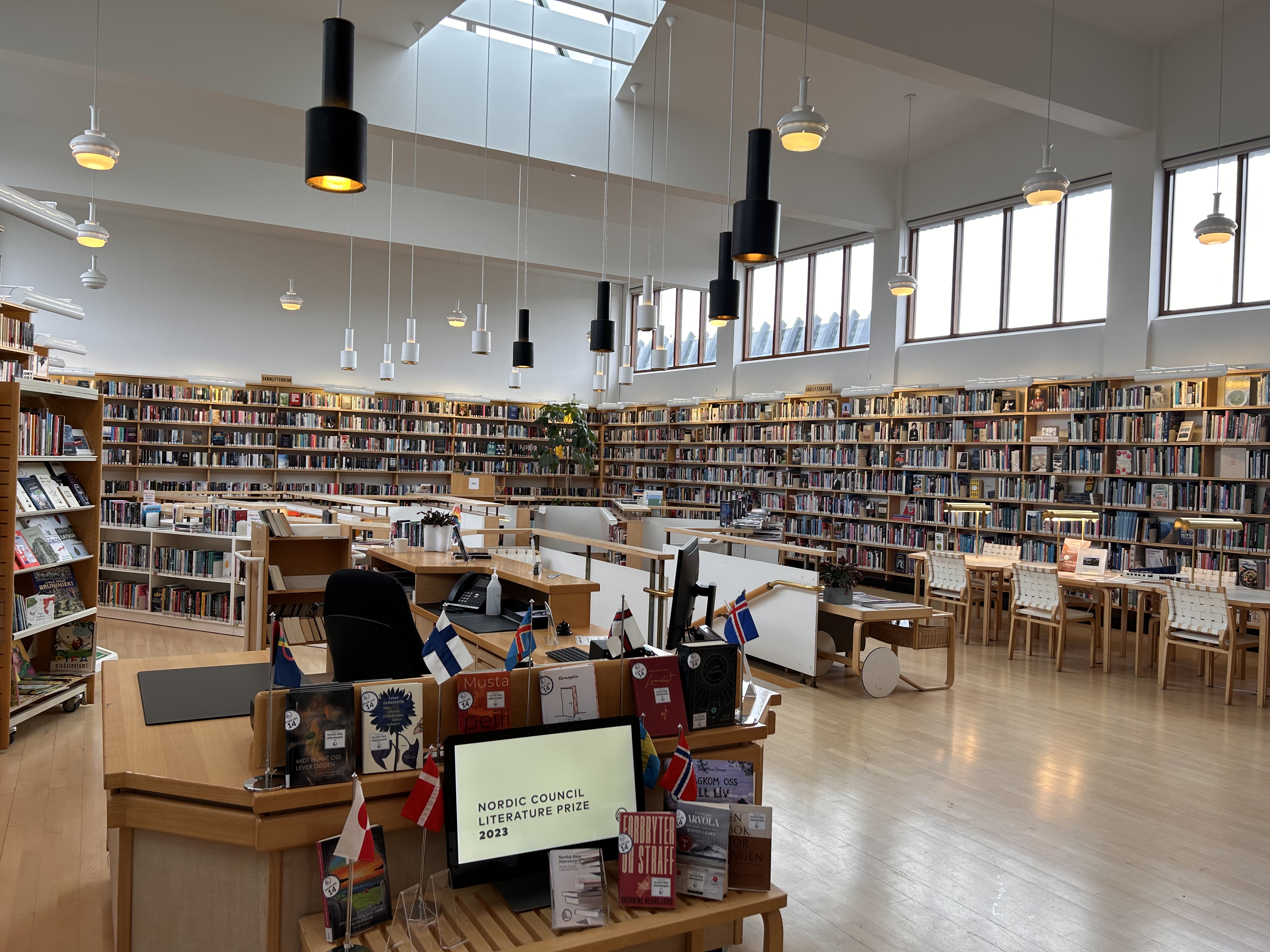
Another place on the University of Iceland campus worth noting was the Nordic House, which is a cultural institute run by the Nordic Council that opened in 1968. Its goal is to foster and support cultural connections between Iceland and the other Nordic countries, and it organizes various cultural events and exhibitions. I enjoyed touring the Nordic Library (https://nordichouse.is/en/library/), which is a public library that beautifully displays books in Nordic languages (Appendix 3). The staff made me feel very welcome and pointed out the main collection on the spacious and airy ground floor and the cosy rooms hosting the children’s library and the library of graphic art located below ground. The staff also showed me how to download the multilingual self-guided audio tour (https://nordichouse.is/en/visitor-guide/) and allowed me to take photos.
Learn Icelandic Online
Throughout the EUROCALL conference, a language lab was set up to showcase the ‘Icelandic Online’ course (http://www.icelandiconline.com). Iceland is one of the fastest-growing European countries due to much-needed immigration. The Icelandic government works hard to ensure that new residents are given access to resources for learning Icelandic, including this interactive course. The course can be accessed via any device. I tried out the ‘survival course’ with the help of one of the tutors from the university. There are also courses for CEFR levels A1 to C1. The graphics were very appealing (although the interface is not as polished as other online courses such as Duolingo and Busuu), and there were a variety of exercise types supported with a dictionary. I can imagine this being an invaluable resource to immigrants settling in Iceland.
Conclusions
During my short stay in Iceland, I was impressed to see so much focus on languages and language study, and as a book lover, I was thrilled to see books all over town, even in bars and cafes (Appendix 4). Although Iceland is located in the far north of Europe, it is very internationally connected, so it does not feel as remote as I had expected. I experienced a positive, thriving, and forward-thinking nation with impressive local expertise in applied linguistics and an ideal host for EUROCALL 2023 and the 30th anniversary of the organisation. The next EUROCALL conference will be in Trnava, Slovakia in August 2024.
Acknowledgements
I am grateful to David McLoughlin and the anonymous reviewer for their comments on this report and to Hisako Yamashita for facilitating the review process.
Notes on the Contributor
Jo Mynard is a professor in the Faculty of Global Liberal Arts, Director of the Self-Access Learning Center, and Director of the Research Institute for Learner Autonomy Education at Kanda University of International Studies in Chiba, Japan. She has an M.Phil in Applied Linguistics (Trinity College, University of Dublin, Ireland) and an Ed.D. in TEFL (University of Exeter, UK). Her research interests include advising in language learning, the psychology of language learning, and learning beyond the classroom. She is on research leave in Italy until March 2024.
Appendix 1
Language Centre at Veröld – Vigdís’ House, University of Iceland

Appendix 2
Student Bookshop and Cafe, University of Iceland

Appendix 3
The Public Library at ‘The Nordic House,’ University of Iceland
Appendix 4
Rúblan bókakaffi, Laugavegur 18, 101, Reykjavík

 SiSAL Journal