
Eda Başak Hancı-Azizoglu, Mediterranean (Akdeniz) University, Turkey. https://orcid.org/0000-0001-6937-5925
Ersen Vural, Mediterranean (Akdeniz) University, Turkey. https://orcid.org/0000-0002-2779-9153
Hancı-Azizoglu, E. B., & Vural, E. (2023). Computer-assisted autonomous linguistic learning: A novel approach to second language expertise. Studies in Self-Access Learning Journal, 14(3), 337–362. https://doi.org/10.37237/140306
Abstract
The invention of the microchip and access to digital devices has altered the way people perceive education and how it is supposed to be practiced. New generations of students, who are the digital natives of today, are more than ready to be educated through the advancements offered by digital learning environments. Language learning is not an exception to these fast-paced technological improvements, and the use of technological devices is slowly altering the way students practice and learn languages. With the advancement of available digital devices, computer-assisted learning has become a reality for today’s learners. Within the context of this research study, an accomplished learner’s think-aloud process and autoethnography function as data to internalize how a learner can transform from a language learner to a language expert through autonomous computer-assisted language learning strategies. This ethnographic study attempts to reveal the keen language learning attitude and self-invented digital learning techniques of an autonomous learner of multiple foreign languages. Thus, it explores and exemplifies the possibility of independent and autonomous language learning without the need for formal education.
Keywords: autonomous language learning, computer-assisted learning, computer-assisted language learning, digital natives, Google translate aided language learning
It is no longer realistic to expect today’s learners to sit passively in rows of traditional desks in a classroom dominated by a teacher holding a piece of chalk or a marker in hand, which is a typical picture reminiscent of classrooms in the 18th century. Today’s digital learners are born to a globally intertwined Earth with digital coding skills to discover units of knowledge with a few taps on their technologically smart devices, and that’s why they are called digital natives. Digital learners are the ones who are experts in speaking the digital language of technological devices (Prensky, 2001). The most influential and complex gadget among these technological devices is surely computers and computer-assisted learning has become a significant focus for advanced self-learning settings (Bennett et al., 2008; Williams, 2011). Computers pose a significant challenge to learning language by offering endless access to resources regardless of their quality, and this not only poses a threat to young learners, but it also requires autonomous learners to reach a level of metacognitive awareness to recognize what works versus what does not work for their learning style (Fortune, 2005; Lasagabaster & Sierra, 2005; Mynard, 2019). Language learning is not an exception to this rule:
An individual’s course of development in learning second/additional languages is largely shaped by his/her attitude towards learning during the initial stages of learning. The attitude formed by the novice learner results from his/her self-perception of inadequacies or achievements. At the start of the learning process, the feeling of accomplishment sustains interest in further learning, while prematurely waning motivation resulting from failures may prove detrimental to learning. When the latter is the case, the learner forms misconceptions about his/her prospect for attainment and quits before reaching the stage at which his/her strengths and weaknesses are assessed realistically. Like many other language learners, the initial language learning experience of mine was not pleasant (Vural, 2022, p. 279).
A highly accomplished language learner (one of the authors) who subsequently became a language expert to guide future English language teachers defines the self-learning journey within three main milestones. First, the autonomous learner realizes that the learner’s attitude towards language learning matters. Within this initial process, there is a fine line between deciding to overcome language learning challenges or quitting from the start due to upcoming challenges (Hancı-Azizoglu, 2018). This decision-making process is the metacognitive awareness of the language learner, which gives the autonomous learner the power to make a choice in the self-directed language learning journey. The autonomous learner confirms the existence of failure and its possible detrimental impact on the next learning phase. It is the moment in which the autonomous learner assesses the weaknesses versus strengths to prepare a road map for self-progress regardless of the first unpleasant experiences (Vural, 2022). Therefore, it is significant to analyze how language learners navigate their autonomous learning effectively (Han & Reinhardt, 2022; Sauro & Zourou, 2019). To summarize:
- Autonomous learning in relation to metacognitive awareness helps learners to self-identify their language learning errors (Amjadiparvar & Zarrin, 2019; Hancı-Azizoglu, 2020; Lasagabaster & Sierra, 2005; Sicola, 2005; Yiakoumetti et al., 2005).
- Autonomous learning in relation to metacognitive awareness results in better pronunciations skills (Derwing, 2017; Kennedy & Trofimovich, 2010; Kotarcic & Swiggers, 2020; Verdugo, 2006)
- Autonomous learning in relation to metacognitive awareness “creates consciousness on deciding which forms to use instead of others and enhances language learners’ writing performance” (Hancı-Azizoglu, 2020, p. 729).
- Autonomous learning in relation to metacognitive awareness transforms the language acquisition process into a context-based language environment where learners have realistic learning goals and expectations (Ammar et al., 2010; Oliveira & Ançã, 2009).
The previous literature highlights the impact of metacognition on language learning (Lai, 2017; Little, 2003; Teng, 2019); however, the process of how computers interact with autonomous language learners is a mystery despite recent scientific developments. Thus, the purpose of this research study is to explore how computer-assisted learning takes place in an accomplished language learner’s mind regarding the phases and outcomes. This research study decodes a highly accomplished language learner’s mind through a think-aloud autoethnography protocol along with Fairclough’s (2013) critical discourse awareness research technique.
Computer Assisted Language Learning
With a retrospective look into language teaching methods from the past to the present, it can be discerned that different approaches to language instruction have been replacing each other since the learning needs of the time change. Even though methods to learn or teach languages are earnestly embraced in their heydays, they ultimately fall into disfavor as they fail to keep up with the ever-changing needs of learners, which is particularly the case for today’s digital learners (Zock et al., 2015).
The invention of the microchip and the transformation of the generation of digital immigrants into digital natives changed the infrastructure of educational platforms, including language learning settings (Williams, 2011). The earliest form of computer-assisted learning mentioned in language learning settings dates back to 1997, with the hope of applying computer applications for making the language learning process more effective (Levy, 1997). The next phase of this research field defined computer-assisted language learning with a more inclusive terminology in which computer-assisted language learning was associated with computer technologies that were used to support and improve the language learning context (Chen et al., 2021; Egbert, 2005; Levy & Hubbard, 2005; Hubbard & Levy, 2016).
In this case, formal educational settings were no longer a necessity, and some aspects of formal educational settings have become redundant with the integration of computers into language learning contexts (Chen et al., 2021). Perhaps more importantly, autonomous and independent learning indeed became possible through computer-assisted learning with the improvement of digital devices. Computer-assisted language learning then offered many benefits to learners as it made the learning process more efficient and flexible by suiting the needs of individual learners. As a result, autonomous and independent language learning became accessible to many other learners, which was a drastic change that reminded us that language study was not limited to the confines of the traditional language classroom anymore.
In its current forms of application, the term ‘computer-assisted learning’ has evolved to refer to a wide array of smart educational approaches ranging from game-based interactive learning to virtual reality exposure in autonomous learning contexts (Azevedo et al., 2019). Computer-assisted learning has gained popularity as recent studies have shown that the use of digital devices has resulted in better learner engagement through autonomous language learning contexts and wider acceptance among learners as a result of its recognition (Guimarães et al., 2018, 2019; Inuwa et al., 2012; Meyer et al., 2016). To illustrate, many new language learners claim to have progressed in their language skills through reading digital stories and playing digital educational games without being aware of the fact that they are indeed learning new languages interactively.
From another perspective, computer-assisted learning functions as a remedial substitution in learning settings in which traditional rote teaching is not favored (Bianchi et al., 2022; Johnston & Ksoll, 2019; Muralidharan et al., 2019; Navarro-Sola, 2019). In particular, computer-assisted learning is often indicated to support critical thinking skills when the application of theoretical learning is evaluated through real-life problem-solving skills (Johnson et al., 2012; Veneri, 2011). Therefore, computer-assisted learning is vital for autonomous learning due to the flexible, resource-rich interactive learning environment that is free from any time or logistical restrictions (Johnson et al., 2012). But what are the phases of autonomous language that prepare the stage for computer-assisted learning?
The Phases of Autonomous Language Learning
In the process of learning languages as a native Turkish speaker, the research participant of this research study has accumulated considerable experience in the process both as a learner and researcher. His memories of rote learning of grammar rules and language structures are still fresh in his mind. He claims to put significant conscious effort into learning multiple foreign languages. His journey as a multilingual learner was filled with times of success and hesitations, especially at the beginning stages of his learning process. Initially, he neither took an interest in learning a foreign language (in that case, English) nor knew the ways to go about it. He was never content with the learning outcomes from tedious instructional sessions dedicated to mechanical tasks that were meant to help learners use the language communicatively. As it was the common practice by then to expect learners to ‘overlearn’ language structures, mechanical drills were ‘prescribed’ as the staple language teaching activities in classrooms.
The realization that mechanical tasks were of little help in authentic communication came during his one-year stay abroad period at age twelve. In his new school context in Germany, he found himself grappling with his rote-learned knowledge of English to make himself understood by others. His knowledge of the language forms was of little or no use in his attempts to interact with others who spoke English communicatively. Now, he realizes that he was more challenged at the time by his approach to language than the target language itself. Fortunately, it was soon obvious to him that his past instructional experiences were wrongly conceptualized because they revolved around ‘learning about the language’ rather than ‘learning the language.’
The linguistic challenges he experienced abroad and the compensatory strategies he developed to cope with them served as eye-openers for him. The fact that he was exclusively confronted with communication problems due to lacking knowledge of two languages simultaneously (German/English) prompted him to take his own initiative. Compared to other individuals who shared the same L1 background in his school context in Germany, he was at a disadvantage. He felt that he had to remedy that problem on his own. He was left to his own devices to find ways of developing his working knowledge of English and/or German. The turning point came when he started to self-study English/German as two foreign languages, which are not linguistically similar to his native language, Turkish.
It would be fair to say that it was his acknowledgment of the acute need to develop knowledge of English/German that pushed him to be an autonomous learner. He purposefully engaged in self-learning activities and started to pay more attention to individual words in utterances and written materials to make sense of them. With his self-study attempts, his focus shifted from language structures to words in the language. He discovered that the ability to say one single word was communicatively more valuable than knowledge of language structures. Words he learned on his own enabled him to express himself to others no matter how ill-formed his sentences were. Accomplishments he made in the process motivated him to further increase his knowledge of L2 vocabulary in English/German.
In his autonomous study, knowledge of vocabulary proved to be an invaluable resource for him to decode target language input (English or German). It was thanks to his one-year stay abroad period that he became an autonomous learner and learned to prioritize lexicon as the most important element of the target language. Using vocabulary as the basis of his learning, he made considerable progress in learning English. He had a handy pocket dictionary ready all the time as a reference. He always compared and contrasted words in sentences in his first language and target language.
After spending one year in Germany as a teenager, he discontinued learning German for a while when he was back in Turkey, yet he focused on learning the English language autonomously. Upon returning to his native country, Turkey, he sustained his interest in learning languages by consuming reading and listening materials because he felt the urge to learn languages since his lack of German language caused him great stress when he moved to Germany as a teenager without any formal German language instruction. Being unable to understand the German language caused him to sit passively in the classroom environment and waste his time, so he decided to invent his own way of language learning as a way to escape any possible future distress. In other words, he wanted to prove to himself that he could also learn and understand other languages in order not to be isolated from his peers again.
Although, as a self-learner, his initial learning experiences were shaped by conventional learning materials such as dictionaries, tape recorders, world-band radios, and satellite television, his subsequent learning experiences drew heavily on computers, which provided further variety and enrichment to his learning. In fact, the stages of his autonomous language learning experience were largely dominated and shaped by digital devices. After years of study, the participant/researcher realized that he was among very few people who were capable of learning new languages through digital devices, and his degree in the English language demonstrated his expertise in how his self-learning techniques worked as a language learning method. Thus, the present study attempts to investigate the process stages of his exceptional language learning journey that was guided by new digital learning environments within the scope of this applied linguistic study.
Methodology
One of the researchers in this study studied linguistics in the United States for her master’s and doctorate degrees in the area of rhetoric and linguistics. Prior to that, she was exposed to an extensive program of English language education since elementary school with a heavy curriculum. Then, she lived in the United States for another 15 years to be more proficient in this language. After years of study and work experience in the target culture, where English is spoken as the first language, she came back to her native land, Turkey. When she started working in the English Language Department, she realized that one of her co-workers could speak English like the BBC channel’s anchorperson with a perfect pitch native British accent. She was later surprised to learn that her professor co-worker friend had never received extensive language training during the critical period as a child until his university education, and moreover, he had never been in an English-speaking country for education either. What is more interesting is that she could not figure out how it was possible for her co-worker to pass a difficult national exam for his university degree without such a formal and extensive education. Moreover, she witnessed that her co-worker also had quite high test scores in other European languages without former schooling as a result of his self-study by using digital devices. She then decided to collect data on how her highly gifted co-worker became such an accomplished language expert as a result of his extensive self-study through using digital resources.
For this purpose, this empirical research study consists of two different data collection phases: The first phase involved asking the highly accomplished language learner participant to reflect on a writing prompt that detailed all his language learning experiences through an in-depth autobiographical reflection requirement. In this narrative inquiry, the participant was asked to share and express his significant milestones for learning multiple languages simultaneously. A narrative inquiry, which is a common research method of applied linguistics, allows participants to provide rich sources of data through life stories. Through life stories, researchers can use people’s critical memories as meaningful units of data because analyzing life experiences of the past, present, and future provides an analytical approach for humans to internalize their turning points in life (Barkhuizen et al., 2013; Kramp, 2003). In parallel, one of the researchers in this study functioned both as the participant and the researcher to self-analyze his learning process.
The research participant’s success is already confirmed by his test scores on credible standardized language proficiency tests. The purpose is to determine the participant’s metacognitive awareness of his own language learning process as a highly accomplished language learner who then became a language expert in several foreign languages. Therefore, the author, also the participant in the study, is asked to focus on his unique digital language learning techniques to explore the nature of his computer-assisted and autonomous language learning techniques in the second phase of the study by using a combination of narrative inquiry and interview questions. The appendix shows both the writing prompt and interview questions. The same set of questions was purposefully asked in both research methods to test the validity of the collected information. The data of this case study analyzed what specifically worked versus what did not work in the participant’s language learning journey. Fairclough’s (2013) critical discourse awareness technique is applied to analyze the common themes that differentiate this accomplished language learner from random learners. The answers are linguistically coded through the frequency analysis of semantic patterns.
Within the scope of narrative inquiry, the participant researcher was asked to describe his feelings in writing as to what motivated him to learn other languages. This part of the data was semantically coded and represented his emotional and motivational state for learning languages. The second part of the data in the narrative and interviews focused on the learning strategies that the participant researcher applied by comparing and contrasting different European languages’ lexical and syntactic structures by using digital devices, which will be discussed and illustrated in the following sections. This part represented how self-learning strategies functioned and transformed the participant researcher from a language learner to a language expert in his second, third, and even fourth language.
Results and Discussion
The Technology Before Computers: Benefitting from Broadcast Technology
Before the availability of computers, the researcher participant of this study had limited access to authentic materials in English because of the circumstances he formerly lived in. He could only listen to English-language radio broadcasts using his world band radio. He listened to BBC World Service newscasts determinedly. His listening comprehension improved thanks to his habit of listening to the radio broadcasts daily. By listening to English language content on the radio, he familiarized himself with the individual sounds of English by comparing the symbols of the international pronunciation alphabet (IPA) in his dictionary to the corresponding sounds he heard on the radio.
Listening to authentic English language content on the radio improved his listening and speaking skills tremendously. He was better able to distinguish nuances of sounds, which were barely perceptible before. He realized that supplementing his language learning endeavor with broadcast technology boosted his learning. He also exploited radio listening to improve his pronunciation. By repeating the manageable chunks of utterances after native speakers on the radio, he perfected his spoken language skills. He kept practicing sounds with the help of the radio, listening earnestly. He even used a tape recorder to record the radio programs and later practiced recorded utterances in a more controlled manner. He even recorded his own voice, repeating the recorded pieces of authentic language. By comparing his utterance to the original utterance on the tape, he made prosodic and intonational corrections to his utterances. That kind of self-correction method using recording devices and radios proved to be an invaluable change for the development of his spoken language skills. Listening activities using the world band radio receiver were replaced later with TV viewing activities using satellite television reception technology. Having access to authentic English-language television stations was a big innovation for language-learning enthusiasts like him. The addition of video to aural input greatly enriched his experience of consuming English language content. The fact that he could see the gestures and lip movements of the native speakers allowed him to better imitate sounds along with gestures. By looking at the speakers’ mouths, he could distinguish sounds that are seemingly similar, such as ‘v’ and ‘w’ sounds. By visually recognizing the distinctions in the way the sounds are produced, he consequently could better pronounce English sounds. In addition, focusing on this type of information served as the basis for his subsequent study interest in phonetics as a prospective linguist.
As an autonomous language learner, the contribution of world band radio listening and satellite TV viewing to his mastery of the English language was undeniable. He hardly benefitted at all from formal instructional contexts at school. He was fully aware that the study of language at school for assessment purposes was meaningless if the goal was to use language ultimately for communication. The three pillars of his autonomous learning in English were his bi/monolingual dictionaries, world band radio listening, and watching satellite TV. With the help of these three autonomous strategies, he attained proficiency in English to such an extent that he was able to further his study of language as an English major at the university. His knowledge of the English language advanced enough to study the English language as an undergraduate degree.
Benefitting from Digital Materials
As a self-taught language major at university, he realized that his knowledge of English stood out as more native-like in terms of lexical selection and pronunciation, as well as being less predictable. Since his learning occurred outside of institutionalized settings, his written and spoken language approximated that of natives. Nevertheless, he had a hard time understanding fellow students’ and some lecturers’ obsession with grammar. In their view, form was more important than content in that they prioritized grammar over meaning. His perception and actual knowledge of grammar were different from theirs. While he implicitly used grammar rules while reading and writing, they could express rules explicitly but failed to use them productively. This observation further affirmed his assumptions that the emphasis in language learning should be on communication rather than knowing explicit knowledge about how language is structured. He was firmly convinced that language structure helps to organize the lexical content, but lexical items in any language bore the essence of meaning knowledge. When he graduated as an English major with top scores, his mastery of English was outstanding, according to the professors at the university, which attested to the efficiency of his learning methods and approach to language learning.
As an accomplished self-learner of English, he was equipped with metalinguistic awareness and experience in learning languages efficiently. It entered his mind that his metalinguistic awareness of language could help him learn other languages. The German language that he had experimented with during his one-year stay period in Germany was the first candidate for learning. He figured that he could effortlessly develop an understanding of German grammar and grasp its vocabulary if he focused on high-frequency German words in sentential contexts and worked on them using English translations to decode meaning. For this purpose, he used a basic German vocabulary book with English translations. The series was named ‘Grundwortshatz’ and existed in various versions for different languages. Using the internet ordering system, he got the four versions of the vocabulary books from Germany in four languages: English, French, Spanish, and Italian. His idea was to use English translations to learn German and use German to learn the other three languages with the help of that vocabulary series.
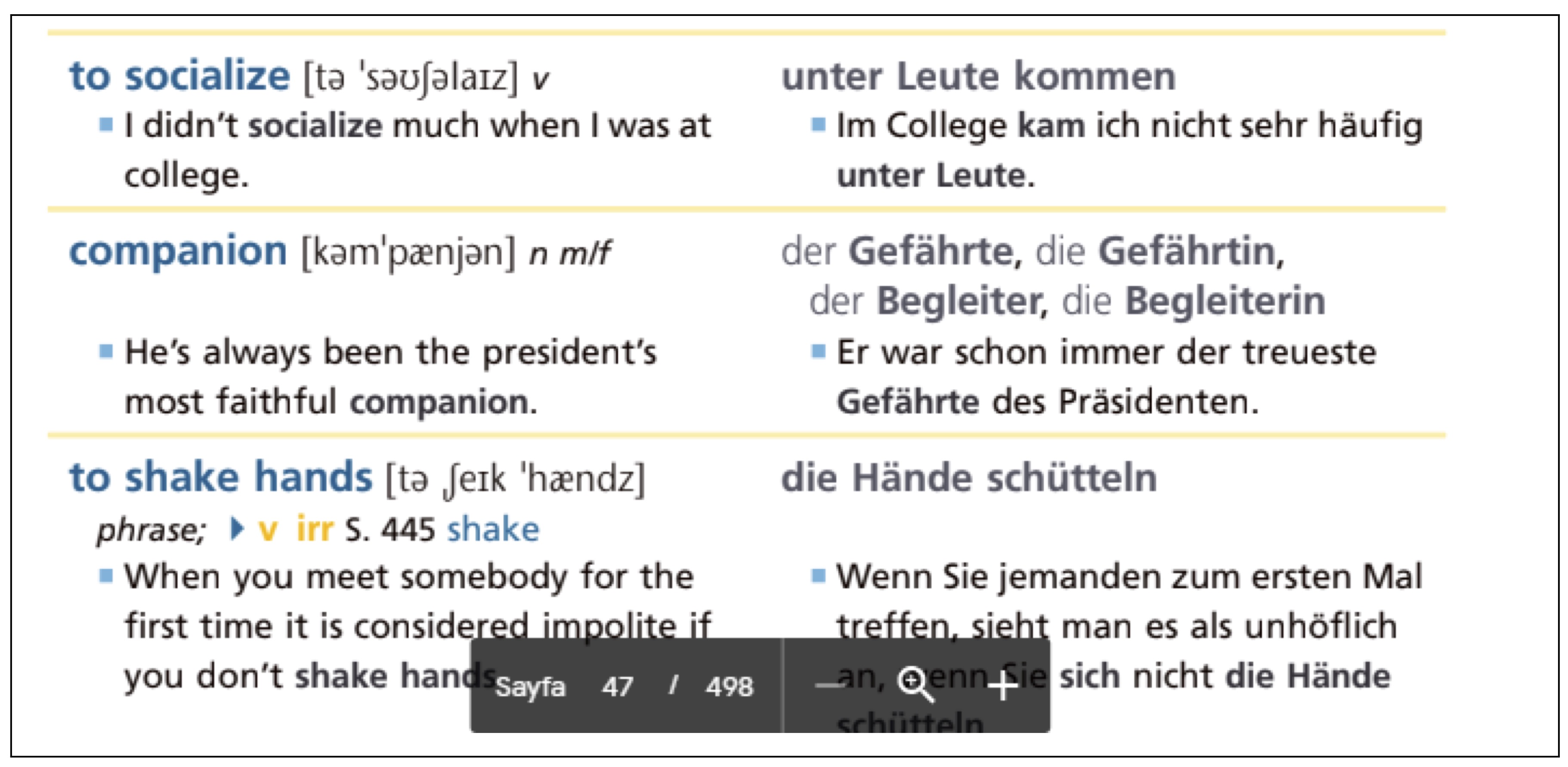
His experience learning English showed the research participant that learning words in combination (i.e., as multi-word units) enhances vocabulary retention and contributes to fluency. With the help of contrastive analysis, he focused on multi-word units in translational equivalents and attempted to learn them as wholes. Figure 1 shows that he was paying special attention to word combinations like ‘shake hands with’ in the contrastive study of German. That approach to lexical learning proved to be highly rewarding for his learning. His realization that learning words with combinational properties is more effective and resembles natural language learning prompted his search for dictionaries with examples of usage, collocational information, and idiomatic use of words. Even the most elaborate dictionaries were limited in that regard. So, he turned to online resources, which were still in their infancy by then. To his astonishment, the potential of computers in language learning became apparent to him when he found out that he could make a corpus search for any lexical combination.
Figure 1
A Section from the Basic Vocabulary Book German – English
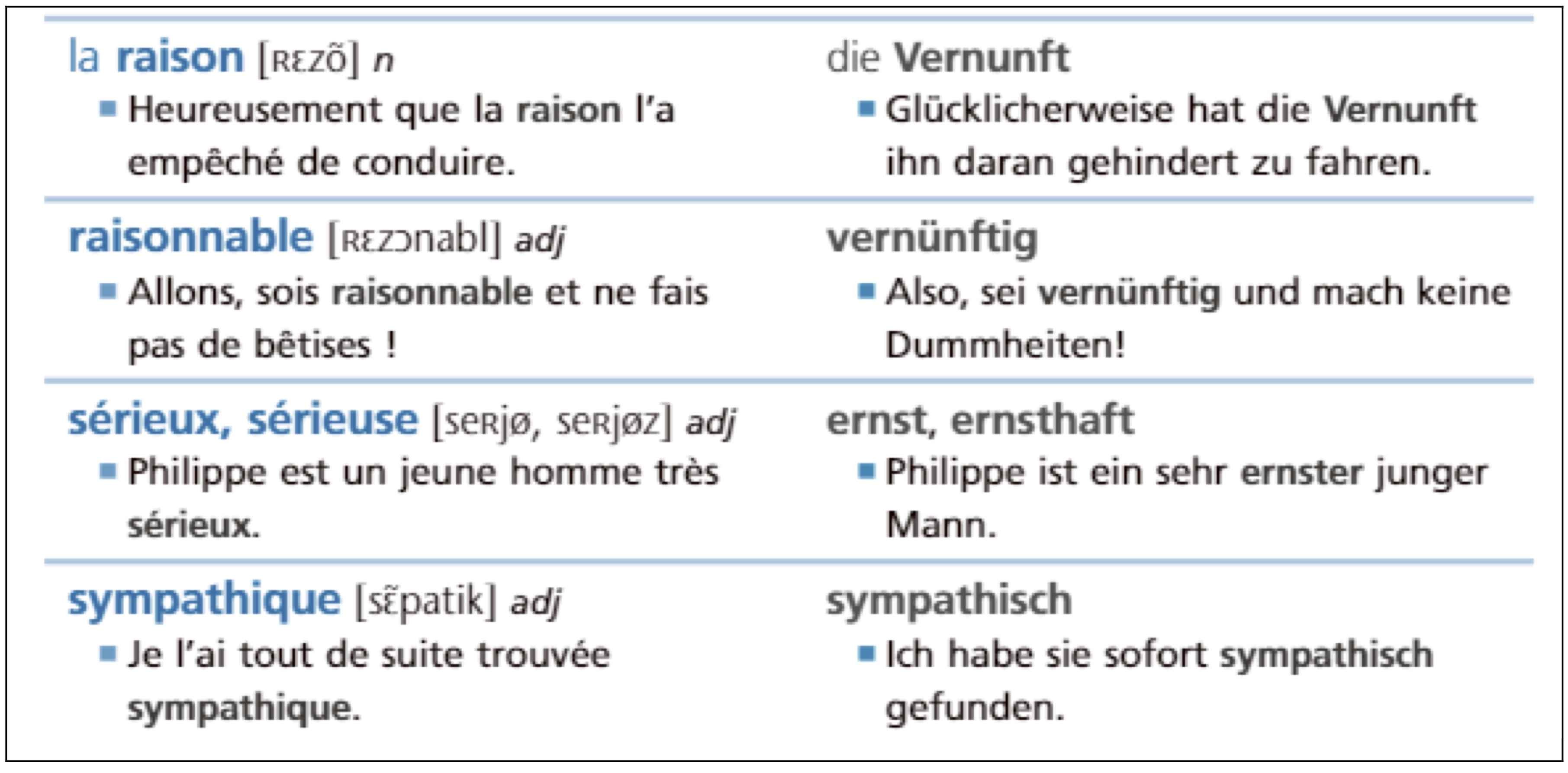
As an experienced language learner and applied linguist, he considered this point as his initiation to the computer-assisted language learning domain. Even the most comprehensive dictionaries released their computer versions on CDs. The advancements in digital language learning technologies come with a bewildering variety of choices and gave him new impetus. He soon replaced his paper-based reference materials with their digital versions. He started to use his bilingual basic vocabulary book in digital format on his computer as a PDF file along with newly supplemented MP3 audio files containing the pronunciation of example sentences in two languages. He regularly listened to the MP3 version of the material on his car stereo as he commuted to work. He also found some audiobooks in German and listened to them when he was on the move, exercising, or commuting. The flexibility afforded by digital materials to study language anytime and anywhere was a welcome innovation to him. As a self-directed language learner, he discovered that computer/digital/online technologies could greatly reduce the time and effort to learn languages. Around that time, he made the decision to supplement his language-learning experience with a new language besides English and German, which he had already become proficient in. With the advent of the internet and his tried-and-tested methods, he thought he could cope with a totally new language. He started learning French using the same basic vocabulary teaching series for learners in Germany. This time, translational equivalents for words in sentences were in French and German (see Figure 2).
In the next step, he routinely listened to the MP3 audio files of a basic French vocabulary book as he commuted to work. He realized that his knowledge of two previous languages and his metalinguistic knowledge were of great help in learning and understanding French. In a very short time, he improved his receptive knowledge of the new language. He was able to read authentic materials in French with ease; however, he had a hard time turning that receptive knowledge into a productive one. He was not able to link several words together. To remedy that problem, he focused purely on audio-based materials designed to help learners develop their aural and spoken knowledge of French. He used Pimsleur’s French series in MP3 format. Thanks to spaced and gradual practice, he benefitted greatly from the series and could produce medium-length sentences in French.
Figure 2
A Section from the Basic Vocabulary Book French-German
Google Translate for Learning/Improving German, French, Italian and Spanish
The latest addition to the research participant’s line of language learning tools was Google Translate, which was not originally designed for language teaching purposes at all. His discovery of it as a tool to learn languages came when he saw that the translations offered to the English language as the source language were exact in meaning. As a self-learner without any access to native speakers for feedback, he discovered that he could use it to get feedback for his sentences in German and French. To practice his productive knowledge of the two languages using Google Translate, he invented the method of writing down or speaking his sentences in either of the two languages (German or French) and writing the idea in Google Translate’s English section as source language so that he could get nearly exact translation in any of the two languages. Using Google Translate to get immediate feedback for correction proved highly efficient, and he was able to form sentences in French and German using his knowledge of English, which served as the source language. As stated above, his use of English as a source language rather than his native language, Turkish, was that the level of accuracy in translations between English and common European languages was exceptionally high. He precluded the possibility of native language interference at a subconscious level by not using his native language.
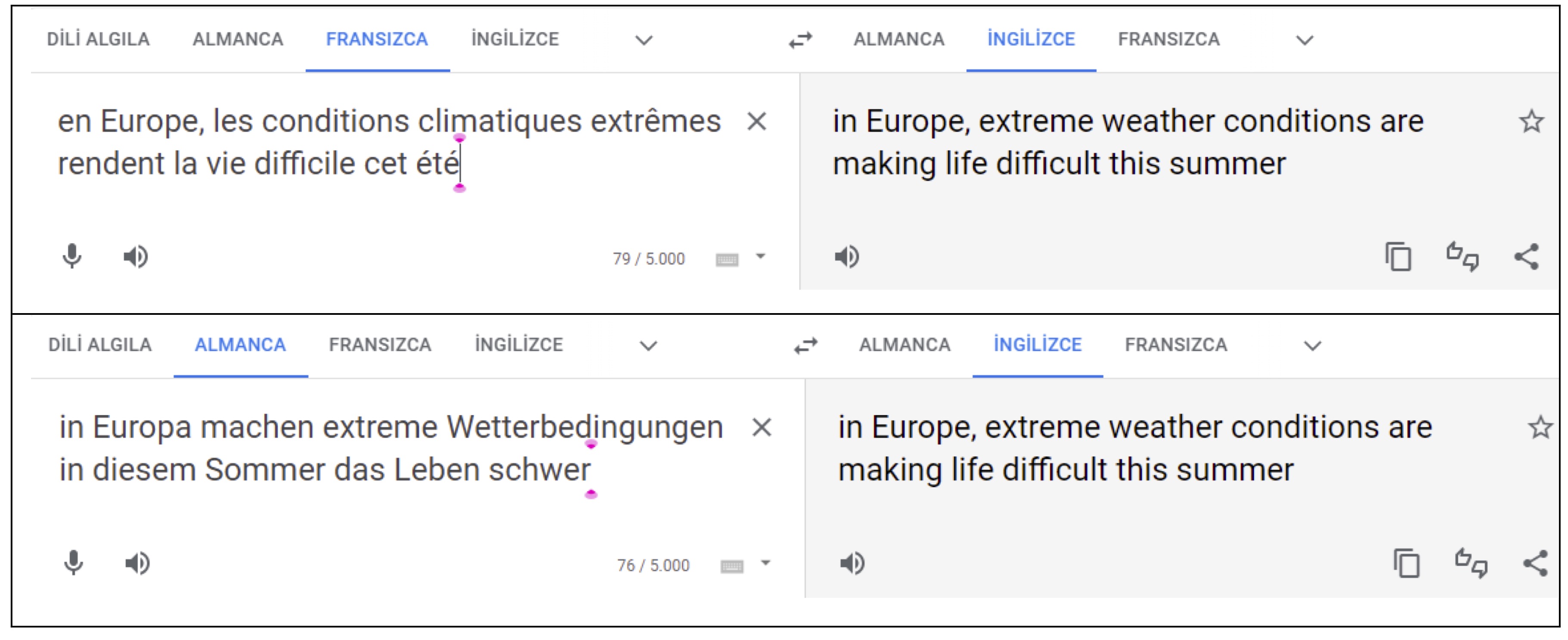
The diversity of use offered by different features of Google Translate allowed him to extend its use to develop his other skills, such as speech intelligibility. To test whether the computer could recognize and correctly transcribe his words, he said German/French sentences and checked transcribed sentences on the screen. By setting the language he wanted to practice as the source language on Google Translate, he tried to express ideas in his mind in sentences in French/German, and he expected the computer to recognize and transcribe his utterance on the left side of the screen (Figure 3). The accurate translation of his transcribed sentence served as immediate feedback. With the help of this feature on Google Translate, he could practice saying any idea in any language he has learned (Figure 4).
Figure 3
Example Showing how Google Translation is Used for Feedback
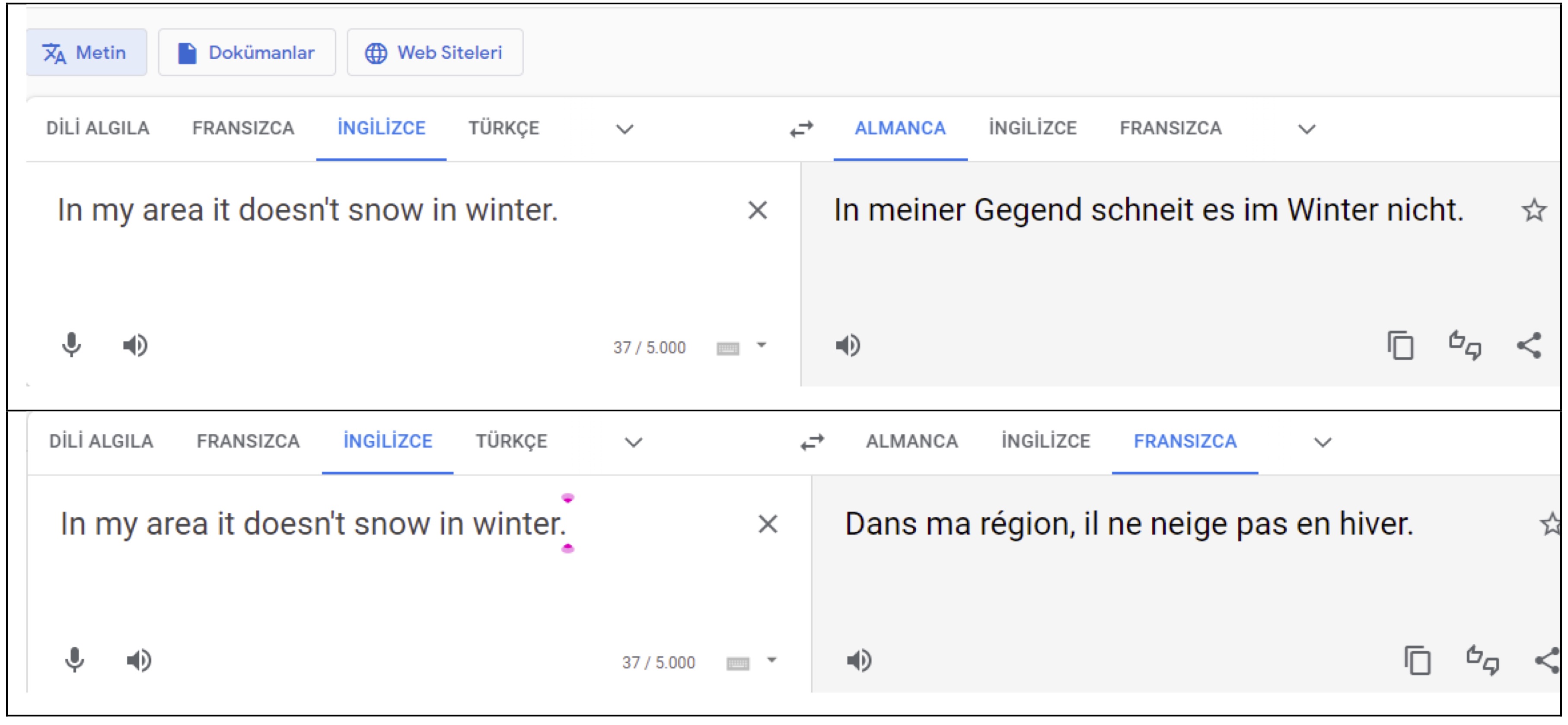
Figure 4
Example Showing How Google Translate is Used for Developing Speaking
As a long-term autonomous language learner and scholar in applied linguistics, he tried to exploit his idiosyncratic techniques to learn Spanish and Italian, the languages that he found to be closely related to French. Using the proximity of the two languages to French, he realized that quick learning gains were possible in terms of vocabulary and grammar structures. His assumption held true as his reading comprehension in both languages emerged shortly after the beginning of his synchronous study of Italian and Spanish. His usual practice this time was to use the pop-up translation feature of Google translation in Chrome internet browser and to compare the translated part (see Figure 5).
Figure 5
Example Showing How Google Pop-up Translation is Used for Reading Comprehension and Vocabulary Development in Spanish
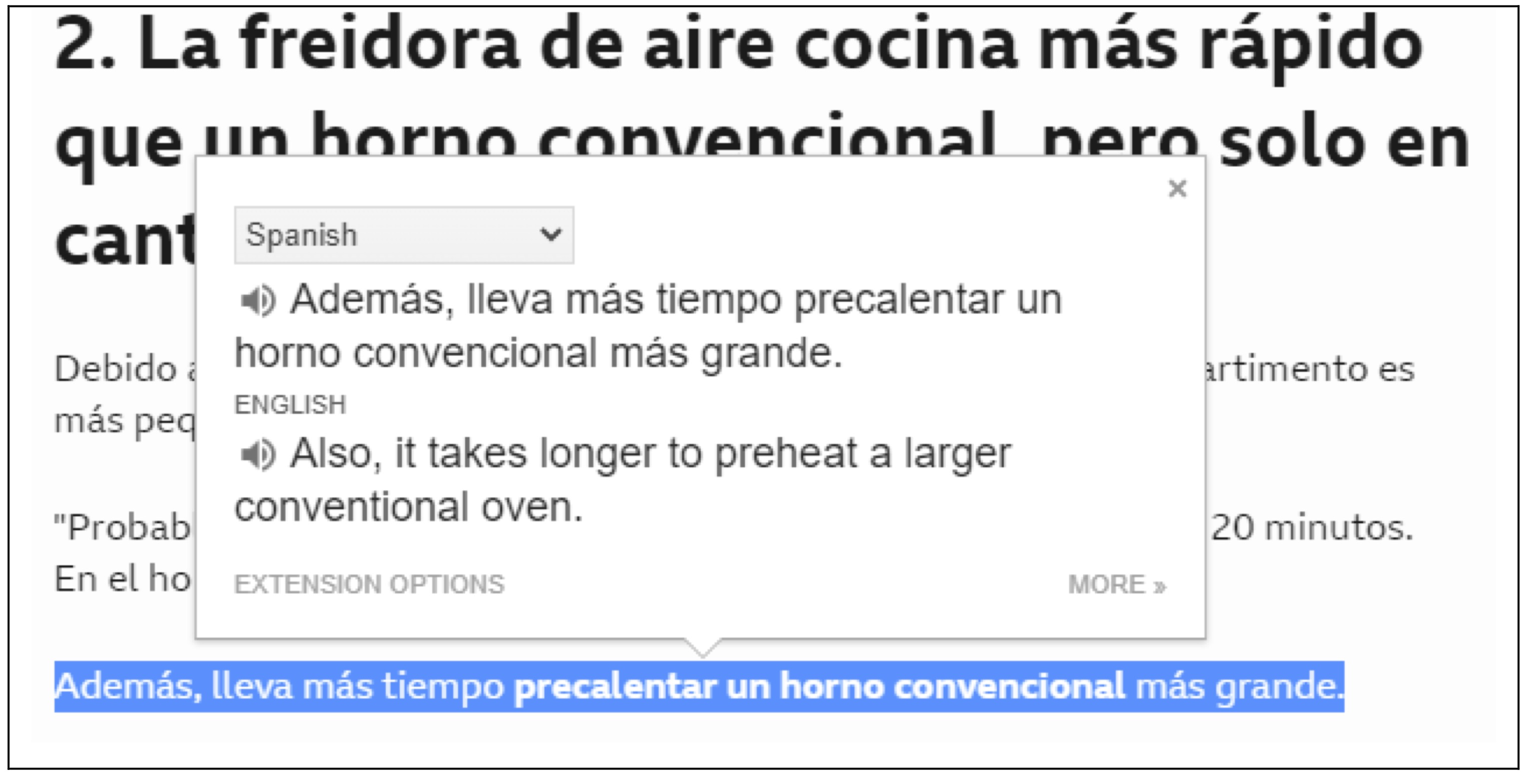
The same technique was used for reading comprehension in Italian. With the help of this technique, he could read authentic materials in two languages. This rapid gain was possible within a span of one year in comparison to his former language-learning attempts before the use of computers. In addition, he used the similar Google translation techniques that he formerly used to develop his productive knowledge of French, mentioned in the previous section, to improve his spoken Spanish and Italian.
Conclusion
It seems that there is not an all-encompassing and single language teaching/learning method that can completely meet the needs of digital second language learners. Nevertheless, one ubiquitous characteristic across all distinct language teaching/learning methods is that they provide learners with target language input. Through specific methods, the input can be presented in rote form, while in others, it is presented meaningfully. The learners are expected to ‘take in’ or ‘absorb’ the input depending on the respective method. Consequently, the underlying decision on how to present the input to language learners is a series of considerations: the span of instructional time, the scope of learning, the context of learning, and contemporary technological aids. Among those considerations, contemporary technological aids greatly shape today’s language-learning contexts with timely restrictions.
The introduction of the microchip into language classrooms marked a major change in the direction of language teaching/learning practice. For the first time, it enabled learners to gain access to L2 input in audio form, which was not possible before the invention of the microchip. The form of presenting L2 input in audio format turned the focus of attention to listening and speaking. By being able to decode written language through computer assistance, the learners came to the realization that they need to master L2 sounds in listening and speaking. The gateway to this was the use of audiolingual materials either in language laboratories or personal audio players. The ubiquitous use of such gadgets in teaching/learning contexts led to the creation of a range of instructional materials enabling learners to get access to enriched L2 input, and even, in some cases, self-study in target language independently of classroom environments became possible.
Within the scope of this research study and the discussions and findings it represents, it is possible to highlight that autonomous learners are often against inefficient instructional methods that prepare them for failure through memorization and rote learning practices. On the contrary, autonomous learners prefer “authentic and meaningful use of language,” which is indeed possible with computer-assisted autonomous language learning. Autonomous learners, regardless of the subject in mind, have significant milestones in their learning process that function as a turning point, as supported by the following accomplished language expert’s claim:
A turning point in my learning occurred when I distanced myself from instructed language teaching and decided to become an autonomous learner as I took charge of my own learning through independent study. From that moment on, I got the idea that language learning was not as hard as I had first assumed and reassured myself that it could be a surmountable and enjoyable undertaking (Vural, 2022, p. 280).
Computer-assisted autonomous learning also allows culturally flexible access to a variety of resources without needing to live in different cultures to learn: “I had no idea that knowledge of English would have practical implications in real life as a lingua franca” (Vural, 2022, p. 280). Autonomous computer-assisted language learning opened up new avenues to see the world from a different angle. This new angle seemed much more meaningful for preferred and functional learning: “I lived in a very isolated social and cultural milieu in which my window to the outside world was limited to what I could glean from TV and read in the books” (Vural, 2022, p. 280). Therefore, it is significant to call attention to the availability of rich and instant resources when the subject matter is computer-assisted autonomous language learning.
It should be remarked that accessing foreign languages was not possible, and this despair reflects an outcome just because the technology was out of reach due to a lack of resources and materials. Regardless of the technological advancements taking place in more resourceful and economically independent places, not all students are lucky enough to have access to computers and internet connections to make autonomous language learning part of their education, no matter how dedicated, motivated, or smart they are. This is one of the most significant limitations of autonomous computer-assisted learning.
On the other hand, computer assistance and motivation for autonomous learning are found to be the determinative indicators and variables that provided success in this case study. This research study exemplified the possibilities of autonomous computer-assisted language learning. The research participant in this case study never gave up on learning through self-motivation for autonomous learning; however, access to digital devices, and lately to Google Translate provided him with a new transformational method of his own in which he could listen, pronounce, and learn an infinite set of linguistic data through a comparative self method, which is a quite innovative and functional self language learning method. Google Translate made this data comparison possible for this autonomous, highly accomplished case. Further similar studies could shed light on other effective computer-assisted methods used by highly autonomous learners.
Notes on the Contributors
Eda Başak Hancı-Azizoglu gained her Ph.D. in English Language from Indiana University of Pennsylvania with a double major in Composition/Rhetoric and Applied Linguistics/TESOL. She has extensive English Language teaching experience in American public schools and universities. She served as a chair in English Departments, where she developed English language programs depending on her students’ unique and diverse needs.
Ersen Vural teaches both undergraduate and graduate-level applied linguistic courses to prospective English language teachers. His research interests are cross-disciplinary innovative approaches to vocabulary acquisition, cognitive applied linguistics methods, and multilingualism. He gained mastery of several European languages, including German, French, Spanish, and Italian, by tapping into the potential of autonomous language learning.
References
Amjadiparvar, A., & Zarrin, G. (2019). The relationship between EFL learners’ level of language awareness and their motivation and achievement. The Journal of Language Learning and Teaching, 9(2), 37–48 .
Ammar, A., Lightbown, P., & Spada, N. (2010). Awareness of L1/L2 differences: Does it matter? Language Awareness, 19(2), 129–146. https://doi.org/10.1080/09658411003746612
Azevedo, R., Mudrick, N. V., Taub, M., & Bradbury, A. E. (2019). Self-regulation in computer-assisted learning systems. In J. Dunlosky & K. A. Rawson (Eds.), The Cambridge handbook of cognition and education (pp. 587–618). Cambridge University Press. https://doi.org/10.1017/9781108235631.024
Barkhuizen, G., Benson, P., & Chik, A. (2013). Narrative inquiry in language teaching and learning research. Routledge.
Bennett, S., Maton, K., & Kervin, L. (2008). The ‘digital natives’ debate: A critical review of the evidence. British journal of educational technology, 39(5), 775-786. https://doi.org/10.1111/j.1467-8535.2007.00793.x
Bianchi, N., Lu, Y., & Song, H. (2022). The effect of computer-assisted learning on students’ long-term development. Journal of Development Economics, 158, 102919. https://doi.org/10.1016/j.jdeveco.2022.102919
Chen, X., Zou, D., & Su, F. (2021). Twenty-five years of computer-assisted language learning: A topic modeling analysis. Language Learning & Technology, 25(3), 151–185. http://hdl.handle.net/10125/73454
Egbert, J. (2005). CALL essentials. Principles and practice in CALL classrooms. TESOL.
Fairclough, N. (2013). Critical discourse analysis: The critical study of language. Routledge.
Derwing, T. M. (2017). The role of phonological awareness in language learning. In P. Garrett & J. M. Cots (Eds.), The Routledge handbook of language awareness (pp. 339–353). Routledge.
Fortune, A. (2005). Learners’ use of metalanguage in collaborative form-focused L2 output tasks. Language Awareness, 14(1), 21–38. https://doi.org/10.1080/09658410508668818
Guimarães, B., Firmino‐Machado, J., Tsisar, S., Viana, B., Pinto‐Sousa, M., Vieira‐Marques, P., Cruz-Correia, R., & Ferreira, M. A. (2019). The role of anatomy computer‐assisted learning on spatial abilities of medical students. Anatomical sciences education, 12(2), 138–153. https://doi.org/10.1002/ase.1795
Guimarães, B., Ribeiro, J., Cruz, B., Ferreira, A., Alves, H., Cruz‐Correia, R., Madeira, M. D., & Ferreira, M. A. (2018). Performance equivalency between computer‐based and traditional pen‐and‐paper assessment: A case study in clinical anatomy. Anatomical sciences education, 11(2), 124–136. https://doi.org/10.1002/ase.1720
Han, Y., & Reinhardt, J. (2022). Autonomy in the Digital Wilds: Agency, Competence, and Self‐efficacy in the Development of L2 Digital Identities. TESOL Quarterly. https://doi.org/10.1002/tesq.3142
Hancı‐Azizoglu, E. B. (2018). Creative writing as a second language: What is creativity for second language writers? TESOL Journal, 9(4), 1–13. https://doi.org/10.1002/tesj.424
Hancı-Azizoglu, E. B. (2020). Language Awareness and Second Language Acquisition: Is there a link? Bartın University Journal of Faculty of Education, 9(3), 721–732. https://doi.org/10.14686/buefad.764394
Hubbard, P., & Levy, M. (2016). Theory in computer-assisted language learning research and practice. In The Routledge handbook of language learning and technology (pp. 24–38). Routledge.
Inuwa, I. M., Taranikanti, V., Al‐Rawahy, M., & Habbal, O. (2012). Anatomy practical examinations: How does student performance on computerized evaluation compare with the traditional format?. Anatomical Sciences Education, 5(1), 27–32. https://doi.org/10.1002/ase.254
Johnson, E. O., Charchanti, A. V., & Troupis, T. G. (2012). Modernization of an anatomy class: From conceptualization to implementation. A case for integrated multimodal–multidisciplinary teaching. Anatomical sciences education, 5(6), 354–366. https://doi.org/10.1002/ase.1296
Johnston, J., & Ksoll, C. (2017). Effectiveness of interactive satellite-transmitted instruction: Experimental evidence from Ghanaian primary schools. CEPA working paper no. 17–08. Stanford Center for Education Policy Analysis.
Kennedy, S., & Trofimovich, P. (2010). Language awareness and second language pronunciation: A classroom study. Language Awareness, 19(3), 171–185. https://doi.org/10.1080/09658416.2010.486439
Kotarcic, A., & Swiggers, P. (2020, January). Language and language consciousness in Aristotle. [Presentation]. In XXXI. Internationales Kolloquium des SGdS: Sprache und Sprachbewusstsein in der Geschichte der Sprachwissenschaft, Europa-Universität, Flensburg, Germany.
Kramp, M. K. (2003). Exploring life and experience through narrative inquiry. In Foundations for research (pp. 119–138). Routledge.
Lai, C. (2019). Technology and learner autonomy: An argument in favor of the nexus of formal and informal language learning. Annual Review of Applied Linguistics, 39, 52–58. https://doi.org/10.1017/S0267190519000035
Lasagabaster D., & Sierra, J. M. (2005). Error correction: students’ versus teachers’ perceptions. Language Awareness, 14(2/3), 112–127. https://doi.org/10.1080/09658410508668828
Levy, M. (1997). Computer-assisted language learning: Context and conceptualization. Oxford University Press.
Levy, M., & Hubbard, P. (2005). Why call call “CALL?” Computer Assisted Language Learning, 18(3), 143–149. https://doi.org/10.1080/09588220500208884
Little, D. (2003). Learner autonomy and second/foreign language learning. Guide to good practice. https://webarchive.southampton.ac.uk/www.llas.ac.uk/resources/gpg/1409.html
Meyer, A. J., Innes, S. I., Stomski, N. J., & Armson, A. J. (2016). Student performance on practical gross anatomy examinations is not affected by assessment modality. Anatomical sciences education, 9(2), 111–120. https://doi.org/10.1002/ase.1542
Muralidharan, K., Singh, A., & Ganimian, A. J. (2019). Disrupting education? Experimental evidence on technology-aided instruction in India. American Economic Review, 109(4), 1426–60. 10.1257/aer.20171112
Mynard, J. (2019). Self-access learning and advising: Promoting language learner autonomy beyond the classroom. Innovation in language teaching and learning: The case of Japan, 185-209. https://doi.org/10.1007/978-3-030-12567-7_10
Navarro-Sola, L. (2019). Secondary school expansion through televised lessons: The labor market returns of the Mexican telesecundaria. Documento inédito.
Oliveira, A. L., & Ançã, M. H. (2009). ‘I speak five languages’: fostering plurilingual competence through language awareness. Language Awareness, 18(3-4), 403–421. https://doi.org/10.1080/09658410903197355
Prensky, M. (2001). Digital natives, digital immigrants part 2: Do they really think differently?. On the horizon, 9(6), 1-6. https://doi.org/10.1108/10748120110424843
Sicola, L. (2005). Communicative lingerings: Exploring awareness of L2 influence on L1 American expatriates after re-entry. Language Awareness, 14(2/3), 153–169. https://doi.org/10.1080/09658410508668831
Sauro, S., & Zourou, K. (2019). What are the digital wilds? Language Learning & Technology, 23(1), 1–7. https://doi.org/10125/44666
Teng, F. (2019). Understanding teacher autonomy, teacher agency, and teacher identity: Voices from four EFL student teachers. English Teaching & Learning, 43(2), 189–212. https://doi.org/10.1007/s42321-019-00024-3
Veneri, D. (2011). The role and effectiveness of computer-assisted learning in physical therapy education: a systematic review. Physiotherapy Theory and Practice, 27(4), 287–298. https://doi.org/10.3109/09593985.2010.493192
Verdugo, D. R. (2006). A study of intonation awareness and learning in non-native speakers of English. Language Awareness, 15(3), 141–159. https://doi.org/10.2167/la404.0
Vural, E. (2022). An idiosyncratic case of multilingualism: The effect of autonomous learning. In E. B. Hancı-Azizoglu, S. Sahinkarakas, & D. Tannacito (Eds.)., Autoethnographic Perspectives on Multilingual Life Stories (pp. 279–292). IGI Global.
Williams, V. (2011). Digital divides among “Digital Natives.” https://ncu.repo.nii.ac.jp/?action=pages_view_main&active_action=repository_view_main_item_detail&item_id=303&item_no=1&page_id=13&block_id=17
Yiakoumetti, A., Evans, M., & Esch, E. (2005). Language awareness in a bidialectal setting: the oral performance and language attitudes of urban and rural students in Cyprus. Language Awareness, 14(4), 254–260. https://doi.org/10.1080/09658410508668840
Zock, M., Lapalme, G., & Fang, L. J. (2015). Become fluent in a foreign language by using an improved technological version of an outdated method. Journal of Cognitive Science, 16(2), 151–175. http://doi.org/10.17791/jcs.2015.16.2.151
Appendix
Please reflect on your language learning experience, and answer the following prompts:
- How did you learn your additional languages?
- What do you think differentiates you from other language learners?
- What worked and did not work during your language learning process?
- What kind of unique strategies did you use while learning additional languages?
- What are the digital/computational techniques you used to master the languages you know today?
Some excerpts to prompt questions are as follows:
- What do you think differentiates you from other language learners?
My experience of starting to learn a foreign language at age twelve was filled with moments of frustration. At the time, the language classes were characterized entirely by rote learning of language forms. Learners were not expected to use their memorized knowledge of language to communicate. The activities were not meaningful for me and did not make sense. For example, when we were supposed to rote learn the ‘underlying rules’ for reported speech, I had no idea why we should change the tense of a sentence to another past form or change certain words like ‘yesterday’ in the direct utterance to the word ‘the day before’ in the reported sentence. But all my tediously learned rote knowledge during English classes at my home country proved to be useless when I was confronted as a teenager with the challenges of real communication with others during my stay in Germany. This was a turning point in my perspective change to the process of language learning as it demonstrated that the real value of language learning lies in communication rather than studying structures. With a new look to the task of language learning, my focus shifted from forms to meaning at an early stage of my learning journey. That kind of new mindset set me apart form from fellow learners who continued to preoccupy their mind with grammatical accuracy. To my surprise, language forms started to ‘emerge’ on their own from meaning as the byproduct of my sustained interest in using language for meaning making purposes.
- What are the digital/computational techniques you used to master the languages you know today?
Even very simple digital tools which we take for granted today like PDF files and MP3 audio files were the pillars of my learning at the initial stage of using computers to enhance my learning. With the help of the internet, I could access the PDF files of useful language learning books published around the world. For example, when I discovered a basic vocabulary series by a publisher in Germany I could access and even download the PDF files and accompanying MP3 audio files of the series using my computer. Before the internet, I would have had to travel to Germany to obtain those materials. Again, some long-established popular language teaching recourses like ‘Pimsleurs audio courses’ were offered online for downloading. With the help of downloadable MP3 files, I could listen to the high-quality sounds of native speaker courses on the move while commuting. With the development of internet-based tools like Google Translate, I could adapt some services to my own learning context. For example, I used Google Translate to decode the grammar of the target language implicitly. I found out that the more reading I did with the help of Google translation the better I got in implicitly mastering the grammar of the target language.
 SiSAL Journal