
David Gardner, University of Hong Kong, Hong Kong
Ken Lau, University of Hong Kong, Hong Kong
Ming-i Lydia Tseng, Fu Jen Catholic University, Taiwan
Li-Tang Yu, National Tsing Hua University, Taiwan
Yun-Pi Yuan,, Fu Jen Catholic University, Taiwan
Gardner, D., Lau, K., Tseng, M. L., Yu, L-T., & Yuan, Y-P. (2023). Language Learning beyond the classroom in an Asian context: Obstacles encountered.Studies in Self-Access Learning Journal, 14(2), 106–135. https://doi.org/10.37237/140202
Abstract
Framed by the notion of Learning Beyond the Classroom (LBC), the study reported here examines the underexplored area of learners’ perceived obstacles to LBC and their locus of control when autonomously engaging in learning or practicing English beyond the classroom. One hundred and seventy-three EFL students from a mandatory General English programme in a Taiwanese university participated in the study by completing a written reflection on their autonomous-learning experiences which included details about the learning affordances they made use of, their successes and struggles, their attitudes, and their motivation. This paper focuses on the obstacles they encountered. Findings show that there were broadly eight types of obstacles reported by the participants, with language difficulties, affect and motivation most frequently mentioned. Although there is no clear-cut pattern of associations between the obstacles participants reported encountering and the language learning affordances they reported using, it is apparent that certain obstacles were more closely related to particular limited uses of affordances.
Keywords: Learning beyond the classroom, obstacles, affordances, Taiwan, EFL learners
There is an increasingly important line of research examining learning beyond formal, institutionalised classroom settings (see, for example, Lai, 2017; Lai & Zheng, 2018; Reinders & Benson, 2017; Richards, 2015; Welch Bacon & Gaither, 2020) which is often characterised as learning beyond the classroom (LBC henceforth), an area identified as “a field ripe for the development of new research agendas” (Reinders & Benson, 2017, p. 561). LBC recognizes the limitations posed by classroom-based learning such as class size and curriculum constraints; and offers flexible alternatives. Indeed, ease of access to information through the Internet, the growing popularity of mobile-assisted language learning (Chen, 2013), and greatly enhanced mobility over the last few decades, have “rapidly expanded the affordances for foreign language learning and use beyond the classroom” (Benson, 2016, p. 110).
LBC has often been treated as an extension of teaching, playing a supplementary role to in-class instruction (Lehtonen, 2017). However, Benson (2011, 2017) considers that “in-class” vs “out-of-class” is not a helpful dichotomy and suggests instead an ecological view in which an individualised combination of settings constitutes a learner’s learning environment. This is a more holistic approach to the situated understanding of learning in which learning manifests itself as “meaning-making” (Lehtonen, 2017, p. 50) opportunities under the control of the learners themselves.
This paper reports a study of LBC among tertiary level students in an East Asian context. It starts with a brief review of LBC in the East Asian context, it then outlines the theoretical framework and methodology of the study, presents the findings and finishes with a discussion.
LBC in East Asian Contexts
The education systems of East Asia are influenced by Confucian philosophy (Gardner & Lau, 2018; Marginson, 2011) which results in an exam-oriented educational culture. The use of English in most of the region is largely confined to classroom settings or academic usage with limited exposure to English for daily communication. Learner autonomy, which is a key contributing factor to the success of LBC (Hsieh & Hsieh, 2019; Mynard, 2019), is often considered within the region as a Western educational concept unfamiliar to the Eastern world (Liu, 2011). This combination of factors produces a sociolinguistic environment that seems to demotivate learning/enhancing English beyond the classroom, questioning the viability of LBC in the region.
There are few research studies of LBC within this region. In China, Lai et al. (2015) surveyed middle school students with respect to the quantity, types and nature of their LBC. They found that LBC which focused on meaning complemented in-class activities which focused on form, producing a positive impact on grades. Lai (2015) examined the learning experiences of a small group of tertiary foreign language learners in Hong Kong who perceived in-class instruction as pivotal to their acquisition of the basics but out-of-class learning “drew them closer to the language and culture, supported the formation of a positive L2 identity, boosted their learning efficacy, sustained their motivation to learning, helped them to develop a sense of community and set them on a trajectory to learn more” (p. 280).
Particularly relevant to our study is the research of Hsieh and Hsieh (2019) exploring the relationship between the autonomous learning behaviours of a group of Taiwanese students and their use of a university self-access centre’s affordances. Interview data and learning logs in that study showed a positive correlation between the degree of learner autonomy and usage of learning affordances. The researchers recommended the use of learning activities linking classroom learning to the affordances of the learning-centre as a way of fostering LBC.
LBC has been greatly facilitated by advances in mobile technologies in recent decades. Barrs (2011), for instance, observed a significant proportion of Japanese students made use of their smartphones for language learning out-of-class such as undertaking pronunciation practice using a Google app and watching English news through news media apps. Also in Japan, a tailored educational social networking platform was built to successfully develop a group of university students’ communicative competence outside the classroom (Okumura, 2016). In China, Wu (2018) used a popular instant messaging app (WeChat) to construct an online community to enable students to engage in out-of-class discussions about the topics covered in their English course. Through meaningful interactions, students in this group learnt collaboratively as they benefitted from peer and teacher feedback. The multimodal nature of the interactions also compensated for students’ linguistic deficiencies.
While LBC remains relatively rare in East Asia, it is clear from the above review that it is a viable educational option. However, previous research says little about potential obstacles to the use of LBC within the region. This study attempts to contribute to filling this gap.
Theoretical Orientation
LBC has been researched from the perspectives of effectiveness (e.g., Lau, 2017), integration (e.g., Law, 2017), teachers’ roles (e.g., Long & Huang, 2015), learners’ beliefs (e.g., Lai, 2019), learner advising (e.g., Mynard, 2019) and technological stimulus (e.g., Welch Bacon & Gaither, 2020). This study examines how learners perceive obstacles presented by LBC. We use Benson’s (2011) LBC framework, detailed below, to interpret our participants’ reflective accounts of the obstacles they encountered.
Benson’s LBC Framework
Four distinct dimensions, location, formality, pedagogy and locus of control, constitute the building blocks of Benson’s LBC framework (2011). Location refers to a physical environment which is essentially the defining characteristic of learning beyond the classroom. Extracurricular activities like ‘English movie night’ organized to extend the knowledge covered in regular English lessons is an example of ‘location.’ While activities considered as LBC predominantly happen ‘out of class,’ they can also be contextualised within an ‘in-class’ setting which takes place after formal schooling such as attending tutorial schools. In other words, the scope of the location dimension in LBC is fairly broad and the remaining dimensions all anchor to it.
The dimension of formality refers to “the degree to which learning is independent of organized courses leading to formal qualifications” (Benson, 2011, p. 10). This can be complex. Typically, second/foreign language learning is embedded in the curriculum structure, which is formal, but elements of LBC may also be incorporated within that same curriculum. For example, at an international university in Hong Kong, students are not able to graduate from their major without passing academic literacy courses, many of which also include LBC components (see, Gardner & Lau, 2019; Lau & Gardner, 2019 for details). The growing attention LBC has attracted is also partly due to the recognition of the importance and benefits of informal and social learning (see, for example, Lai & Lyu, 2019). Gao (2008), while researching English Corners (places where language learners meet to practice together), a popular form of LBC in Mainland China, found that the participants became more autonomous and experienced “subtle changes in their self-identities” (p. 60). Focusing on workplace literacies, Lau (2012) illustrates how students engaged in internships learnt to act and write like their professional counterparts through a range of informal encounters and social interaction with expert members. These critical learning events, albeit informal, are crucial to the development of the professional practices and identities of these novices.
The third dimension conceptualises pedagogy as a continuum from naturalistic to self-instructed language learning. Lau and Gardner (2019) found in a study of Hong Kong first-year university students’ preferences for out-of-class options that high entertainment value activities (such as watching foreign movies) were, unsurprisingly, rated highly. This kind of activity is considered naturalistic as learners expect to pick up the language incidentally. Other LBC activities are specifically designed to be educational such as TV programmes produced by institutions offering distance learning degrees. This is considered ‘instructed’ as it involves “formal processes, such as sequencing of materials, explicit explanation, and testing” (Benson, 2011, p. 11).
The final dimension, the locus of control, is of most relevance to our study as it underlies decision-making about what and how to learn, and what to do next. Sometimes learning decisions are made by learners themselves but sometimes decisions are imposed. This dimension is also emphasised by concepts such as self-access and independent/autonomous learning. For example, Lai et al. (2013) found that teachers new to promoting self-access learning were surprised they needed to control learning less than they had originally expected.
Objective of This Study
The study reported here was conducted with Taiwanese university students as they engaged in LBC. This paper focuses specifically on the aspect of the study which looked at participants’ perceptions of obstacles to their LBC and is guided by the following research question: What obstacles do Taiwanese EFL university students perceive impact on their self-access language learning experiences?
Methodology
Context and Participants
Participants were enrolled in a mandatory General English (GE) programme in a private, comprehensive university located in the northern part of Taiwan. The programme develops students’ English proficiency and includes a variety of English learning courses and activities. The programme also includes a self-access learning component during which participants engage in LBC.
The university has demonstrated its commitment by establishing a Self-Learning Center (SLC) for self-access English language learning which is recognised as facilitating learner autonomy (Gardner, 2022). This provides a popular venue for the participants’ LBC although it is not the only option. The SLC partners with other facilities on the campus to provide support, such as the Holistic Education Centre, the Resource Centre for Foreign Language Teaching and Digital Learning, the university library as well as the academic departments of the university. The SLC and its partners jointly promotes learner autonomy and English proficiency through a variety of meaningful and interesting activities, covering language skills training and the promotion of intercultural awareness. These include a writing clinic, online conversation tutoring, an international corner and cloud discussion forum promoting cultural awareness, English corner sessions, board games, theme-based movie-watching sessions, TV series, social media, and workshops on English for Professional Purposes.
On entering the university, students take ‘Freshman English,’ a year-long, two-credit course which includes a mandatory self-access learning component which contributes at least 10% towards the course grade. Students are streamed into beginner, intermediate, or advanced level classes based on their scores in the English subject in the College Entrance Examination. In the following year, students are required to earn an additional four foreign-language credits (although not necessarily in English).
The 173 study participants were aged 19-20 and all enrolled in advanced-level Freshman English classes. They participated in the study at the end of the semester in which they had been engaged in LBC. They had previously received English instruction for nearly 12 years. Their academic majors included international business administration, mass communication, and foreign languages. This broad coverage of disciplines enhances the generalisability of the study’s results.
Ethical Consideration
The nature of the research and participants’ rights were clarified for participants who were informed they could withdraw at any time. Participants signed a consent form (Appendix 1*). All data collection was anonymous. The data collection instrument carried no markers of identity and was handled by researchers who were not the participants’ class teachers. The collected data although handwritten was not shown to class teachers to prevent recognition of handwriting.
Research Instruments
Prior to the data collection participants were involved in a workshop about reflecting on their prior self-access learning activities. English was used in the workshop for presentation, the documents and teacher-student interactions. During group discussions within the workshop, students were free to use English or their native language but their contributions to workshop documents were made entirely in English. The emphasis on English was considered acceptable because the workshop was part of the General English programme and the students were in the advanced level stream. The workshop explained the importance of reflection as a way of evaluating outcomes and planning for further learning. As part of this workshop, participants were shown examples of weak reflections which simply listed a few words, phrases or incomplete sentences, to dissuade participants from giving incomplete, uncomprehensive descriptions. They were also shown good examples of reflections, with more detailed descriptions of learning experiences (see Appendix 2* for good and bad examples shown during the workshop). Participants also engaged in a practice reflection looking at two fictious students and considering how they might reflect (see Appendix 3*).
Participants were then presented with an open-ended form to reflect individually about their own experiences with LBC (Appendix 4*). This began with them defining “self-learning” and “reflection,” and reflecting on how these concepts impacted on their academic study. Then, they were invited to comment on the LBC activities they had undertaken and to focus on two experiences, one which went well and one which did not. They were encouraged to reflect deeply as a way of gaining from the experience. Borton’s Reflective Model (1970), which has proved a useful framework for reflection (e.g., Chalkright & Nurse, 2017; Skinner & Mitchell, 2016) was used to guide students to clarify their thoughts effectively and efficiently. Using this model, participants were asked to think about: “What” (activity undertaken), “So what” (evaluation), and “Now what” (forward planning). The reflection form was the instrument for the study and responses from the section about an experience which did not go well are the focus of this paper.
Data Analysis
Data analyses were undertaken by means of descriptive statistics and content analysis. Two research assistants digitized students’ written reflections to facilitate data coding. The digitised data was shared among the researchers using Google Sheets. Before data coding, conceptual content analysis (Patton, 2002) was conducted to examine the participants’ reflections and to identify overarching themes and categories. All researchers carefully read through the reflections and inductively explored students’ perspectives of their LBC.
In order to ensure reliability, all researchers initially coded one fifth of the data individually, compared the coding results, and discussed discrepancies. The themes and categories were further refined to more appropriately interpret the data. Then, the same data were re-coded. Following this coding process, inter-rater reliability was checked again. A random sampling of data from individual researchers was conducted. All researchers coded the same data sub-set and the coding results were examined. The inter-rater reliability was 87%. The final coding results were accepted by the researchers. After coding was complete, the frequencies of each category within the various themes were measured.
Results and Discussion
This section begins with a summary of the affordances participants reported using for their LBC in order to provide a context in which to frame the ensuing results and discussion about the reported obstacles they encountered. It then addresses the research question by examining the obstacles participants reported, the frequency with which they mentioned these obstacles, the language skills with which the obstacles were associated and the ways in which participants reported reacting to the obstacles.
The Affordances Participants Reported Using
Participants mentioned ten types of affordances and associated them with a range of language skills (see Table 1). The most frequently used affordance was books (typically novels, short stories, and comics), conversation/speech affordances (like online chatrooms) and videos (of all genres). Least used affordances were phone apps and computer software. The most commonly targeted language skills were practicing or improving speaking (84 mentions), listening (75 mentions) and reading (62 mentions). Affordances were less often associated with developing writing (19 mentions) and vocabulary (17 mentions).
Table 1
Affordances Participants Reported Using for their LBC

The Obstacles to LBC Reported by the Participants
Participants reported eight types of obstacles to LBC (Table 2), the most common of which were language difficulties (42 mentions), affect (16 mentions) and motivation (13 mentions). There are five other types of obstacles which are mentioned far less often. These relate to issues around time (7 mentions), lack of affordances (6 mentions), problems with learning strategies (3 mentions), lack of familiarity with the content of learning materials (2 mentions), and performance-related obstacles (2 mentions). It is also worth noting that many participants did not mention obstacles in their reflections.
Table 2
The Obstacles to LBC Reported by the Participants (Arranged by Frequency)
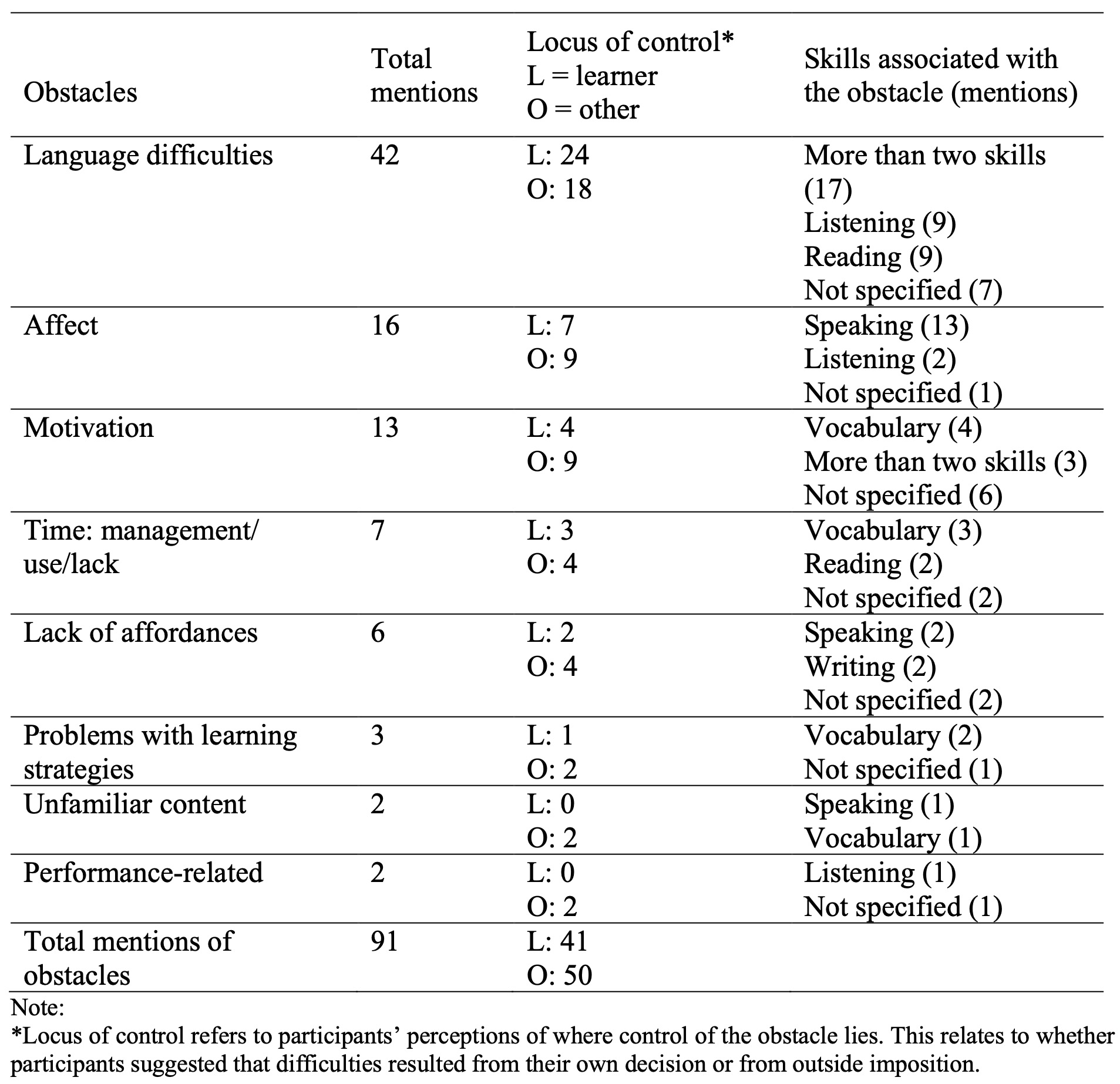
Table 2 also shows an analysis of the participants’ perceptions of where the locus of control lies in relation to the obstacles they report. If, while reflecting, they relate an obstacle to themselves (such as a lack of ability or unwillingness) the locus is considered to be with them. If they relate the obstacle to an outside imposition (such as from a teacher, peer or friend) the locus is considered to be beyond them (and is recorded as other). The results show that participants perceive the locus of control of obstacles as beyond them (50 mentions) more often than with them (41 mentions). Interestingly, although this pattern holds true across most of the data set it is reversed for reflections about language difficulties, the largest sub-set.
Obstacle 1: Language Difficulties
Language difficulties are the largest category of obstacles reported (42 mentions) and are unique in their locus of control being more strongly perceived as being with participants (24 mentions) than being with others (18 mentions). This indicates that participants see such difficulties arising more from their own decisions than from suggestions made by teachers or peers.
Many of the reported language difficulties are associated with more than one language skill, often two skills, such as listening and speaking, reading and listening, or vocabulary and listening. Because of limited prior exposure to oral communication in English in Taiwan, the participants often chose learning affordances to practice listening and speaking skills such as conversation opportunities or video and audio materials. However, they encountered obstacles in understanding particular accents or in speaking in out-of-class settings to native English speakers or to international students, either face-to-face or during online activities (see extracts 1-3). More specifically, they reported encountering difficulties with word usage, sentence structure, pronunciation, and the speed of speaking. Some also mentioned that their English sounded like Chinglish resulting from literal or inappropriate translation.
Extract 1: I tried to watch a BBC news to see if I could understand it even in a different accent. It went no so good [didn’t go well] compared to the talk show experience. I could understand part of it, but there were parts that I totally missed [unable to follow] and couldn’t understand any of it.
Extract 2: Though I can understand what an American is talking about, I can’t answer them well. The words in my head suddenly get disappeared and I can’t organize my speaking. All I can though[t] about [are] very simple words.
Extract 3: To improve my listening, I tried listening an English learning CD, and tried to write down every word I heard. However, I found it very stressful since I couldn’t keep up the speed with the CD. Thus, I gave up.
Many participants used internet or mobile technology affordances such as online chatrooms, videos, podcasts, songs, YouTube videos or movies which is consistent with recent observations of popular means of learning beyond the classroom among other Taiwanese learners (Wang & Chen, 2020). Participants acknowledged in their reflections the informal and authentic language opportunities such affordances offered them. However, they also reported language-related obstacles with online learning materials including: comprehending vocabulary, intonation, accent, speaking speed, cultural connotations and understanding content without subtitles (see extracts 4-6).
Extract 4: I tried to watch an English Disney movie without Chinese subtitles. I watched the whole movie in this way, but I couldn’t really understand the plot in the end.
Extract 5: I tried to watch the CNN news without any subtitles to test my own listening ability. But in fact, it wasn’t that easy since the reporters were really fluent speakers and weren’t able to handle all of the things they have told you. So I gave up.
Extract 6: When I was reading an article that has lots of different words for me, usually, I would not finish my reading completely. Instead, I would stop and try to find every word that I ca[not]n figure out in the dictionary.
Despite these difficulties, participants seemed eager to use online affordances, especially YouTube, and reported trying to overcome the obstacles in order to achieve their intended learning goals. They reflected that they needed to invest “more time,” to devote “more efforts,” or to adopt “effective learning strategies.” Despite these intentions they did not report specific actions or successes.
Obstacle 2: Affect
Some participants felt their failure in LBC activities resulted from affective factors (16 mentions) although they were mostly rather vague, mainly referring to being nervous or bored during their LBC activities (see extracts 7 and 8). However, in some cases participants used terms such as nervous, bored, frustrated alongside a mention of motivation which suggests that these affective obstacles were in some way connected with low or lacking motivation (which is considered more fully below as obstacle 3). There is also a fairly even distribution between participants who perceive affective obstacles as within their own control (seven mentions) or within the control of others (nine mentions). To tackle this obstacle of feeling nervous or stressed, some participants proposed taking the initiative by frequently practising their English skills with online tutors, classmates or friends out of class to boost their motivation or confidence. This is similar to the findings of earlier studies (e.g., Hsieh & Hsieh, 2019; Lai et al., 2015). Even though some participants seemed to be willing to tackle affective obstacles in an autonomous way, they did not elaborate in their reflections on whether they overcame these obstacles.
Extract 7: I sign on an online tutor course once per month. There’re two students at the same time and when the other student speaks better than me, I feel really frustrated and stressful. Then my sentences become influent [less fluent] and separate.
Extract 8: I want to improve my English so I try to talk to the foreign student in our class. However, when I talked to her, I felt nervous. Unfortunately, the conversation ended in a bad way.
Obstacle 3: Motivation
Among the 13 mentions of motivation as an obstacle in the participants’ reflections, six can be categorised as illustrating attitudes toward self-access learning while the remaining seven concerned learning behaviour. Those relating to attitudes were associated with ill-defined goals and perceived inability to continue autonomous learning beyond the classroom. This confirms Dörnyei’s (2001) argument that motivational factors are intertwined with goal specificity and persistence. Those related to learning behaviour involved participants’ attempts at improving their speaking, reading, and listening skills by means of the available affordances including articles, audio-visual materials, oral presentations and drama activities (see extracts 9-11). It is notable that such reflections inevitably result in perceived failure with no remedy mentioned.
Extract 9: I got a really bad English listening ability, so I tried to listen [to] more BBC broadcast, I listen[ed to] it every morning on the bus. In the end, I just always fell asleep on the bus.
Extract 10: After reading a novel during the winter vacation, I really wanted to pick up some key-words and tried to organize them as the outline of the story. But I was too lazy to do it on time.
Extract 11: When I was younger, I would write down words. I didn’t recognize and look up the dictionary. But the result was that I didn’t have the motivation to memorize them.
Obstacle 4: Time
Perceptions of time as an obstacle were relatively rare in the participants’ reflections but where mentioned, it was seen as an obstacle in relation to poor time management, ineffective use of time, and insufficiency of time (see extracts 12-15). Such experiences are perceived as resulting in failed or incomplete autonomous-learning experiences. Poor time management seems to be related to poor decision making. The participants’ reflections suggest that at least some of them had difficulty committing themselves and thus got distracted from the process of LBC. They felt incompetent in attempting to take control of their own learning and for some, at least, this was because they are used to having others (their teachers or parents) guide them in when, how, and what to learn out-of-class.
Extract 12: I have set up a plan that I want to read one novel every semester. But during the semester, I found that I was crowded by the major subjects, [and] I don’t have time to fulfil my goals.
Extract 13: Sometimes, I will read the vocabulary books to make myself [to] remember more and more words. But I got tired almost every day after I went home, and I don’t have the strength to read the book.
Extract 14: I usually do self-learning when near the end of the period and I have to spend a lot of time on it.
The participants reflected little on solutions. However, some perceived teachers’ guidance as indispensable to boosting confidence and determination in implementing LBC activities (extract 15). They seemed eager for more scaffolding on implementing those activities which supports Lai et al.’s (2013) observations.
Extract 15: This semester I want [me] to finish my self-learning before June, however, it seems hard to achieve now. I did poorly in time management. The main reason is no teacher reminds us when and how to do it [LBC].
Obstacle 5: Lack of Affordances
Some participants reported lack of affordances as an obstacle. Opportunities to speak English beyond the classroom are rare in the context of this study. Nevertheless, some participants tried to find suitable affordances such as conversations with capable peers or foreigners (extracts 16-19) which is a reasonable compromise given the circumstances. Finding suitable out-of-class opportunities to practise writing and vocabulary skills was also reported as difficult by some participants.
Some general suggestions for overcoming this obstacle were made in participants’ reflections, such as seeking peer assistance or teachers’ guidance (extract 18) and having more patience to search for suitable affordances to meet needs and interests (extract 19). The phrases “go to library,” “search online at home,” and “look for more recent and reliable sources from more proficient classmates” confirm that this obstacle is encountered by the participants in settings beyond the L2 classroom.
Interestingly, even though participants reported their desire of “finding more reliable resources” to practice their speaking skills, they seemed insufficiently autonomous to utilise affordances at the university’s own self-access centre which offers, for example, online chatrooms and conversation tutors. A similarly low degree of autonomy among Taiwanese students engaging in TBC was found by Hsieh and Hsieh (2019).
Extract 16: ….We seldom have the chance to speak in class, for the custom in Taiwan isn’t right for students.
Extract 17: I intend to improve my speaking ability by of course talking. I cherish the time in English class, which gives [me] a chance to talk. However, my group member dislike[s] to talk. The courses outside are expensive, and the [my] budget is limited. I don’t have enough English environment to speak even though I tried to create.
Extract 18: I want to make friends with foreigners who are also not good at speaking English.
Extract 19: I would like to ask my friend who have [has] good writing[s] skills for help. Ask them whether they can give me some suggestions about writing an essay. I really hope I can look for more recent and reliable sources from more proficient classmates to help me.
Obstacle 6: Problems with Learning Strategies
Some participants reported that problems with learning strategies created an obstacle to their LBC. Two participants believed they did not apply any vocabulary learning strategies when reading a novel or a news article (see extracts 20-21). Another reported inappropriate use of a learning strategy when writing a script as a way of practising English speaking skills (extract 22). The use of phrases like “after class” and “do it on my own after practising such strategy in English courses,” emphasises that these participants are reflecting on, and are disappointed with, their out-of-class learning behaviours. Although few participants chose to comment on their use of learning strategies, others might have encountered similar problems but were unable to identify strategies as the cause of the obstacles. The finding discussed here reinforces the argument made elsewhere that learners need support in employing appropriate learning strategies as an effective means of developing their learner autonomy (Benson, 2017).
Extract 20: It was frustrating for I can’t know what the article was saying after reading, I checked out words before it again but still forget it just another day.
Extract 21: It’s really a bad idea trying to memoriz[ing] a whole vocabulary book, not all the words are that practical, and it’s really exhausting during the time. I forgot the spelling or mistake one word into another. And it made me really depressed, thinking that all my effort resulted in nothing.
Extract 22: I’m really frustrated. I plan to practice English speaking on my own after practicing such strategy in English courses. I wrote notes or even all words what I want to say, but maybe I practice English speaking in a wrong way. Because most of the time, I still think English in a Chinese way.
Obstacle 7: Unfamiliar Content
Three participants indicated that their biggest obstacle in LBC was a lack of familiarity with the content of the learning materials they had chosen. This relates largely to problems with discipline-specific vocabulary (technical terms) but can also extend to a general lack of familiarity with the concepts within a specific field (see extracts 23-25) and occurred when the participants were engaged in reading and listening in out-of-class activities. Unfamiliarity with discipline-specific language and concepts is a challenge across many learning contexts and is consistent with findings from another study of Taiwanese university learners (Shen, 2013). The acquisition of discipline-specific terminology is essential for tertiary learners engaging in LBC.
Extract 23: The book is full of professional terms of business that I can hardly understand.
Extract 24: I went to a cross-cultural program to improve my speaking ability. However, there was not much discussion through the class yet lectures on very specific topics. So I find [it] difficult to understand the content and to share my opinions.
Extract 25: I used to learn English by reading CNN news because it would record[ed] news sources around the world so that I could broaden the horizon. However, there were more and more political news being collected into CNN, and this is the dullest theme for me.
Obstacle 8: Performance-Related Difficulties
Some participants mentioned difficulties demonstrating ability in English (categorised here as performance-related difficulties because they are about demonstrating ability rather than learning). These include taking listening tests and attending oral interviews where participants felt they were unable to do well and that their LBC was unable to prepare them for. The participants failed to provide sufficient detail about the problem and mentioned no potential solutions. It is notable that the locus of control relating to this obstacle was placed with others, that is, outside the control of the learners themselves (extract 26).
Extract 26: School provides some exam like TOEIC online. We can do the exam online to practice, but actually the TOEIC test is presented on paper. We can only learn the question not to adapt the way that we do the real test.
Key Findings
The majority of obstacles identified by these students relate to language difficulties, frequently to difficulties with multiple language skills, and often the locus of control of these difficulties was assigned by the learners to themselves rather than to outside influences. These reflections suggest that the participants were developing as autonomous learners because they were able to evaluate their learning and take responsibility for it, including responsibility for the obstacles encountered. The data also indicate that most of the participants were unable to suggest solutions to their reported obstacles. So, while the learners’ autonomous development is encouraging, it is also disappointing to detect their frustration at being stymied by their own language difficulties while attempting to pursue LBC.
It is interesting to note that language difficulties are mentioned far more often than any other obstacles, including those created by a lack of affordances or factors like time management or learning strategy use. However, it should be remembered that participants were asked to think of a specific problem and reflect on it, so it is possible that other difficulties also exist but were less uppermost in participants’ minds. Nevertheless, it seems reasonable to suggest that language difficulties are the most pressing problem for these students.
Although there is no clear-cut pattern of associations between the obstacles participants reported and the language learning affordances they reported using, it is apparent that certain obstacles were more closely related to particular “limited” uses of affordances, particularly books, conversations/speech, and videos. Despite the many mentions of obstacles to LBC by these participants, there are few mentions of solutions (either actual or potential).
Conclusion
This study has identified obstacles to LBC perceived by Taiwanese university students engaged in LBC as part of a mandatory Freshman English course. These students’ perceptions may have been influenced by their natural modesty and their lack of pedagogical expertise. However, their natural modesty has been at least partly neutralised by the workshop held before data collection which helped participants understand the reflection process and its importance. The lack of expertise is a feature of all self-reported data and is common in studies like this one because such data is often the only way to gain insights into the individualised and personalised aspects of autonomous learning. The next steps must be to find ways to help learners overcome the difficulties identified in this study, so they do not lose confidence in their LBC. In the context of the current study, this may involve the SLC encouraging LBC learners to communicate the obstacles they encounter sooner and more openly; and perhaps training student advisors to help LBC users to understand and overcome those difficulties. It would also be useful to extend the scope of research to other LBC groups to discover how far the findings can be generalised to other learners.
Notes on the Contributors
David Gardner is an adjunct associate professor at the Centre for Applied English Studies at the University of Hong Kong. His research interests are in self-access learning and the student learning experience in EMI institutions. He is co-author of Establishing Self-Access (CUP) and Managing Self-Access Language Learning (City University Press), and has written numerous articles and book chapters.
Ken Lau is a senior lecturer at the Centre for Applied English Studies, the University of Hong Kong. He has taught and researched in the areas of systemic functional linguistics and English for specific/academic purposes. His recent publications are concerned with English language education and discourse analysis of oral defences.
Ming-I Lydia Tseng is an associate professor in the Department of English Language and Literature at Fu Jen Catholic University, Taiwan. Her research interests include academic literacy studies, second/foreign language learning and teaching, qualitative research methodology, and discourse analysis (particularly, critical discourse analysis and genre analysis). Email: 023148@mail.fju.edu.tw
Li-Tang Yu is an associate professor in the Department of English Instruction at National Tsing Hua University, Taiwan. His research interests include technology-enhanced language learning, TESOL, bilingual education, and teacher education. Email: ltyu@mx.nthu.edu.tw
Yun-Pi Yuan is an associate professor in the Department of English Language and Literature, Fu Jen Catholic University, Taiwan. She has taught and researched in language assessment, reading pedagogies, and quantity reading. Her recent publications have centred on the curriculum design, development and assessment of a college general English program.
References
Barrs, K. (2011). Mobility in learning: The feasibility of encouraging language learning on smartphones. Studies in Self-Access Learning Journal, 2(3), 228–233. https://doi.org/10.37237/020311
Benson, P. (2011). Language learning and teaching beyond the classroom: An introduction to the field. In P. Benson & H. Reinders (Eds.), Beyond the language classroom (pp. 7–16). Palgrave.
Benson, P. (2016). Review of language learning beyond the classroom. ELT Journal, 70(1), 110–113. https://doi.org/10.1093/elt/ccv061
Benson, P. (2017). Language learning beyond the classroom: Access all areas. Studies in Self-Access Learning Journal, 8(2), 135–146. https://doi.org/10.37237/080206
Borton, T. (1970). Reach, touch, and teach: Student concerns and process education. McGraw-Hill.
Chalkright, D., & Nurse, S. (2017). Advocating with confidence: Does past experience help? Journal of Neonatal Nursing, 23(2), 82–85. https://doi.org/10.1016/j.jnn.2016.07.006
Chen, X. B. (2013). Tablets for informal language learning: Student usage and attitudes. Language Learning & Technology, 17(1), 20–36. http://hdl.handle.net/10125/24503
Dörnyei, Z. (2001). Teaching and researching motivation. Longman.
Gao, X. (2008). The ‘English corner’ as an out-of-class learning activity. ELT journal, 63(1), 60–67. https://doi.org/10.1093/elt/ccn013
Gardner, D. (2022). Self-access centres for facilitating autonomous language learning. In H. Reinders, C. Lai, & P. Sundqvist (Eds.), The Routledge handbook of language learning and teaching beyond the classroom (pp. 271–285): Routledge.
Gardner, D., & Lau, K. (2018). Learning and using English: What experience and expectations do non-local Asian international students bring to their university studies in Hong Kong? Oxford Review of Education, 44(6), 755–770. https://doi.org/10.1080/03054985.2018.1448262
Gardner, D., & Lau, K. (2019). One international university, two perspectives: The role of English as a lingua franca as perceived by Mainland and Hong Kong Chinese students. Compare: A Journal of Comparative and International Education, 49(2), 192–210. https://doi.org/10.1080/03057925.2017.1392846
Hsieh, H.-C., & Hsieh, H.-L. (2019). Undergraduates’ out-of-class learning: Exploring EFL students’ autonomous learning behaviors and their usage of resources. Education Sciences, 9(3), 159. https://doi.org/10.3390/educsci9030159
Lai, C. (2015). Perceiving and traversing in-class and out-of-class learning: Accounts from foreign language learners in Hong Kong. Innovation in Language Learning and Teaching, 9(3), 265–284. https://doi.org/10.1080/17501229.2014.918982
Lai, C. (2017). Autonomous language learning with technology: Beyond the classroom. Bloomsbury Publishing.
Lai, C. (2019). Learning beliefs and autonomous language learning with technology beyond the classroom. Language awareness, 28(4), 291–309. https://doi.org/10.1080/09658416.2019.1675679
Lai, C., Gardner, D., & Law, E. (2013). New to facilitating self-directed learning: The changing perceptions of teachers. Innovation in Language Learning and Teaching,7(3), 281–294. https://doi.org/10.1080/17501229.2013.836208
Lai, C., & Lyu, B. (2019). Hong Kong and informal language learning. In M. Dressman & R. W. Sadler (Eds.), The handbook of informal language learning (pp. 273–288). Wiley Blackwell.
Lai, C., & Zheng, D. (2018). Self-directed use of mobile devices for language learning beyond the classroom. ReCALL, 30(3), 299–318. https://doi.org/10.1017/s0958344017000258
Lai, C., Zhu, W., & Gong, G. (2015). Understanding the quality of out-of-class English learning. TESOL Quarterly, 49(2), 278–308. https://doi.org/10.1002/tesq.171
Lau, K. (2012). Learning to become a professional in a textually-mediated world: A text-oriented study of placement practices. Peter Lang.
Lau, K. (2017). ‘The most important thing is to learn the way to learn’: Evaluating the effectiveness of independent learning by perceptual changes. Assessment & Evaluation in Higher Education, 42(3), 415–430. https://doi.org/10.1080/02602938.2015.1118434
Lau, K., & Gardner, D. (2019). Disciplinary variations in learning styles and preferences: Implications for academic English provisions. System, 80, 257–268. https://doi.org/10.1016/j.system.2018.12.010
Law, Y. (2017). Promoting learner autonomy through a self-access language learning (SALL) component of a taught English course. Unpublished PhD thesis. Hong Kong: The University of Hong Kong.
Lehtonen, T. (2017). “You will certainly learn English much faster at work than from a textbook.” – Law students learning English beyond the language classroom. System, 68, 50–59. https://doi.org/10.1016/j.system.2017.06.013
Liu, L. (2011). An international graduate student’s ESL learning experience beyond the classroom. TESL Canada Journal, 29(1), 77–92. https://doi.org/10.18806/tesl.v29i1.1090
Long, N., & Huang, J. (2015). Out-of-class pronunciation learning: Are EFL learners ready in China? In D. Nunan, D & J. C. Richards (Eds.), Language learning beyond the classroom (pp. 43–52). Routledge.
Marginson, S. (2011). Higher education in East Asia and Singapore: Rise of the Confucian model. Higher Education, 61(5), 587–611. https://doi.org/10.1007/s10734-010-9384-9
Mynard, J. (2019). Self-access learning and advising: Promoting language learner autonomy beyond the classroom. In H. Reinders, S. Ryan, & S. Nakamura (Eds.), Innovation in language teaching and learning: The case of Japan (pp. 185–209). Springer International Publishing.
Okumura, S. (2016). The use of an educational social networking site for English language learning beyond the classroom in a Japanese university setting. Research Bulletin of Education, 11, 39–45. https://files.eric.ed.gov/fulltext/ED575013.pdf
Patton, M. Q. (2002). Qualitative research and evaluation methods. Sage.
Reinders, H., & Benson, P. (2017). Research agenda: Language learning beyond the classroom. Language Teaching, 50(4), 561–578. https://doi.org/10.1017/s0261444817000192
Richards, J. C. (2015). The changing face of language learning: Learning beyond the classroom. RELC Journal, 46(1), 5–22. https://doi.org/10.1177/0033688214561621
Shen, M. Y. (2013). Toward an understanding of technical university EFL learners’ academic reading difficulties, strategies, and needs. Electronic Journal of Foreign Language Teaching, 10(1), 70–79. https://e-flt.nus.edu.sg/wp-content/uploads/2020/09/v10n12013/shen.pdf
Skinner, M., & Mitchell, D. (2016). “What? So what? Now what?” Applying Borton and Rolfe’s models of reflexive practice in healthcare contexts. Health and Social Care Chaplaincy, 4(1), 10–19. https://doi.org/10.1558/hscc.v4i1.28972
Wang, H. C., & Chen, C. W. Y. (2020). Learning English from YouTubers: English L2 learners’ self-regulated language learning on YouTube. Innovation in Language Learning and Teaching, 14(4), 333–346. https://doi.org/10.1080/17501229.2019.1607356
Welch Bacon, C. E., & Gaither, K. (2020). Personalized learning pathways: Using technology to promote learning beyond the classroom. New Directions for Teaching and Learning, 2020(162), 91–102. https://doi.org/10.1002/tl.20394
Wu, J. G. (2018). Mobile collaborative learning in a Chinese tertiary EFL context. TESL-EJ, 22(2), 1–15. https://tesl-ej.org/wordpress/issues/volume22/ej86/ej86int/
 SiSAL Journal