
Candradewi Wahyu Anggraeni, Universitas Negeri Semarang / Universitas Tidar, Central Java Indonesia
Januarius Mujiyanto, Universitas Negeri Semarang, Central Java, Indonesia
Katharina Rustipa, Universitas Stikubank, Central Java, Indonesia
Widhiyanto Widhiyanto, Universitas Negeri Semarang, Central Java, Indonesia
Anggraeni, C. W., Mujiyanto, J., Rustipa, K., & Widhiyanto, W. (2023).Book review: Self-regulated learning and second language writing, Springer 2022. Studies in Self-Access Learning Journal, 14(4), 509–514. https://doi.org/10.37237/140408
Abstract
This article provides a review of a recent monograph, Self-Regulated Learning and Second Language Writing, by Lin Sophie Teng, published by Springer in 2022. The book investigates practical applications to self-regulated second-language writing. Self-regulated learning (SRL) provides several benefits. For instance, it fosters active and productive learning, enhances writing achievement, impacts writing performance, and supports learning outside the classroom. Phases of forethought, performance, and self-reflection are pivotal domains of SRL and essential for effective self-access learning and writing beyond the classroom. The review concludes with some thoughts about the book’s strengths and weaknesses and recommendations for readers.
Keywords: book review, self-regulated learning, writing, learner autonomy
Self-regulated Learning and Second Language Writing, written by Lin Sophie Teng and published by Springer, is aimed at writing lecturers, language learners, and researchers interested in the practice of self-regulated learning (SRL) in second or foreign language writing instruction. The benefits of SRL are that it activates internal and external motivation that leads students to be more autonomous, resilient, and keen foreign language writers (Wijaya, 2021). SRL also positively affects the development of foreign language skills in the flipped classroom model (Öztürk & Çakıroğlu, 2021). Furthermore, SRL develops students’ creative problem-solving and academic self-efficacy (Eladl & Polpol, 2020). SRL highlights students’ reliance on internal resources to direct their independent learning, yet the resources are activated based on their own will (Fitriati et al., 2023).
This volume provides detailed explanations of theories and practices for implementing SRL that can be applied to support self-access writing and learner autonomy. The author highlights that “self-regulation strategy writing instruction has contributed to fostering self-regulated EFL (English as a Foreign Language) writers who are independent, capable, reflective and goal-oriented with lifelong learning capabilities” (p. 212). This argument is evidenced by the research implication in this volume, showing how SRL in writing instruction guides students to be autonomous learners by monitoring and evaluating their learning.
The volume consists of nine chapters. Chapter 1 provides an overview of SRL and its strategies, SRL strategies in writing, the current situation of EFL teaching and EFL writing teaching in China, the research purposes, and research significance. This chapter underscores the importance of SRL in a second-language writing context, which can support self-access writing.
Chapter 2 gives a comprehensive and current literature review on SRL and language learning strategies to create a robust research instrument for evaluating SRL strategies. The theories can be used as a conceptual framework for SRL studies and as a basis for implementing SRL effectively in writing instruction.
Chapter 3 provides an overview of SRL strategies in writing, followed by an empirical study on L2 writing strategies, writing motivation in China, and writing self-efficacy in China. The findings in this chapter guide readers to discover the link between psychological aspects such as writing motivation and writing strategies to develop active writers in the EFL context.
In Chapter 4, the author addresses SRL as viewed from the perspectives of sociocognitive and sociocultural theories. These perspectives link to cognitive, behavioral, and environmental factors that propose a triadic model of SRL. The cyclical model of SRL covers the forethought, performance, and self-reflection phases (Zimmerman & Moylan, 2009). Each phase of SRL constructs the learners’ autonomy to be independent learners who can implement self-access learning. For instance, learners who regulate their self-control (self-instruction, imagery, attention focusing, task strategies) and self-observation (metacognitive monitoring, self-recording) in doing the tasks. The author also highlights metacognition, motivation, self-efficacy, and feedback loops as important domains of SRL.
Chapter 5 discusses the development and validation steps for the Writing Strategies for Self-Regulated Learning Questionnaire (WSSRLQ) and Second Language Writer Self-Efficacy Scale (L2WSS). In developing WSSRLQ, the author modified the Self-Regulated Learning Interview Scale (SRLIS, Zimmerman & Martinez-Pons, 1986), the Motivated Strategies for Learning Questionnaire (MSLQ, Pintrich et al.,1991) and the Motivational Regulation Strategies Questionnaire (MRSQ, Wolters, 1999). For L2WSS, the author adapted some items from Shell et al.’s (1989) questionnaire measuring component writing skills, self-regulatory efficacy (Bruning et al., 2013; Zimmerman & Bandura, 1994) students’ interviews, and Pintrich et al.’s (1991) questionnaire, which was designed to elicit participants’ self-efficacy for learning and performance in classroom environments. Researchers interested in SRL and self-efficacy in second-language writing can adapt or adopt the self-report questionnaires to explore learners’ SRL and self-efficacy in self-access learning contexts. Self-efficacy refers to the ability to accomplish a given assignment (Bandura, 1997).
Chapter 6 provides comprehensive information on a cross-sectional study to examine the relationship between individual differences in EFL writing and SRL strategies. Dealing with the implementation of SRL both inside and outside the language classroom, the writing lecturers, learners, and researchers must consider learners’ individual differences and writing proficiency.
Chapter 7 shares a quasi-experimental research project examining an SRL strategy intervention that helps EFL learners become more confident and motivated in finishing writing assignments, solving learning problems, and enhancing learners’ academic outcomes. The author explains that the instructional model of SRL consists of “knowledge activation, teacher-led discussion, modeling, memorizing, supporting, and independent performance” (p. 154). It is highlighted that the findings promote learner autonomy, enhance writing proficiency, and develop learners’ self-regulation in writing.
In Chapter 8, the author provides a detailed case study that collects data from semi-structured interviews and reflection journals to describe the participants’ development in self-regulation strategy instruction. The results showed that SRL instruction is effective in encouraging EFL learners’ active use of SRL strategies in developing a positive attitude with high self-efficacy and motivation that supports greater academic outcomes. This finding can be used as a guide to integrate SRL strategies in a self-access learning context.
Chapter 9 provides a comprehensive summary, practical implications, and recommendations for future research of the empirical studies that have been reported in Chapters 6, 7, and 8. This chapter is practical for researchers and educators who are interested in conducting studies integrating SRL strategies for helping learners monitor and evaluate their learning. The development of such strategies will assist learners to be more autonomous and self-reflective.
As educators and researchers, we found the book provides a comprehensive and practical read that addresses the theories and utilization of SRL strategies in second or foreign-language writing to empower strategic language learners and learner autonomy. The volume is well-structured and complete with references at the end of each chapter that assist the readers in understanding each chapter effectively. In terms of limitations to the book, it would have been useful to have more information about the in-class experimental procedures for the research studies. In addition, some guidance for writing teachers who would like to integrate SRL, such as sample lesson plans, would have been appreciated. Finally, the inclusion of writing samples would have improved the volume in order to examine writing quality before and after the intervention. If space permits in the revised version of the book, we suggest adding some lesson plans and writing samples. Despite these points, this book is a valuable resource for researchers, students, and teacher educators interested in SRL strategies for writing instruction to foster self-regulatory capacity in second-language writing, which can certainly be applied to self-access writing.
Publication Information
Title: Self-regulated Learning and Second Language Writing
Author: Lin Sophie Teng
Publisher: Springer
DOI: 10.1007/978-3-030-99520-1
ISBN 9783030995195 (hardcover)
ISBN 9783030995201 (eBook)
ISBN 9783030995225 (softcover)
Date of publication: 31 May 2022
Price: Hardcover: EUR € 109.99, e-Book EUR € 93.08, Softcover: EUR € 109.99
Format: Hardcover, e-Book, Softcover
Available from: https://link.springer.com/book/10.1007/978-3-030-99520-1#about-this-book
Notes on the Contributors
Candradewi Wahyu Anggraeni is a doctoral student of English Language Education at Universitas Negeri Semarang and a teacher educator in the English Education Department of Universitas Tidar. She is interested in English language teaching, writing, and technology-enabled learning.
Januarius Mujiyanto is a Professor at Universitas Negeri Semarang. His research focuses on applied linguistics, translation studies, and language philosophy.
Katharina Rustipa is an Associate Professor at Universitas Stikubank. Her research interest is in applied linguistics.
Widhiyanto Widhiyanto is an Assistant Professor at Universitas Negeri Semarang and is currently the head of the language education doctoral study program. His research focuses on academic writing and systemic functional linguistics.
References
Al Ghazali, F. (2020). Challenges and opportunities of fostering learner autonomy and self-access learning during the COVID-19 pandemic. Studies in Self-Access Learning Journal, 11(3), 114–127. https://doi.org/10.37237/110302
Bandura, A. (1997). Self-efficacy in changing societies. Cambridge University Press.
Bruning, R., Dempsey, M., Kauffman, D. F., McKim, C., & Zumbrunn, S. (2013). Examining
dimensions of self-efficacy for writing. Journal of Educational Psychology, 105(1), 25–38. https://doi.org/10.1037/a0029692
Eladl, A. M., & Polpol, Y. S. (2020). The effect of self-regulated learning strategies on developing creative problem solving and academic self-efficacy among intellectually superior high school students. International Journal of Psycho-Educational Sciences, 9(1), 97-106. https://journals.lapub.co.uk/index.php/perr/article/view/1390/1195
Fitriati, S. W., Wijayatiningsih, T. D., Farida, A. N., & Hapsari, C. T. (2023). Model of self-regulated strategies in a project-based blended synchronous learning in writing class for English language students at a university level. UNNES Press.
Öztürk, M., & Çakıroğlu, Ü. (2021). Flipped learning design in EFL classrooms: implementing self-regulated learning strategies to develop language skills. Smart Learning Environments, 8(1). https://doi.org/10.1186/s40561-021-00146-x
Pintrich, P. R., Smith, D. A., Garcia, T., & McKeachie, W. J. (1991). A manual for the use of the motivated strategies for learning questionnaire (MSLQ). University of Michigan
Shell, D. F., Murphy, C. C., & Bruning, R. H. (1989). Self-efficacy and outcome expectancy mechanisms in reading and writing achievement. Journal of Educational Psychology, 81(1), 91–100. https://doi.org/10.1037/0022-0663.81.1.91
Wijaya, K. F. (2021). English education master students’ self-regulated learning strategies in academic writing. JET (Journal of English Teaching), 7(1), 15–29. https://doi.org/10.33541/jet.v7i1.2313
Wolters, C. A. (1999). The relation between high school students’ motivational regulation and their use of learning strategies, effort, and classroom performance. Learning and Individual Differences, 11(3), 281–299. https://doi.org/10.1016/S1041-6080(99)80004-1
Zimmerman, B. J., & Martinez-Pons, M. (1986). Development of a structured interview for assessing student use of self-regulated learning strategies. American Educational Research Journal, 23(4), 614–628. https://doi.org/10.3102/00028312023004614
Zimmerman, B. J., & Bandura, A. (1994). Impact of self-regulatory influences on writing course attainment. American Educational Research Journal, 31(4), 845–862. https://doi.org/10.3102/00028312031004845
Zimmerman, B. J., & Moylan, R. (2009). Where metacognition and motivation intersect. In D. J. Hacker, J. Dunlosky, & A. C. Graesser (Eds.), Handbook of metacognition in education (pp. 299–315). Routledge.
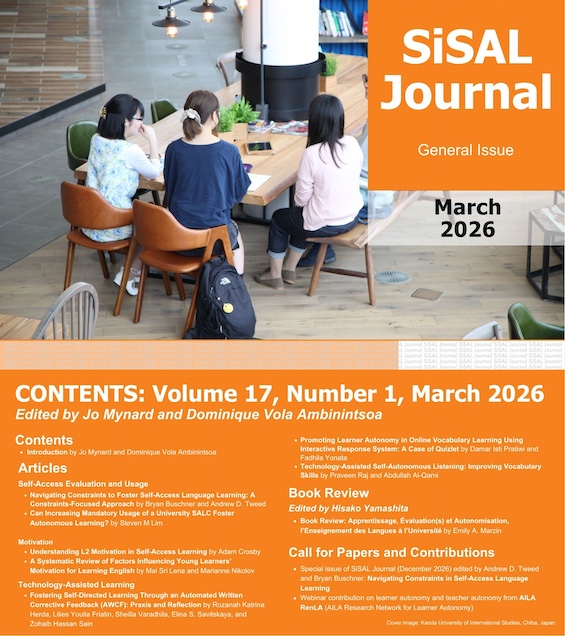
 SiSAL Journal