
Danica Anna D. Guban-Caisido, Department of European Languages, University of the Philippines Diliman, Quezon City, Philippines. https://orcid.org/0000-0002-3933-6383
Guban-Caisido, D. A. D. (2023).Student perceptions of language advising as a complement to the flipped classroom. Studies in Self-Access Learning Journal, 14(4), 438–455. https://doi.org/10.37237/140403
Abstract
The flipped classroom was implemented in an intermediate-level Italian class in the Philippines. Owing to the difficulties of the flipped classroom as described by existing literature, which includes a general lack of genuine motivation to access the materials needed for autonomous learning, language advising was conducted as a complementary tool to assist in the smooth implementation of the flipped classroom without the need to resort to extrinsic motivational strategies. Five students participated in the language advising sessions which were scheduled four times throughout the semester for each student with a duration of twenty minutes each. Through an open-ended questionnaire, the participants gauged their perceptions of the complementarity of the language advising sessions to the flipped classroom that was implemented throughout the semester. Using thematic content analysis for the open-ended responses, the following themes emerged from the students’ experiences: a sense of control of one’s own learning, personalized instruction, performance boosting and balance, and a fostering of student rapport.
Keywords: flipped classroom, language advising, foreign language learning, Italian, Philippines
The flipped classroom is a rather novel methodology for educators attempting to move away from the traditional mode of instruction to address a variety of educational and social issues. The growing network of educators adopting the methodology, along with the ubiquitous upgrades in terms of educational technology in recent years, have solidified the proliferation of the flipped classroom method in a variety of educational contexts. Its flipped nature allows for flexibility for both educators and learners and provides opportunities to maximize both the online space and the physical classroom for content consumption and mastery of the material (Junio & Bandala, 2018).
The concepts of flipping the classroom, flipped learning, and flipped classroom are attributed to the efforts of two high school chemistry teachers, Bergmann and Sams, back in 2007. School absenteeism was the primary issue they faced, and both were eager to solve the problem by trying a different approach to teaching. By attempting to answer the questions “What is the value of class time if a student can access all the content while not attending class?” and “What do students really need a physically present teacher for?” (Bergmann & Sams, 2014, p. 13), they resorted to a form of experimental pedagogy by literally ‘flipping’ the classroom: what is done at school is done at home, and homework done at home is completed in class (Bergmann & Sams, 2014). Through this approach, the more theoretical parts of the lesson are already pre-learned prior to attending classes, which are then dedicated to problem-solving and group and individual work instead of discussions. From working on pre-recorded lectures to building a professional network out of the growing interest in the teaching methodology, the flipped classroom has gone a long way in terms of its scope. The flipped classroom is defined as a pedagogical approach wherein the instructional elements are transposed from the group learning space to the individual learning space (Flipped Learning Network, 2014). In essence, there is a shift in the way that class time, resources, and focal persons are utilized. Compared with the traditional pedagogical approaches wherein the teacher is considered a “sage on the stage” and is expected to be the foremost source of knowledge through in-person lectures and typical presentations, the opposite is done in the flipped classroom approach. Basically, the students are given access to materials pertinent to the lessons and are expected to study and consume them independently prior to attending the in-class hours, which are then transformed into a synergistic and dynamic group space that is conducive for clarifications, applications, and practice of the subject matter. At the same time, there is a shift in focus regarding the role of the teacher from being the primary information source to that of a facilitator, hence, “a guide on the side.” The concept works on the principle that while the content may be studied independently, the interaction with the teacher and peers during the in-class hours is instrumental in the practice and mastery of the subject matter (Cunningham, 2016).
Several studies have been conducted pertaining to the efficiency of the flipped classroom among different disciplines and across diverse educational levels. Álvarez (2012) reported a significant improvement of grades since the implementation of the flipped classroom among major subjects with usual high failure rates, such as English, Math, Science and Social Studies among high school students in the US. Parra Pérez and Medina Riveros (2014) narrated the experiences of a Colombian higher education institution which implemented both blended learning and a flipped classroom and stated that both teachers and students had to adjust and optimize the resources available, owing to the success of the experience to the students’ self-regulation, efficiency, and interactions within the classroom.
The Flipped Classroom and Language Learning
This concept of flipping the classroom has been applied to the case of language learning as well. In the ESL context, Evseeva and Solozhenko (2015) found that 85% of the students who experienced the flipped classroom favored it over the traditional classroom setup, while 15% reported difficulties because of technological concerns. Ansori and Nafi (2018) found that the implementation of the flipped classroom helped foster teamwork among students, while an analysis of case studies conducted by Herreid and Schiller (2013) reported that the flipped approach helped bring out the more innovative side of the students. Similarly, Hung (2015) narrated that the flipped classroom has positively affected academic performance, participation levels, and learning attitudes.
It is a fact that interaction using the target language is of paramount importance to achieve a certain level of language fluency (Ellis, 1991; Mackey, 1999; Tran, 2009). The application of the flipped classroom in the language learning setup provides the learners with asynchronous access to class materials while also being exposed to a variety of linguistic realia for consumption of their own choice and at their own pace. Moreover, the nature of the flipped classroom also frees up ample space in the class hours for more instructor and peer/classroom interactions.
The primary challenge in implementing the flipped classroom is a general lack of motivation to access the materials intended for the allotted independent study time (Cunningham, 2016). Several studies centering on student attitudes have found that despite the ease of accessibility and availability of the materials intended for asynchronous use of the flipped classroom, many students do not necessarily comply with the activities intended for self-study. In the context of engineering education, Bishop (2013) found that students neglected the materials intended for self-study, especially when the expected class interactions were not to be graded. Similarly, in an English for Specific Purposes class, Cunningham et al. (2010) found that the learners were not inclined to listen to teacher-crafted podcasts despite the accessibility of the resources. These experiences manifested an apparent lack of motivation for self-access. As per existing literature, the following were solutions implemented by educators to combat the issue: utilizing extrinsic motivation measures such as assigning points, evaluating the understanding of the flipped materials via online quizzes, and test-taking prior to each lesson as assessment of understanding (Bergmann & Sams, 2014; Boyer, 2013; Looney, 2003). These strategies, however, tend to assess only performance, mostly driven by the extrinsic motivation of getting good grades. The learning process and the intrinsic motivation to genuinely progress in their studies are not addressed by any of these means. In this regard, language advising was hypothesized to be a possible complementary tool to address the gap in the literature.
Advising in Language Learning
Advising in Language Learning or ALL is a process aimed to direct a language learner towards being ‘effective, aware, and reflective’ (Kato & Mynard, 2016) through a series of purposive dialogues intended to incite autonomy within the learner (Mynard, et al., 2018). ALL is seen as a means of scaffolding wherein a student meets with an advisor in an individualized session of ongoing monitoring and feedback to provide guidance regarding one’s language learning progress. These sessions may take place in a variety of set-ups at the primary, secondary, and tertiary levels in the formal school environment and self-access learning centers (SALCs) (Reinders, 2008). While sessions are mostly conducted in SALCs, ALL may also be conducted in different modes such as telesupport through email (Makin, 1994, as cited in Reinders, 2008), in open and distance learning programs (Hurd, 2001), electronic learning environments (Reinders, 2007), and even online, both asynchronously (Kidd & von Boehm, 2012) and synchronously (Guban-Caisido, 2020).
ALL acknowledges the challenges and difficulties that accompany the process of language learning. While it may be easy to confuse the practice with the traditional methods of tutoring where the advisor is expected to directly instruct the student on what and what not to do, ALL does the opposite. The foremost intention of ALL is to identify the learner’s needs, understand the student’s context, and negotiate ways in which to deal with the student’s plateaus through cooperative language (Shelton-Strong, 2022). As such, it is goal-directed in its practice of providing support to the language learner through ‘intentional reflective dialogue’ (Kato, 2012), a dialogic strategy which involves listening and responding through individualized conversations. Kato and Mynard (2016) enumerate the following strategies that may be utilized for intentional reflective dialogue: repeating, summarizing, empathizing, the use of metaphor and powerful questions, sharing experiences, complimenting, silence, and promoting accountability. Through the implementation of such strategies within advising conversations, a gradual shift is expected in the learner without the language advisor having to impose nor require compliance for any rigid assignment. As ALL promotes self-regulation, the students become responsible for handling their affairs, taking charge of their own decisions, priorities, time management, and other pertinent processes, giving them an active role in their own language learning progress (Kato & Mynard, 2016; Tassinari & Ciekanski, 2013). Furthermore, the intentional reflective dialogue framework of ALL allows the student to be inherently reflective because of the cooperative dialogues, which result in an action-oriented and transformative shift both in perception and in behavior, which Kato and Mynard (2016) coin as ‘transformational advising.’. Transformational advising challenges the learner’s existing beliefs by increasing one’s awareness about learning, translating the awareness into action, which then promotes a change in action (Kato & Mynard, 2016). It incites metacognition within the learner through the consistent use of reflective dialogues and, as such, goes over and beyond support intended only for language proficiency.
The Flipped Classroom, ALL, and the Self-Determination Theory (SDT)
The principles and implementation of both the flipped classroom and ALL work in harmony with the psychological needs as implied by self-determination theory (SDT). From the SDT perspective, Deci and Ryan (1985), the proponents of the theory, state that people are inherently dynamic and are wired towards their own growth and development but would need to fulfill the basic cognitive needs of autonomy, competence, and relatedness in order to do so. Competence involves the improvement of one’s knowledge, capacity, and skill set through continuous interaction with the environment and is associated with “optimal challenge, effort, mastery, and self-efficacy” (Shelton-Strong, 2022, p.969). Autonomy refers to a congruence between one’s actions and beliefs, a feeling of control and ownership of one’s own experiences (Ryan & Deci, 2017). On the other hand, relatedness refers to feelings of social belongingness, connection, and reciprocity (Ryan & Deci, 2017).
The flipped classroom emphasizes, first and foremost, the need for autonomy. Given the nature of the flipped classroom, where students are expected to self-study using a combination of instructor-given references and self-access materials prior to attending in-class hours, which are dedicated to practice and interaction, the students are expected to be self-regulated. They must be autonomous in handling the demands of their own language courses and highly capable of making decisions on which matter to prioritize to maximize their language learning process (Han, 2015). Furthermore, the student is also expected to keep abreast with the requirements through proper time management. The same goes for ALL; without autonomy, it would be difficult for the student to progress, given the nature of cooperation and partnership between the advisor and the student (Ciekanski, 2007).
Competence is another distinctive quality fulfilled by both the practices of the flipped classroom and ALL. The interactions provided by the in-class hours require a certain level of language proficiency which can only be built by grit and a drive to improve by taking on incremental challenges in the language that is being learned. Self-efficacy, which is a key component towards competence, is an important characteristic that is inculcated by the ALL sessions through transformational advising (Shelton-Strong, 2022).
Relatedness in a classroom setting refers to the interactions between the instructor and the student and between and among the student and the groups during the in-class hours of the flipped classroom approach. Similarly, this is another feature that is imperative in the ALL sessions. While the nature of relatedness differs for both contexts, it works on the same principles of positive regard and belongingness.
The University Context: Vestiges of the Pandemic
The flipped classroom was piloted during the final semester of the fully online mode in the Department of European Languages of the University of the Philippines. At the time of the study, the university had since shifted from a fully online learning setup to the blended learning mode due to the ameliorating developments of the country in terms of COVID-19 numbers (Subingsubing, 2022). The blended learning setup, as implemented by the university, entailed three learning models: fully online, blended block learning (independent online study + intensive face-to-face sessions), and classic blended learning (asynchronous study + face-to-face sessions). While there have been several colleges within the university which have opted for either blended block or classic blended learning models, the college which houses the department offering the foreign language courses had decided, for the most part, to continue with the fully online model to allow its constituents to fully prepare for the expected return to campus transition.
A study on ALL in the Philippines was previously conducted by the researcher in 2020, during the peak of the COVID-19 pandemic. As a result of having shifted from fully traditional instruction to a sudden transition to self-access learning, the researcher piloted the use of ALL among first-time self-access learners in the online setup, as published in the September 2020 Special Issue of SiSAL Journal (Guban-Caisido, 2020). As a form of follow-up study in the same university context, the current study takes the form of ALL as a complementary tool to the flipped classroom to maximize the feasibly remaining semester to be conducted in a fully online setup in the university.
Research Questions
The study intends to answer the following research questions:
- What are the students’ perceptions of the flipped classroom and language advising combination?
- In what ways does language advising complement the flipped classroom approach?
Methodology
Participants and Procedure
Five students from the BA European Languages program of the University of the Philippines participated in the study. The Flipped Classroom and ALL were implemented in an intermediate Italian language course (level B1 by the CEFR standards).
The Flipped Classroom was introduced right from the very beginning to set class expectations and accommodate the semestral schedule. The university works on a four-day work-week schedule for its students. Thus the following division was implemented: (a) the first two days were assigned to be asynchronous to allow students to digest the traditional learning materials and multimedia resources provided by the faculty and to allow them the liberty to access whatever form of linguistic realia might be expedient for their learning styles, while; (b) the last two days were assigned synchronous, which were dedicated for class interaction; utilizing the class hours mostly for practice of the subject material, questions and clarifications, and assessments. Throughout the semester, ALL was conducted synchronously via Zoom, and in a combination of languages (Italian, English, and the mother tongue, Filipino) to avoid any miscommunication and to fully address the concerns and accommodate the needs of the students. The compulsory ALL sessions were conducted four (4) times at regular intervals for each individual student and lasted at least twenty (20) minutes each to allow for adequate time to discuss assessments, surface learning issues, and to track student progress. The language teacher handling the said course handled the ALL sessions. With a background in educational psychology and counseling, the advisor had also handled previous ALL sessions with other language students of the same degree program.
Data Gathering
Towards the end of the semester, the participants were requested to narrate their experiences on the perceived complementarity of ALL to the flipped classroom. The participants were asked to respond to a short 6-item open-ended questionnaire which was sent online through a Google form after the final ALL session with the students. The questionnaire was constructed in English to allow the students to fully articulate their responses. With the objective of understanding the complementarity of ALL and a flipped classroom from the point-of-view of the students, the questions were conceptualized to be free-form and in an open-text format without predefined frameworks to exploit details and descriptive information. All six items of the questionnaire centered on the experiences of the implementation of the Flipped Classroom, the ALL sessions, and the perceived complementarity of ALL to the Flipped Classroom.
Data Analysis
The responses were gathered and analyzed using thematic content analysis. In the first step, the researcher identified verbatim transcripts that generated several themes and sub-themes that were consistent with the questionnaire content. The second step involved a rereading of the preliminary themes and sub-themes to identify and eliminate possible overlapping and discordant coding. The final step involved a summary of textural themes and their accompanying verbatim transcriptions.
Findings and Discussion
Five themes emerged on the perceived complementarity of ALL and the flipped classroom: a sense of control, personalized learning, performance boosting, balance, and fostering student rapport.
Table 1 synthesizes the emerging themes on the perceived complementarity of ALL with the flipped classroom from the analysis of the student evaluation transcriptions.
Table 1
Emerging Themes From the Perceived Complementarity of Language Advising with the Flipped Classroom
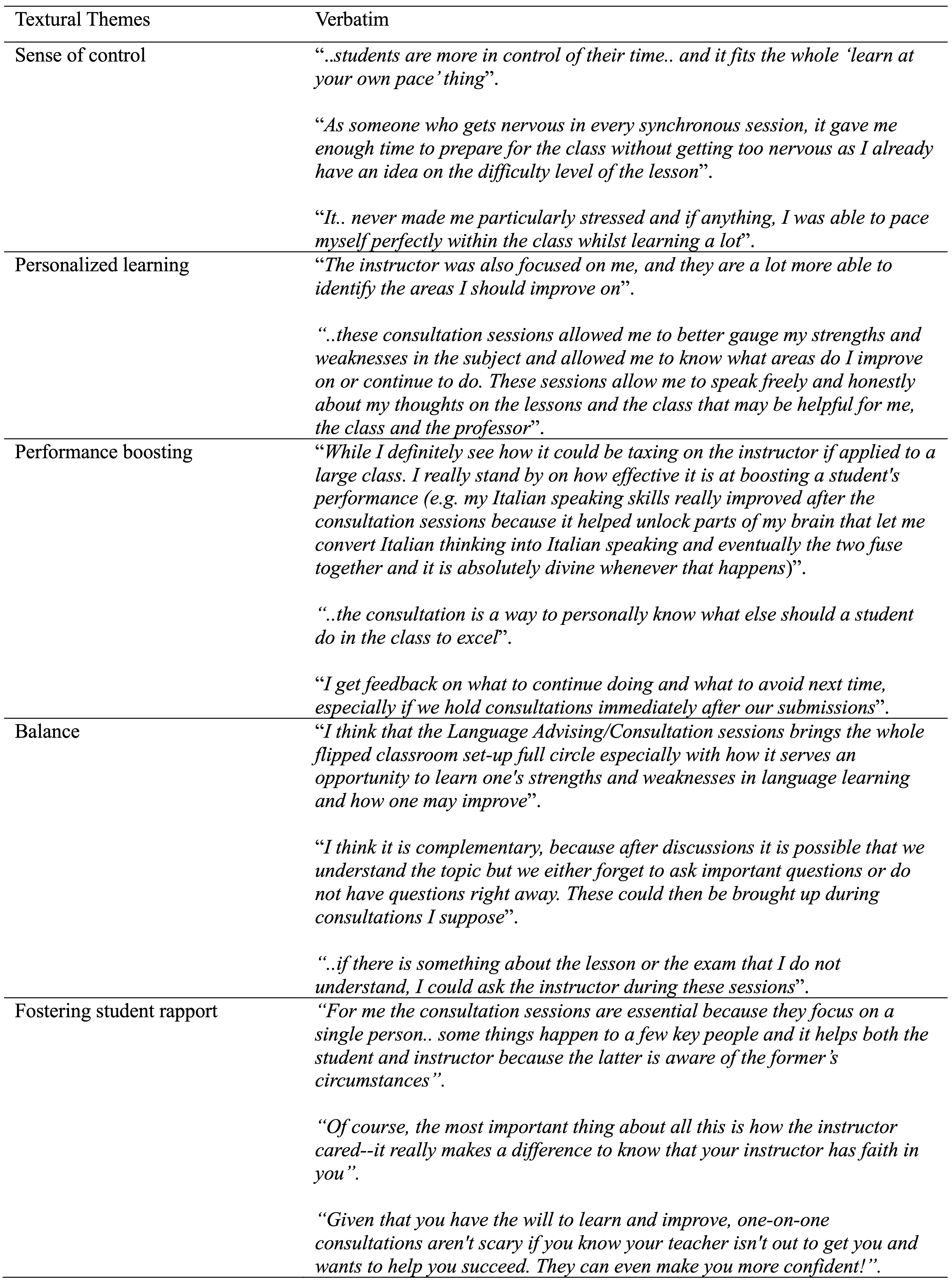
The themes emerging from the textual analysis convey a positive and complementary relationship between the flipped classroom and the implementation of ALL sessions. The participants reported that there is ownership and accountability for one’s actions through a perceived sense of control, a feeling of individualized and tailor-made instruction manifested as personalized learning, an increase in performance through constant feedback, balance, and a promotion of a positive student rapport.
Sense of Control
The autonomous nature of the flipped classroom is seen to be in harmony with the principles of ALL as a means of support, providing guidance to the student, and encouraging learner autonomy (Reinders, 2008). The participants reported a sense of control in their own learning in terms of time management, mental preparation, and self-pacing.
Through ALL in the flipped setup, the students reported a feeling of ownership and accountability of their own learning, especially in managing the time intended for their academic tasks. As one participant narrated: “it fits the whole learn at your own pace thing.” Given the liberty they enjoyed with the flipped classroom approach and the individualized consultations of ALL, the students were at ease in exploring options for their own learning while being guided by the ALL sessions.
The participants also noted how there is ample time for mental preparation. Some students confessed to feeling anxious prior to synchronous sessions, and the flipped classroom, coupled with ALL sessions, helped ground their expectations on the difficulty level of their assigned lessons.
Finally, the participants were able to take advantage of self-directed pacing in their own learning without the need for teacher promptings. The inculcation of self-awareness from the reflective dialogues of the ALL sessions helped the students direct and redirect their intentions and behaviors, resulting in a stronger sense of autonomy and control. According to Kato (2012), among the ways to inculcate a profound sense of control in ALL is through the practice of intentional reflective dialogue, whose strategies involve a diverse array of communicative techniques which aid in the promotion of self-awareness in the student (Mozzon-McPherson, 2018). Increasing self-awareness is a starting point to transformative action on the part of the learners, which can only be possible when the students maintain control of their own learning and progress.
Personalized Learning
ALL is perceived to be a very useful tool in catering to the specific needs of each individual student. The importance of individual differences in language learning cannot be underestimated; it has been proven in many studies as a significant factor contributing to potential language learning success (Dörnyei & Ushioda, 2009; Ortega, 2009).
The participants felt that instruction was tailor-made for them, as opposed to the one-size-fits-all approach that they had been used to in most language classes. According to one participant: “.. the instructor was focused on me, and they were able to identify the areas I should improve on.”
Moreover, some students commented on their liberty to speak during ALL sessions, which prompted them to be critical of their own performance: “these sessions allowed me to better gauge my strengths and weaknesses in the subject and allowed me to know what areas do I improve on or continue to do.” As ALL prompts the students to be reflective and critical of their learning and consequent performance in class activities, the advisory sessions tend to be formative because they are informed by the actual experiences that transpire in the language classroom (Reinders, 2008). Furthermore, the nature of ALL is reflective, such that there is an intention to encourage “deep, reflective processes” (Kato & Mynard, 2016, p. 82) within the student, which is then expected to be purposive and action-oriented.
This self-reflective activity, coupled with the succeeding reflective dialogue with the advisor, allows for better gauging of the learner’s strengths and weaknesses and the identification of problematic areas that need further improvement.
Performance Boosting
Among the perceived strengths of the combination of ALL and the flipped classroom is boosting performance. Given the sense of control and autonomy fostered by the flipped classroom and the individualized content of the ALL sessions, which promotes metacognitive reflection and purposive action, the expected result gears towards a positive change in performance. While one student reported an improvement in speaking skills (“my Italian speaking skills really improved after the consultation sessions because it helped unlock parts of my brain that let me convert Italian thinking into Italian speaking and eventually the two fuse together and it is absolutely divine whenever that happens”), most students attribute the performance boost to the direction and redirection provided by the advising sessions. The feedback is found to be useful in determining the paths to take and the pitfalls to avoid in order to excel in class.
However, while the students report optimistic changes in their language learning progress, it would be challenging to perfectly assess the extent of the reported development given the short duration with which the flipped classroom and the ALL sessions were implemented.
Balance
The ALL sessions in the current study were conducted four times throughout the semester, some coinciding with post-examination schedules. As such, these were welcome opportunities for the advisor to itemize the tests, aid the students in error analysis, and for the students to facilitate the decision-making process for their self-improvement.
While most students regarded the ALL sessions as individualized consultations intended to help direct their learning, some students utilized the ALL sessions as an extension of their classes. Given the liberty with which they could converse with the advisor, they deemed the ALL sessions as platforms where they were able to clarify what they felt was unclear during the activities done in class: “if there is something about the lesson or the exam that I do not understand, I could ask the instructor during these sessions.”
All students seem to agree that the addition of the ALL sessions struck a balance with the flipped classroom experience; in their own words, “it comes full circle,” as it completes what elements they felt were lacking in the flipped classroom alone.
Fostering Student Rapport
Building healthy teacher-student rapport is important in the classroom, much less in the ALL environment. Typically, the ALL context is an autonomy-supportive environment, which can be attained only when the basic psychological needs of autonomy, competence, and relatedness are satisfied, as stated by SDT (Reeve et al., 2016, 2018; Ryan & Deci, 2017; Vansteenkiste et al., 2019). This autonomy-supportive environment relies heavily on the conduct, approaches, and actions of the stakeholders (such as the teachers/language advisors), among others (Reeve, 2016). Vansteenkiste et al. (2019) state that these important social agents may take on a participatory approach in fostering an autonomy-supportive environment through inclusive action that acknowledges and validates even negative emotions. Furthermore, there is a need to supplement the dialogues with meaningful options, non-controlling communications, opportunity provision, and unconditional positive regard (Reeve et al., 2018).
One student experiencing anxiety claimed to have benefitted substantially from the ALL sessions. While there was initial inhibition at the thought of participating in the individual advising sessions given her condition, she found that these were helpful not only in acknowledging her circumstances but in pinpointing specific areas where her condition seems to overflow from her personal life into her language learning, hence impeding her progress. She stated that the most essential factor that helped her deal with her context was the comportment of the language advisor: “one-on-one consultations aren’t scary when you know your teacher isn’t out to get you.”
Conclusion and Recommendations
ALL is used as a form of scaffolding in various means of language education, whether this be in the form of traditional or online language classes, hybrid and/or blended, and through self-access learning centers. As a possible solution to the apparent literature gap on providing possible solutions to concerns of students not accessing the materials intended for self-study in the flipped classroom approach (Bishop, 2013; Cunningham et al., 2010), ALL was implemented in the study as a complementary tool to address the issues of process improvement and genuine interest in language learning to avoid the need to resort to extrinsically rewarding strategies. Based on student perceptions, the implementation of ALL sessions throughout the semester, along with the flipped classroom approach, has proven to be complementary. Its use in the flipped classroom acted as a clutch that identified the students’ needs for autonomy, competence, and relatedness while also providing homeostasis to the rather laissez-faire approach of the flipped classroom. Students reported a fortified sense of control, a personalized approach to learning, improved performance and balance, and an instituted rapport between the language advisor and the learner.
This case study is by no means intended to provide generalized findings. The brevity of the time for the implementation of both the flipped classroom and the ALL sessions and the small number of participants is not enough to evaluate any improvements in terms of language proficiency. Reinders (2008) states that it is difficult to formally assess the perceived improvements of ALL to language learning since these activities are never done in isolation. Given that most learners either attend language classes or benefit from a self-access center, it may be difficult to narrow down the effects of the ALL sessions alone.
In this light, more research, especially those containing learner feedback and experiences on ALL, may be conducted to fill the gaps in the literature. Furthermore, there is a pressing need to allow for more opportunities for participatory assessment among learners who benefit from ALL as complementary or supplementary functions to other pedagogical approaches to further advance the practice.
Notes on the Contributor
Danica Anna D. Guban-Caisido is an Assistant Professor in the Department of European Languages at the University of the Philippines Diliman. Her research interests include foreign language pedagogy, Italian as a foreign language, educational psychology and counseling, and communication studies.
References
Álvarez, B. S. (2012). Flipping the classroom: Homework in class, lessons at home. Education Digest, 77(8), 18–21.
Ansori, M., & Nafi, N. N. (2018). English teachers’ perceived benefits and challenges of flipped classroom implementation. JEELS, 5(2), 211–227. https://doi.org/10.30762/jeels.v5i2.820
Bishop, J. L. (2013). A controlled study of the flipped classroom with numerical methods for engineers. [Unpublished dissertation]. Utah State University.
Bergmann, J., & Sams, A. J. (2014). Flipped learning: Gateway to student engagement. International Society for Technology in Education.
Boyer, A. (2013). The flipped classroom. TLN Journal, 20(1), 28–29. https://search.informit.org/doi/pdf/10.3316/informit.302825604903142
Ciekanski, M. (2007). Fostering learner autonomy: power and reciprocity in the relationship between language learner and language adviser. Cambridge Journal of Education 37(1), 111-127. https://doi.org/10.1080/03057640601179442
Cunningham, U., Beers Fägersten, K., & Holmsten, E. (2010). Can you hear me, Hanoi? Compensatory mechanisms employed in synchronous net based English language learning. International Review of Research on Open and Distance Learning, 11(1), 161-177. https://doi.org/10.19173/irrodl.v11i1.774
Cunningham, U. (2016). Language pedagogy and non-transience in the flipped classroom. Journal of Open, Flexible and Distance Learning, 20(1), 44–58. https://doi.org/10.61468/jofdl.v20i1.269
Deci, E. L., & Ryan, R. M. (1985). The general causality orientations scale: Self-determination in personality. Journal of Research in Personality, 19(2), 109–134. https://doi.org/10.1016/0092-6566(85)90023-6
Dörnyei, Z., & Ushioda, E. (2009). Motivation, language identity and the L2 self. In Multilingual Matters eBooks. https://doi.org/10.21832/9781847691293
Ellis, R. (1991, April). The interaction hypothesis: A critical evaluation. Regional Language Centre Seminar, Singapore. https://files.eric.ed.gov/fulltext/ED338037.pdf
Evseeva, A., & Solozhenko, A. V. (2015). Use of flipped classroom technology in language learning. Procedia – Social and Behavioral Sciences, 206, 205–209. https://doi.org/10.1016/j.sbspro.2015.10.006
Flipped Learning Network (2014). The four pillars of FLIPTM. https://flippedlearning.org/wp-content/uploads/2016/07/FLIP_handout_FNL_Web.pdf
Guban-Caisido, D. (2020). Language advising as psychosocial intervention for first time self-access language learners in the time of COVID-19: Lessons from the Philippines. Studies in Self-Access Learning, 11(3), 148–163. https://doi.org/10.37237/110305
Han, Y. (2015). Successfully flipping the ESL classroom for learner autonomy. NYS TESOL, 2(1), 98–109. http://journal.nystesol.org/jan2015/Han_98-109_NYSTJ_Vol2Iss1_Jan2015.pdf
Herreid, C. F., & Schiller, N. A. (2013). Case studies and the flipped classroom. Journal of College Science Teaching, 42(5), 62–66. http://www.jstor.org/stable/43631584
Hung, H. (2015). Flipping the classroom for English language learners to foster active learning. Computer Assisted Language Learning, 28(1), 81–96. https://doi.org/10.1080/09588221.2014.967701
Hurd, S. (2001). Managing and supporting language learners in open and distance learning environments. In M. Mozzon-McPherson & R. Vismans (Eds.), Beyond language teaching towards language advising. (pp. 135–148). CILT Publications. http://oro.open.ac.uk/621/3/ManagSupporDLLs-Hurd-2001.pdf
Junio, D. A., & Bandala, A. A. (2018). Characterization and effect of enhanced flipped classroom implementation. 10th International Conference on Humanoid, Nanotechnology, Information Technology, Communication and Control, Environment and Management (HNICEM), Baguio City, Philippines, 2018 (pp. 1–6) https://doi.org/10.1109/HNICEM.2018.8666273
Kato, S. (2012). Professional development for learning advisors: Facilitating the intentional reflective dialogue. Studies in Self-Access Learning Journal, 3(1), 74–92. https://doi.org/10.37237/030106
Kato, S., & Mynard, J. (2016). Reflective dialogue: Advising in language learning. Routledge.
Kidd, K., & Von Boehm, S. (2012). Kaleidoscope, an online tool for reflection on language learning. In J. Mynard & L. Carson (Eds.), Advising in language learning. Dialogue, tools, and context (pp. 213–230). Longman.
Looney, M. A. (2003). Facilitate learning with a definitional grading system. Measurement in Physical Education and Exercise Science, 7(4), 269–275. https://doi.org/10.1207/S15327841MPEE0704_5
Mackey, A. (1999). Input, interaction, and second language development. Studies in Second Language Acquisition, 21(4), 557–587. https://doi.org/10.1017/S0272263199004027
Mozzon-McPherson, M. (2018). Considerations on using mindful listening in advising for language learning: A micro study. Zeitschrift Für Fremdsprachenforschung, 28, 159–179. https://www.dgff.de/assets/Uploads/ausgaben-zff/ZFF-2-2017-Mozzon-McPherson.pdf
Mynard, J., Kato, S., & Yamamoto, K. (2018). Reflective practice in advising: Introduction to the column. Relay Journal, 1(1), 55–64. https://doi.org/10.37237/relay/010105
Ortega, L. (2009). Sequences and processes in language learning. In M. H. Long & C. J. Doughty (Eds.), The handbook of language teaching (pp. 81–105). https://doi.org/10.1002/9781444315783.ch6
Parra Pérez, D. P., & Medina Riveros, R. A. (2014). Unleashing the power of blended learning and flipped classroom for English as a foreign language learning: Three spheres of challenges and strategies in a higher education institution in Colombia. Proceedings of the 7th International Conference of Education, Research and Innovation, 17-19 November, 2014, Seville, Spain , (pp. 2829–2836). https://library.iated.org/view/PARRAPEREZ2014UNL
Reeve, J. (2016). Autonomy-supportive teaching: What it is, how to do it. In: W. Liu, J. Wang, R. Ryan (eds.), Building Autonomous Learners (pp. 129–152). Springer. https://doi.org/10.1007/978-981-287-630-0_7
Reeve, J., Jang, H.R., & Jang, H. (2018). Personality-based antecedents of teachers’ autonomy-supportive and controlling motivating styles. Learning and Individual Differences, 62, 12–22. https://doi.org/10.1016/j.lindif.2018.01.001
Reinders, H. (2007). Big brother is helping you. Supporting self-access language learning with a student monitoring system. System, 35(1), 93–111. https://doi.org/10.1016/j.system.2006.10.009
Reinders, H. (2008). The what, why, and how of language advising. MexTESOL, 32(2). https://innovationinteaching.org/docs/article-2008-Mextesol-the-what-why-and-how-of-language-advising.pdf
Ryan, R. M., & Deci, E. L. (2017). Self-determination theory: Basic psychological needs in motivation, development, and wellness. Guilford Press.
Shelton-Strong, S. J. (2022). Advising in language learning and the support of learners’ basic psychological needs: A self-determination theory perspective. Language Teaching Research, 26(5), 963-985. https://doi.org/10.1177/1362168820912355
Subingsubing, K. (2022, July 11). UP shifts to blended learning. Inquirer News. https://newsinfo.inquirer.net/1625405/up-shifts-to-blended-learning
Tassinari, M. G., & Ciekanski, M. (2013). Accessing the self in self-access learning: Emotions and feelings in language advising. Studies in Self-Access Learning Journal, 4(4), 262–280. https://doi.org/10.37237/040404
Tran, T. (2009). The interaction hypothesis: A literature review. Education Resources Information Center. https://files.eric.ed.gov/fulltext/ED507194.pdf
Vansteenkiste, M., Aelterman, N., Haerens, L., & Soenens, B. (2019). Seeking stability in stormy educational times: A need-based perspective on (de)motivating teaching grounded in self-determination theory. In Motivation in education at a time of global change (Advances in motivation and achievement, Volume 20) (pp. 53–80). Emerald Publishing Limited. https://doi.org/10.1108/S0749-742320190000020004
 SiSAL Journal